Blogia

Transistor kills the radio star?

Nota metodológica (objectivos)

«What researchers in their efforts to scrutinise the modalities of adolescent media use and its effects have often failed to ask is why adolescents use the media, and why media can be assumed to have an effect. The starting point of most research was the fact that they certainly do, but not so much the reasons for it.» (Boehnke, 2002: 1) (não é objectivo saber porquê que usam, embora se deva ter isto em conta: «The picture changed somewhat with the emergence of the so-called ‘‘uses-and-gratifications’’ paradigm, Rosengren (e.g., 1981; cf. Swanson, 1979) probably being one of the founders of this approach. It shifted the focus of media studies from the angle of what the media did to or with the adolescent to what benefits adolescents gain from media use.» idem)
Pessimismo sempre que se fala num novo meio?

«Work that emerged early after the introduction of a new medium was often governed by the myths of a general cultural pessimism.»

Boehnke et al (2002: 193)

Boehnke, K., Münch, T., and Hoffmann, D., Development through media use? A German study on the use of radio in adolescence, International Journal of Behavioral Development 2002; 26; 193-201

Uma geração que cresce sem saber o que é a rádio

«The other big audience challenge is youth. Most of my generation grew up with radio. Memories of that first car, that first cigarette, that first pint of heavy, are for many of us inextricably bound up with particular pieces of music, particular radio programmes or DJs. Today, while television can still capture children up to their early teens and the challenge is simply getting them back in their twenties, for radio, is there a generation growing up who are simply not introduced to the habit and may thus not get the point as they mature. Two thirds of today’s young mobile users have their phones on and within easy reach for between 21 and 24 hours a day. I earnestly hope that radio- possibly using the mobile as delivery medium - can capture at least some of that time», Stephen A Carter (Chief Executive, Ofcom), The Radio Festival - Certainty or Security? The Path to Digital 04|07|05

A queda das audiências na GB

«The biggest hit has been taken by chart-led mainstream music. In part this reflects the generic decline of the chart from something central to mass audience judgements on popular music, to a smaller part of the overall music scene. The gradual decline in main-stream chart radio listening over the past 5 years has accelerated: from 40% of commercial listening at the start of the decade, to 30% and still falling. Some interesting parallels with main-stream, mass audience television; but unlike mass television there are no rising power ratios to sustain the value of radio advertising.» Stephen A Carter (Chief Executive, Ofcom), The Radio Festival - Certainty or Security? The Path to Digital 04|07|05

O futuro ameaçado da rádio musical

«So what does the future hold for traditional broadcast radio (even those services on DAB)? My contention is that it will (should) return to basics, do what it does best on the understanding that the world is changing. Stations operating ‘more music’ formats cannot succeed in an environment where listeners have access to large libraries of music on iTunes, Napster or Kazaa. Variety-led radio formats like ‘Jack FM’ have been launched in the US to offer greater diversity, and KYOU Radio has launched an all Podcast format in San Francisco in which listeners submit Podcasts for FM broadcast. These are the exceptions and will probably remain so. Podcasts may not only reconnect audiences (as seen by CBC in Canada) but may also result in a rise in audited listening, as audiences have access to material at any point in time (rather than at time of transmission or production) and consequently slowly regain the radio habit. However, there still remains a challenge for the reinvention of broadcast radio. Interviewed by ABC Radio in October 2004, Nick Piggot of the GWR (now GCap) Group in the UK said radio stations have some rethinking to do: ‘The main job will still be to produce a radio station that people recognise . . . and is a good listen’ (ABC Radio National, 2004).» (Berry, 2006: 159)

A queda das audiências entre os jovens

« (...) despite its obvious strengths, radio listening amongst 15–24-year-olds has fallen over recent years in both the UK and the USA, with various factors being blamed for falling audiences. In 2004, the UK’s Broadcast and Telecommunications regulator – OFCOM – commissioned a report into the so called ‘iPod Generation’ and the report made uncomfortable reading for traditional broadcasters. The report revealed what radio academics already knew from talking to students, that the medium was no longer offering them what they wanted and that ‘younger people are listening to the radio noticeably less than their parents’ (OFCOM/The Knowledge Agency, 2004: 5). Not only that but they are fussier in their listening habits and choices and they were turning off ‘faceless presenters’ and a ‘playlist culture’ in favour of their own music, in their own way (OFCOM/The Knowledge Agency, 2004). It seems as though the ‘wirefree’ generation is growing up without the radio habit enjoyed by the previous generation and that offers a threat to broadcast radio (Carter, 2005).» (Berry, 2006: 148)

Um novo média «horizontal»

«What Podcasting offers is a classic ‘horizontal’ media form: producers are consumers and consumers become producers and engage in conversations with each other» (Berry, 2006: 146)

Os novos ouvintes impõem novos hábitos (e desafios)

«If old consumers were predictable and stationary, then new consumers are migratory, showing a declining loyalty to networks or even media’ (Jenkins, 2004). This is the real challenge for radio when attempting to communicate with the ‘wirefree’ generation in the converged age. It is time to rethink not only established practices but also our notions of what audiences really want.»

(Berry, 2006: 144)

Sobre a rádio no futuro

O multimédia acaba com a ideia de rádio?

A rádio é acumulação, escuta secundária e portabilidade. E é óbvio que as ferramentas multimédia, associadas à Internet, matam esta ideia de rádio.

Mas poderá continuar a haver canais só de áudio para desempenhar essa função de acumulação ao nível da música.

Contudo esses canais terão menos ouvintes: porque a acumulação tem agora concorrência, porque as ferramentas multimédia oferecem um novo tipo de comportamnento ao utilizador que já não se compadece só com ouvir.

Daí que os telemóveis permitam visualizar

A rádio tal como a conhecemos ficará confinada à rádio de palavra, essa sim insubstituível, à palavra em directo, e a situações de acumulação passiva (correr) em que ou não haja outras opções (iPod, telemóvel) ou em que apeteça ser passivo. Mas essas situações configurarão menos ouvintes, menos dimensão.


Portanto: a rádio como a entendemos não está em causa se:

- for a rádio de palavra (os leitores de mp3 concorrem com a rádio musical):

- enquanto houver gente que não tenha alternativa ou queira ser passiva na escuta de música.

Se no primeiro caso, é de pensar que os ouvintes continuarão a ser os mesmos (ainda que haja mais hipóteses de obter informação ‘em cima da hora’, através da net, a ráido poderá de palavra em directo será insubstituível), já relativamente aos canais de musica, falta saber se o numero de utilizadores garante massa critica que os viabilizem comercialmente (apesar dos baixos custos)

Bebo e Imeem salvam a industria musical?

«(...) Especially among 15- to 25-year-olds, people seem to need their peers to validate their musical tastes, making the Internet a perfect medium for the intersection of MP3s and mob psychology. (...) Imeem and Bebo are two Web sites trading on the idea that music is a social phenomenon, and that the Internet is the place to be to gather around it. Imeem asks, "What's on your playlist?," while Bebo calls itself a "social media network." Imeem draws 20 million visitors a month by specializing in free streaming music and music-video playlists that you can customize. The offerings are surrounded by information about the artists, rankings, related songs, polls, and profiles of other fans. (...)"We can target to hip-hop fans in L.A. who are also into indie films," said Steve Jang, Imeem's chief marketing officer. The most successful sites in any category, Jang maintains, are not the ones with the most money or the best technology, but the ones with the best "user experience," like the simple interface that Google started out with.The recent wave of social music sites that Imeem is a part of is showing the music industry that a free, open, ad-supported system is better than tying down digital songs with software that limits their playability, Jang said. Just look at radio and MTV, which have been sustained by advertising for years, he said. (...)Like Imeem, Bebo surrounds its offerings with extras: fan groups, artist information, concert dates and charts. Bebo, which has 40 million registered users and drew 11 million visitors last month from Britain alone, also lets its users bring in music and other media from Web sites like YouTube by using "widgets" that can be dropped on to personal pages. (...) Shields acknowledges that teenagers, the age group most attached to socializing around entertainment, do not have the kind of income that many advertisers would like to attract. But they make up for it with loyalty. As a testament to how attached Bebo users are, the average time spent on the site per session is 40 minutes - an eternity by Internet social-networking standards.»

fonte: «Could social networking sites save the music industry?», Victoria Shannon, IHT, 30/01/08

Há futuro se a rádio se tornar noutra coisa (um fornecedor de conteúdos)

«Play to the available audience because the next generation is busy on their cell phones and iPods. Don't try to aim for the generation you need so badly -- the one you let get away by doing nothing to fill their needs for the past ten years. The result: Gen Y has no strong attachment to radio and isn't likely to get one.

But...
Can radio be saved by becoming a content provider for the Internet and for consumption on mobile phones and devices?
You bet.
And that's why I am so optimistic about the future of radio-produced content away from the terrestrial signal. But radio people hardly know about the preferences of this elusive generation. I get emails every time I write about them from angry broadcasters who think Gen Y is the enemy. No, you are the enemy -- you've proven to be your own worst enemy.
They are not. They are your future business because terrestrial radio will never again be a growth business.»

fonte: Jerry del colliano, The Inconvenient Truth About Radio 14/01/08

O DAB pode acabar como o betamax e o video (GB)

«Digital audio broadcasting (DAB) may end up to radio what Betamax was to video, warns a report published today. The report, by media and telecoms specialist Enders Analysis, said the launch of the second national commercial digital radio multiplex, headed by Channel 4, might exacerbate the problems rather than solve them, and warned that media regulator Ofcom would face a public outcry if DAB failed. Enders Analysis added that the high cost of DAB transmission and slow growth in revenue had combined to undermine confidence in the new medium and led to the closure of a string of national digital stations. Today's report urged the radio sector to "stop continually beating its chest in public about the wonders of DAB and instead partake in an honest industry debate about the future of the platform". "The exodus of stations from the DAB platform is starting to look like a stampede," said the Enders report, written by Grant Goddard

«Digital sets are at risk of becoming obsolete unless sales pick up, industry analysts warned yesterday. That would mean they follow a host of other gadgets - such as Betamax video cassettes and mini-disc audio players, which were bought by millions but are now mere curiosities. Although 6.5million digital radios have been bought since 1999, it is not enough for broadcasters to recoup their costs.  And unlike in TV, there is no Government approved timeline for an analogue switch-off.  The problem seems to be that despite the huge investment in Digital Audio Broadcasting (DAB) by commercial stations, many of us are sticking to our old-fashioned analogue sets. Companies are now scrapping digital stations because the number of listeners is too small to justify their running costs. In recent months, longstanding outlets Groove, Oneword and Core have all been been taken off the digital service. »

Rádio em Portugal perde 5% mas jovens seguram-se

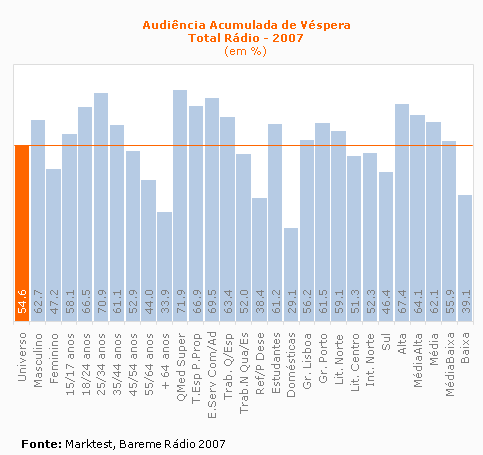
«Entre o primeiro trimestre de 2003 e o quarto trimestre de 2007, este indicador oscilou entre os 53.4% observados no 3º trimestre de 2007 e os 60.2% registados no 1º trimestre de 2005. (...) »

Os quadros médios e superiores e os jovens dos 25 aos 34 anos são os targets com maior afinidade com o meio, ao registar audiências superiores, respectivamente 71.9% e 70.9%. Os homens, os residentes no Grande Porto e no Litoral Norte, bem como os indivíduos da classe social alta registam audiências superiores à média do universo, enquanto a menor afinidade com o meio se encontra junto dos idosos, das domésticas e dos indivíduos da classe social baixa.

fonte: «Bareme Rádio 2007 disponível Marktest.com, 29 de Janeiro de 2008

Imeem compra Anywhere FM

«(...) Popular social media network Imeem has wasted no time in responding. It issued a release early this morning announcing its acquisition of San Francisco Internet radio service Anywhere.fm. Among the benefits for Imeem users are a new music player and an enhanced recommendation engine. Users will also be able to upload their olwn music to the service a la MP3Tunes, making their entire music libraries streamable from any browser. Playlists, song ratings, and play counts can also be uploaded to Imeem's new music player, which will be integrated into the site's existing services. "Anywhere.FM makes it simple for consumers to bring their music to the Web and discover new artists through recommendations and social connections," said Imeem founder and CEO Dalton Caldwell. "That's a great fit with what we do. Combining Anywhere.FM's expertise with the reach and scope of the Imeem community creates some truly exciting possibilities, and we're psyched they're joining our team." Toward the end of last year, Imeem announced several partnerships with music labels, including the four majors, Universal, EMI, Sony, and Warner, giving the company one of the most comprehensive free streaming libraries on the Web.» fonte: «Imeem Purchases Internet Radio Service Anywhere.fm», PC Mag, 01.28.08

A escuta através da net começa a ter dimensão

«More than 8 million people in the UK listen to web-based radio services every week and nearly 2 million download podcasts on a weekly basis, according to a survey that suggests internet radio has hit the mainstream.

Commissioned by the industry's audience research body Rajar, the Ipsos Mori survey last autumn found that more than 12 million people have listened to the radio online and 8.1 million listen every week either through live streaming or "listen again" services.

Ipsos Mori found that 75% of users do not listen to less live radio as a result of listening again online, with 50% tuning into new shows as a result» Jemima Kiss guardian.co.uk, January 28 2008

Cuidado com os conteúdos fabricados pelo povo

«A Ofcom criticou os operadores de televisão pelo uso dos conteúdos gerados pelos consumidores. O regulador considerou no seu parecer que os canais de televisão estão a colocar demasiada responsabilidade para o cumprimento do código de emissão nos criadores de conteúdos, em vez de levarem a cabo validações e controlo próprio dos conteúdos que emitem, noticia a edição online do The Guardian. As declarações do regular britânico surgem na sequência de dois clips emitidos em Julho passado pelo Sumo.TV, um deles apresentava um rap com referências a incesto e uso de drogas ilícitas, enquanto que o outro exibia uma criança a ser deliberadamente assustada por um adulto»

Rádios tambem criam redes sociais (EUA)

«Radio jumps on the social networking craze.
Forget Facebook and MySpace - more stations are launching a social networking component and some predict it could eventually become a solid revenue source. Clear Channel's social networking beta test has more than 150,000 registered users since its launch last April with two million page views each week» Inside Radio, 22/01/08.

Conteúdos produzidos pelos utilizadores

«The iPod is an example of how a generation decided to program their own "radio stations" with the music they choose to buy or steal online. And their stations really do have fewer commercials and more music unlike the promises we've made and broken to them for decades.
Broadcasters do what they have always done -- broadcast. When radio programming got more specific in the 70's we used the term narrowcasting to reflect how the broadcasting service had adapted.
But one thing never changed -- broadcasters made all the content decisions. Radio may have flirted with research and focus groups but in the end a PD made the call.
(...) There's a new worldwide study by Nokia, the cellphone manufacturer, about the topic of "circular entertainment" -- that is, content produced, edited, contributed to and adjusted by peer groups. Nokia estimates by 2012 up to 20% of entertainment content will be created, edited and shared within their peer circle rather than coming out of traditional media groups
. (Jerry Del Colliano, 22/01/08, Peer-to-Peer Radio )

As telefónicas dinamizam os serviços de musica on line

«French telecom Orange has partnered with Lagardere Active and music service provider Yacast, to launch a new ad-supported streaming music service in France called Musiline, Billboard reported. Available for free to Orange France's 7 million broadband subscribers, the personalized radio service also offers paid downloads for about $1.45 per track.»

fonte: «Orange Debuts Ad-Supported Web Radio Service in France», 22/01/08