Blogia

Transistor kills the radio star?

Ler as notícias on line melhora a compreensão

Como fazer persistir a mensagem, tornando o consumo de rádio num mais acto primário: «(…) listening to news online improves both recall and comprehension of events. Participants were able to retrieve more details and understand developments of actions when they had more control over the pace of information (...)», conclui-se num estudo de Hesham Mesbah (2006: 188)»

«Um programa de rádio também não precisa de se fazer visivel»

«E, no entanto, nada lhe falta! Pois a essência do rádio consiste justamente em oferecer a totalidade somente por meio sonoro. Não no sentido exterior, de incompletude, segundo a visão naturalista, mas fornecendo a essência de um evento, uma ideia, uma representação. Todo o essencial está lá – e neste sentido um bom programa de rádio é completo. (…) As estátuas não precisam ser pintadas na cor da pele, e um programa de rádio também não precisa se fazer visível». Rudolf Arnheim (1936), Estética Radiofónica, Barcelona, Gutavo Gili, 1980

Os sites das rádios têm o que os ouvintes querem?

«In our content analysis, we found that many radio station Web sites do not include the features most desired by Web site visitors. Radio station Web site visitors were asked to rate their interest in different features on radio station Web sites. As we can see in the table below, the most popular radio station Web site feature is the “ability to listen to the radio station”; however, less than 60 percent of the Web sites stream their audio and allow people to listen to live broadcasts. “Information about local concerts,” the second most wanted feature, was found on only half of the Web sites. A mere six percent of the Web sites gave the “title and artist of songs recently played on the station,” which is the third most desired feature.»

Rank of interest in each Web site feature* (% radio station Web sites with each feature)Ability to listen to the radio station 1 59 %Information about local concerts 2 50Titles and artists of songs recently played on the station 3 6To enter contests 4 49Listings of fun and interesting places to visit in local community 5 27Opportunity to vote on whether songs are good or not 6 13Information on local weather 7 44Schedule of programming 8 63Information on and pictures of DJs 9 78To contact or e-mail the DJs and personalities 10 53Traffic information 11 12Information on upcoming DJ and personality appearances in local area 12 43Listings of local restaurants and bars 13 10"Side channels" (Additional Internet-only audio provided on the site) 14 1Reviews and schedules of movies playing in local area 15 17Information on professional sports in local area 16 26Information on charity events in local community 17 25To print out coupons from advertisers 18 8Local shopping and merchant information 19 13To buy radio station clothing and other merchandise 20 11To see an advertiser's products 21 9To buy products or services (other than station merchandise) 22 14

fonte: ROSIN, Larry e SHUL, Janet S., Radio Station Web Site Content: an in depth look, (2000), Arbitron

A. Komarova (The content of music radio websites, by Komarova, Anastasia, M.A., University of Missouri - Columbia, 2004, 112 pages; AAT 1420925) lembra contudo que «what one most frequently finds there is information that is interesting from the point of view of the people working at the radio: DJ's bios with photos, music news, requests, and stations events» (pag 12)

A erosão da escuta (EUA): menos 13% (1998-2006)

«Owing to numerous media alternatives available, overall time spent listening (TSL) has slipped 13% between 1998 and 2006, but less than an hour in the four years from 2002 to 2006. The largest erosion since 1998 for men has been with 18-24s, with a decline of 17%; for women, the largest decline has been among Teens, whose TSL has decreased 23%. The least slippage in time spent listening among men during those eight years has been with 45-54s, losing less than 6%; among women, it is the 45-54 group, down 9%»

fonte: Radio Today 2007, Arbitron, pag 91


Audiência da rádio no carro continua a subir (EUA)

«The majority of radio listening throughout the week takes place out-of-home except in the evenings.  (...) : At-home and in-car lead in mornings, at-work dominates in middays, in-car takes over in afternoons and at-home wins again in the evenings. Between 2002 and 2006, in-car listening rose throughout each daypart and on weekends, primarily at the expense of at-work tune-in. Over those four years, in-car’s share of listening was up 2% overall, 3% in mornings, 6% in middays, 5% in afternoons and 4% in evenings, while at-work was down in each daypart at least 2% and as much as 8%. These figures reflect the reality of American workers’ gradually longer commutes and increasingly mobile lifestyles.»

fonte: Radio Today 2007, Arbitron, pag 96

Mais um estudo que confirma a queda entre os jovens

«Important listening shifts have been taking place in recent years: Overall, the percentage of both men and women listening to radio at least once per week gradually decreased between Spring 2002 and Spring 2006. The biggest declines took place among Teens, Men 18-24 and Women 18-24. For both Teen boys and girls, the largest dropoff was from 7PM to midnight, down 9% over those four years, though afternoons and weekends also were off 4% to 5%.» fonte: Radio Today 2007, Arbitron, pag 97

«Owing to numerous media alternatives available, overall time spent listening (TSL) has slipped 13% between 1998 and 2006, but less than an hour in the four years from 2002 to 2006. The largest erosion since 1998 for men has been with 18-24s, with a decline of 17%; for women, the largest decline has been among Teens, whose TSL has decreased 23%. »

fonte: Radio Today 2007, Arbitron, pag 91

Ruckus.com, mais um serviço de música personalizada

«Ruckus is a completely legal and advertising supported music service geared exclusively to the college community. All students with a valid school email (.edu) have free unlimited access to the entire Ruckus music library.  Why Sign Up?   Free unlimited download access
   Download full albums in under a minute
   New music every week
   Create and share your playlists
   It's 100% Free!»

«The company supports itself through advertisements on the Web site.
Students can choose from a database of over 3.2 million songs to download, which are completely legal and virus free, according to Ruckus' Web site.
"The downside is that unless you buy an MP3 player from (Ruckus), you can't download music to (other MP3 players)," he said. Students with iPods, for instance, wouldn't be able to use music from Ruckus on that player.
Students interested in using Ruckus can download it at Ruckusnetworks.com using their student e-mail account
».

You need a school email address that ends in .edu to register as a student or faculty with Ruckus. However, you can still register as an alumni and pay a small fee to access our music catalog. Keep in mind only students with .edu email addresses get Ruckus music for free.

Programas feitos pelos ouvintes (interactividade)

«(...) Spark, a show about technology and culture hosted by founding Definitely Not the Opera host/producer Nora Young, has launched a "wiki." The term wiki - which comes from a Hawaiian slang term meaning "quickly" - refers to websites that anyone can edit. One of the most popular examples is Wikipedia, the "open source" encyclopedia. Young says she hopes that listeners will use the Spark wiki to offer thoughts about show topics, to contribute questions for guests and generally to interact with her and the rest of the show staff. Spark is planning to do its entire show on Feb. 6 using ideas generated by listeners. It airs on CBC Radio One on Wednesdays at 11:30 a.m. and on Saturdays at 4 p.m."It's a way of making public radio in a public way," Young said in an e-mail. "Of embracing the values of public radio using 21st-century tools. What better way to encourage conversation about technology and society than by opening the show itself to more participation?"The Spark host said it was also a way for people to get a look inside the process of creating a radio show.»

Outro exemplo: «Crave on Demand -It's where YOU control the sound of a 50,000 watt radio station.  Here's how it works - Weekdays starting at 2 p.m., we post three way song races right here on this page.   Vote for the one YOU want hear next.  If it wins - we play it next.   And while we don't condone illegal betting,  only you know if you've got your own office pool going. Crave on Demand  - weekdays from 2 to 3 p.m»  

A interactividade sempre foi um mito no consumo passivo

«Viewers want advanced interactive television functionality across every genre of programming and advertising:

 Mark Ramsey comenta: «This leads to a series of questions I haven't asked, but ones I suspect I know the answer to: How many listeners to your station want to interact with your programming? How many opportunities do you provide for them to do that? This is one of the great and largely squandered opportunities for radio. Sure we take callers on the air. But getting your call through is like winning a contest - it's the luck of the draw. Tools like TXT messaging and the Internet, however, are made for universal access. But how very few of our stations invite it?»

Um terço dos utilizadores de mp3 têm 10 ou menos anos (EUA)

«Childsplaychart011808Did you know that almost one-third of mp3 player users are kids 10 or younger?

I'll bet you didn't.

Did you know that 40% of 6 to 8-year-olds own an mp3 player?

Or that 60% of 13 to 18-year-olds do?

Our youth are being raised on a diet of media control and extreme customization.

The consequences for how we program and market to this demo today - and as they mature - are profound.  As every smoker knows, lifetime habits are shaped during your youth. We can't prevent a generation of listeners from embracing mp3 players, but we most definitely can make sure we're embracing the listeners who are doing the embracing. We can make sure we're a part of their iPods and a part of their lives.

And to do that we're going to have to care about youth oriented stations and find a way to monetize our efforts there. We're going to have to inject a spark of engagement into these stations like never before. We're going to have to convert the monologue into a dialogue and the dialogue into a conversation. We're going to have to open up the airwaves for their input and their voices and their production and their content.Staying relevant for the future is not about launching a social network. It's about being a brand worth joining a social network for.»

fonte: «Kids embrace iPods rather than Radio», Hear2.0, 23/01/08

“14-24 year olds are actively designing radio that’s not on the radio

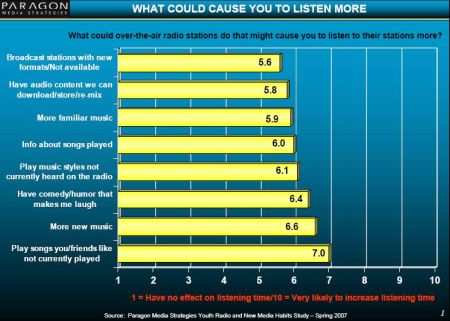
«In the 2000s it’s the music that young listeners are sharing among themselves that radio seems to systematically ignore. Herein lies a great new format opportunity. “Paragon Media Strategies research into Youth Radio makes clear that there is a body of music that has reached gestation. Whether it be called ‘Indie’ music or ‘music that my friends and I like that isn’t on the radio,’ there’s a format out there. Check out Last.FM and see what this generation is doing in forming their own library.“Concentrating on this body of music—which also contains a lot of new music—would address pleas research respondents make to radio, and it would shore up one of radio’s big unique selling propositions: introducing listeners to new music

14-24 year olds are actively designing radio that’s not on the radio. The average (median) young adult has 500 songs on their computer, 400 songs on their MP3 player, and 50 CDs. 14-18 year-olds have more than double the number of songs that 19-24s have on their computers and MP3 players… Young music consumers are already creating their own ‘radio stations’ by creating playlists on their iPod.»

fonte: «A Once In A Generation Format Opportunity», Paragon Media Strategies, 17/01/08

Os jovens são grandes consumidores de video

«(...) Who is watching all this homegrown video?

Harris Interactive asked US adult Internet users about the types of online video they would like to see more. The supply of UGV was apparently sufficient for most of those surveyed, since it drew the lowest response rates. However, young adults were most likely to want more user-generated video.

Online Video Content Categories that US Adult Internet Users Would Watch a Lot More if Available, by Age, November 2007 (% of respondents)

An even more detailed picture of UGV viewer demographics came from the "Annual Gadgets Survey 2007" by the Pew Internet & American Life Project, which profiled active adult users of video-sharing sites where many UGVs are hosted. Pew found that more than half of these site visitors were 18 to 29 years old. (...)»

fonte: «Who's Watching User-Generated Video?», eMarkeeter, JANUARY 24, 2008

O que querem os jovens ouvintes

«(...) Young people have voted again and again in this race that they want to own their music not rent it or listen through a glorified subscription or ad-supported service.
The labels -- a group that would cause me to do the opposite of what they do -- is simultaneously selling music to cellphone companies so their customers can have a phone full of music included with the price of the phone. That's a loser with young people.
Last.fm -- now with the ability to play what you say instead of what terrestrial stations like "Jack" want to play -- is also a non-starter.

These ideas and concepts are the creative result of older and in some cases out of touch people who do not understand the young consumer. These products are what they think young people should listen to vis-a-vis their dying record businesses. They are not, however, what young people want. In the months ahead, the painful truth will become evident even to them.

Here's what the entrance and exits polls -- so to speak -- are telling us about the next generation, the record business and new forms of listening:

1. They want to own their music (I use the term own loosely to include paid and stolen music). Rental services like Napster and Rhapsody have not resonated. The labels want young consumers to rent. Cell phone companies can't see why adding a few extra bucks to the monthly bill for all the music in the world won't be a winner. I'll give you two reasons: one is the iPod -- the choice of the next generation and it isn't going away any time soon. And, two, the next generation can steal music without a problem. Who needs rental?

2. Young listeners don't like radio because they have alternatives, but radio has sucked since the 80's -- at least that's when the term "radio sucks" emerged. No one says, "iPods suck" -- at least not yet. But young people show signs of iPod fatigue. Properly read, this means they are not giving up their iPods, they'd just like to be entertained every once in a while.

3. Internet radio will be the smash hit we all think it can be once it can be received everywhere on every device. It's beginning to happen now, but most people don't listen to Internet radio on the go. And by Internet radio I don't mean terrestrial radio "lite" or another version of an HD subchannel. I mean real entertainment. Internet radio is the killer app.

4. Keep an eye out for some form of mash-up music sharing. We're seeing this in video where users can take pictures and send them along to a friend to add music or whatever. Control freaks like record and radio execs will do just about anything but enable a generation to fool with their artists rights. Admirable? Not when their customers do it anyway.

5. Young consumers have iPods -- they have hard drives loaded with music bought and stolen. They also want to be entertained. Instead the labels and their cohorts keep trying to invent the next thing but this generation is going to tell you what the next thing is. And what is it? Entertainment. They want to be entertained. They want to participate in the entertainment. If I'm in radio reading this I am jumping for joy -- that's a core radio skill -- but it will have to be transfered to where the next generation lives and it's not on the radio band.»

Last.fm é rádio?

«(...)The Motley Fool investors publication says Last.fm could mean the end of radio.

Kurt Hanson, who I respect more on these issues, says wait one minute -- Last.fm isn't even radio.

It's an interesting prospect either way. To bring you up to date the four major record labels have cut a deal with Last.fm to get a penny or so for every time a young consumer goes to Last.fm and requests a song. Hanson points out, "Going to a website and saying “I would like to hear ‘You Know I’m No Good’ by Amy Winehouse right now and then being played that song is not “radio” by any stretch of the definition that I’ve ever heard."
The Motley Fool is enamored at the prospect of free online streaming of music from the major labels and a host of indies.

One problem.
Young people have voted again and again in this race that they want to own their music not rent it or listen through a glorified subscription or ad-supported service.
(...) 6. Radio (whether Last.fm or terrestrial) cannot compete with an iPod for playing favorite music. An iPod is a storage device that plays back music. Radio entertains -- or should. Subscription services or ad driven services like Last.fm will be more popular with record labels than with young consumers.

The Motley Fool says:

“Last.fm, bought by CBS… is providing on-demand delivery of its growing digital library for free...Naturally, this is also bad news for other companies selling digital tracks, like Apple, or music subscription services like Napster and RealNetworks".

I disagree. Terrestrial radio doesn't have to worry about what Last.fm is doing. It needs to worry about what radio isn't doing.(...)»

fonte: «lost.fm», Jerry Del Colliano, 25/01/08

KURT HANSEN: «This is not radio! Going to a website and saying “I would like to hear ‘You Know I’m No Good’ by Amy Winehouse right now” and then being played that song is not “radio” by any stretch of the definition that I’ve ever heard. Reasonable people can differ as to what is “radio.” The NAB and the RAB, for example, apparently don’t consider XM or Sirius to be “radio.” Some traditional broadcasters think it’s not “radio” if it doesn’t have disk jockeys (although then you have to reject Jack FM stations and 50 years of automated FM stations). Others might say it’s not “radio” unless it’s a one-to-many transmission, which would exclude personalizable Internet radio brands (even though most consumers wouldn’t). But in every case above, there’s some element of a continuous stream of music that’s selected by someone (or, in the case of a smart recommendation engine, something) else. Influenced by the consumer? Sure. A precise sequence of songs specifically selected by the consumer? I think not. That’s not radio — that’s an “on-demand music service.” Just like Rhapsody, except without a 25-songs-per-month limit (and with more advertising). And it has far less value to both the average adult consumer and to record labels» 24/01/08

O MySpace substitui a rádio

«In the absence of radio play, garage bands all across America are establishing a presence on MySpace, a social-networking site popular with young adults. According to MySpace, more than 240,000 artists of every kind -- from unsigned amateurs to international rock stars -- are using MySpace as a way to market themselves and build a fan base. Artists are using the site to build massive social networks and spread the word about upcoming shows and CD releases. Startup bands like My Chemical Romance have launched careers exclusively through MySpace, collecting more than 100,000 fans through the service. As the seventh most popular domain on the internet in terms of pageviews, according to February numbers from comScore Media Metrix, MySpace gives bands the chance to be seen and heard in a way never before possible. Traditionally, bands toured cities and played dive bars to create buzz about their music. But with MySpace, bands can host demos of their songs, announce shows and connect with fans without spending weeks on the road. (...) "It's a medium where people can go and hear new music and develop an attachment to the band," said Miller. MySpace is aimed at teenagers. It claims more than 15 million members, and even established acts like Weezer, Beck and Billy Corgan are starting to realize the potential of social networking.»

fonte: «Bands Embrace Social Networking» Wired, 18/05/05, david Cohn

«A maior jukebox do mundo»? (LastFM)

«"We have created the world's biggest free jukebox," said Richard Jones, one of Last.fm's three founders. "People love our recommendation service but they also want to cherry pick songs and now we can offer both."» 

«O site de música Last.fm vai passar a oferecer a seus usuários a possibilidade de escolher a canção que deseja ouvir após fechar acordo com as quatro grandes gravadoras, informou a agência de notícias Reuters esta quarta-feira (23). Até então, o site vinha funcionando como uma espécie de rádio on-line na qual o internauta pode escolher o estilo das músicas que gosta, mas não faixas individuais para audição. A mudança, por enquanto, valerá apenas para usuários dos Estados Unidos, Reino Unido e Alemanha. O serviço será gratuito para ouvir as faixas em streaming, mas oferecerá também a opção de download pago em MP3, em parceria com o site Amazon.com. A possibilidade de ouvir músicas via rádio em streaming, com seleções randômicas baseadas no gosto do usuário, continua para todos os usuários internacionais. De acordo com a Last.fm, fundada há seis anos, a oferta se tornou possível graças à receita obtida com a venda de anúncios em seu site. A rede americana CBS comprou a Last.fm em maio passado pela quantia de US$ 280 milhões

«Asked how Last.fm was able to make its ad-funded operation economically viable, Jones said that Pandora operated purely as an internet radio station, while his company had a diverse offering including social networking and music recommendation.He added that the company had always enjoyed "good industry relations" and had been paying artists and licence fees since 2002.Last year saw the launch of Spiral Frog, an ad-funded online music service that forces users to listen to an ad before being able to access the music track

«Até aqui, o modelo do Last.fm era baseado na oferta da audição linear de música através de acordos com estações de rádio e do seu serviço de recomendação de música. As faixas não estarão, contudo, disponíveis para download, o que quer dizer que os utilizadores não poderão transferir a música para um leitor de MP3. Depois de ouvirem as faixas, os utilizadores terão a possibilidade de fazer a compra a partir de uma das plataformas parceiras como o iTunes, o Amazon ou o 7 Digital

«(...) last.fm would make an announcement which might radically shape the way we consume music, and certainly makes Pandora look a bit old hat. (...) this puts last.fm right up there with MySpace as a place to hear tracks by, well, most bands you'd care to mention. (...) But last.fm are clearly on the right track, here. OK, there are caveats; individual tracks can only be played three times by each user, although they state that they're aiming to increase this number. Beyond three plays, a subscription service will allow you to listen to each track an unlimited number of times. But, crucially, it's taking the element of "ownership" of the music out of the equation. Traditional subscription models, such as the ones run by Napster, where you "rent" your mp3 files for the duration of your subscription, now look increasingly under threat. last.fm store the music, and they let you listen to it when you like. And as mobile phones, mp3 players and living room hi-fis become net-savvy, it's going to be something more and more people turn to.»

A cotação das empresas de rádio na bolsa de NI (recessão)

«A friend put together this list of key radio companies before yesterday's roller coaster ride on the Dow. Look how well they have built shareholder value for their investors.

Spanish Broadcasting
High 42.00 -- Recently 1.54 -- Loss of 96.33% (1.50 yesterday)

Emmis
High 62.34 -- Recently -- 2.47 -- Loss of 96.04% (2.62 yesterday)

Radio One
High 31.33 -- Recently 1.77 -- Loss of 94.35% (1.68 yesterday)

Citadel Broadcasting
High 22.79 -- Recently 1.69 -- Loss of 92.58% (1.52 yesterday)

Regent
High 14.19 -- Recently 1.49 -- Loss of 89.50% (1.32 yesterday)

Salem
High 33.65 -- Recently 4.63 -- Loss of 86.24% (3.93 yesterday)

Entercom
High 67.75 -- Recently 11.00 -- Loss of 83.76% (11.00 yesterday)

Cumulus (Private buyout in progress)
High 22.70 -- Recently 5.90 -- Loss of 74.01% (5.43 yesterday)

Saga
High 23.44 -- Recently 5.90 -- Loss of 74.83% (5.97 yesterday)

Beasley
High 19.34 -- Recently 5.05 -- Loss of 73.89% (4.48 yesterday)

Cox Radio
High 34.67 -- Recently 11.10 -- Loss of 67.98% (10.89 yesterday)

Entravision
High 20.31 -- Recently 7.27 -- Loss of 64.20% (6.03 yesterday)

Clear Channel (Private Buyout in Progress)
High 91.50 -- Recently 34.42 -- Loss of 62.38% (32.14 yesterday)

CBS
High 35.50 -- Recently 24.00 -- Loss of 32.39% (22.28 yesterday)
(New issue missing most of the loss)

fonte: «Radio's "Recession" Started A Long Time Ago», Jerry Del Coliano, 23/01/08

A publicidade on line a chegar aos 10%

«Em 2010, o investimento na Internet deverá corresponder a 10% do total do mercado. Mas, segundo a Deloitte, três quartos dos utilizadores consideraram a publicidade no meio intrusiva

«O ano de 2008 será provavelmente o ano de confirmação do modelo de negócio da publicidade online» revela Miguel Eiras Antunes, partner responsável pela área de consultoria no sector de tecnologia, media e telecomunicações da Deloitte. Na apresentação do estudo «TMT Predictions 2008», que ao mesmo tempo decorreu em diversos mercados ao nível mundial foram, no entanto antecipadas algumas barreiras a este meio. «A publicidade na Internet enfrentará múltiplos desafios relacionados com uma crescente antipatia por parte dos utilizadores e com um maior escrutínio regulamentar», sugere. No ano em que celebra 15 anos de actividade, desde o primeiro banner vendido, a publicidade online tornou-se numa indústria que vale 28,5 mil milhões de euros, devendo crescer 23% face a 2007. Estima-se também que em 2010, a fatia correspondente à publicidade online proveniente do investimento dos anunciantes seja de «10% do total do mercado». «É no entanto provável que em 2008 a publicidade online enfrente uma multiplicidade de obstáculos», destaca Miguel Eiras Antunes. Uma delas prende-se com o facto de «três quartos dos utilizadores considerarem este tipo de publicidade intrusiva, sendo que um quarto pagaria para ter conteúdos livres de publicidade no meio», salienta o responsável»

fonte: «Publicidade na internet cresce 23%», Briefing, 2008/01/23 Paula Ferreira Fernandes

O (lento?) avanço do WiMax

«From NewsFactor.com: “The trademark ‘SprintSpeed’ could take on a whole new meaning in 2008, as the telecommunications firm moves ahead with plans to deploy its long-awaited WiMAX service, known commercially as Xohm. “[Recently,] the company announced at the Consumer Electronics Show (CES) in Las Vegas that a soft launch of the service to Xohm employees in Chicago, Baltimore and Washington, D.C., is now under way.

“The show in Las Vegas was a busy time for Sprint. In addition to the soft launch, the company has announced a number of new Xohm agreements** for portal services and WiMAX devices…

“The promise of WiMAX technology is remarkable: data transmission speeds as fast as 70 Mbps over distances as great as 50 kilometers. Transmission speeds do drop over distance, however, and it is a shared-bandwidth technology, so actual mileage may vary. A more common metric for the service is 10 Mbps over 10 kilometers. Nonetheless, WiMAX offers the potential for significantly faster and far-reaching wireless Internet than cellular data transmissions or the more well-known WiFi» fonte:

Há sempre quem veja o copo meio cheio (ou como é preciso ter cuidado com as previsões)

«A pesar de las aciagas predicciones de la segunda mitad de los años noventa, la radio está de regreso y, en muchas maneras, mas fuerte que nunca. Las ganancias están aumentando y la audiencia es constante. A medida que avanza un nuevo siglo vemos también como las fortalezas tradicionales de la radio siguen realzando el atractivo del medio. Ahora también es posible acceder, por medio de un teléfono celular, a estaciones de radio por Internet» (Hausman, Benoit e O'Donnell, 2001: 351)