Blogia

Transistor kills the radio star?

A escuta de rádio através da internet

«Assiste-se, nos dias que correm, a uma reestruturação do meio rádio em função das novas disponibilidades tecnológicas de que dispõe. A escuta através da internet é algo possível já há alguns anos e aí estão também o podcasting e a disponibilização de conteúdos multimédia através dos respectivos sites. Ou seja, a nova Rádio deixa de ter apenas ouvintes e, atráves das multi-plataformas de transmissão de conteúdos, passa a ter também leitores e visualizadores, permitindo, ainda, a liberdade para a gestão do melhor momento de acesso aos mesmos. São vários os sinais que indicam que este será o futuro. Contudo, analisando objectivamente a situação presente do meio rádio em Portugal, esta é uma realidade ainda longe de estar generalizada. Ou seja, a rádio de hoje continua a ter essencialmente ouvintes, mantendo-se o FM como o grande veículo de ligação entre as estações e os seus públicos. Comecemos por observar, precisamente, o modo como se tem desenvolvido a relação dos portugueses com a rádio através da internet. Este acompanhamento tem vindo a a ser efectuado pela Marktest já desde 2004, e os resultados são os seguintes:
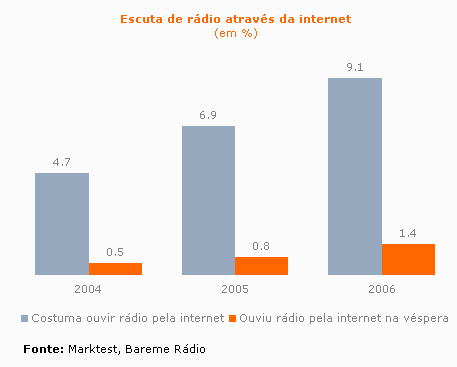
Como se observa, se o hábito de escuta de rádio pela internet está em crescimento e em 2006 apresenta já valores consideráveis, a escuta regular (diária) apresenta ainda valores pouco expressivos. Reportando-nos ao local onde o hábito de escuta pela internet é praticado, o comportamento manifesta-se da seguinte forma:
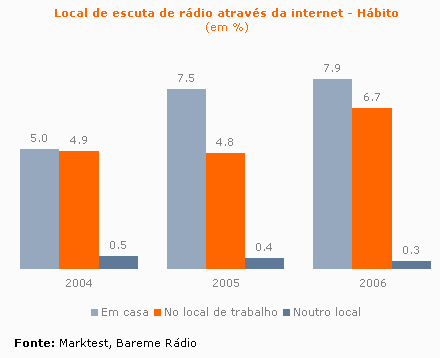
O gráfico acima mostra-nos que essa escuta ocorre maioritariamente em casa, contudo, é já relevante a penetração evidenciada no local de trabalho. Neste contexto de novos desafios, é importante perceber que alterações têm ocorrido no comportamento dos Portugueses e as suas repercussões na relação com o meio.»

fonte: «Os Portugueses e a Rádio – evolução e alteração de comportamentos», 27/02/07, Marktest.com
A atitude dos pais perante os seus filhos mudou

« Once, parents would say, "I want him to have all the things I never had." Now? "I want him to have all the things I have."

Fonte: Gen-X gives birth to stylish baby products, January 19, 2007, By Karen Sommer Shalett, Washington Post

A propósito: «No mundo desenvolvido, as pessoas consomem crianças, não as produzem. Têm-nas para se manterem felizes - em vez da solidariedade, as pessoas sentem necessidade de manter as suas necessidades satisfeitas. Assim, as crianças são o derradeiro bem de consumo. Não as vemos como parte de nós mesmos, colectiva ou individualmente: tendemos mais a encará-las como uma das coisas da nossa vida, em vez de nos revermos nas nossas crianças, o que revela aquilo que a nossa sociedade tem de mais autodestrutivo» (Castells, Manuel e Ince, Martin, Conversas com Manuel Castells; Porto: Campo das Letras; 2004: 87)

Mais uma vedeta do MySpace (Tila Tequila)

«MySpace celebrity Tila Tequila is now branching into music with a do-it-yourself game plan.  Tequila, who has over 1.7 million MySpace friends, is releasing her first single, "I Love U," exclusively on iTunes.  The move is happening without the help of a label, and Tequila is promoting her track heavily on her MySpace page.  "Tila Tequila turned down two record deals, believing that having absolute control over the kind of music she released and how she was portrayed was more important than being part of the system," a blurb on the Tequila page declares.  The model-turned-artist is also promoting the release with a free video for the track, available on iTunes for a two-week window.  A sample of the song can be streamed on the MySpace page, along with a number of other tracks. "I Luv U" was produced by Lil Jon, and carries a rough edge that is consistent with the Tequila image.  That has clearly resonated with the MySpace audience, though it remains unclear if those fans will also purchase the Tequila download.  Celebrities have had mixed success crossing into music, though Tequila will pull a far greater percentage of revenues than a traditional label artist.  And the Tequila audience is entirely online, and easily accessed and marketed to.  If successful, expect Tequila to release more materials direct-to-fan, with or without iTunes as a partner.  Fans can also expect a fair amount of revolutionary, anti-label zeal, an approach that also fits neatly into the Tequila profile.»

fonte: Digital music news, «MySpace Celebrity Tila Tequila Releases iTunes Single ». 26/02/07

Publicidade ajuda a arrancar com o PPM?

No Diário Económico de hoje um texto intitulado «Agências de publicidade estão fartas de falhar o alvo» mostra que pode ser a publicidade a arrancar com o PPM, já que os meios não parecem ter força suficiente.

Quase todas as rádios estão codificadas (PPM)

Agora foi a vez da Cox.

«Arbitron said that Cox Radio has agreed to encode its four radio stations in Houston for the Arbitron Portable People Meter radio ratings service. Cox had been holding out pending Media Rating Council accreditation in that market; that happened recently. The broadcast group has not yet said whether it will subscribe to PPM data from Arbitron. The audience research firm has not released a schedule for PPM implementation in Houston, the second market to go PPM after Philadelphia


A geração iPod e a rádio

"When I was growing up," says Chris Anderson, author of the new media bestseller, The Long Tail, "you had top 40 radio. Generation Y-ers are just not listening to top 40 radio. They’re not listening to radio at all." Anderson, at 45, is hardly over the hill, but the shift between how he consumed culture and how today’s teenagers consume, has been dramatic. In The Long Tail, Anderson charts how consumption of media has shifted from a world of narrow broadcast spectrum, few television and radio stations and a handful of newspapers to a world of seemingly limitless choice. As the costs of creating and distributing media have collapsed, we have gone from a world of a few hits to a world where even the most arcane content has a commercially-viable audience.

fonte: «The Impact of Digitalization», KPMG, 2007


A geração iPod e os media tradicionais

«On the content front, the question is how far online sources of news and entertainment will replace traditional ones. In the case of newspapers, a 2006 survey by the Pew Research Centre found that nearly one in three Americans regularly get their news online. Even adding print and online readers of daily newspapers gives a readership of 43 percent of Americans, well below the 50 percent who read a newspaper 10 years ago. Is the content worthless? Certainly, many peer-produced sites contain large amounts of rubbish. But some sites have considerable impact. CNET, some of whose stories are written by "citizen journalists", broke more stories on the crisis at Hewlett Packard this summer than did The Wall Street Journal. Flickr collected pictures that summed up the London bombings of July 7 2005. Where such sites are visited by a small elite, they may offer sophisticated commentary on law, finance and management. A further challenge to traditional producers of content is the ease with which material can be distributed online. Copyright laws are poor protection online, although publishers have fought a fierce rearguard action to protect their intellectual property.

Some traditional producers of content will find ways to benefit from these new online channels. The Wall Street Journal, for instance, uses clever software to deliver to readers the stories likely to interest them most, and to tell them which are the stories most widely read or blogged, and to encourage them to air their own views. As for the music industry, it has suddenly acquired new showcases for snippets of music videos, with vastly larger audiences than ever before. Advertising online As for advertising revenue, it is threatened not just by Craigslist et al. The business model for most open source and peer-produced activities online is advertising: a real diversion of resources from traditional media. The challenge is all the greater because online advertising is often carefully targeted, like Google’s. In 2005, online advertising became the fourth largest in revenue terms in Britain, running at three times the level of radio advertising, and overtaking billboards and the business and consumer magazine markets.»

«The Impact of Digitalization», KPMG, 2007 pag 14

«Uma tecnologia tão recente pode servir uma comunidade?»

«(...) Generation Y is arguably the first generation to use technology to facilitate communication, to spawn creativity and to air political views on a grand scale. But this raises the question: if the gatekeeping role has been acquired by an entire generation, could an even newer technology be embraced by the whole community?(...)»

fonte: «The Impact of Digitalization», KPMG, 2007 (8-11)

Quatro grandes desenvolvimentos da digitalização (online world)

«Broadly, there have been four big developments in the online world in the past few years.

The first is the decline in the cost of media distribution—thanks to digitization and broadband—which has helped to make even relatively unloved content commercially viable. The second phenomenon, which has been sparked by the decline in the cost of media production, as well as by the development of tools for sharing content, has been the rise of user-generated content perhaps better described as "participatory media". This has been exemplified by the phenomenal success of web sites like MySpace, acquired by Rupert Murdoch’s News Corp, and YouTube, the video-sharing site acquired by Google. The third development is the rise of sharing, be that deliberately, for example, through wikis—a software tool allowing for collaborative working—or involuntarily. The way in which information is organized is also changing – phenomenon number four. Instead of a traditional hierarchy of information by experts, i.e., a taxonomy, web users are increasingly categorizing online content—web pages, photographs and links—for themselves. This dramatically reduces the cost of search and information management and has given rise to new businesses.»

«The Impact of Digitalization», KPMG, 2007

Um guia sobre o DRM

Várias questões abordadas neste texto («A random guide to DRM»); alguns excertos:

«Remember when you used to play deejay with your first radio-cassette player and produce tapes to impress your girlfriend? The music industry does and has expressed concern about the potential for high quality ripping from DAB. Record executives believe it could pose a serious threat to their core business. Most broadcasters address this problem through the desynchronization of the most relevant metadata (i.e. artists' names and song titles). And as all budding teenage deejays know, radio stations still cross-fade songs for the same reason. The music industry has called for more stringent safeguards. »

«A survey by Jupiter Research has found that that more than 60 per cent of European music executives believe that abolishing copy control software would make more people buy the tracks. A study published in the Journal of Political Economy suggests that illegal music downloads have had no noticeable effects on the sale of music.»

RR em PDF e video

«Em relação à Renascença parece-me que a "Boa Onda da Rádio" está a significar uma empenhada aposta num novo conceito de rádio, virada para um conjunto de serviços disponíveis em diferentes suportes.
A Renascença já nos tinha dado a possibilidade de VER reportagens no seu site. Agora anuncia que vai possibilitar em breve notícias num formato PDF para que possam ser impressas e lidas» (Luis Bonixe, Renascença em PDF)

«(...) O projecto de um jornal bi-diário disponibilizado na internet em formato pdf surliu na sequência de uma "análise do futuro e da evolução dos meios, com a  possibilidade da entrada em novas plataformas", explicou ao M&P José Luis Ramos Pinheiro, administrador do grupo. (...) É um projecto pioneiro. É uma forma mais completa de comunicar", adianta, revelando que a meta do Página 1 é transportar para o papel aquelas que são as mais valias da rádio". O lançamento deste jornal teve como principal objectivo alcançar "novos patamares de comunicação, com novos públicos", adianta, "Fomos pioneiros a colocar som e vídeos nos sites. Queremos também encontrar novas fomas, mais adequadas, de comunicar com um público que já vive online, construindo pontes seguras com esse público", sublinhou o responsável da Renascença. A publicação, que tem duas edições, a primeira às 12h30 e a segunda às 17h30, ou seja, "antes das pessoas irem almoçar e antes de irem para casa", é coordenada por Pedro Leal e tem dois editores a tempo inteiro, Raul Santos e Pedro Caeiro.  (...). Em termos de conteúdos, o Página 1 é um jornal generalista, de leitura rápida, mas que não abdica de opinião nas suas duas edições, sempre com uma perspectiva informativa e enquadramento editorial", frisa o administrador da Renascença, (...). José Luís Ramos Pinheiro começa por dar o exemplo do próprio Página 1, que pode vir a ter "edições temáticas em dias fixos da semana". Além dos projectos de imprensa, o responsável da Renascença refere que "tudo aquilo que em que ver com web tv" pode vir a ser desenvolvido» (Meios e Publicidade, 02/03/07, «Página 1 nasce para captar públicos online», pág 24).

A rádio não se pode esquecer do video

«La radio, especialmente en Estados Unidos, se está convirtiendo poco a poco en un medio visual. ¿Contradicción? No. Un recurso más de supervivencia. Ahora que muchas estaciones tienen páginas web, las usan para ofrecer cobertura visual.
Es así, las estaciones de radio comienzan a poner programas de video en sus páginas Web: comedias musicales, clips de noticias y acontecimientos especialmente pensados para conservar relevancia. Allí, se inician también en una estrategia que hasta hace poco les era extraña: la interactividad. La radio llega tarde a la era interactiva, pero ahora aprovecha su cara en la red para incorporar todo aquello que puede atraer publicidad, público y ganancias. Lejos de matar a su antecesor,entonces, parecería que el negocio de la transmisión de imágenes se convierte ahora en salvador de la vapuleada radio tradicional.»

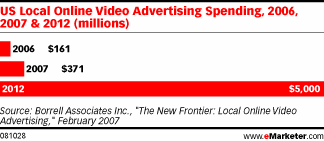
Mais: «The Internet does change everything. Another barrier between media has fallen. Local television stations are now competing with local radio stations and newspaper sites for online video ad revenues. According to a new report from Borrell Associates, "The New Frontier: Local Online Video Advertising," local online video advertising will more than double this year, increasing from $161 million in 2006 to $371 million.

Although local online video advertising currently accounts for less than 5% of all local online advertising — which is expected to hit approximately $7.7 billion in 2007 — Borrell analysts predict that in five years it will exceed $5 billion and account for more than one-third of all local online advertising. The main driver? Increasing competition between local online newspaper, radio and TV sites, each attempting to poach one another's business.

Fonte: «Local Online Video Advertising Forecast to Double», E-Marketer FEBRUARY 16, 2007

A MediaAudit não desiste do seu telemóvel

«Dallas - Feb 9, 2007 - The Media Audit/Ipsos is developing an electronic audience measurement system that tracks listener habits by using a device called a Smart Cell Phone. This system does not require listeners to carry a device strictly for listening measurements like the Arbitron PPM. The Media Audio study will be conducted in Houston and will include a panel of 2,500 respondents aged 12+ to use a cell phone that monitors radio listening. An initial core of five of the nation's nine largest radio broadcasters, representing more than 25 percent of all radio revenue, have agreed to support The Media Audit/Ipsos media measurement initiative financially. The company expects that additional radio broadcasters will join the initial group of Clear Channel, Cox, Cumulus, Entercom and Radio One during the next several weeks. The Media Audit/Ipsos is one of three finalists bidding for the U.S. radio measurement contract with Arbitron, and Mediamark Research

fonte: «Media Audio Plans Market Study of Smart Cell Phone» RadioCurrents Online, 12/02/07

XM e Sirius fundem-se (XSirius?)

«WASHINGTON - A Sirius Satellite Radio e a XM Satellite Radio, as duas principais rádios por satélite dos Estados Unidos, decidiram se unir, informaram hoje ambas as emissoras em um comunicado conjunto. As duas companhias explicaram que Mel Karzamin, executivo-chefe da Sirius, será o principal responsável pela companhia que nascerá da fusão. (...) A aprovação definitiva da fusão dependerá das autoridades de concorrência e anti-monopólio americanas. O comunicado conjunto não especifica o nome da nova empresa e o conselho de administração da mesma passará a ter 12 membros, entre eles Parsons, Karmazin, quatro diretores independentes nomeados por cada companhia e um representante da General Motors e da Honda. Ambas as empresas automobilísticas tem um acordo exclusivo com as duas emissoras de rádio. (...) "A companhia resultante se beneficiará de uma equipe altamente qualificada, com ampla experiência na indústria radiofônica", segundo a nota conjunta divulgada hoje.»

«Laws prohibiting the two to combine have been in place since each were granted licenses about a decade ago, in effect creating a government-mandated duopoly because regulators had no intention of allowing other sat-radio operators to spring up in the U.S. Nevertheless, laws can be tweaked to grant permission for the two money-losing companies to merge, and that has competitors nervous.
Dennis Wharton, an executive vp with the National Association of Broadcasters, which represents traditional radio, said he'd be "shocked if federal regulators permitted a merger of XM and Sirius."
Others aren't so certain. Barton Crockett, an analyst with JP Morgan Securities, upgraded shares of XM and Sirius last month because of persistent and credible rumors that the two might "attempt a merger this year, with regulator approval a tossup."
Experts have been saying for months that approval of a combined XM-Sirius depends on how the FCC and anti-competition regulators view the industry. If considered broadly, with digital music players and the Internet thought of as competition, then approval ought to be granted. However, if the government sees competition for XM and Sirius stemming only from each other and from free radio, then approval isn't likely.» (fonte: Sat radio rivals unveil merger agreement, By Paul Bond, Feb 20, 2007, Hollywood Reporter)

Fred Jacobs: (20/02/07)«Top 10 reasons why an XM-Sirius merger sounds like a bad idea:

1.  $19.99/month

2.  Since when did the government reward failure?

3.  Does this mean that the FCC will completely de-regulate radio now?

4.  Howard gets wealthier because the stock goes up

5.  $25.99/month

6.  Voice-tracked music channels

7.  18 units/hour on the music channels

8.  How come my (Sirius/XM) receiver can't pick up my (Sirius/XM) signal?

9.  If the FCC will approve this merger, they'll probably approve local traffic and weather (wait, they already have?????)

10.  $29.99/month»

Procurar integrar a rádio nas novas plataformas

«THE BBC is in talks with technology companies to develop a plug-in device that turns MP3 players into digital radios. While the BBC last night refused to name its potential partners, Apple, maker of the iPod, is understood to be one. The device would be a small tube containing a DAB digital radio chip that clips on to an MP3 player. Users of the iPod already use tiny bolt-on transmitters, such as the iTrip, to play their MP3 collections through car radios. BBC officials stressed last night that talks were in their early stages. However, the corporation believes part of its public service mission is to make digital radio as available as possible. Simon Nelson, controller of radio and music interactive at the BBC, said: "We need to ensure there are devices that can enable people to listen to radio - especially on something they already carry around." The BBC is also looking at a digital plug-in that could work with car radios. Apple recently signed deals with Mazda, Ford and General Motors, which will manufacture 2007 models with a docking system for iPods»

fonte: Scotsman, Britain's 'wired generation' shuns traditional media for a life online, 11/08/06 FERGUS SHEPPARD

Interactividade e personalização

«BRITAIN'S "wired generation" is increasingly shunning television, radio and newspapers in favour of online networking, websites and downloading media to phones and iPods. The 16-24-year age bracket now watches TV for an hour less per day than the average viewer and listens to 15 minutes a day less radio than average. They also say they read fewer newspapers because of their internet use. The findings emerge in Ofcom's communications market report for 2005. It says Britain's young people arrange their lives online and via mobile phones. But rather than just surfing the web, teenagers are increasingly fixated by networking websites such as Bebo and Myspace, which allow users to create virtual communities. More than 70 per cent of those aged between 16 and 24 said they used social networking websites, far higher than the UK average of 41 per cent. The urge to network is further illustrated by the fact that 37 per cent of under-24s say they have contributed to a blog or website message board, more than double the percentage among net users as a whole. The younger generation's reliance on mobile phones was also underlined by Ofcom's research. The under-24s make seven more mobile calls and send 42 more texts per week than the wider UK population. Claire Woffenden, deputy editor of Web User magazine, said young people were ditching traditional media for new technology because of the interactivity and personalisation it allowed. "What's appealing is being able to dictate their own agenda tailored to their own tastes," she said. "Why listen to the radio, when you can create your own personalised radio station? Instead of regimented TV listings, the likes of YouTube mean you can watch video clips on a variety of subjects whenever when you want to, or become an instant celebrity by creating your own." The increasing use of mobile phones is not just confined to teenagers, however. Ofcom says that one in ten households now rely exclusively on mobile phones and nearly a third of people regard their mobile as their main telephone, even if they have a landline at home. Mobile phones also appear to have doomed the public payphone. For the first time, none of those surveyed relied on payphones for their main means of making and receiving calls, compared to 2 per cent in 2004. »

fonte: Britain's 'wired generation' shuns traditional media for a life online, Scotsman, FERGUS SHEPPARD 11/08/06

Previsões de perda no Canadá

«Conventional radio stations are losing their grip on the iPod generation as younger listeners shift to new technology, such as MP3 players, satellite radio and the emerging world of music-playing cellphones, the industry is warning Ottawa.In a lengthy document submitted to the federal broadcast regulator yesterday, the industry paints a bleak picture for itself as new technology permeates its market, eroding audiences and eating away at advertising revenue.Falling listenership among teenagers has become a particular concern for the industry, the Canadian Association of Broadcasters (CAB) said in its submission to a sweeping review of the sector being conducted in Ottawa."It is generally agreed that teens have abandoned conventional radio in favour of other audio platforms including peer-to-peer file sharing, music downloading and iPods," says the CAB, which represents Canada's radio companies."The key question this raises is whether today's teens can ever be repatriated to conventional radio." (...) Industry data on declining radio audiences are among the most surprising figures contained in the document. Under the group's worst-case scenario, listenership could fall 16.1 per cent over the next 10 years, causing a 14.5-per-cent drop in advertising revenue. The sector's most optimistic view predicts a 9.6-per-cent drop in listeners during that time, resulting in a 4.8-per-cent decline in revenue.If the industry saw a decline of that proportion last year, it would have cost $188.5-million in advertising revenue, the CAB said. (...) "We are facing an unprecedented level of competition." Mr. Goldstein said in an interview, adding that CHUM is very conscious of the industry's technological changes.  He said achieving "regulatory certainty" from the CRTC is more important. Several broadcasters are concerned that rivals, such as satellite radio, are not bound by the same regulations as conventional radio.The CAB says the fastest erosion of conventional radio listenership is coming in the 12-17 age demographic. (...)

Radio feels heat from iPod generation», Globe and Mail, SIMON TUCK, GRANT ROBERTSON, March 16, 2006)

Como o iPod pode ganhar ainda mais

«O presidente da Apple, Steve Jobs, incitou as maiores editoras discográficas do mundo a venderem online as suas músicas sem o actual software de segurança, que previne a pirataria dos ficheiros. Para Steve Jobs, a abolição do software de protecção anti-pirataria de música, conhecido como «digital rights management» (DRM), seria uma boa medida para os consumidores e até para as próprias editoras, argumentando que este é ineficaz no combate à pirataria. A Apple tem vindo a sofrer pressões para compatibilizar as músicas vendidas na sua loja virtual iTunes com outros leitores de música, já que estão restringidas ao leitor que a própria empresa comercializa, o iPod. Desde Junho de 2006, associações de consumidores de vários países da Europa têm recebido queixas sobre a Apple, relativas à incompatibilidade das músicas do iTunes com aparelhos de outras marcas. Referindo-se a esta situação, Steve Jobs afirma que, a abolição do DRM permitiria a todos utilizadores de mp3 o acesso às músicas de qualquer loja virtual, incluindo a iTunes. «É claramente a melhor alternativa para os consumidores, e a Apple iria envolver-se a 100% nesta iniciativa», declarou. Os analistas referem que esta medida iria reforçar a posição da Apple como líder do mercado da música digital. A loja virtual de música da Apple, iTunes, vendeu cerca de 2 mil milhões de músicas, desde que foi lançada em 2003, e conta com mais de 70% do mercado de música digital dos Estados Unidos. Segundo Steve Jobs, caso a protecção DRM seja retirada, a Apple estará em condições de criar um sistema de download, que permita a compatibilidade das suas músicas com outros leitores, para além do iPod, inclusive o Zune, recentemente lançado pela Microsoft.» 

fonte: Diário Digital, 7/02/07, Apple apela à venda de música sem software anti-pirataria

O novo fenómeno musical criado pela Internet: Mika

«Há um semana, ainda o disco de estreia de Mika, Life in Cartoon Motion, não tinha chegado às lojas e já o rapaz era apontado como a nova grande estrela musical do Reino Unido. Completava então duas semanas no topo da tabela de singles inglesa, com mais de 100 mil downloads vendidos do tema 'Grace Kelly'. E mesmo sem um único álbum no currículo (chega a Portugal a 5 de Março) (...). Em Julho de 2006, a newsletter Popbitch, dedicada às celeridades inglesas e ao mundo pop, fazia prova de um olfacto apurado ao vaticinar que um desconhecido chamado Mica Penniman seria 'a super estrela dos próximos anos'. Mika, recém-chegado ao site MySpace [que permite disponibilizar música online], viu-se, de um dia para o outro, venerado por centenas de visitantes. O fenómeno estava lançado. Pouco depois, uma votação organizada pela BBC apostava em Mika para talento revelação de 2007 - os vencedores anteriores tinham sido 50 Cent e Keane. Colin Martin, da estação, apressou-se a afirmar que, por vezes, aparece um artista com sucesso escarrapachado na cara e 2007 parece que vai ser o ano de Mika». Do outro lado do Atlânlico, Tommy Mottola, o homem que lançou Mariah Carey, afirmava que «ele poderá atingir a grandiosidade de [David] Bowie, Robbie [Williams] ou Elton [John] » .

fonte: «Estrela Imprevista», Sol/Tabu, Gonçalo Frota, 9/02/07, pág 22 

Canais de streaming cada vez mais poderosos

Chama-se Oboe Free

«MP3tunes is announcing free, unlimited storage music lockers for everyone. Oboe - our music locker technology - has been out for more than a year. We've refined the process and are ready to invite the world to come create an Oboe music locker. Sign-up now to realize the benefits of online storage. Here's a Q & A about Oboe Free, our new music locker with free unlimited storage.

Q: Why is the Oboe Free music locker a significant development?
A: This is the first time a free music locker with unlimited storage has been made available. Users sign-up with a valid email address and then load their Oboe Locker with their music using the free Oboe Sync software for Linux, Macintosh or Microsoft Windows. Once loaded, users stream their music from any browser or from a growing list of mobile devices - and can also sync to another computer. Oboe Sync will even add cover art for all your albums at the end of the sync process. We've also added our number one feature request of scheduling so a locker sync can happen in off-peak hours when your computer is normally idle. (...)»

fonte: «Unlimited Storage Free Music Lockers», February 12th, 2007

NOta: primeiro sinal: afinal não é ilimitado (alegadamente por excesso de adesão), apenas 1GB; depois: a ideia é venderem-nos um serviço «praemium»; é preciso optar pelo grátis; ao contrário de outros, exige pelo menos um software proprio, que tem de ser instalado no nosso computador