Blogia

Transistor kills the radio star?

Cada vez menos a rádio convencional é útil para indicar nova música

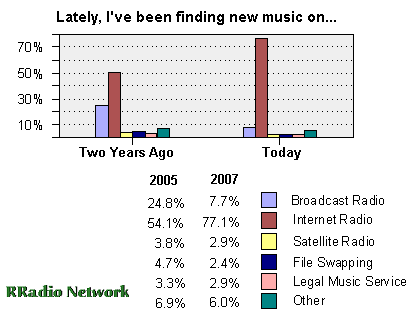
«(...) asking online radio listeners where they uncover new music. The question used was a fill-in: "Lately, I've been finding new music on..." The survey respondents were given the choice of broadcast radio, internet radio, satellite radio, file swapping, legal music service, and other.

A funny thing happens when you crunch these numbers. It shows that a substantial number of the internet radio audience give internet radio the nod as their key "new music" source - 77.1% to be exact. Only 7.7% say that, of late, they've been finding new music on broadcast radio.

This same question was asked of RRadio Network's online radio station audiences in 2005. In April of that year, 24.8% said that broadcast radio was leading them to new music. And, of these online radio station listeners - two years ago - 54.1% reported internet radio was where they found "new music." All other choices (satellite radio, file swapping, legal music service, and other) also dropped in the percentage of people using them to find new music between 2005 and 2007.

Study the chart and consider that online radio has, in just two short years, run away with the perception that it's delivering new artists (to people who listen to internet radio).


This is a strong argument for internet radio stations to take to their next meeting with the people who decide royalty rates for music. If "new music" is being discovered by online radio listeners by such a vast margin, it means that the internet radio industry is effectively promoting that music.»

fonte: «Trends for Internet Radio Industry», Audiographics, 11/05/07

A Apple tem medo da rádio?

«Even old-school DJs see the appeal of personalized radio. Elvis Duran, who hosts a popular morning show on New York City's Z100, says he could imagine a future in which listeners wake up to some comedy and conversation from the show followed by three songs tailored to their tastes. But he doesn't expect live DJs to become obsolete: "When people wake up in the morning, it's good to hear some people who are talking about interesting topics and who let you know, hey, the world's still spinning and I can go out there." Good idea. No wonder Apple never built a radio tuner in the iPod: it's scared of the competition» (fonte: «Learning to Love Radio Again», By Anita Hamilton, Time Magazine, 29/05/07)

O futuro da rádio é a rádio personalizada?

«Radio's got a problem. Although some 200 million people tune in each week to hear their favorite overcaffeinated DJ or catch those crucial rush-hour traffic updates, it's getting tougher to hold listeners' attention. Facing flat revenues and competition ranging from iPods to music phones, the 87-year-old industry is scrambling to reinvent itself. But not even satellite radio or the new HD format addresses this analog medium's fundamental flaw: it doesn't give people any say in which songs they hear. If you don't like a track or a DJ, your only option is to turn the dial--or turn it off.

That could change if the pioneers behind personalized radio continue to win over music lovers who are burned out on regular radio but can't be bothered to constantly refresh their iPods with 99¢ iTunes. On websites such as Last.fm, Pandora.com and the new Slacker.com personalized radio lets you train it to understand your tastes. You can, of course, just listen to the music passively as it plays on your computer. But it's even better when you make it your own, by marking each song as a favorite, skipping past it or banishing it from the station's playlist altogether. (See chart below for more details on how personalized radio works.) And despite growing concern about how proposed new royalty fees for Internet radio stations could hamper the industry's growth, on May 23 Sprint became the first wireless carrier to offer personalized radio on its phones.»

fonte: «Learning to Love Radio Again», By Anita Hamilton, Time Magazine, 29/05/07

18-24 ouvem podcasts

«According to a recent comScore study, podcast listening (as measured by who downloads what from iTunes) is dominated by Men. And 18-24's are twice as likely to download a podcast as anyone else.

Here are some summary stats:

Podcasting

fonte: Mark Ramsey, «Who listens to Podcasts?», Hear2.0

Novas estratégias comerciais

«Radio should hire an entirely different sales staff solely compensated by commission to sell Internet and podcast opportunities. The pricing would differ from radio ad sales. And because the sales team is a different group of people, there would be no added-value giveaway opportunity. It would be treated as another business and not tied directly to the radio station’s ad sales team. This would allow stations to grow additional business from podcasts, HD channels and Internet sites that are linked to the local community.The cost will be low, and the potential revenue gains can be almost unlimited. We are amazing promoters and marketers, but we must turn our attention to new growth technologies. Broadcast companies must recruit creative people who can develop new revenue streams, then empower them to make it happen. If radio companies hire and support these “drivers,” they will deliver the goods on entirely new levels of business and generate a strong future beyond what radio used to be.» (Lloyd G. Ford,PodcastingFor Profit, 29/09/06)

O mercado publicitário está a crescer em Portugal

é a convicçaõ de Carlos Marques, director-geral comercial das rádios da MediaCapital, na sua última newsletter:

«No final de 2006, os analistas de media previam um crescimento de investimento dos anunciantes no meio rádio para 2007.
Ia eu dizendo, em conversa com um amigo meu, também dos media, mas da área de imprensa, que as previsões dos analistas teriam, relativamente à rádio, bastante probabilidade de se confirmarem, dado que sentíamos desde Fevereiro, na MCR (Media Capital Rádios), um incremento do nosso espaço publicitário, de que é exemplo máximo a Rádio Comercial com ocupação total do seu espaço.
A determinado momento, o meu amigo confrontou-me com várias notícias que tinham surgido na imprensa, especializada e não especializada, que veiculavam a ideia de que, e segundo dados do Mediamonitor da Marktest, o meio rádio estava em queda face a períodos homólogos de 2006.

Ora o Mediamonitor apenas contabiliza spots publicitários, não inclui - nem live copy’s (comunicação integrada na emissão), nem marketing de conteúdos, nem acções de especiais como passatempos, endorsement, extensão da comunicação através dos nossos sites e outros. Consequentemente, e em rigor, o Mediamonitor da Marktest apenas serve para medir o número de spots difundidos e não para avaliar alterações rigorosas de investimentos. Como a tendência de comunicação em rádio passa cada vez mais pelas soluções atrás   referidas, que vão muito para além do tradicional spot, vou, provavelmente, ter de continuar a explicar, de tempos a tempos, esta nuance ao meu amigo. Concluindo, através dos dados que consegui reunir do mercado, o investimento em rádio está efectivamente a crescer… pelas audiências que tem, pela adaptação que o meio está a conseguir face às novas necessidades de comunicação dos anunciantes e pela constatação de que a rádio é um meio poderoso e omnipresente – está em todo o lado, em nossa casa, no nosso trabalho, no nosso carro e no nosso walkman!»

De qualquer forma não parece ser isso que dizem os números da própria Media Capital; Vejam-se as contas do primeiro trimestre, com uma quebra nas receitas publicitárias de 14% face ao ano anterior.

CHAVES, Mónica (et al.) (2007). Kids' Power, A geração Net em Portugal. Corroios: Plátano Editora,

O HD não descola

diz a Business Week:

«Five years after winning FCC approval, HD (hybrid digital) Radio is still a mystery to most consumers. Pricey HD receivers, most of which cost upward of $200, have caused many potential listeners to tune out—despite the support of major broadcasters including Clear Channel Communications (CCU), who have boosted the quality of existing stations by using analog-digital transmitters and created hundreds of HD subchannels. In a survey released May 23, radio researcher Bridge Data estimates there are only 450,000 weekly listeners of HD Radio—compared with 15 million satellite subscribers and 57 million Internet radio listeners. (About 93.5% of all Americans tune into traditional radio every week.) "A majority of Americans are now aware of the term HD Radio. But fewer than 5% of them understand what it is, what is the benefit," says Dave Van Dyke, CEO of Bridge Data. Still, 40% of respondents expect to listen to HD Radio more frequently in a year.» (fonte: «Trying to Figure Out HD Radio», Douglas Macmillan, 29/5/07, Business Week)

YouTube na Apple TV

«O YouTube assinou um acordo com a Apple disponibilizando, a partir de Junho, todo o catálogo do site no Apple TV set-up box. Os proprietários da Apple TV poderão, assim, navegar pela oferta do YouTube e guardar os seus vídeos favoritos, usando a hard drive imbuída no sistema, avança a edição online da Variety.
O acordo deverá beneficiar os criadores de conteúdos, bem como estações de televisão, que estão a carregar a sua programação no YouTube, um serviço que atrai cerca de 20 milhões de utilizadores únicos por mês. Dará ainda aos grandes estúdios e às marcas uma nova ferramenta de marketing para promover os seus filmes e produtos.
A Apple TV, que desde Fevereiro está a ser comercializada, usa o iTunes e a tecnologia sem fios, para transferir conteúdos de vídeo, música, fotografia e podcasts de um computador e da internet para um televisor de alta definição.»

fonte: «YouTube e Apple firmam acordo», Meios e Publicidade, Ana Marcela 1 de Junho de 2007

Last Fm comprada pela CBS

«A rádio virtual Last.fm foi comprada pela CBS, gigante da mídia norte-americana, por US$ 280 milhões (cerca de R$ 560 milhões). A rede online foi criada na Inglaterra há cinco anos e hoje tem mais de 15 milhões de usuários. Ela permite que um internauta se conecte a outros com gostos musicais semelhantes, possibilitando a criação de estações personalizadas. O fundador da Last.fm, Martin Stiksel, disse ao site da rede inglesa BBC que foi uma “oportunidade empolgante”. O acordo prevê que a equipe será mantida e a identidade visual também.
“A parceria vai permitir que todas as músicas já gravadas e todos os videoclipes já feitos estejam na Last.fm”, disse Stiksel. “Com um parceiro forte como a CBS, agora isso está ao nosso alcance.”
A CBS é o maior grupo de rádio dos Estados Unidos, com 179 estações de notícias e música. O presidente e CEO da corporação, Leslie Moonves, disse que “a Last.fm é uma das comunidades virtuais que estão crescendo mais rápido. A aquisição se encaixa no objetivo da CBS de atrair público jovem e ouvintes de outras áreas.”
A CBS não é a primeira mega-empresa a adquirir websites em ascendência por milhões e até bilhões de dólares, impulsionando o que se chamou de “segundo boom das pontocom”. Em 2005, a News Corp., de Rupert Murdoch, arrematou o site MySpace por US$ 580 milhões. No ano passado, o Google pagou U$S 1,65 bilhão pelo YouTube.
Stiksel disse que os usuários da Last.fm não vão ficar desapontados pelo fato de o site ter sido comprado por um grande grupo. “Quando falamos sobre revolução queremos dizer isso – os usuários estão no comando. A CBS entende que os padrões de consumo de informação estão mudando.” Antes de ser adquirida pela CBS, a Last.fm não cobrava por seus serviços. Resta saber, agora, se a aquisição vai mexer com o bolso dos usuários.»

fobte: «Rádio online Last.fm comprada pela CBS», Globo.com, 30/05/07

O comentário do guru Ramsey: «It is inevitable that radio - or aspects of radio - will become personalized. If personalizing advertising makes Google virtually priceless, what effect on listeners does personalizing radio have for CBS? All of this is theoretical at this stage, of course, and I don't mean to sound breathless. But this is where I think things are headed. Instantly, the value of a huge "variety" of channels or stations will be obliterated. Because ultimately nobody wants a hundred diverse channels or stations. They want THEIR one or two or three diverse channels or stations. A hundred stations is what you provide when technology limits you from doing better. Now you can do better. Bad news for HD. Bad news for satellite. And bad news for you if you expect your station's future to be strictly tied to terrestrial broadcast.» («CBS buys Last.fm - and what it means», 30/05/07)

«Of everything that’s been written about last.fm’s sale, one point has been missed, apparently: the not insubstantial point that the company has made it’s fortune by not playing by the rules.

Commercial radio doesn’t have “listen again”, the main point of the impressive BBC Radio Player. If you’re a fan of The Geoff Show, you can only listen to the podcast, and not the entire show, music and all. And, that’s been the case with virtually every single commercial radio station. There’s no licence arranged with the RadioCentre, unlike with podcasting, so therefore it’s difficult and arguably even impossible for each radio company to pursue a separate deal. And, because there is no deal, there’s no way to “listen again” to the wealth and breadth of commercial radio output - leaving that to the BBC to exploit. This isn’t through lack of trying, I should add» (Screw it, lets do it, James Cridland blog, 1/06/07)

Brasil quer o HD (e não o DAB)

«Ainda não há uma data definida para a mudança do atual padrão analógico de transmissão de rádio para o digital no país, nem foi escolhido o modelo a ser implantado.  Um seminário organizado hoje na Câmara, porém, mostrou que as emissoras comerciais já se articulam para impor um padrão tecnológico que, na avaliação de representantes de emissoras públicas e comunitárias, poderá aumentar a exclusão desses modelos alternativos de radiodifusão.

O modelo de rádio digital a ser adotado no país ainda está em discussão por um grupo interministerial, porém os empresários radiodifusores já têm uma preferência, o Iboc (In Band – On Chanel). “Optamos pelo Iboc por que é o único sistema que atende as necessidades da radiodifusão brasileira, seja ela pública, privada ou comunitária. É o único que opera em AM e FM na mesma banda e freqüência”, afirma o presidente da Associação Brasileira de Emissoras de Rádio e Televisão (Abert), Daniel Slaviero«

fonte: «Evento na Câmara expõe interesses no processo de digitalização do rádio no país», Agencia Brasil, Yara Aquino, 29/05/07

Uma aplicação no telemóvel ao serviço da rádio

«San Antonio - May 21, 2007 - Clear Channel Radio has begun the national roll-out of customized mobile phone applications to extend its local station brands. The effort begins in New York City for stations WHTZ-FM Z100, WAXQ-FM Q104.3, WKTU-FM 103.5, WWPR-FM Power 105.1 and WLTW-FM 106.7. Clear Channel expects to launch similar programs on as many as 100 more of its radio stations by the end of 2008, beginning with stations in Salt Lake City and St. Louis in the next 60 days. With the application, users will be able to send text messages into the studio, participate in contests, receive alerts before songs play, make requests and dedications, and view the last 10 songs played. The feature is available on most cellular phones via carriers that offer SMS text features. Phones with WAP capability can access an enhanced user interface. Listeners send the message "join" to a station's short code to subscribe to the service. »

fonte: «Clear Channel Launches Cell Phone Interactive Application» RWOnline, 21/05/07

O primeiro milhão do Zune

«Microsoft has now sold one million Zunes, an early benchmark that comes one month ahead of schedule.  The accomplishment is somewhat unspectacular, though Microsoft quickly assumed a modest growth forecast following a soft initial reception last fall. "It's a good start. It's not an overwhelming start," said Robbie Bach, president of Entertainment and Devices at Microsoft in an interview with the San Francisco Chronicle.  "I'm not going to pretend it's some gigantic move."  Meanwhile, Microsoft is investing more capital and brainpower into the development of the player.  Just recently, the company attempted to perk the marketplace by introducing a pink Zune, a precursor to broader model updates.  Microsoft is also pushing a strategy that will allow more control over its Chinese production.

Comparisons to the iPod are unavoidable, and incredibly lopsided.  Since launching in 2001, Apple has shifted more than 100 million iPods, and the device has captured the imagination of consumers.  That makes a competitive entrance incredibly tricky, though Microsoft is betting that the market will continue to expand.  Meanwhile, all eyes are shifting towards the iPhone, a device that carries all the signs of another Apple smash.  The iPhone will undoubtedly alter the playing field for mobile-based music, though it remains unclear if Apple will translate its dominance in stand-alone MP3 players into converged phones.  Microsoft has not disclosed plans to unveil a converged mobile device, though it does distribute mobile-based operating systems.  (San Francisco Chronicle "Getting in the game at Microsoft", via Digital Music News, 28/05/07


Outras formas de ouvir nova música, para além da rádio (Starbucks)

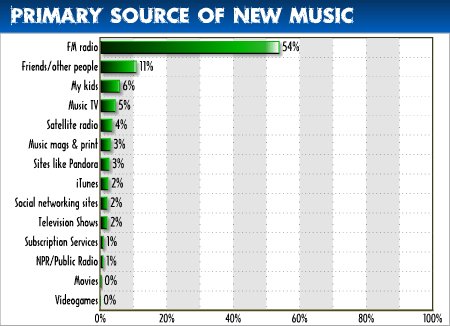
Diz Fred Jacobs: «Our recent Tech Poll continues to show that while radio is still the primary source for new music for more than half of our respondents, however, there are many other outlets that are playing a role in exposure:

Music_sourcetots_07_pr

Vem isto a propósito do esforço da cadeia de cafés Starbucks de se ligar à música: «After signing Paul McCartney to launch its new record label, coffee retailer Starbucks is planning to make sure that as many people as possible hear the former Beatle's latest album. The coffee giant will host a worldwide listening party on June 5 for McCartney's new Hear Music-released album, "Memory Almost Full," with more than 10,000 Starbucks stores in 29 countries set to participate in the event by playing the disc for customers all day long


A importancia do video

«Kids hate to be bored. This is no joke; it is a real issue. They have shorter attention spans, are used to a diet of highly stimulating visual information. From an early age they are gratified instantly and so have less patience for delay of any kind."[Eric Miller]. True, they are used to a stimulating environment. True also, kids hate to be bored. This is not surprising, given that they are more knowledgeable, likely smarter and more active than their boomer parents. Interaction with the digital media is many things but it is not boring - perhaps explaining why so many of the Growing Up Digital kids said "TV was boring by comparison. But as for instant gratification and short attention spans - at best , loaded terms - the evidence isn't there. best» (Tapscott, 1997: 108-109).

Novos meios versus velhos meios (sincrónicos e asincrónicos)

«But television is not dead, just television as we know it - a rigid, one-way medium delivered by networks that schedule programming according to their estimates of likely viewership. Those who view the Net as another TV channel have got it backward. Sometime early in the next century, television programs will become accessible through the Net. Rather than talking about TV versus the Net, we will talk about stored access of content versus real-time access. In stored (asynchronous) access, the user picks up previously stored content (information, music video, a drama, sitcom, news program) when convenient. In real-time (synchronous) use, people access content (a sports game, election reporting) as it is occurring.» (Tapscott, 1997: 27)

«The gap is highlighted by the fact that media panics over new forms of media are spread by old forms of media. That broadcast and print coverage of the internet in newsapapers and on television has often been so negative can also be explained through Drotners historical analysis of media panics. "Those who have invested most an accepted cultural capital," Drotner writes, "are also the principal victims in capital loses its currency"[Drotner, Kirsten (1992) Modernity and Media Panics. In Michael Skovmand & Kim Christian Schrøder (Eds.), Media Cultures: Reappraising Transnational Media (pp. 42-62). London: Routledge.. p. 57 ]. Since the Internet has been the primary means displacing time formerly spent watching television and has provided yet another option for information gathering in place of newspapers, Drotner's words have a special emphasis in our current media panic. Parents are worried about losing control of children while newspapers and television broadcasters are worried about losing their audiences and so each anxiety comes to fuel the other. This should not surprise us. People become hostile and defensive when threatened by something new and which they don't understand» (Tapscott, 1997: 49) 

Uma espécie de declaração de intenções

«For the first time ever, children are taking control of critical elements of a communications revolution» (Tapscott, 1997: 26)  

A internet é a antítese da TV (diz Don Tapscott)

«Many people think the new media and television are analogous because they both involve screens. For example. the term screenagers has been used to describe today's youth. TV viewers and Net surfers alike have been called couch potatoes. (...) Those who say that the Net is all about a bigger crop of couch potatoes not only have a cynical view of humanity, but they ignore the budding experience with interactive technologies. Unfortunately for these commentators and fortunately for kids, the similarities between the two technologies end with the screen. In fact, the shift is more like from couch potato to Nintendo jockey.

Tv is controlled by adults. Kids are passive observers. In contrast, children control much or their world on the Net. It is something they do themselves; they are users, and they are active. They do not just observe, they participate. They inquire, discuss, argue, play, shop, critique, investigate, ridicule, fantasize, seek, and inform. This makes the Internet fundamentally different from previous communications innovations, such as the development of the printing press or the introduction of radio and television broadcasting. These latter technologies are unidirectional and controlled by adults. They are very hierarchical. inflexible, and centralized. Not surprisingly, they reflect the values of their adult owners. By contrast, the new nedia is interactive. malleable. and distributed in control.(...) This distinction is at the heart of the new generation. For the first time ever, children are taking control of critical elements of a communications revolution» (25-26)  

Quando os mais jovens comprarem carro

«The entire auto industry is getting ready for something called ITS-Intelligent Transportation Systems. This is the convergence of the highways with the Net. My car already has voice recognition for the phone system ("call home") and can log on to the Net. Some cars already have global positioning systems which tell you which turn to take. Toll booths scan your information and ensure collection of tolls at 70 milles per hour. And most N-Geners will travel in vehicles which sense the road, traffic, and other conditions, and drive themselves. This is not science fiction - it is already in prototyping and development» (Tapscott, 1997: 25) 

Notas metodológicas (a quem se dirige o trabalho)

«The term Net Generation refers to the generation of children who, in 1999, will be between the ages of two and twenty-two, not just those who are active on the Internet. Most of these children do not yet have access to the Net, but most have some of degree of fluency with the digital media. The vast majority of adolescents report they know how to use a computer. Nearly everyone has experience with video games. The net is coming into households as fast as television did in the 1950s» (Tapscott, 1997: 3) 

«Globally, most children of the new generation are not growing up digital. In fact many of them will not grow up at all. One billion people were born over the last lecade - the biggest increase in human history. However, 97 percent of them were born in developing countries that often lack the ability to feed, house, and educate them[Data from a presentation by Rick Uttle, president of the International Youth Foundation, cited at World Economic Forum. Davos. Switzerland. 1997]. More than half of the 1.2 billion children in the world aged six to eleven have never placed a phone call [As cited in a column entitled "2B1" by Nicolas Negropome in Wired, June 1997, p. 184].  There is also a growing gap between have and have-not nations. Most net users are in the United States, Europe (excepting Scandinavia) and Japan are far behind. But the real gap comes between the developed and developing world. Most people in the latter don't have telephones, let alone the digital media.» (Tapscott, 1997: 12)