Blogia

Transistor kills the radio star?

Jovens 18-34 preferem Internet à televisão

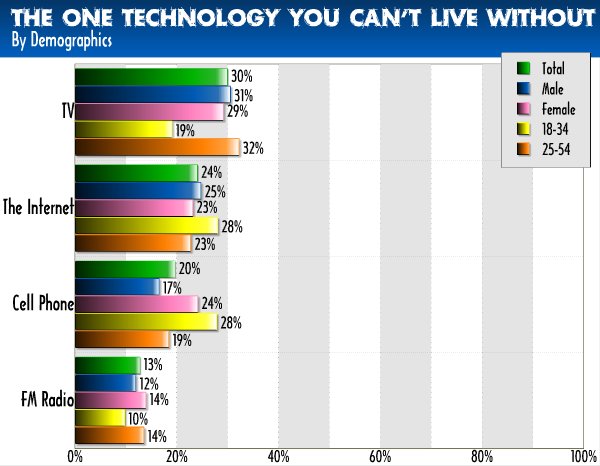
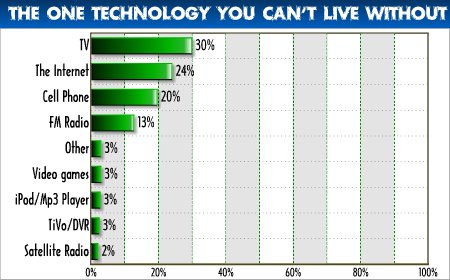
«If you had a choice - if you had to live with just one device or technology - what would it be?  Would you choose the Internet?  Or TV?  Or your iPod?  Or FM Radio? That was the hypothetical question we posed to 25,000+ Rockers in this year's Technology Poll, and the winner may surprise you. Television came out on top - despite all the hype about new technology and how everything's changing.  It's a real tribute to how the TV networks (not to mention HBO, Showtime, etc.) have produced compelling, habit-forming programming.

Tech_cantlive_tots_07_450

Radio is still in the hunt, of course, powered mostly by its morning and personality-driven shows.  But we have a long way to go in the content department if we're going to remain vital and competitive with new - and old - media.»

fonte: Jacobs Media, The One Thing, 12/06/07

Mas entre os 18/34 a questão é bem diferente: 28% para a Internet, 19% para a televisão

Tech Survey III:

Queixas contra a rádio tradicional

«Let's face it -- radio stinks. It's 40 minutes of commercials, 10 minutes of annoying DJs looking to offend, and maybe 10 minutes of music. And in that 10 minutes, you're bound to hear the same five artists multiple times, and the music will generally be the most inoffensive pablum imaginable. DJs are corrupted by payola and stations are driven by the profit motive to turn as much time over to advertising as possible. This sorry state of affairs comes just as listeners have a broad array of new options -- satellite broadcasting, the iPod-driven culture of user-created playlists, and Internet radio stations like Pandora and Last.FM, raising real doubts about whether broadcast radio will be able to pull out of its slump and find its creative spark. (...)»

fonte: «Notes From The Future Of Radio», Martin H. Bosworth, ConsumerAffairs.Com, 15/06/07

NUmeros do podcasting

«According to research from The Diffusion Group, 11 percent of adult broadband users, or approximately 12 million U.S. consumers, listen to podcasts at least once per month. TDG’s report on new media predicts that by 2012 that number will grow to 24 percent of broadband users or 38.5 million people. It says that while podcasting continues to expand, two factors are keeping a lid on usage: podcasting is perceived as too complex for average consumers to use; and so they remain unaware of the quantity and quality of content available for consumption. Dale Gilliam III, director of primary research and author of the report, says this lack of understanding is due to the many ways in which pundits and marketers have used the term “podcast.”

Other findings: * Among those who listen to podcasts at least once a month, 68 percent use a portable device while 49 percent listen on a PC; * On average, users listen to 5.4 podcasts per month on a portable device and 4.7 on a PC; * On average, those who subscribe to podcast services are signed up for 4.1 different feeds; and 70 percent of users rely on iTunes to access podcasts.»

fonte: «TDG: Podcasting Audience Growing, Medium Poorly Defined by Marketers », RWOnline, 15/06/07

Músicos querem ir buscar receitas às rádios (EUA)

«Another group has formed to represent the rights of artists in the digital music rights fight to get music royalties compensation from radio. A partnership of artists and music industry organizations launched musicFIRST, for “Fairness in Radio Starting Today.” This coalition is asking that performers - aspiring and local artists, background singers and stars - be compensated when their music is broadcast over the air. Some 100 recording artists, including Martha Reeves, Jimmy Buffett, Celine Dion, The Doors, Earth, Wind & Fire, Patti LaBelle and Mary Wilson, have signed on as founding members. Radio does pay royalties to ASCAP, BMI and SESAC, groups that distribute compensation to artists, but music labels have been fighting for higher rates from radio. The RIAA and SoundExchange are among 11 music industry organizations that belong to the new coalition. “Of all the ways we listen to music, ‘Corporate Radio’ is the only medium that refuses to pay performers even a fraction of a penny for their voice and creativity,” stated Mark Kadesh, executive director of musicFIRST. “This campaign is about making sure everyone, from up-and-coming artists to our favorites from years-ago, is guaranteed fair treatment when their music is played.” The new group is lobbying Congress, along with the RIAA, to support legislation to levy digital performance rights royalties on radio. NAB calls it a performance tax. NAB, CEA, other interested parties and the RIAA have been in talks to try to develop a non-legislated solution. In hearings on the digital performance rights issue, lawmakers have said they prefer that industry solve the issue without government intervention»

fonte. «New Group Formed by Artists, Labels; Bashes ‘Corporate Radio’ », 15/06/07, RWOnline

A industria já respondeu:

«In response to the formation of the advocacy group musicFIRST Coalition, NAB said it will continue to aggressively fight the RIAA’s proposed performance “tax” on local radio stations. “Congress has long recognized that radio airplay of music generates millions of dollars in revenue for record labels and artists,” said NAB Executive Vice President Dennis Wharton in a statement. “Were it not for radio’s free promotional airplay of music on stations all over America, most successful recording artists would still be playing in a garage.” Additionally, NAB referenced a radio commercial that aired in 2005 as part of an NAB campaign promoting radio. In it, John Legend, then an up-and-coming new artist, praised and thanked a radio station in Chicago for giving him his big break.»

fonte: «NAB to musicFirst: ‘If It Weren’t for Radio, You’d Still Be in the Garage.’ RWOnline, 15/06/07 

a opinião de Mark Ramsey: «As I have long argued, it is inevitable that the music biz would come knocking on radio's door for a bigger piece of their pie - because in an age when its consumers would rather steal than buy, the only thing a suffering industry can do is hold out their palm to the legitimate industries which license their content and can't hide in the P2P jungles of the Internet. And, for one, that means radio. Now I'm not saying we shouldn't necessarily pay more for the privilege of creating immensely profitable hits for an industry which couldn't possibly create them without us. Maybe we should pay more for that service. Then again, this is an age when a hit is more important than ever but even scarcer than it used to be. And when something is both more important and more scarce its value goes up. That makes radio's promotion MORE valuable to the labels now, not less. And that, my friends, means our industry may be paying too much.» (It's Time to Reduce Radio's Music Rights Fees, 14/06/07)

O segundo choque é isto

«(...) Confronted by a slow erosion of listeners who are turning to iPods, podcasts and other sources for entertainment, the radio corporations are trying to merge their over-the-air music and D.J. chatter with the Web, adding online streams of their broadcasts and features already found on many independent Web-based stations. These include live chat rooms, blogs and MySpace-style social networking features.

Late last month, CBS said it had paid $280 million to acquire Last FM (last.fm), a popular Web radio service where listeners can customize stations based on their personal taste, and also explore other users’ playlists. And Clear Channel, the biggest radio corporation, with a stable of more than 800 stations, has built miniature social networks into the Web sites of Hot 99.5 (hot995.com) and 7 other pop-music stations in major markets in the latest step in an ambitious digital initiative (...).

Broadcast radio still commands a massive audience: An estimated 230 million people tune in each week. The trick for the big radio corporations, though, is that pursuing listeners online may mean developing a wholly different approach to programming. Many Internet-based stations say their medium allows them to offer an abundance of genres far outside the boundaries of traditional over-the-air music stations, often with playlists that can be tailored to the taste of the individual listener. Pandora (pandora.com), one of the most popular Internet radio services with roughly seven million users, creates personalized stations based on the characteristics of users’ favorite songs. Live 365 (live365.com), which says it has four million listeners a month, is a searchable portal to thousands of tiny stations playing genres ranging from neo-soul to Christian blues. Given the proliferation of wireless Internet access, many of the fledgling radio services hope that fans will soon be able to flip on an online radio stream while driving to work instead of tuning into the local morning radio D.J. “It’s just a matter of time before you can get Internet streams wherever you are,” said Tim Westergren, a co-founder of Pandora.

Broadcast radio still commands a massive audience: An estimated 230 million people tune in each week. The trick for the big radio corporations, though, is that pursuing listeners online may mean developing a wholly different approach to programming.

Many Internet-based stations say their medium allows them to offer an abundance of genres far outside the boundaries of traditional over-the-air music stations, often with playlists that can be tailored to the taste of the individual listener. Pandora (pandora.com), one of the most popular Internet radio services with roughly seven million users, creates personalized stations based on the characteristics of users’ favorite songs. Live 365 (live365.com), which says it has four million listeners a month, is a searchable portal to thousands of tiny stations playing genres ranging from neo-soul to Christian blues.

Given the proliferation of wireless Internet access, many of the fledgling radio services hope that fans will soon be able to flip on an online radio stream while driving to work instead of tuning into the local morning radio D.J. “It’s just a matter of time before you can get Internet streams wherever you are,” said Tim Westergren, a co-founder of Pandora»

fonte: «Big Radio Makes a Grab for Internet Listeners»; The New York Times, JEFF LEEDS, Published: June 12, 2007

Mudança no método de medição dá aumento de audiências (EUA)

«Internet listening to AM/FM radio stations grew substantially in the last reporting period from Arbitron, going from 4,684 quarter hours in the spring of 2006 to 20,331 quarter hours in the fall of 2006.

The increase in quarter hours coincides with the implementation of new diary instructions, effective in the fall of 2006, that identify internet and satellite radio as sources of listening for respondents to note in their diaries in addition to AM/FM radio, according to Arbitron.
Sixty-six percent of the quarter-hours that included an internet identifier for an AM/FM station identified a local station. Seventy-eight percent of these diaries that contained listening to the internet streams of local stations also contained listening to the over-the-air version of the station.

Despite the growth in internet listening, listening to AM/FM radio stations online still accounts for less than 1 percent of un-weighted quarter-hours overall in the 30 analyzed markets (from 0.11 percent in spring 2006 to 0.47 percent in fall 2006).»

fonte: Internet Listening to AM/FM Radio Stations Soars in Fall 2006 Media buyer planner, 11/06/07

DAB e iPod convergem (à margem da Apple)

«Ipod owners in the UK will soon be able to tune in to digital and analog broadcasts, thanks to a new plug-in accessory developed through a joint effort by Frontier Silicon and Roberts Radio.

The first of-its-kind device, measuring 52.4mm x 32.0mm x 8.1mm, Frontier Silicon's Kino 2 DAB IC connects directly to a users Ipod, enabling users to listen to DAB or analog FM radio. It also offers remote control functionality to play, pause, fast-forward or rewind stored music files. Roberts plans to launch the product in October 2007 at an MSRP of about $100 US

O video não é uma ameaça, é uma oportunidade...

diz Fred Jacobs:

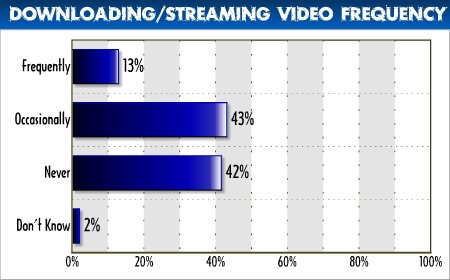
«The video revolution is underway, led in large part by YouTube.  While most people focus on its sale to Google for $1.65 billion, consider this:  YouTube didn't even exist until February 2005.  This reinforces the amazing potential of web-based business concepts, as well as the meteoric rise of streaming video. This year's version of the Jacobs Media Tech Poll reinforces the video phenomenon among Rock Radio listeners.  (Consider that we didn't even ask about video streaming until this year's poll.)The data shows the rising tide for video streaming, as over half our respondents download/stream video on a frequent or occasional basis.  Of them, nearly three-fourths visit YouTube.

Stream_video_freq_07_blog

Of course, this has implications for radio, a world in which pictures have traditionally not existed.  But today, listeners expect to see video.  Video is everywhere, from flat-screen TVs to phones to iPods to elevators. Radio's ability to turn that corner and provide cool video of a morning show stunt, the "Rock Girl" competition, the backstage scene from concerts, or as a way to recap a great event are all new applications that can breathe life into terrestrial radio, its personalities and its communities.  But most stations don't have a webcam, can't post simple video to their websites, and often lack a person in the building with rudimentary editing skills.  (After watching my 15 year-old son and his friend edit a 5-minute video on iMovie the other night, it dawned on me that these are not skills that require a high level of tech knowledge.)» (fonte: «Video Helped The Radio Star», Jacobs Media, 7/06/07)

Video isn't a threat to radio - it's an opportunity.

«os ouvintes serão gradualmente os seus próprios programadores»

A propósito das funções/capacidades do iPhone, escreve Mark Ramsey:

«While the new iPhone does not literally contain a radio, it functions like an iPod (among many other things) and can thus fulfill that part of you that wants your tunes in a groovy cross-category package, albeit one with a $600 entry fee. Just as we are seeing more music consumers choose the singles they want (digitally) rather than the ones they don't want (by buying CD's), we will increasingly see those same consumers demand control over their passive music environment (i.e., radio) as well. Not by seeking out more choices but by controlling the nitty gritty of the choices they have. Actively or passively, listeners will gradually become their own programmers.When it comes to music, future radio will have to be much more responsive to the individual than to the collective. Closer to an iPod than a theyPod.»

eBay e Googe a vender anúncios de rádio

«The jury may be out on Google's attempt to sell radio advertising, but that didn't stop eBay from joining the business last week, through a pact with Bid4Spots. The company sells last-minute radio inventory through weekly online auctions for about 2,300 radio stations.
"This deal is intended to pump more ad dollars into our system," said Dave Newmark, chairman, CEO and founder of Bid4Spots, which does between $50,000 and $250,000 of business a week.
So far, radio stations—particularly big-market outlets—have been cautious about handing over inventory to Web auction systems. But Google got some traction in April, when it signed a long-term deal with Clear Channel (which has also used Bid4Spots) for 5 percent of the inventory on 675 stations.
While Google and eBay broaden the radio marketplace by making it easier for smaller agencies and advertisers (many of which rarely or never use radio) to do business, larger agencies find little use for the two online giants. "Our clients want more control," said Maribeth Papuga, senior vp and director of local broadcast for MediaVest. "We have to know what we're buying and the systems don't go deep enough in markets or have enough inventory." (fonte: Katy Bachman «EBay Dives Headfirst Into Radio Ad-Selling Pool, Mediaweek.com, JUNE 11, 2007)

«O eBay, maior site de leilões virtuais dos Estados Unidos, está ingressando no mercado de anúncios para rádio, tornando-se negociador de inserções comerciais no meio e um competidor do Google, qua já provê um serviço similar.
O novo serviço estréia na quarta-feira (06/06), dentro do eBay Media Marketplace, disse a companhia em um comunicado na terça-feira.
O serviço de agenciamento de anúncios de rádio será provido pela Bid4Spots. Tanto anunciantes quanto agências de publicidade já podem se registrar no site do eBay Media Marketplace. Por meio da plataforma, o anunciante terá acesso ao inventário de mais de 2,3 mil estações de rádio.
A exemplo do Google, o eBay vai usar a internet para tentar melhorar a forma como os anúncios são comprados e vendidos e a maneira como as campanhas são monitoradas e analisadas. Executivos do Google disseram repetidas vezes que a empresa está confiante de que pode usar a tecnologia da internet para melhorar as transações de anúncios offline, não só no rádio, mas na mídia impressa e na TV também.
O eBay Media Marketplace também tem um sistema para comercialização de anúncios em TV a cabo, mas é voltado para grandes anunciantes fazerem compras planejadas. Este serviço ainda não se tornou muito popular.
O serviço de rádio, por outro lado, oferece maior flexibilidade para que os anunciantes façam inserções de “último minuto”, disse o eBay, o que também pode levar as emissoras a oferecerem preços mais agressivos
»

Internet: A diferença fundamental entre pais e filhos

«If analysts are taken aback by the rapid growth of Internet usage among, adults, that incidence pales in comparison to the proportion of teenagers who use the Net- currently some 91 percent! Teenagers also go online more frequently than do adults, and tend to stay online for longer periods of time. If the Net is just becoming a comfortable addendum to the adult media world, it has already become an indispensable focal point of the teenagers' world of communications. It is relied Upon for self-expression, information and entertainment» (Barna, 2001: 32) 


A música continua a ser muito importante para os jovens; e isso é importante para a rádio

«Music remains one of the seminal influences in the lives of young people, though we also discovered that less than one out of flve teens lits that music impacts their thinking or behavior. The » (Barna, 2001: 104) 


BARNA, George (2001). Real teens. Ventura (CA): Regal Books

Para além da legimitação empírica da Internet

A Internet não precisa de ser legitimada cientificamente, dirão, porque todos nós sabemos que a usamos.

Mas há dados que mostram que a Internet não é como ver televisão ou ouvir rádio. «Num estudo efectuado em 2002/ a Datamonitor, uma multinacional especializada em estudos de mercado e líder na disponibilização de informação onine, apurou que a Internet demorou menos de dez anos até ser utilizada por cinquena milhões de indivíduos, enquanto a televisão precisou de aproximadamente quinze anos e o rádio cerca de quarenta». (Chaves et al., 2007: 29)

Música sem DRM na iTunes

«CUPERTINO, California—April 2, 2007—Apple® today announced that EMI Music’s entire digital catalog of music will be available for purchase DRM-free (without digital rights management) from the iTunes® Store (www.itunes.com) worldwide in May. DRM-free tracks from EMI will be offered at higher quality 256 kbps AAC encoding, resulting in audio quality indistinguishable from the original recording, for just $1.29 per song. In addition, iTunes customers will be able to easily upgrade their entire library of all previously purchased EMI content to the higher quality DRM-free versions for just 30 cents a song. iTunes will continue to offer its entire catalog, currently over five million songs, in the same versions as today—128 kbps AAC encoding with DRM—at the same price of 99 cents per song, alongside DRM-free higher quality versions when available. ler mais em http://www.apple.com/pr/library/2007/04/02itunes.html»

O iPod-killer? Da Creative

É da Creative (linha Zen),  custa metade do preço de um iPod Shuffle e baseia-se na ideia da «escolha aleatória»

«Creative Zen Stone é o que poderíamos chamar de iPod shuffle reprodutor MP3 e WMA sem tela. Segundo palavras da própria Creative "deixe-se surpreender pela canção que virá depois" com o seu modo aleatório.
Com uma capacidade de 1GB o Zen Stone não trousse nada de novo, a não ser seus cantos mais arredondados e a variedade de cores.
O Zen Stone armazena 500 faixas de 4 minutos com codificação WMA a 64kbps e sua bateria dá uma autonomia de 10 horas contra 12 do iPod shuffle
»


Esforços na GB para valorizar o streaming

«The RadioCentre Player features 12 preset stations, including the national services, Classic, Virgin and TalkSport; other big stations such as Heart and Capital, and a few smaller regionals from Channel 103 FM to Lincs FM. The selection of the preset list is not based on audience or any other consumer measure but on who sits around the RadioCentre board table, hence the bizarre mix.

Putting such political nonsense to one side, the player gives access to every single station in the UK, either in an alphabetical format or by group ownership basis. This means that you can listen live, in real time, for free, to any station in Britain. Whether you are a record plugger wanting to assess a music format (or, more importantly, find out whether a station really is playing your artist's song), or a media buyer checking out the target audience, this is a brilliant tool. It is quick - almost every station buffers and streams live in less than 10 seconds - and there are fewer clicks than going on to the BBC website to "listen again".

This brings me to the BBC, and where some commercial radio executives start to get uneasy. The player features a "search" button, which brings up all of the BBC's national, regional and local stations (http://www.bbc.co.uk/imp/). So imagine if you are tuned to Magic, and the breakfast presenter Neil Fox promotes the RadioCentre Player URL. Listeners are instantly transported to a place where not only can they hear all of Magic's commercial rivals, but the BBC as well. Chris Moyles is just three clicks away.» (http://media.guardian.co.uk/mediaguardian/story/0,,2094429,00.html)

fonte: «This is the future of radio - and new music», On An Overgrown Path, 08/06/07 

Peter Gabriel e o futuro da música: grátis e com publicidade

«Parece que a moda pegou. Depois do SpiralFrog e do Qtrax é agora a vez de Peter Gabriel lançar o We7, outro serviço de música online baseado em publicidade que oferece downloads gratuitos de ficheiros MP3 sem DRM (via The Register). Cada faixa irá incluir no início um anúncio com a duração de 10 ou menos segundos, sendo o lucro gerado distribuído entre os artistas. As músicas deverão ter um bit rate de 192 Kbps. Os anunciantes deverão pagar entre 0,30 a 0,60 libras (44 a 88 cêntimos de euro, respectivamente) e o utilizador pode ver-se livre do anúncio depois de entre três a cinco audições - se bem que no site apenas se mencione que existe a possibilidade de remover a mensagem publicitária quatro semanas depois de se ter escutado a faixa pela primeira vez; não se sabe é se se terá que pagar alguma coisa em troca…»

fonte: «We7 de Peter Gabriel oferece música com publicidade », Remixtures.com, 01/05/07

O telefone será o receptor rádio de amanhã

Mark Ramsey: «the mobile phone of today will, in some meaningful sense, be the portable radio of tomorrow»

Como será a rádio em 2015 na Europa?

Conclusões de um estudo envolvendo 40 especialistas do Canadá, Dinamarca, Finlândia, Irlanda e Grã-Bretanha:

- most Europeans would have digital terrestrial radio. The DRACE report says DAB will be a strong option in the UK and Denmark, but supplemented with Digital Radio Mondiale (DRM) and DMB; DAB is “an expensive and uneconomic system.”; Nevertheless, by 2015, Finns are likely to be using the DVB-H technology developed by Nokia, while Canadians will have IBOC, DAB and satellite radio 

-  TV-style digital switchover for radio is very unlikely. They also predict that given existing market penetration, FM radio will continue to play a significant role in both Europe and Canada.

- most respondents predict there will be distinct national solutions. Differences in national regulation and frequency administration will fragment the digital radio landscape.

- there will be an increase in personalized and on-demand radio, with more listener sovereignty, personalization options and the gradual disappearance of schedules. Radio will be available when and where listeners want it.

- traditional broadcast radio will continue to play an important role in people’s lives. This is attributed to the strengths of linear radio, including mobility, ease of access and localism, as well as powerful journalistic and artistic content.

(excertos deste texto: «DRC07: radio in 2015», Multimedia meets radio, Mike Mullane on 04 June 2007)