Blogia

Transistor kills the radio star?

A chave são os conteúdos

«There's a lesson here, and we've written about it before:  content is everything, and distribution is secondary.  Whether it's HD Radio, satellite radio, or anything else, it's all about the content» FRed Jacobs, in «A Positive Story About Radio», 17/08/07 (Jacoblog)

HD chega à Alemanha

«Network operator Media & Broadcast of T-System and one of Germany’s private stations plan to begin HD Radio field tests, including two multicast channels, at the end of this month.

Radio Regenbogen is in the Rhine-Nectar area of Germany.

Helping to support the tests are: Ibiquity Digital, audio expert Georg Neumann, Orban/CRL Systems, Broadcast Electronics and Ruoss AG, which is also assisting with HD-R tests in Switzerland.

Initial test results are to be revealed at a communications event in Stuttgart on Sept. 27»

fonte: «German HD Radio Field Test Slated to Begin in August», RW on line, 8.17.2007 

«45% dos novos telemóveis já tocam música»

«That's up 11% from the first quarter according to NDP Group. The explosion of music-on-mobile phones has implications for radio, which is increasingly developing cell strategies for both programming and strategy. Also of note - NDP says 11% of new mobiles are smartphones, which is the kind Ipsos and The Media Audit intend to use for a ratings service.»

fonte: newsletter Inside Radio, «45% of new cell phones play music», 15/08/07; ou «Forty-five percent of new phones were able to play music in the second quarter of 2007 (up 11 percent, since the prior quarter)»

A banda larga ainda não chega?

«Vários operadores de Internet de banda larga do Reino Unido estão a criticar o iPlayer da BBC, serviço que permite realizar o download de programas da estação, devido aos elevados custos inerentes ao streaming de vídeos on-line. De acordo com o Independent as operadoras estão preocupadas com o possível estrangulamento das suas redes por causa de centenas de milhares de cibernautas que querem ver os programas da BBC no iPlayer. Estas já ameaçaram que podem limitar a largura de banda da estação caso não contribua com os custos, o que como consequência diminuiria também o tráfego on-line disponível para a utilização do iPlayer. Para um porta-voz da Tiscali «o potencial que o iPlayer tem para sugar a banda larga é uma preocupação e temos de ter um melhor dialogo com a BBC sobre isso». Tal como o serviço de áudio «Listen Again», que permite ouvir programas de rádio emitidos pela BBC Radio até sete dias antes, o iPlayer vai permitir a quem faça o download do serviço aceder a conteúdos televisivos que passaram nos últimos sete dias. Estes conteúdos ficam depois disponíveis até 30 dias após download e podem ser vistos durante sete dias a contar da primeira visualização. O iPlayer entrou em fase Beta no passado dia 27 de Julho e deverá estar completamente funcional durante os próximos meses.»

fonte: «Operadores de banda larga contra iPlayer» Sol, 15/08/07

Rádio tradicional pode perder 8,5 % dos ouvintes até 2010 (Canadá)

« (...) In Canada, the Canadian Association of Broadcasters and the Canadian Radio-Television and Telecommunications Commission are seeking smart ways to work with new media. The CAB…

…believes that traditional radio could lose between 4.9 and 8.5 per cent of its listeners by 2010, with revenue losses of between $13 million and $39 million.

The CRTC has said that the rapid changes in digital technologies and distribution of media – such as music and other programming have “presented the radio industry with new opportunities, but also new challenges.”

It cited satellite radio, file-sharing and downloading, podcasting and audio streaming on the internet as “new and more flexible alternatives to the traditional practices of purchasing recorded music and listening to radio broadcasting.” »

fonte: «Radio Killed The Radio Star, Part One» March 20, 2006, Medialoper

Mais sobre esta previsão:

«New technologies like satellite radio and digital players are changing the traditional radio landscape and the industry says it wants help from the CRTC to survive. The Canadian Radio-television and Telecommunications Commission had called for submissions that would be considered in its current review of the country's commercial radio policy. (...) "We no longer have one single and regulated system of radio services delivered over the public airwaves and free of charge to Canadians. Instead, we have both a regulated system of the past and a largely unregulated, parallel system of new delivery platforms for audio content," the CAB said. Canadian private radio is confronted with an unheard-of array of competition for listeners and for revenues." The existence of these new competitors does not necessarily mean that more regulation is required from the CRTC, the group said, "but rather that smarter and more effective regulation needs to be designed." The group believes that traditional radio could lose between 4.9 and 8.5 per cent of its listeners by 2010, with revenue losses of between $13 million and $39 million. The CRTC has said that the rapid changes in digital technologies and distribution of media – such as music and other programming– have "presented the radio industry with new opportunities, but also new challenges." It cited satellite radio, file-sharing and downloading, podcasting and audio streaming on the internet as "new and more flexible alternatives to the traditional practices of purchasing recorded music and listening to radio broadcasting."»

(fonte: Radio group calls for 'smarter, more effective' CRTC policy», CBC.ca, March 16, 2006 )

É a indústria musical que está a travar o crescimento do audio online

«(...) Smokler noted that when Pandora was launched, he wrote a long, cranky letter to Tim Westergren because the service didn’t do what he wanted it to do. For example, the licenses allow the listener (like me) to only skip a certain number of songs per hour. So I need to sit through a bunch of stuff I don’t want to hear because of legal limitations. If I just wanted to browse without listening, well, the limit in skips prohibits that. I’m not likely to go back in a hour to see what songs I might like if I like the song “Beyond Belief”.

Westergren responded by saying that licensing structures create inherent limitations in the service he can provide to his customers. Nordling commented that these restrictions affect her ability to respond to listener requests – she can’t even play a requested song until 20 minutes after the request is made (stations are also limited the number of songs they can play in a row by an artist and pre-announcing songs). These restrictions turn away listeners; if the music industry were serious about their business, the last thing in the world they’d want to do is send consumers running.

Both agreed that one key problem facing their industries is the DMCA. Designed to protect copyright holders, the act also limits new media’s ability to interact with customers. The DMCA states that delivery services can’t replace commerce, despite the fact, as Westergren noted, Soma and Pandora lead to commerce. Because labels continue to wallow in the notion of “hits” and slotting, they are in actuality limiting artist exposure.

(...)

A key aspect limiting online music services is cost. Sound Exchange, which collects fees for the RIAA takes approximately 12% of every dollar earned by stations like Soma; the fees are 14% for music delivered via satellite. Sound Exchange is lobbying Congress to increase this amount to 37% of receipts. Just for the privilege of playing a song on the newfangled version of the radio. While presumably this benefits artists in some way, it also kills innovation

It should be noted that these fees are not imposed on traditional radio, to quote Station Manager Ken Friedman of WFMU,

Broadcast stations have never been asked to pay this performance royalty. (On the contrary, record labels have traditionally lobbied, bribed and paid radio stations to play their records. Believe it or not, many stations will now be charged for webcasting the same songs they are paid to play over the airwaves.)

fonte: «Radio Killed The Radio Star, Part One» March 20, 2006, Medialoper; e «Radio Killed The Radio Star, Part Two», 22/03/06, Medialoper 

SANTOS, José Rodrigues dos, Comunicação, Lisboa: Prefácio, 2001

O novo modelo representa o fim de um paradigma

A rádio convencional, sobretudo musical, é estruturada de forma a que - por muito que se ouçam declarações de intenções dos realizadores - o ouvinte seja um consumidor passivo. Existiam formas de convocar a participação dos ouvintes (até como forma de procurar saber de que é que eles gostam...) mas sempre minoritárias (ainda que, em mercados competetivos, haja rádios que testam previamente as suas escolhas). No fundo, a rádio convencional estrutura-se assente em dois conceitos das teorias da comunicação, muito antes das teorias da comunicação se dedicarem a estudar estes fenómenos: há um gatekeeper (o director de programas, o autor da playlist, o autor do programa) que define, de acordo com critérios variados, um agenda setting: esta passa, esta não passa; esta presta, esta não presta; esta enquadra-se no espírito da rádio ou do programa, esta não se enquadra. A rádio, ouviu-se muitas vezes a acusação, por causa deste agenda-setting, é ela própria um «problema de representação do real» (SANTOS, 2001: 114)

A digitalização, ao oferecer um conjunto de ferramentas de interactividade, acaba com esta ideia de produto previamente concebido por um e dirigida a muitos. Os ouvintes afinal têm poder, e não é apenas o poder de ajudarem a escolher as músicas que passam na rádio; é o poder de escolherem efectivamente o que estão a ouvir - LastfM ou PAndora, por exemplo.

E não é só a rádio que está em perda de audiências

(da edição de hoje da newsletter Inside Radio, reservada a assinantes):

«Radio's declining time spent listening is just the tip of the iceberg. Consumer media usage declined last year following two consecutive years of decelerating growth. Veronis Suhler Stevenson says the drop is because of changing consumer behaviors and digital media efficiencies which require less time investment»

fonte: «Media usage dips for the first time in a decade», Inside Radio, 14/08/07

Mais:

«For the first time since 1997, consumers spent less time with media in 2006 than they did the previous year, as media usage per person declined 0.5% to 3,530 hours, due to changing consumer behaviors and digital media efficiencies, according to the VSS Forecast. The drop in consumer media usage was driven by the continued migration of consumers to digital alternatives for news, information and entertainment, which require less time investment than their traditional media counterparts. For example, consumers typically watch broadcast or cable television at least 30 minutes per session while they spend as little as five to seven minutes viewing consumer-generated video clips online.  VSS expects consumer media usage to stabilize in 2007 and increase slightly through 2011, as out-of-home media and videogames will be the only major segments to achieve accelerating growth in the forecast period compared with the 2001-2006 timeframe. Overall consumer time spent with media will increase at a CAGR of 0.5% from 2006 to 2011, compared with 0.8% in the previous five-year period. The VSS Forecast is the only source to track, analyze and forecast spending, usage and trends in all 19 segments and more than 100 sub-segments of the U.S. media industry. The VSS Forecast also features the industry’s most accurate spending forecasts, producing a margin of error of +/- 2% for 9 of the last 10 years. The margin of error for the 2006 forecasts was + 0.4%. In addition to shifting their attention to alternative media, consumers are also migrating away from advertising-supported media, such as broadcast TV and newspapers, to consumer-supported platforms, such as cable TV and videogames. Time spent with consumer-supported media grew at a CAGR of 19.8 percent from 2001 to 2006, while time spent with ad-supported media declined 6.3 percent in the period» (fonte: «New VSS Forecast Released», VSS, 7/08/07)


Mais do multitasking

«Young people are so used to multitasking they can't imagine life any other way. They visit with their friends while they download music, check MySpace and text message other friends who are visiting with friends, downloading music and checking MySpace. It makes us old folks wonder if they are truly doing any of those things. Or perhaps what they are doing is something we don't have a word for yet. The compilation of those activities creates a new activity.»

fonte: «Multitasking in a 'right now' kind of world», InsideBayArea.com, 12/08/2007

Rádio? Áudio! (mais)

A propósito de um relatório da indústria publicitária norte-americana, Mark Ramsey lembra que ou a rádio convencional percebe que há uma mudança em curso ou outros farão isso por ela. Com óbvios custos. A rádio deixa de ser rádio e passa a ser a indústria do áudio.

(«In a new report being circulated to clients, MediaVest has adopted the position that terrestrial broadcast radio should no longer be looked at as a discrete medium in communications plans, but as part of a greater array of audio media--including satellite, online, mobile and a variety of personal media device technologies, such as iPods, other MP3 players, and even television, which increasingly is being used as an audio-only medium)

In my two-year-old book Fresh Air, I noted that radio was no longer "radio" but was now the "audio entertainment and information industry." It's critical for all broadcasters to get their heads around this notion because the definition of your industry determines everything about your strategy and everything about your fate.

Under a definition of radio as "audio entertainment and information" the channel by which content reaches the consumer is considerably less important than the nature of the content itself and how that content is leveraged and magnified across channels. It's the ownership and licensing of the content, not the ownership of the channel, that will make tomorrow's "audio" stars.»

fonte: «"Radio" is now "Audio" says the Ad Industry», Hear2.0, 13/08/07

Do relatório:

«(...) MediaVest's new approach to audio planning is part of a growing industry shift away from defining media based on their distribution platforms and toward understanding how consumers interact with the essential nature of their content and formats. That argument is at the heart of "StrADegy: Advertising In The Digital Age," authored by TNS Media Intelligence President-CEO Steven Fredericks. In it, he argues that in the future, "Content is defined not by its old media name, but by its core property: text, video and audio. All content, clarified and freed, can be distributed via any converged technology." In terms of audio, MediaVest seems to think we are already there. In fact, the "single source audio study" looks at how people are using audio devices like iPods to watch video, and how they are using television to listen to audio. The important thing, the agency concludes, is to understand why people are using new technologies and where they are using them. That opens new opportunities to connect people with audio content.» (fonte: «Audio Kills The Radio Noir, Agency Broadly Redefines Medium», Media Daily News, Joe Mandese, Monday, Aug 13, 2007) 

O consumo de vídeo(s) vai generalizar-se (EUA)

«Television networks, film studios, independent content owners, Web portals, social media sites, technology providers, online stores, brand marketers and consumers are all joining the Internet video revolution. They are changing the way digital content is created, distributed, consumed and monetized. (...) Some players are fearful that the widespread availability of video content on the Internet will threaten the TV and film industries. Others see the potential to increase revenues through a variety of business models, including ad-supported streaming, pay-to-own downloads, subscription services and online rentals as a boon.

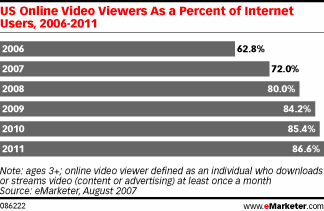
eMarketer projects that by 2011, 86.6% of the US Internet population will consume online video, up from 62.8% in 2006.

In raw numbers, that means the number of viewers will rise from 114 million in 2006 to 183 million in 2011.

US Online Video Viewers As a Percent of Internet Users, 2006-2011

Fonte: «Online Video: Making Content Pay», eMarketer, 14/08/07

Consumo de meios em simultâneo (multitasking)

«Researchers estimate that 25-30% of total media time is spent multitasking, and the more media a person consumes, the more likely they will consume several channels at once. Why should marketers care? Because multitasking has a profound impact on consumers' ability to absorb and remember ad messages. (...) However, as more media floods into consumers' lives, they are finding ways to make room for them. Multitasking is a necessity. As a result, for marketers, "breaking through" to consumers is more difficult than ever. (...)

Key questions the "Multitasking Consumers" report answers:

  • How often do teens and adults use two or more media simultaneously?
  • Which media are most often consumed simultaneously?
  • How is multitasking affecting TV networks and online video sites?
  • Are consumers still engaged with media and advertising when they're multitasking? »
  • Fonte: «Multitasking Consumers: Distracted or Connected?» eMarketer, Janeiro 2007

Em 2020 a rádio na Internet terá a mesma publicidade da rádio hertziana (hoje; EUA)

«In the following media growth projections, Bridge Ratings estimates based on current trends that Internet radio will have 180 million listeners by 2020, 250 million will still be listening to terrestrial radio, but HD will have less than 10 million. Which will contribute more to radio's financial future?

According to John Blackledge analyst with JP Morgan, Internet radio advertising is estimated at $500M this year (2007). Bridge Ratings estimates that by 2020 Internet radio is projected to generate revenues equal those terrestrial radio acheived in 2006. Traditional radio companies are finding insufficient resources for the type of development of new media content and strategies needed to transition with its future audiences who today are between 10 and 24 years of age. With Internet advertising set to surpass that of traditional radio by the beginning of 2008 and Internet radio advertising growing alongside, traditional radio companies should see the benefit of fully developing compelling Internet radio content and highly trained sales forces»

fonte: «HD Radio vs. Internet Radio - Which is Radio's Future?», Bridge Ratings, 8/08/07 

Bareme Rádio vai incluir telemóveis e internet!!!

«A Marktest está a preparar a reformulação da metodologia de medição dos dados de audiências de rádio e imprensa. "Estamos a fazer testes e a ultimar a metodologia de recolha de dados de modo a incluir a rede móvel e o online", adianta ao M&P Jorge Fonseca Ferreira, director comercial da Marktest. A empresa de estudos de mercado responsável pelo Bareme Imprensa e o de Rádio conta apresentar a nova metodologia de recolha de dados (cuja a amostra além da rede fixa irá incluir a rede móvel e o online) entre Outubro e Novembro à Comissão de Análise de Estudos de Meios (CAEM), segundo adianta o responsável da Marktest. Se a entidade que valida estes estudos aprovar a proposta da Marktest a empresa, afirma Jorge Ferreira, terá como timing de implementação Janeiro do próximo ano, sendo que a partir dessa data os Bareme de Rádio e o de Imprensa vão já incluir a nova forma de medição de audiências

fonte: «Baremes vão incluir amostra de telemóveis e online», Meios e Publicidade, 10 de Agosto de 2007, por Ana Marcela

«Os jovens portugueses, hoje»

Via Marktest:

- Segundo os dados do INE disponíveis no sistema de informação Sales Index da Marktest, residiam em 2005, em Portugal, 1 293 031 jovens entre os 15 e os 24 anos, um valor que representa 12.2% dos efectivos nacionais. O peso dos jovens na estrutura demográfica do país tem decrescido na última década: em 1996 representavam 15.9% da população residente em Portugal Continental, mais 28% do que em 2005.

- Uma análise do perfil dos jovens entre os 15 e os 24 anos com base em dados exclusivos da Marktest e MediaMonitor, revela-nos um grupo de indivíduos com ocupação maioritariamente de estudante e adeptos das novas tecnologias: 98.8% utiliza telemóvel e têm consumos importantes de Internet. Uma grande percentagem, 94.9%, costuma ouvir música e 93.1% utiliza computador. 

- Distinguem-se da média do Universo na posse de conta jovem e na utilização da internet para fazer download de jogos, filmes ou músicas, onde registam valores muito acima da média do universo. Têm também hábitos diferenciadores na ida ao futebol, na frequência de discotecas, ida ao cinema ou hábito de jogar computador ou consola.

- Quanto à audiência de meios, vêem menos televisão do que a média, mas ouvem mais rádio, sobretudo durante a tarde e noite. Na internet, lideram, com consumos acima da média do universo.

fonte: Os jovens portugueses, hoje, 10/08/07 e «Os jovens portugueses, hoje (II)», 10/08/07


Rádio? «Audio Entertainment»!

«Radio One this week named Barry Mayo president of its radio division. (...) In the announcement, Mayo stated: “We are no longer in the radio business, we are in the ‘audio entertainment business’ and we need to leverage our products well beyond the terrestrial signals we are licensed to operate.” (...) Liggins said then, “Our diversification into a broad-based media company consisting of radio, cable, Internet and print is beginning to coalesce, as we continue to identify new and myriad ways to satisfy our advertiser client base. This transition from a pure-play radio company to a media company is longer-term in nature, but I am confident that our team is up to the challenges and opportunities we have before us.” »

fonte: «Mayo: ‘We’re in Audio Entertainment, Not Radio’», Radioworld, 10/08/07

Como atrair gente para os sites (de rádio)?

Mark Ramsey responde:

«So many people ask me what they can do to attract more listeners to their websites. And the answer is to give listeners what they want that relates to your station that they can't get or do as a unified community in any other place

Ainda outra ideia: «Just because YouTube is hot, for example, doesn't mean YOURtube will be hot. Just because I can share photos on Flickr doesn't mean I'll want to share them on my favorite radio station's website. Economy of effort is part of the media economy, so your site will win my web traffic only because you invite it in a way that is unique to you and compelling to me»

O exemplo que inspira Ramsey: http://www.xponentialmusic.org/885/index.php

A TV substitui a rádio como divulgadora de novos artistas

A propósito dos sucessos de algumas serie de TV na divulgação de novos artistas, pode ler-se na Forbes:

«Radio can blame itself. While radio exposure remains essential for recording artists to notch platinum-plus sales, much of the FM dial remains mired in the nostalgia of classic rock and "Jack" programming formats or conservative playlists of new releases by mostly proven hitmakers. Those seeking musical discovery look elsewhere.

Meanwhile, the sharp decline in the sale of compact discs has pushed record labels and music publishers to seek new revenue sources and has left them more than happy to cooperate with TV shows looking to license their music. It's also helped that many recording artists have dropped their previous aversion to licensing their songs to movies, ad agencies and TV shows. They're no longer "selling out"--they're "gaming the system."»

fonte: «Video Kills The Radio Star (Again)», Forbes.com, Louis Hau, 07.13.07,

Rádio via satélite nos Fiat em Itália

«Fiat SpA unit Fiat Group Automobiles SpA and the Worldspace group signed a commercial agreement to distribute satellite radio services, according to a statement released late yesterday. Worldspace, the US satellite radio provider, plans to broadcast 40-50 satellite channels in Italy from end-2008, one of which will be exclusively dedicated to the network and clients of Fiat (nyse: FIA - news - people ) Group Automobiles, it said. From end-2009, Fiat will also offer to its clients the fitting of Worldspace radios on some of its Fiat, Alfa Romeo and Lancia models, as well as portable satellite radios, it added.»

fonte: Fiat, Worldspace in satellite radio deal, Forbes.com 07.19.07