Blogia

Transistor kills the radio star?

O consumo de «novos media» não é feito à custa dos «velhos» (estudo)

«(...) While young people, the 13-to-24 set, do in fact spend more time than older people on the internet and with even newer media such as text messaging, it's not at the expense of traditional media. Rather it comes on top of it, according to a new study by Deloitte & Touche, the management consulting firm. “The evidence tells us that TV usage is not down, it’s slightly up, and radio usage is about flat to slightly down,” says Anthony Kern, deputy managing principal of the technology, media and telecommunications practice at Deloitte. The study found that 48 percent of 13-24s visit a TV web site at least once a week. The one area of traditional media that is in fact suffering is newspapers, where readership among the young is in fact down. The Deloitte study was conducted online by Harrison Group, a research company, with more than 2,200 people. The findings are in line with those from other research in media usage.
A recent Magna Global analysis of Nielsen Media Research data found that TV viewing among kids 2-11 is flat to the same time last year for the broadcast season through mid-February, while viewing is down 1 percent among teens and 1 percent in the 12-34 demographic. By comparison, the percentage of adults 18-49 watching any form of TV on an average night is down 4 percent.  Moreover, radio listening is down slightly among young people but not much more than it is for other age groups. The average quarter-hour rating among teenagers last fall was an 8.7 compared to a 9.2 rating one year earlier, according to Arbitron. Among adults 18-24 the rating dipped to a 13 from a 13.6 rating. The average rating among adults during that time frame fell to a 14.7 from a 14.9 rating.

Among its others findings, Deloitte found that 71 percent of people 13-24--folks it calls Millennials-- still enjoy reading magazines, even though they know they can find the same information online. Of this group, 58 percent say they use magazines to find out what’s cool. “They prefer the [print] magazines because they are highly targeted and they are getting specific information they want, whether it’s fashion, star news or whatever it happens to be,” says Kern. “There is also a group that says ads in magazines are generally more effective than ads on the internet.” That's consistent with another Deloitte finding, that ads in traditional media are effective among all age groups, from 13-year-olds to folks of 75. Says Kern: “A lot of people thought consumers weren't paying attention to traditional media but they are.” One thing the Deloitte study did discern about young people that sets them apart from their elders is their power to influence others by word of mouth in the choice of media outlets and presumably advertised products. This 13-24 demographic tells 18 people on average if they find a web site or television show they enjoy, compared to only 10 people among all survey respondents. “We call that amplification,” says Kern. “Word of mouth and viral marketing are very important for this [13-24] age group. They are very fast at communicating. And one of the things they talk about most is TV shows.”»

fonte: «For young folks, old media's still cool», Apr 17, 2007
Da publicidade do Google

«O site de buscas Google ampliou ainda mais seu império de publicidade nesta segunda-feira, ao assinar um acordo para a venda de anúncios com o gigante de rádio americano Clear Channel. O acordo, válido por muitos anos, prevê a venda de uma parte garantida de anúncios de 30 segundos em mais de 675 estações AM/FM do Clear Channel

Mark Ramsey: «will Google consummate the acquisition of a radio rep firm, as has also been rumored? Under any scenario, this deal radically reshapes the radio landscape and further blurs the boundaries between radio and other audio entertainment media, since it is Google who can theoretically mediate the advertising buys on all»

Os formatos tornam a rádio toda igual

«Formats allow us to seek out a monotone mood with only the tiniest surprises. (...) those, especially young people, who are looking for community-building communication technologies that allow for independent, unconventional expression, are deserting radio for the Internet. . . . But I, and millions like me, don't have a radio station to listen to anymore. (DOUGLAS, 1999: 347, 356)


DOUGLAS, Susan J. (1999): Listening In: Radio and the American Imagination, from lmos en' Andy and Edward R. Murrow to Wolfman Jack and Howard Stern. New York and Toronto: Random House.

Emissão via internet aumenta a persistência da mensagem radiofónica

«The results show that listening to news online improves both recall and comprehension of events. Participants were able to retrieve more details and understand developments of actions when they had more control over the pace of information. (...) This physical attachment could translate into more cognitive activity, especially if a user can control the pace of information flow. In return, traditional radio listening is less engaging. This might explain why respondents in the condition of regular radio listening had a poor cognitive performance in the experiment. Nonlinear listening to news had an important role in elaboration on news content» (MESBAH, Hesham M. The Impact of Linear Versus Nonlinear Listening to Radio News on Recall and Comprehension, Journal of Radio Studies 13(2), 2006, 196-197)

MESBAH, Hesham M. (2006) The Impact of Linear Versus Nonlinear Listening to Radio News on Recall and Comprehension, Journal of Radio Studies 13(2), 187-200

Ter o controlo do conteúdo sobre os conteúdos

«In the Lind and Medoff (2001) study, respondents reported being fairly satisfied with Web stations as they were exercising great control over the pages. Listeners' control over the pace of online audio news is, hence, expected to yield deeper levels of information processing, whereas traditional radio news presentation are not expected to be equally effective. This comparative cognitive effectiveness of both traditional and online radio news needs to be examined empirically».

fonte: MESBAH, Hesham M. The Impact of Linear Versus Nonlinear Listening to Radio News on Recall and Comprehension, Journal of Radio Studies 13(2), 2006, 188 


Apanhar os ouvintes onde eles estão (agora)

A propósito desta notícia «Rádio nas consolas de jogos», a RWOnline acentua uma tendência da nova «rádio»: «Get Your Listeners Where You Find Them»

O audio portátil tem futuro, diz estudo

«Mobile audio is a promising opportunity that has not yet been fully exploited. That’s the conclusion of a study by Arbitron and Telephia that examines the evolving market for mobile audio services from the consumer point of view. One in 16 mobile phone subscribers (6%) report using one or more mobile audio features in the last 30 days.  Downloading music over-the-air has the highest awareness among the general mobile population. Listening to music transferred from another device is the most commonly used way of accessing mobile audio. The companies said mobile audio users spend more time than the general wireless population on “nearly every media and entertainment activity.”»

fonte: «Study: Mobile Audio Is a ‘Significant’ Growth Opportunity», RWONline, 4.06.2007

Rádio nas consolas de jogos

«UK based radio station Virgin Radio have made their stations available to PlayStation 3 and Wii users by offering an MP3 streaming connection on the consoles internet browsers. They also offer compatible videos, recordings, concert tickets and tracks for download.
James Cridland director of Virgin digital media said;  "People are treating the consoles as part of their home entertainment media centre, and now Virgin Radio will be part of that experience."
"PlayStation 3 or Wii will become the entertainment hub in your front room. We have worked hard to make the station available on as many different platforms as possible… We’re looking into providing the station via the Xbox 360 as well, but for now it’s only available via the PS3 and Wii browsers."
The consoles will also be able to connect to Virgin Radio Classic Rock, Virgin Radio Xtreme and Virgin Radio Groove, allowing a wide choice of music to satisfy your needs.»

fonte: «Listen to Virgin Radio on your PlayStation 3!», Playstation universe, 11/04/2007.

«Portugueses mais tempo na internet em casa»

«De Janeiro a Março de 2007, 2 845 mil portugueses com 4 e mais anos navegaram em suas casas na internet, o que representou um aumento de 0.7% relativamente ao mesmo período do ano anterior. Este valor significa que 94.1% dos internautas nacionais acederam à internet a partir de casa no período em análise. Neste trimestre, foram visitadas mais de 9,2 mil milhões de páginas, menos 10.7% do que em igual período de 2006. Cada utilizador viu, em média, 3249 páginas, menos 11.3% do que no primeiro trimestre de 2006. O número de horas de navegação no trimestre superou os 91 milhões, o que representou um acréscimo de 9.1% face ao mesmo período do ano anterior. O tempo despendido neste meio situou-se nas 32 horas por utilizador, mais 28 minutos do que trimestre homólogo»

Fonte: «Portugueses mais tempo na internet em casa», 10/04/07, Marktest.com

«Apple anuncia que já vendeu 100 milhões de iPods»

«SÃO PAULO - A Apple anunciou que já vendeu 100 milhões de iPods. A cifra alcançada pela linha de tocadores digitais da companhia foi divulgada nesta segunda-feira, dia 9, e contabiliza todas as vendas de aparelhos desde o lançamento da primeira versão do iPod em 2001.

Além de ter se tornado um tocador extremamente popular (responde por mais de 70% do mercado norte-americano de players), o iPod possibilitou à Apple estabelecer-se como um distribuidor de conteúdo graças à loja virtual iTunes, que, em mercados como Japão, EUA e Europa, fornece canções e vídeos pagas para os players.

Desde o início da linha iPod, já foram fabricados mais de 10 modelos diferentes de iPods, a indústria gerou acessórios que vão de caixas acústicas para o tocador a despertadores que trabalham em conjunto com o iPod, passando por adaptadores para ouvir o conteúdo do aparelho em aparelhos de som automotivo.»

fonte: «Apple anuncia que já vendeu 100 milhões de iPods», 9/04/07, Estadão.

400 blogues por dia em Portugal!

«Segundo o caderno do estudo “O Observador Cetelem” sobre a relação dos Portugueses com a Internet e a subscrição de créditos online, 20% dos inquiridos visita blogues. O fenómeno blog tem despertado o interesse do mundo empresarial, devido ao facto de permitir atingir, comunicar e interagir de forma muito precisa com um determinado perfil de consumidor. A blogomania é tal que, passados apenas três meses sobre o lançamento pelo Sapo.pt de um serviço de blogues, já foram criados 37 mil blogues. A uma média de 400 blogues por dia, os utilizadores desse serviço, na sua maioria portugueses, já colocaram 200 mil comentários, ou posts [???], terminologia própria deste novo modo de comunicar e interagir»

fonte: «Portugueses criam cerca de 400 blogues por dia», Cetelem/Multicom, 9/04/07


«Rádio personalizada»; agora wi-fi (Slacker)

«Slacker is the latest in personalized internet radio. Last FM is out there along with Pandora and a few others. The list is growing, and folks are tuning in because it gives "control" to the user. About Slacker, it does do a few extra neat tricks such as getting internet radio stations away from the computer - via a Wi-Fi refreshed portable unit that fits in your pocket. Now that personalized radio is becoming portable, look for these internet radio stations to start gaining audience, quickly, especially with youth. (...) The start thinking how it's nearly a sure bet that we'll be hearing broadcast stations start making some reference to personlizing the station or listening experience. So, here's the bet now. What are the odds that in the next few years the perception that a playlist tailored to your taste will be the main reason a person chooses a station? My thoughts, pretty good. And, getting back to our earlier bet about broadcast radio, any takers that we'll start hearing personalized references on terrestrial radio within two months? (fonte: «Personalized" Radio is Industry's Next Hurdle» Audio Graphics, 15/03/07)

«Here's how it works: Users who log on to Slacker can begin listening to music from more than 10,000 stations that are built around specific artists and preprogrammed genres. Users also can create their own stations by indicating what types of songs they want and letting the Slacker "DJ" -- a mostly automated system based on complicated algorithms -- fill out the station program with more content.Customization adjustments to stations include choosing "more popular" versus "more eclectic," or newer versus older music. Users can click on a button to ban a certain song. Clicking on a "heart" button will mark the track as a favorite and cause the song to be played more often on that station»

A certeza de que a rádio resistirá

«“The conventional thinking over the past couple of years has been that new technologies were going to overpower radio and threaten its relevance to the American consumer,” said AMS President/CEO Ed Seeger.  “Well, we’ve heard all that before.  Radio was going to become obsolete when television came along, and then when the eight-track cassette was installed in cars, and, most recently, when the computer revolution began.  It didn’t happen, and it isn’t happening now.”»

Baseado nestes numeros: «According to the AMS study results, 64 percent of those surveyed said they listen to the radio every day, while 69 percent say they listen more or the same amount as five years ago. Also, 84 percent said they expect that in five years, they will continue to listen more or about the same amount as they currently do. Additionally, 64 percent described radio as important to their everyday lives, with 84 percent describing radio as important to American life in general. In an AMS study from April of last year, only 36 percent of those surveyed had listened to Internet radio. One year later, 67 percent have listened to radio online, with 47 percent saying they anticipate listening to Internet radio in the future. Only six percent of respondents said they had listened to radio via a cell phone though.»

fonte: «FMQB, «AMS Study Finds Radio Still Going Strong», 5/04/07

O crescimento dos iPods

«iPods show no signs of stopping.  , our showed that the growth of personal mp3 players was far from over.  confirms that this phenomenon continues to have lots of life, and we expect strong growth throughout %u201907. Since this poll was started in February %u201905, year-to-year personal has steadily increased.  From the %u201906 to %u201907 studies, ownership is up to 47% of the Rock sample, an impressive jump of 34%.  And among Alternative listeners, two-thirds (67%) now own an iPod-like device».(Jacobs Blog, «», 3/04/07)

O risco da rádio optar pelo video (e deixar de ser rádio)

De acordo com Mark Ramsey:

«Sirius will surely face competition from other delivery systems, but - as I have often said - when there are multiple ways to deliver content to consumers it's the strongly branded content - the good stuff, the cream of the crop - that will rise to the top.» OU seja, «When satellite radio isn't satellite radio...it's Sirius Backseat TV.» (fonte; MR, «When satellite radio isn't satellite radio...», 31/04/07)

«My only concern with Sirius Backseat TV: there are tons of ways for a substitutive product to overtake them in the marketplace. Yes, it's live streaming content while on-the-go, but - as the iPod has shown us - people are just as accepting of a cached solution (especially if it's without a monthly charge). With WiFi-enabled households becoming nearly ubiquitous, what's to stop a device to download new programs while your car is parked in the garage? I'm not saying that Sirius Backseat TV doesn't have potential, but ignoring the competitive risks is silly. But with Nickelodeon, Disney Channel and Cartoon Network on their side - as well as the key OEM partnership with Chrysler - Sirius might have a decent jump on the competition as demand for this type of service grows. (Orbicast, «Initial thoughts on Sirius Backseat TV», 31/03/07

»Agregar» e partilhar

«(...)"Young people don't think in terms of radio stations, they think in terms of aggregation." That is, they think in terms of the playlist, the "stations" that are created by them and their friends - some of whom are the taste-makers in their crowd. Those playlists are shared in the same way a radio station shares its playlist. Most of the online radio resources have the ability to share any playlist you create. And it's hardly uncommon for kids to share the contents of their iPods with their friends.

Music radio used to be about listening. In the future it will increasingly be about sharing. This is an interesting perspective which certainly explains why younger male audiences (in particular) are drying up for radio.  It also suggests that when a radio station is all about music and only music, your program director creates just one of many playlists that a college age audience will enjoy. And it's not nearly likely to be the best one.» Mark Ramsey, «"Sharing" the future of radio», 5/04/07

LAD (iPod) devem ter receptores de rádio

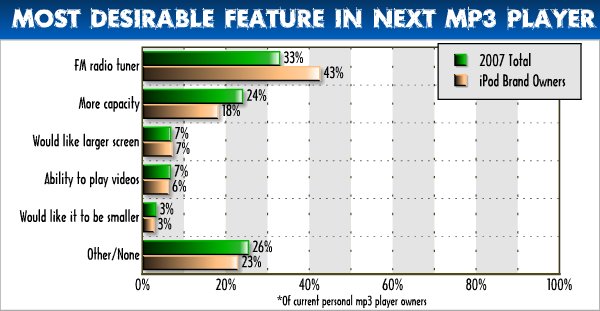
«Conventional wisdom suggests that iPod owners are swimming in their own collections, and leaving programmed radio stations behind.  That certainly sounds like the typical iPod owner, though fresh research indicates that a large number of portable music fans want terrestrial radio receptivity.  According to a recent internet-based poll conducted by Jacobs Media, 33 percent of respondents expressed a preference for FM radio in their next portable media device.  And among iPod owners, the number was a more substantial 41 percent.  In both cases, the preference for radio receptivity outweighed demand for increased capacity, a larger screen, and video playback.  "It's a no-brainer," said Fred Jacobs, head of the research group. "If Apple truly wishes to make the most versatile, user-friendly personal MP3 devices, an FM tuner should be standard equipment." Currently, iPod owners can grab FM receptivity by purchasing an add-on from a large number of companies.  But off-the-shelf, the iPod does not contain terrestrial radio reception, an approach that Jacobs disagreed with.  But tempering the opinion is a potentially heavy skew in the results, which were compiled by a company that focuses its expertise on rock radio.  In fact, the survey pool of 25,000 was pulled from nearly 70 rock radio stations across the United States, a selection process that offers a less-balanced consumer picture.  Meanwhile, Apple is most likely reviewing sales data on add-ons like FM receivers, and weighing its product decisions on actual buying information.  A number of iPod rivals, including the Microsoft Zune and a range of SanDisk players, currently offer FM receptivity.»

fonte: «Researchers Raise Importance of Portable FM Reception», Digital Music News, 2/04/07

Jacobs Media Report

Mais: «Of course, FM radios are available in Microsoft's Zunes and SanDisk players, for example, but they are not built into Apple branded products, such as nano, shuffle, or video iPods.  Clearly, this is a great opportunity for Apple to better serve its millions of iPod customers, while keeping ahead of its growing competition.  It’s a no-brainer - If Apple truly wishes to make the most versatile, user-friendly personal mp3 devices, an FM tuner should be standard equipment» (Jacobs Blog, «iPod Owners Want WHAT?», 3/04/07)

Ipod_feature_07_pr
Mark Ramsey acha que isso nunca vai acontecer:
«

First, the iPod is not an island. It's an mp3 player, and there are many mp3 players out there equipped with FM tuners. That is, the thing these folks say they want is already available on a different branded unit, and they deliberately chose not to buy that unit and purchased an iPod instead. What does that tell you about what they say they want vs. what they really want? Second, Jobs knows full well that there's demand for an FM tuner in the marketplace. And that's why Apple makes such a tuner as an add-on for the iPod. Indeed, the iPod is deliberately manufactured to be the centerpiece of an ecosystem of products that "plus" the iPod, and an FM tuner is one such "plus." So arguably, this problem is solved even before it's posed as a problem. Third, why should Apple burn their iPod batteries to empower the radio industry's agenda when those batteries could be alternatively burned playing video and audio purchased from Apple's own iTunes, a proposition which not only drives the value of iPods but fills Apple's coffers to the brim?»

fonte: Mark Ramsey, Hear2.0, «Will iPods feature FM tuners? Nope.», 2/04/07

Mais cedo do que o previsto, pub na net passa a rádio (GB)

«The internet will overtake radio by next year and become the world’s fourth-largest advertising medium, a year earlier than forecast. Global spending on internet advertising increased from $18.7 billion in 2005 to $24.9 billion (£12.6 billion) last year, according to ZenithOptimedia, the media-buying agency.  (...)In the Middle East and Eastern Europe, advertising spending is growing faster than in North America and Western Europe, which are “maturing rapidly” as advertising markets, Zenith said. (...) Although spending on traditional media, such as magazines and radio, has been falling in the UK, more than £2 billion was spent on internet advertising in 2006. Online advertising accounts for 11.4 per cent of total advertising revenue in Britain, almost double the global average of 5.8 per cent and above the 7.8 per cent share of advertising expenditure in the US.»

fonte: «Advertising on internet soars as world follows British lead», April 3, 2007, Rebecca O’Connor