Blogia

Transistor kills the radio star?

Música na net sem protecção

«NEW YORK (Reuters) - Apple and EMI will reveal a ground-breaking deal on Monday for Apple to sell the music label's songs free from copy protection limits, the Wall Street Journal reported on Sunday. The report said music giant EMI plans to sell "significant amounts" of its catalogue without anti-piracy »

fonte: «Apple and EMI in copy protection deal», Reuters, Mon Apr 2, 2007 12:56PM BST, Yinka Adegoke

Uma audiência que não quer saber dos suportes mas dos conteúdos

«(...) audiência mais ampla, que passa tanto tempo na Internet e jogando videogames quanto dedica à televisão, e não quer mais se incomodar com quando e onde um programa será exibido

fonte: «06/03/2007, MTV Networks reforça ação na Web para reconquistar espectadores», Por Kenneth Li

iPod tem 73% do mercado EUA

«"Apple Inc. sold a record 21 million iPods for the holiday quarter, which helped boost the company's revenues by 50% and accounted for sales of $3.43 billion--half of Apple's total sales for the quarter, the company reported this week," Emily Burg reports in an updated article for MediaPost's MarketingDaily.

Burg reports, "Stellar sales have earned the iPod a 72% share of the portable music player market. Microsoft's Zune, meanwhile, recorded 2.8% of the market for December, and 10.2% of all 30GB hard drive models sold, according to retail research firm NPD Group." (fonte: NPD:  Apple iPod held 72% share of PMP market in December; Microsoft Zune had 2.8% share, Sunday, January 21, 2007).

Já teve mais: «Research company The NPD Group said in a report released Tuesday that various versions of the iPod accounted for 92.1 percent of the market for hard drive-based music players, up from 82.2 percent a year ago. Players from Creative Technology and Digital Networks North America's Rio were a distant second and third, with 3.7 percent and 3.2 percent of the market, respectively.» (outubro 2004)

A MTV também procura na net recuperar audiências

«NOVA YORK (Reuters) - A MTV Networks, que controla os canais MTV e Comedy Central, adotou uma nova e arriscada estratégia para a Web, a fim de reconquistar os espectadores jovens que a trocaram por sites como o YouTube e o MySpace. A rede, que já tem 150 sites operando em 162 países, planeja criar literalmente milhares de outros, na expectativa de atrair espectadores permitindo que assistam, contribuam e até reeditem seus programas de TV. "As pessoas tendem a encontrar conteúdo na Internet por milhares de portas, e não uma só", disse Mika Salmi, novo presidente da divisão digital da MTV Networks, subsidiária da Viacom."De certas maneiras, estamos em posição melhor do que a maioria das empresas de mídia, ocupamos o lugar que elas desejam", disse. O canal MTV no passado era sinônimo de cultura jovem, mas redes sociais de grande popularidade, como o MySpace, da News Corp., e o site de vídeo online YouTube, do Google, atraíram número considerável de seus espectadores. A nova estratégia da MTV Networks é parte de um esforço da Viacom para atingir uma audiência mais ampla, que passa tanto tempo na Internet e jogando videogames quanto dedica à televisão, e não quer mais se incomodar com quando e onde um programa será exibido. O objetivo é construir sites relacionados a cada personalidade e aspecto de seus programas, esperando atrair espectadores quer pela Internet, quer pelo celular, disse Salmi em entrevista.O grupo criou três mundos virtuais --Laguna Beach, para adolescentes; Nicktropolis, para crianças; e Virtual Hills, para adultos-- e diz que os novos sites podem ajudá-la a promover programas e personalidades específicos de maneira mais ampla. (...)Nos próximos meses, Salmi disse que a companhia planeja abrir mais seus arquivos, permitindo que internautas publiquem vídeos em seus próprios sites e também reeditem alguns deles. "Os consumidores querem controle", disse o analista Richard Greenfield, da Pali Capital. "Lutar contra essa tendência não é uma estratégia vencedora... Eles estão indo na direção certa agora."»

fonte: «06/03/2007, MTV Networks reforça ação na Web para reconquistar espectadores», Por Kenneth Li

Grande queda na venda de CD (EUA)

«In a dramatic acceleration of the seven-year sales decline that has battered the music industry, compact-disc sales for the first three months of this year plunged 20% from a year earlier, the latest sign of the seismic shift in the way consumers acquire music. The sharp slide in sales of CDs, which still account for more than 85% of music sold, has far eclipsed the growth in sales of digital downloads, which were supposed to have been the industry's salvation.»

fonte: Wall Street Journal, «Sales of Music, Long in Decline, Plunge Sharply», By Ethan Smith, Março 07

mais: http://www.kurthanson.com/archive/news/032207/index.shtml

O negócios dos conteúdos vs o negócio da distribuição

Ramsey: «There are two places worth being in the future: The business of content - the unique and compelling kind. And the business of distribution - the wider the better.Some of the smarter groups are already experimenting with deals in these non-radio channels. Look for these deals to multiply. Further, look for players to get into the radio "game" who have no history here. To the degree that you simply need to hire a handful of program directors to create a broad menu of music-only channels, radio - on a national level - becomes easy for any company which has the distribution - and that means lots of competition which will quickly turn weaker radio brands into commodities.And where should you NOT be? You should not be putting all your eggs in the basket of any one technology (including over-the-air radio, by the way), especially if that technology has no significant distribution (you know what I'm talking about, but I already wrote my one post of the week on that topic).And you should not be in the business of pumping out tunes with no distinction and no added value. You should not, in other words, be in the business of creating a weak all-music brandless brand.Of course, you'll see these challenges first from the younger end of the audience. And no, they will not grow out of it.»

10 preocupações para a nova rádio (muito bom)

«Here are my thoughts on how news-based radio stations can rise to the challenges of multimedia convergence without overstretching finite resources. The key is sustainability.

1) Play to your strengths
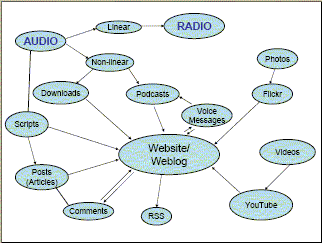
The starting-point is your core product: the audio that you already produce and broadcast on the radio. Make it available in a digital format like MP3 for users to listen to or download from your station's website. Podcast highlights of popular programmes and longer (complete) versions of broadcast interviews.

2) Start a conversation with your audience
Your website is not just a place for programme schedules. The easiest and most effective way to create interactivity is by having a weblog. For more idea about using a weblog, see this post by the Bivings Group.

3) Listen to your audience
Try to respond to comments and always answer direct questions - giving your audience a voice only makes sense if you are prepared to listen. Make your audience feel part of the editorial process by soliciting ideas for future broadcasts/blogposts.

4) Don't bite off more than you can chew
(Pseudo-) multi-platform authoring is a good way to achieve sustainability. For example, with a bit of tweaking, the (carefully written) scripts that accompany your radio programmes can become your online articles/blog posts.

5) Make your podcasts interactive
Use free software like Odeo, Evoca or Voicethread to allow your listeners to leave messages on your website. Edit the voice messages for use on-air and in podcasts.

6) Don't reinvent the wheel
Whenever possible, use existing applications/platforms to build and foster communities. Not only do they work, but the best social software is often free. Upload your videos to YouTube and then embed them in your weblog. Hopefully, you will attract comments and reactions on both platforms. Create user groups. Put some of your photos on photo-sharing sites like Flickr  and encourage your audiences to share their pictures.

7) Create a multimedia culture
Winning over your staff may be your biggest challenge, but most will come round when they start feeling that they are engaging in a genuine conversation with their audience. Make short films of your presenters at work and of any studio guests. This will interest your audience and also boost morale in the newsroom because everybody likes seeing themselves on video. Encourage your reporters to take pictures and shoot videos to enhance online storytelling. As Howard Owens suggests, this does not necessarily mean investing in expensive, state-of-the-art equipment.

8) Cross-promote
Regularly remind listeners about your web address and talk about your online content. Use your weblog to preview upcoming stories - begin a conversation about your reports before they are broadcast.

9) Link to your community
Provide editorial guidelines online and link to the blogs of members who agree to abide by the rules. They may even link back to your website.

10) RSS feeds
Make your blog posts available as RSS feeds. This will make it easier for your audience to keep up-to-date and aware of new content on your website.

fonte: Multimedia meets radio, «10 ideas for a successful multimedia strategy» 27/3/07

A diferença entre rádio (convencional) e o áudio on line

Project 

fonte: Multimedia meets radio, «10 ideas for a successful multimedia strategy» 27/3/07

As queixas do costume contra a rádio

«The radio is a magnificent invention. It transports information and music in a manner that my English major mind cannot even grasp-for free. Radio was hilarious and endearing as voiced by Jon Lovitz in the Brave Little Toaster. We should all love the radio.

However, the radio stinks. Driving in my car, I could do without hearing "Walk It Out" for the seventh consecutive time. DJs really love to hear themselves talk, and they should be rounded up and kept in a pen not unlike the ones that Sawyer and Kate were held in by the Others on Lost. The radio has helped make the likes of Nickelback and Breaking Benjamin famous. Ignore the radio, and pay attention to these bands that have existed outside the trainwreck of Top 40 music.»

fonte: «Boycott your radio», Jess McCauley '07, 03/29/07

Mais escolha ou melhor (pessoal e simples) escolha?

Mark Ramsey:

«Everybody wants more choice, right? Wrong. Everybody thinks they want more choice. In fact what they want is their choice - and the shortest possible path to it. Misunderstanding this leads us down a path that fills our supermarket aisles, not to mention our HD and satellite radios. (...)»

Outro contributo: «Having grown up in the abundance of the US, I was basically taught that freedom is, among other things, the maximization of choices. The more choices the better. All those choices. All that abundance.157 kinds of breakfast cereal…how to decide? The freedom to choose, at least on things that matter most, is a wonderful gift indeed. Yet, in our daily lives we too often burden ourselves with petty choices, unimportant matters, and frivolous decisions. In today’s world we may have political/social freedom (if we're lucky), but often lack “a freedom of mind,” the very freedom that can matter most when aiming to construct creative solutions to complex problems. Our minds — even our lives in general — have become complicated by clutter. (...) Life is about living with limitations and constraints of one type or another, but constraints are not necessarily bad, in fact they are often helpful, even inspiring as they challenge us to think differently and more creatively about a particular problem. While problems such as a sudden request to give a 20-minute sales pitch or a 45-minute overview of our research findings have built-in limitations — such as time, tools, and budget — we can increase our effectiveness by stepping back, thinking long and hard, and determining ways we can set our own parameters and constraints as we set out to prepare and design our next presentation (or next design project, etc.) with great clarity, focus, balance, and purpose» (fonte: «Can limitations and restrictions be liberating?», 29/03/07, Presentation Zen) 

Os sites dos jornais são concorrência à rádio

«

‘Quem me leva os meus fantasmas’ é o nome da nova música de Abrunhosa, que poderá ser ouvida aqui, a partir de segunda-feira, logo de manhã. 'Quem me leva os meus fantasmas' é o tema de apresentação do quinto álbum de originais de Abrunhosa. O site do Expresso foi escolhido por Pedro Abrunhosa para lançar, em exclusivo no ciberespaço, o seu novo single. A partir das 8h15 de segunda-feira, dia 2, vai ser possível ouvir ‘Quem me leva os meus fantasmas’, o tema de apresentação do novo disco.
Composto e escrito pelo músico do Porto, o single conta com os fiéis Bandemónio e com o St. Dominic’s Gospel Choir, dirigido por João de Castro. Sem “romantismos nem ilusões”, Pedro Abrunhosa promete “romper a superficialidade da pop contemporânea” com a música ‘Quem me leva os meus fantasmas’. Tudo porque a “canção não pode continuar a ser apenas entretenimento”.
Este disco, o quinto de originais, sucede a ‘Momentos’, que em 2003 vendeu mais de 90 mil exemplares e rendeu ao artista do Porto a dupla platina. A edição do novo álbum está prevista para o final de Maio, mas o seu nome continua em segredo.
O «videoclip» de ‘Quem me leva os meus fantasmas’ vai ser também lançado no sítio do Expresso, uma semana depois do single: dia 9 de Abril».
fonte: «Pedro Abrunhosa lança single no site do Expresso», 30/03/07, Paula Cosme Pinto

O esforço da Google no mercado dos anúncios radiofónicos

«(...)Then there is radio. The chief executive of Google, Eric Schmidt, said last year that the company would eventually have 1,000 employees dedicated to radio advertising alone. (...) Google's effort to sell radio ads, the oldest and most advanced of its major offline advertising plans, has run into several hurdles, including radio stations that are wary of losing control over the sale and pricing of ads. The promise that Google offers old-line media markets is that it can replicate the formula that has worked so well for it online. It is a formula that relies heavily on technology to allow advertisers to buy their own ads, have them appear on relevant pages across a vast network of Web sites, and then track the results (...).»

fonte: IHT, Can Google sell that radio gaga?, Miguel Helft, 29/03/07

Serviço personalizado de notícias nos AUdi (inovador)

«ZURICH, Switzerland, March 27 /PRNewswire/ -- SVOX, a global supplier of text-to-speech output solutions for the automotive and mobile industries, teamed with Audi and the Fraunhofer Institute for Integrated Circuits IIS to demonstrate during CeBIT a real-time transmission chain of the first live in-car reception of NewsService Journaline(R) service over Digital Radio DAB (Digital Audio Broadcasting) according to SVOX CEO Volker Jantzen.
NewsService Journaline is the basis for Audi's Personal News service now in final testing. This "teletext for radio" provides continuously updated information for immediate access. Drivers choose text news sorted by topics from a hierarchically organized menu. Jantzen reports that Audi considers to bring the service to market soon and make it available worldwide based on market acceptance.

The real-time transmission chain consists of the new "Fraunhofer Multimedia DataServer(TM) for DAB R4" by Fraunhofer IIS and DAB receiver technology by Atmel Corporation. The Fraunhofer Multimedia DataServer automatically aggregates content for NewsService Journaline and transmits it using DAB. The powerful SVOX text-to-speech system installed in the car then presents the text messagespreviously transmitted over DAB to the driver.
The service can be managed using the Audi multimedia interface and is easy to personalize. Based on individual preferences, the system chooses only news of interest to the driver. Topics of specific interest can also be bookmarked for an easy and direct access in future.»

fonte: «Audi - SVOX Powers In-Car Digital Radio News Service Developed by Audi and Fraunhofer IIS», Auto Spectator, 2007/3/29

Tendências actuais nas páginas web

«(...) The days when radio station sites could simply function as blinking billboards, showcasing station events and DJ bios are long gone.  Today, sites need to be interactive, focus on the music that listeners love, provide video, and cater to the needs of listeners [Fred Jacobs dá o exemplo de uma rádio dos EUA, a 107.7 The Bone, que tem uma página chamada «Ask th PD», ou seja, perguntem ao director de programas; este responde on line às perguntas dos ouvintes].»

fonte: Fred Jacobs, «MyCandidate», 30/03/07, Jacobs Media

Transmissão da rádio por telemóveis

(dir-se-ia que pagar para ouvir rádio através de streaming nos telemóveis, como um serviço da assinatura internet, não faria sentido, mas é preciso não esquecer que a rádio via streaming não tem fronteiras nem limites geográficos)

«Clear Channel Radio and mSpot said music programming from 10 Clear Channel stations can be heard on mSpot’s radio services over cell phones. Next month, mSpot expects to distribute live broadcasts from about 100 Clear Channel stations. The agreements broaden Clear Channel’s mobile content portfolio and expose it to subscribers of mSpot’s operator customers. Clear Channel Radio is providing CHR and urban programming from five stations. MSpot offers mobile music, radio and movie services to wireless carriers»

fonte: «Clear Channel Adds Music Channels to Cell Phones With mSpot Radio, Radio World, 30/3/07

MAIS:

«The BBC is to trial the broadcasting of up to eight of its national radio stations via 3G mobile phones. Radio 1, 1Xtra, Radio 2, Radio 3, Radio 4, 6 Music, BBC7 and the Asian Network will be available within a month to Vodafone, Orange and 3 customers who subscribe to their network's TV service. Radio 5 Live will not be available.
Mobile phone and handheld computer users have viewed almost 90 million pages since the BBC's WAP services were introduced and the corporation believes accessing radio over 3G is a natural progression.
Richard Halton, BBC Controller of Business Strategy, who was speaking at the Broadcast Mobile TV Congress today, said: "The BBC constantly aims to make its content available to as many people in as many ways as possible. "The mobile platform is a great opportunity for us to reach existing users in a new way and connect better with people who are not currently big users of the BBC."
Customers of 3 can access the channels free for a month after which the network charges £5 a month.

fonte: Radio Today, BBC digital radio via 3G, Thursday 29 March 2007

O mercado dos serviços de áudio nos EUA

«A recent FCC analysis of satellite competition determined that the relevant market for satellite radio consists solely of Sirius and XM. The agency relied on antitrust law and the Department of Justice merger guidelines in finding that other audio services such as terrestrial radio (including HD Radio), iPods, and Internet radio are not competitive substitutes. Sirius and XM have tried to justify their proposed merger based on competition from iPods, HD Radio and other forms of audio entertainment. "The reality is that satellite radio competes with an awful lot of audio services -- terrestrial radio, Internet radio, with cell phones when hooked up to Bluetooth, and we compete with MP3 players," said Sirius CEO Mel Karmazin testifying before the Senate Judiciary's Subcommittee on Antitrust Competition last week. "This FCC decision that the current duopoly of XM and Sirius do not compete with radio, iPods or any other audio sources in the satellite radio market further undermines the arguments made by XM and Sirius to obtain a government-sanctioned monopoly," said NAB President/CEO David K. Rehr. "While the FCC clearly intends to examine all issues surrounding the XM/Sirius merger, the hurdle the parties must overcome to convince the FCC to change direction is very high."»

fonte: «FCC: Sirius, XM Do Not Compete with Terrestrial Radio », 30/03/07, Radio Online 

Slacker, a nova next big thing do audio streaming?

«(...)The ad-driven beta program at www.slacker.com resembles Pandora. But when the full-fledged release becomes available in early summer, Slacker will have several components. Slacker was founded by former chief executives of Musicmatch and Rio, so it is only fitting that Slacker will offer a free software player, like the once-popular Musicmatch Jukebox, and sell a portable iPod-like device, like those Rio made. One twist is that, like Last.fm, the Slacker jukebox will enhance the radio stream by paying attention to the songs you choose. (D.J.’s will aid in programming as well.) Another twist is that, in addition to MP3s, the portable player will carry personalized radio streams that will be automatically freshened. For $7.50 a month, users get access to more features, but even if you do not pay, you will be able to buy the portable device and have access to free — though ad-rich — radio streams. Most radically, sometime this year Slacker says it will introduce a satellite receiver dock for the portable player. The Slacker team plans to blast individual song files to listeners from a satellite several times an hour. As each song is sent, the player itself will determine whether the song is a good fit for its particular user. If so, it will be saved. If not, it will be rejected. Because of the controversy over royalty rates, and because of its unique portable properties, Slacker made its own licensing deals directly with the four major music groups plus several hundred independent labels. Last.fm recently announced content deals with the Warner Music Group and EMI for tracks on its new, ad-free $3-a-month premium radio service.»

fonte: «A Radio Station Just for You», NYT, By WILSON ROTHMAN, March 29, 2007

Televisão no carro

«Washington, 29 mar (EFE).- O Grupo Chrysler começará a oferecer televisão por satélite em seus monovolumes e outros veículos dos modelos de 2008 após chegar a um acordo com a empresa Sirius Satellite Radio. Inicialmente, o serviço, intitulado "Sirius Backseat", transmitirá apenas a programação dos canais Nickelodeon, Disney Channel e Cartoon Network, três canais especializados em conteúdos infantis e juvenis. Mike Kane, diretor de Inovação do Grupo Chrysler, afirmou hoje, através de comunicado, que considera "que o veículo está se transformando em outro cômodo da casa". "No caso do monovolume é óbvio", declarou. Kane acrescentou que os clientes do Grupo Chrysler estão solicitando inovação, e que "o próximo passo é a televisão no veículo". O serviço, que custará US$ 470 no primeiro ano, estará disponível nos monovolumes da Chrysler e da Dodge. O Grupo Chrysler será a única que contará com este serviço nos modelos de 2008, mas no ano seguinte a Sirius começará a oferecer o serviço a outros fabricantes de automóveis. O sistema, que será mostrado publicamente na semana que vem no Salão Internacional do Automóvel de Nova York, funciona através do equipamento de rádio por satélite da Sirius e do sistema de DVD instalado nos veículos.» fonte: «Chrysler se torna primeira fabricante a oferecer veículos com TV via satélite» 29/03 - 21:17 - EFE EFE

internet atinge praticamente o pleno junto dos estudantes

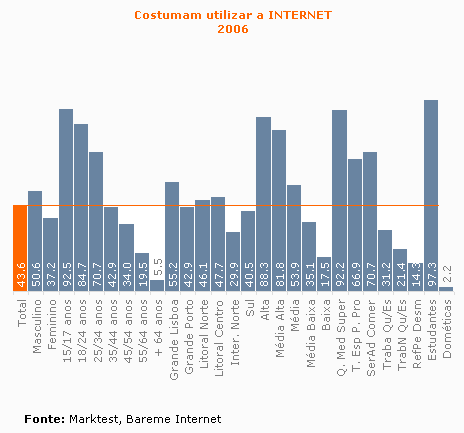
«(...) A análise por targets mostra como a penetração da internet atinge praticamente o pleno junto dos estudantes (97.3% deles costuma usar a internet) e como é no grupo dos mais jovens que se encontram as maiores taxas de acesso (92.5% junto dos jovens dos 15 aos 17 anos). A ocupação e a idade são as variáveis mais discriminantes na análise deste indicador, pois são as que revelam mais diferenças de comportamento. A classe social também apresenta oscilações significativas, com valores que vão dos 88.3% junto dos indivíduos da classe alta até aos 17.5% junto dos indivíduos da classe baixa. Entre as regiões há menor heterogeneidade, embora os residentes na Grande Lisboa se destaquem dos restantes, pois são os que apresentam taxas superiores de utilização da internet (55.2%).

A análise realizada teve como base os resultados da segunda vaga de 2006 do estudo Bareme Internet da Marktest. Este estudo analisa o universo constituído pelos residentes no Continente com 15 e mais anos. Contacte-nos se deseja adquirir este estudo ou se pretende mais informações sobre o assunto.

fonte: Marktest, «Acesso à internet aumenta oito vezes em dez anos», Marktest.com, 29 de Março de 2007

O enorme crescimento da net em Portugal

«

Os dados do Bareme Internet da Marktest mostram como o número de portugueses que costuma aceder à internet aumentou oito vezes nos últimos dez anos. Os dados recentemente divulgados pela segunda vaga de 2006 do Bareme Internet, o estudo de base do Netpanel, contabilizam 3 622 mil indivíduos que costumam utilizar a internet. Este valor representa 43.6% do universo composto pelos residentes no Continente com 15 e mais anos. A análise deste indicador ao longo da última década evidencia o elevado crescimento que tem registado entre nós, ao aumentar oito vezes no período em análise. Os 5.6% de indivíduos que em 1997 acediam à internet passaram em 2006 para 43.6% - mais 679% do que então. Neste período, o ritmo de crescimento da penetração da internet no nosso país situou-se nos 30.6% ao ano.»
fonte: Marktest, «Acesso à internet aumenta oito vezes em dez anos», Marktest.com, 29 de Março de 2007