Blogia

Transistor kills the radio star?

Jovens do Canadá ouvem muito menos

«(...) Canadians spent an average of 18.6 hours a week listening to the radio in 2006, a drop of half an hour from 2005, according to annual statistics reported by the Canadian Radio-television and Telecommunications Commission. (...) Average weekly listening time - which includes mornings, at work and while driving, the three points of the day when most people tune in - has fallen substantially from eight years ago, when Canadians averaged 20.5 hours of radio a week, the regulator said. "Since 1999, the overall per capita weekly radio listening levels decreased by almost two hours," the regulator said. "The most notable decreases have been in the teen demographics and for adults aged from 18 to 34, where weekly listening levels have decreased three to four hours."

fonte: «Time with radio on the decline», Report on Business.com GRANT ROBERTSON, August 1, 2007

Menos tempo mas mais rádios (Canadá)

São os sinais contraditórios do tempo de mudança:

«Canadians are spending less time listening to radio, but the number of stations across the country is rising. As broadcasters chase advertising dollars in robust consumer markets such as Alberta, 29 more radio stations sprang up last year, bringing the total to 1,252, as dozens of new operating licences were awarded. The growth came as Canadians spent an average of 18.6 hours a week listening to the radio in 2006, a drop of half an hour from 2005, according to annual statistics reported by the Canadian Radio-television and Telecommunications Commission. Average weekly listening time - which includes mornings, at work and while driving, the three points of the day when most people tune in - has fallen substantially from eight years ago, when Canadians averaged 20.5 hours of radio a week, the regulator said. "Since 1999, the overall per capita weekly radio listening levels decreased by almost two hours," the regulator said.

fonte: «Time with radio on the decline», Report on Business.com GRANT ROBERTSON, August 1, 2007

HD no Brasil (um ano para a troca?)

«O ministro das Comunicações, Hélio Costa, afirma que persiste a idéia da criação de um sistema híbrido de rádio digital no país. Seriam então adotados dois diferentes sistemas: o americano In Band on Chanel (Iboc), para as rádios AM e FM e o europeu, Digital Radio Mondiale (DRM), para as rádios de ondas curtas (OC). Isso porque nenhum dos dois sistemas contempla todas as freqüências. O americano não tem transmissão de ondas curtas e o europeu não transmite FM.
“Precisamos de AM, FM e OC e nenhum dos sistemas tem os três elementos. Eu entendo que o que vai acontecer é realmente uma proposta de um sistema híbrido. O mesmo ocorreu com a TV. O sistema europeu atende às TVs a cabo e o japonês as abertas”, compara Hélio Costa

«Atualmente, 16 emissoras de rádio AM e FM operam em caráter de teste no sistema norte-americano In Band on Chanel (Iboc). Outras 42 já pediram autorização à Anatel, mas ainda não iniciaram os testes.
As únicas emissoras que irão testar o sistema europeu Digital Radio Mondiale (DRM) em ondas curtas (OC) são a Faculdade de Tecnologia da Universidade de Brasília (UnB) e a Radiobrás. Os testes ainda não começaram
»

«O consumidor terá que trocar o aparelho de rádio para ouvir as rádios digitais. A expectativa do Ministério das Comunicações é de que o aparelho mais barato custe de R$ 60 a R$ 70. O Ministro das Comunicações, Hélio Costa, imagina que em um ano todo o sistema tenha migrado para o digital. “As empresas de fabricação Sansung e Sony me informaram que farão um rádio que custará em torno disso”, afirma o ministro.
O novo rádio terá as duas opções. Irá recepcionar tanto as rádios AM e FM atuais, em sinal analógico, quanto as novas rádios que transmitirão em sinal digital. Para iniciar a fabricação dos novos rádios, as empresas esperam a decisão do governo federal sobre qual sistema de transmissão será adotado pelo país, o que deve ocorrer em no máximo 60 dias. Outra opção que poderá chegar ao mercado brasileiro são os conversores. O aparelho permite que os rádios atuais captem as transmissões digitais. Ele hoje é utilizado nos Estados Unidos e na Europa. Mas o ministro tem dúvidas sobre sua utilização no Brasil, “a menos que custasse no máximo R$ 10”, diz
»

YouTube, MySpace e Hi5

«A expressão YouTube foi a mais pesquisada na internet pelos portugueses no primeiro semestre de 2007. Segundo um estudo do NetPanel, da Marktest, a palavra YouTube foi pesquisada por 432 mil portugueses com mais de 4 anos a partir de suas casas. Este valor equivale a 14,3% do universo nacional.
A segunda expressão mais procurada foi Hi5, que, com 398 mil pesquisas, representa 13,2% dos internautas portugueses. Na terceira posição surge gmail, pesquisado por 336 mil utilizadores únicos: 11,1% do universo total.
Na lista das dez expressões mais procuradas na internet surge a Wikipédia em quarto lugar, jogos em quinto, seguido pelas palavras google, hotmail, sapo, you tube e sexo.»

«Youtube é a expressão mais pesquisada na internet», Meios e Publicidade, 23 de Julho de 2007, por Maria João Morais

«De acordo com os resultados do estudo Netpanel da Marktest, o domínio myspace.com foi o que em Junho mais aumentou em páginas visitadas a partir do lar. Em Junho de 2007, 2 563 mil portugueses com 4 e mais anos navegaram em suas casas na internet, o que representou um pequeno acréscimo de 0.5% relativamente ao mês anterior e de 2.5% face ao mês homólogo de 2006.»

fonte: «Myspace aumenta páginas visualizadas», Marktest.com, 24 de Julho de 2007


Um telemóvel que emite para o FM!

«Music-playing cellphones are a dime a dozen, right? Not the new Musiq by LG. This slim clamshell phone, available from Sprint for $99 with a two-year contract and rebate, can download music wirelessly and transmit audio to any nearby FM radio, taking the party out of your earbuds and into your car or kitchen. The 3-ounce phone, available next month, comes with a 64-megabyte MicroSD memory card, enough to hold about 20 songs, and it can handle cards up to 2 gigabytes. It includes a 1.3-megapixel camera and can work as a music player for up to 10 hours, while talk time is about 4 hours. The phone has track controls on its front, and the external buttons vibrate when you touch them, so you don’t mistake fast-forward for pause. You can add music to the Musiq from your computer desktop or from Sprint’s Music Store, which lets you download music wirelessly. A bonus: with the FM radio transmitter, you can have fun sharing your favorite hits with the entire car just by hijacking the frequency of the current radio station»

fonte: JOHN BIGGS, «Transmit Your Music to FM Right From Your Cellphone», New York Times, July 12, 2007

O que rádio que tem é o último que vai comprar?

Diz Mark Ramsey: «It is very likely that the so-called "radio" you now own will be the last one you ever buy».

Tudo por causa da explosão, que se adivinha, das redes 4G dos telemóveis, a tecnologia wi-Max: «Analysts are bullish on the prospects for Wi-Max. Boston-based Yankee Group is forecasting 28 million subscribers by 2011, while research firm In-Stat says Wi-Max infrastructure equipment and devices will become a $5 billion market within four years, up from $177 million today. Wi-Max "will enable all sorts of new devices we've never even thought of," says Fred Wright, senior VP for networks and enterprise at Motorola. "Any applications that are cumbersome today because the cell phone can't provide a fast enough data rate, those will be the sweet spots Wi-Max will be able to address."

Ideias sobre a geração iPod (e o lugar da rádio)

« (...)But it also seems that the idea of buying a radio is "anathema" to the kids. For them, radio is something that comes free with another device. Winter revealed some alarming research about the "iPod generation", many of whom have no interest in local communities and are distrustful of mainstream media. Some 27% of them think radio is outdated. But despite this level of disengagement, 30% said they would spend more time with radio in future. So how to reach out to them? Parfitt said teens want to be taken seriously and not stereotyped, want aspirational role models from the media, as well as a spirit of "mucking about". And radio should be aware of its strengths. While MP3s allow listeners the music they have already chosen - music recovery - radio is better for music discovery. And in the talk field, radio offers company and connection, rather than the self-immersion of the iPod world. Young listeners still appreciate radio's liveness, spontaneity and unpredictability. Nevertheless you can smell the unease in the auditorium: the world is changing fast and the teens of today are the first to grow up with this dizzying and rapidly evolving array of technologies, and no one knows for sure what will turn out to be merely a fad and what will bring fundamental change to consumer habits.

fonte:  «Radio Festival - day two», Guardian Unlimited, 

Rádios da GB pedem switchoff

«According to an article in the Sunday Telegraph newspaper, commercial radio companies in the United Kingdom are looking to set a firm end date for analog radio. The industry body RadioCentre was expected to approach the British broadcast regulator, Ofcom, about setting a shutoff date for analog radio that could be as early as 2015. An analog shutdown would mirror the transition path being followed by the television industry, which will see an end to terrestrial analog broadcasting in 2012. There is a concern, according to the Telegraph report, that only a firm analog shutoff date will ensure continued investment and development of digital radio, although there are political concerns about making millions of analog receivers obsolete»

fonte: «Call for 2015 End to Analog Radio in UK», RWOnline, 6/07/07

Mitos na geração iPod (avisos a ter em atenção)

«This generation of 18- to 24-year-olds is defined by technology. They are the MySpace generation, iPod generation, digital generation, PlayStation generation - sobriquets that evoke lives spent in a techno-maelstrom of blogging, uploading, text-messaging, file-sharing, flash-mobbing and instant messaging. But is the MySpace generation a media myth? A recent survey by the global market-research company Synovate, whose Planet Edge project researches youth lifestyles across Europe, paints a very different picture. Two thirds of 18- to 24-year-olds in the UK have never used MySpace; across Europe - Planet Edge surveyed at least 400 people in 11 countries - it's 76 per cent. Only one in ten of British 18- to 24-year-olds have ever blogged. There is a surprisingly conservative attitude towards online dating: 94 per cent of British young people say they don't do it, and their European cousins are only marginally more liberated, at 92 per cent. Another stereotype-smashing statistic is the 94 per cent of British youngsters who say they never download ringtones for their mobile phones. Perhaps the biggest surprise of all is their preferred source of new music - not MySpace, iTunes, MTV, nor even ripping their friends' music collections to their own hard drives. It turns out to be the humble radio, cited by 31 per cent of British teenagers, with the internet, friends and MTV on 20 per cent each. (...) The picture that emerges, then, is not of a generation unified by the technological revolution, but of one divided by it - with less than a third in the fast lane of the digital superhighway. And it appears that class is a significant factor. "We found that those from the middle class and above understand the value of the internet, and tend to have it explained to them by parents, by older generations and in school," says Rolfe. "As soon as you get underneath that, the knowledge is much less likely to be passed down at home, nor are they as likely to use computers in the workplace. And for many, IT at school is pretty basic."  Dr Paul Hodkinson, a lecturer in sociology at the University of Surrey who has conducted research into youth culture and technology, agrees. "My understanding of social-networking sites such as MySpace and Facebook is that usage is biased - although not exclusively so - towards the white middle class," he says. (...)The answer, of course, is that we don't know yet. "On one level, I want to say that all this talk of a MySpace generation is not as dramatic as everyone is making out," says Professor David Buckingham, of the Institute of Education at London University, who is an authority on young people and the media. "But we should be careful of saying, 'We've seen it all before' or 'Nothing has really changed'. Things are evolving very quickly. The issue is how lasting any of these innovations will be. We probably won't have MySpace in 10 years' time, although we will have something similar but different.»

fonte: «The myth of the MySpace generation» Telegraph.co.uk; 30/06/07 

Mark Ramsey: «I'd be interested in what these proportions look like stateside. If you have access to this research, please point me to it»; e «This is not to say that MySpace and its like are not important. After all, critical trends usually start at the fringes. But it remains important to understand the difference between where we are today and where we'll be tomorrow. Meanwhile it's also important to recognize that a great many supposed MySpace members created a page and left it for dead years ago»


A publicidade começa a transitar para a Internet

«Os jornais nos Estados Unidos estão a perder grande parte da sua receita publicitária para a internet, em comparação com os outros media. A conclusão é de um estudo feito pela Wachovia Equity Research, citado pelo site da Adweek. A equipa analisou 100 anunciantes norte-americanos de topo e constatou a transição feita dos media tradicionais para a internet. A Wachovia Equity Research revelou que 55 desses anunciantes cairam em categorias como retalho, telecomunicações, serviços financeiros, media e tecnologia/internet. Globalmente, os jornais perderam 14,3% de receitas publicitárias em 2006, enquanto que a televisão ganhou 4,4%. Já a internet, alcançou um crescimento de 17,8%.»

fonte: «Jornais perdem publicidade para a internet», Meios e Publicidade, 11 de Julho de 2007, por Maria João Morais

Mais uma tentativa de cobrar por um podcast

«I have seen the future of radio - and its name is Danny Baker. The BBC London presenter, former Radio 1 DJ and one-time saviour of the TV chatshow has his own daily podcast - and hundreds of thousands of people are downloading it, writes John Plunkett. It's called the All Day Breakfast and you can find more about it here. Who needs the BBC or commercial radio when you can stick your own show on the web? No-one. In a conference hall packed with industry executives who rely on talent to pull in the listeners, you can almost taste the fear. No wonder Baker joked on his show that the podcast was the "noose around the neck of radio that would pull it slowly to its death". Baker says he was only joking. The interesting thing is that Baker records his daily podcast while still presenting a show for BBC London. What does the BBC think of it? Baker puts his fingers in his ears and starts humming. I think he means they ignore it. "I have been told as long as you are not charging for it, it's not a problem," said Baker. But the problem is he is going to start charging for it - around £2 a week. 270,000 listeners at £2 a pop? Wow. Big money. It's almost as much as Jonathan Ross gets. "They have said we would have a problem when you start charging for it but that's okay because I'll have a problem when I start charging for it as well - why would I want to go to work?" And it's not only Baker who is going it alone. Paul Myers, chief executive of podcast download company wippit.com, which hosts the All Day Breakfast Show, says Baker is the first of a "long queue of presenters who are leaving traditional radio to go and do their own thing". "The technology is there and the means of distribution is there. Now you can do your own thing, you can do it legally and you can build a fanbase [worldwide]".  I can feel the fear building in the room once again, and a whole heap of admiration (sprinkled with envy) for what Baker has done. (...)»

fonte: «Radio Festival - live from Cambridge», Guardian Unlimited,

(5.1) Quando a crise pode ser uma oportunidade

«The UK radio industry needs widespread regulatory reform and should prepare to switch fully from analogue to digital signals, the chief executive of regulator Ofcom, Ed Richards, said on Tuesday "Fundamental reform is needed. The status quo is dead," the head of the media watchdog told delegates at a radio industry conference in Cambridge. Richards said listeners had never had more choice with at least 25 radio services broadcast via television, more than 90 stations via satellite and the majority of the country's cities having at least 35 digital stations. However, multi-channel television, mobile phones and gaming, and broadband entertainment via services such as YouTube and MySpace meant commercial radio was facing possibly its biggest ever economic challenge. UK commercial radio revenues fell by 5 percent in the fourth quarter of 2006 from the previous year. (...)»

fonte: «UK radio watchdog calls for regulation revamp», Reuters, Jul 10, 2007162

Mais tempo na net do que a ouvir rádio

«A Internet ocupa já 25% do tempo total que os protugueses gastam no consumo de meios. A Net ultrapassou, inclusive, o tempo dispendido com a rádio e a imprensa, estando apenas atrás da televisão na preferência dos portugueses. Estas são algumas das conclusões de um inquérito realizado pela Media Contacts (grupo Havas Media), em conjunto com a Milward Brown (empresa de estudos de mercado) a 800  portugueses de várias etárias e socioeconómicas. Com efeito, a televisão continua a ser o meio de comunicação onde os portugueses mais tempo despendem (33,7%), mas a Internet aparece já em segundo lugar com 25%, seguido da rádio com 21,8% (...).  se tivermos em conta os jovens dos 12 aos 24 anos, o tempo passado em frente ao computador on line representa 72% do total dispendido no consumo de media. (...) Não obstante, a Internet ainda só recolhe 1,5% do investimento publicitário».

Fonte: ANDRADE, manuel Posser, Internet em Alta, Expresso, 30/06/07

Transmitir informação de trânsito pelo HD

«Clear Channel Radio has begun transmitting traffic data using HD (high definition) Radio technology in 48 of the largest markets in the United States. "HD Radio is the future for broadcast data delivery, allowing us to not only deliver traffic data, but provide additional services as well," says Jeff Littlejohn, Clear Channel Radio executive vice president of distribution development. In addition, Clear Channel Radio has extended the reach of its real-time traffic data service -- RDS-TMC (Radio Data System Traffic Message Channel) -- to 19 new markets, including Albuquerque, N.M.; Birmingham, Ala.; and Montreal, Canada. Clear Channel's Total Traffic Network is now available in 68 cities, and the company plans to add more markets throughout 2007. "With the addition of these 19 markets, we cover over 160 million people with our traffic service for consumer devices," Littlejohn says. Clear Channel Radio's Total Traffic Network currently provides real-time traffic information to devices made by Garmin, TomTom, Mio-Mitac, Delphi, Kenwood, Clarion, Navigon, Cobra Electronics and Siemens VDO and supplies traffic content to several media outlets -- including Citadel Broadcasting, Univision, Fox Interactive Media, and others.»

fonte: «Clear Channel Radio expanding traffic data services», San Antonio Business Journal, July 9, 2007

100 mil ouvintes perdidos em três meses?

«As rádios portuguesas perderam cerca de 100 mil ouvintes no segundo trimestre deste ano face ao mesmo período do ano passado, tendo a Comercial, a Cidade FM e o Rádio Clube sofrido as maiores quedas. Entre Abril e Junho deste ano, o consumo de rádio rondou uma média de 4,5 milhöes de ouvintes, contra os 4,6 milhöes registados nos mesmos meses de 2006, de acordo com dados hoje divulgados pela Marktest no Bareme-Rádio trimestral.»

fonte: «Rádio: Emissoras perdem 100 mil ouvintes no 2º semestre, Comercial, Cidade», LUSA,09-07-2007

«Renascença lança nova rádio generalista»

Que sentido faz a notícia de hoje do Diário Económico revelando-nos que a «Renascença lança nova rádio generalista»?

Por aquilo que se percebe esse novo canal pretende ficar com o público que tem mais de 54 anos e que ouve actualmente a Rádio Renascença (e não só).

Ou seja, tratar-se-á de mais um passo na reformatação da actual RR: um canal abaixo dos 54 anos (35-54?), o que pressupõe uma «descaracterização» real do produto que em tempos foi o mais ouvido e é actualmente o segundo mais ouvido.

Aparantemente seria mais indicado criar uma nova rádio para o público acima dos 35 anos e deixar a Renascença com o seu público clássico. Mas alguma erosão nas audiências da Renascença (inevitável e provavelmente a acentuar cada vez mais) terá feito soar as campaínhas.

aguardemos.

PS - uma rádio que se apresenta como estando vocacionada para um público acima dos 54 anos (ou seja, para um determinado público e não para todos os públicos) não pode ser considerada generalista. É o quê, então? Não há uma transposição da nomenclatura de formatos dos EUA, mas será certamente algo entre os «adult hits» os «classic hits»

Metade do tempo livre é a ver televisão

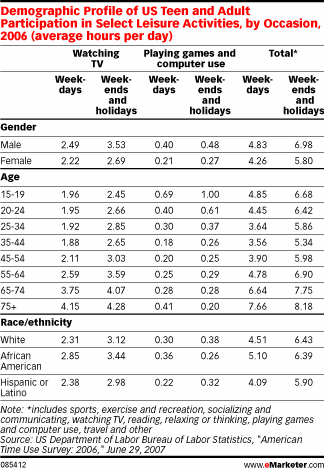
« On an average day, nearly everyone in the US ages 15 and older engages in some sort of leisure activity, like watching TV, using a PC, socializing or exercising, according to the US Department of Labor's Bureau of Labor Statistics' "American Time Use Survey." Watching TV accounted for about half of leisure time, on average, for both men and women. Socializing accounted for about three-quarters of an hour per day for both sexes. Time spent reading for personal interest and playing games or using a computer for leisure varied greatly by age. Those ages 75 and older averaged 1.4 hours of reading per weekend day and 0.2 hours (12 minutes) playing games or using a computer for leisure. Individuals ages 15 to 19 read for an average of 0.1 hours (seven minutes) per weekend day and spent one hour playing games or using a computer for leisure.

Demographic Profile of US Teen and Adult Participation in Select Leisure Activities, by Occasion, 2006 (average hours per day)

fonte: «TV Consumes Half of All Leisure Time», eMarketer, JULY 9, 2007

Tirar partido do RDS para enviar mensagens

«Five radio stations in Alabama are among the first in the state to deploy a local platform for Alert FM, an FM-based digital alert and messaging system. The Alabama Broadcasters Association joined GSS for this announcement and encourage local broadcasters to support the Alert FM system as a demonstration of their commitment to first responders, businesses and citizens. Alert FM uses RBDS to send digital information via FM radio stations. Targeted alerts and messages are delivered by satellite to FM transmission facilities and can be received on Alert FM receivers and other mobile devices.

fonte: «Five Alabama Broadcasters Deploy GSS Alert FM», Radio Magzine On line, Jun 28, 2007

Pode o telemóvel substituir o iPod? Há quem ache que sim

«Can the mobile phone compete with the iPod as the user's device of choice? For example, can podcasting become a service enjoyed on mobile phones? Clearly, podcasting is very suitable for the mobile phone. First, it is an “on-the-go” experience. Second, audio content is not effected by the handset’s small screen. Third, mobile phones already support video and high-quality audio. Four, content can be delivery directly to the handset with superb user experience. (...) All of us carry our phones with us everywhere. We like our phones. Phones are getting smarter, with better user experience. The iPod is great, if you have one. Most do not. An iPod also means carrying around two devices. I do not. Given a compelling user experience and fair and clear pricing, many will gladly listen to great audio content during dead-time. »
fonte: «Mobile Phones vs. iPod - Can Mobile Operators/Carriers Win? - By Monte Silver », wpfblog, 08/07/07

A rádio de mentalidade analógica!

Sempre foi uma das questões com que os animadores das rádios musicais portugueses lidaram mal, a apresentação das canções que se seguem ou se seguiram (genericamente, mais por desleixo do que por incompetência).

Ou não apresentam, deixando os ouvintes pendurados, ou apresentam de uma forma incompleta, ou apresentam todas seguidas, como se tivessemos um lápis para assentar e ficar à espera (e, claro, às vezes apresentam bem!).

Esta manhã, antes das 10, na Antena 3 passou uma música que já tinha ouvido, com a qual simpatizei, mas de que nada sabia. Fiquei à espera, mas no final, Raquel Bulha disse apenas «Closer». Porque o refrão dizia isso mesmo, percebi que se tratava do nome da canção. Mas quem a canta? Felizmente existe hoje a internet e uma busca simples por «Closer» não demorou muito a fornecer uma resposta: «Closer», de Travis.

Não sou dos que defendem a pureza da complementaridade entre rádio convencional e internet, como se elas pudessem coexistir tranquilamente. O que me parece é que quanto mais a rádio convencional desiste de servir o seu cliente, dando azo a que ele procure noutro lado, menos tempo o cliente passará a ouvir a sua rádio. Veremos...