Blogia

Transistor kills the radio star?

O podcasting e a publicidade

«Writing in the First Monday online journal a group from the MBA programme at Indiana State University report that: ‘In addition to providing greater flexibility in when audio programming is listened to, Podcasting invariably also offers listeners an escape from the advertising that plagues traditional radio broadcasting’

(Crofts et al., 2005)»

fonte: Will the iPod Kill the Radio Star?, Richard Berry, Convergence 2006; 12; 146

«Produtores são consumidores e consumidores tornam-se produtores»

«What Podcasting offers is a classic ‘horizontal’ media form: producers are consumers and consumers become producers and engage in conversations with each other. At a grassroots level there is no sense of a hierarchical approach, with Podcasters supporting each other, promoting the work of others and explaining how they do what they do. Whilst this is true of radio on the internet as a whole it is especially the case with Podcasting because the means to create are as accessible as the means to consume

fonte: Will the iPod Kill the Radio Star?, Richard Berry, Convergence 2006; 12; 146

«It is clear that in the Podcast world it is content that is king, with listeners choosing material that appeals to them, rather than selecting radio stations or formats as has been the case in traditional commercial radio models» (berry, 148)

BERRY, Richard, Will the iPod Kill the Radio Star?, Convergence, vol 12 (2), 143-162

UM telemóvel com ligação wireless ao carro (fazer uma rádio pessoal...)

(em vez de um modulador/adaptador de FM, que se liga ao LAD, este telemóvel já emite FM para o receptor do carro - ou de casa:

«(...) along comes LG, the Korean giant that's making news in a variety of consumer electronics markets, with its 550 FUSIC phone. This is a fully featured cell phone that offers all the stuff to which we've become accustomed, plus you can use it as your own private radio station. It does this via a low-powered FM transmitter that sends signals from the phone to your car (or home) FM tuner, eliminating the need for a wireless connection between the devices. This makes it attractive to the millions of people who don't have iPod input jacks in their vehicles. It isn't a new concept, but this is the first time I've seen it applied to a cell phone; the other devices I've seen that transmit your tunes via FM are standalone device such as the AudioBug. The feature makes the FUSIC perfect for use in my personal cars, which are so old they didn't even come with CD players - but which do have tuners.

I downloaded a few tunes from Bell and spewed them through the ether to the stereos of a variety of cars I was driving. You can choose and set the frequency you use, which is handy since it's best to find a frequency that isn't already saddled with some lame local radio station's signal. In my area, 107.9 worked well. In practice, the FM transmitter also worked well, but its performance depended a great deal upon the vehicle I was in. This is because the signal is actually being transmitted from the phone to the car radio through the car's radio antenna - and where the antenna is located on the vehicle can have an effect. Remember, the signal isn't just going a couple of feet from phone to radio - it's going outside the car to the antenna, and then back in again to the tuner. For example, my old Infiniti Q45 has the antenna on its right rear corner and during my wintry test it was frozen with only about a third of its length extended. This led to a lot of problems with interference. On the other hand, when I enclosed the FUSIC into the cubbyhole at the top of the 2007 Nissan Sentra's dashboard, it worked like a hot darn!»

fonte: «Make Your Own Radio Station With LG's 550 FUSIC Phone/Music Player», The Post Chronicle, By Jim Bray, Mar 10, 2007

A qualidade de som é importante na rádio via net?

«En épocas de home theater, el audio adquiere una relevancia especial. Según López, esta tendencia se encuentra transformando a Pinnacle: "Se está abriendo un nuevo mercado porque cada vez más el audio y el video corren juntos", dijo. "Antes, al editar video, el audio no importaba si estaba en alta calidad o en baja. Lo importante era la imagen. Hoy la mentalidad de la gente está cambiando, y el usuario está más exigente, quiere buen audio y video, y ya no alcanza con que la imagen sola esté bien. Por eso Pinnacle se está asociando con varias empresas que están en el entorno de la edición del audio, lo que le permite mejorar la calidad de sonido ambiente, de audio en micrófonos, etc."»

fonte: «¿Qué es una radio wireless? 12/03/07, Canal Ar

A entrada do vídeo na rádio

«(...) Las emisoras de radio comerciales estadounidenses han vislumbrado el futuro, y está, entre otras cosas, en el vídeo. Por ello, el estereotipo de locutor de voz aterciopelada como Stryker, desplomado en la silla del estudio y desmelenado, tal vez cambie radicalmente. (...) Por todo el país, las emisoras de radio incluyen vídeos en sus ciberpáginas, desde una simple cámara en la cabina de emisión para cubrir exclusivamente acontecimientos como la Super Bowl hasta videoclips, noticias y actuaciones musicales sólo para Internet. "Ahora es un medio visual", opina Dianna Jason, directora general de mercadotecnia y promociones en Power 106, una emisora de hiphop de Los Ángeles. Si bien antes se decía que el vídeo había matado a la estrella de la radio según la canción de Buggles, cuyo vídeo fue el primero emitido en MTV en 1981? ahora se presenta como inesperado salvador de un sector que afronta múltiples retos. En la era de YouTube, podría parecer que lo único notable a este respecto es que la radio haya sido inusualmente lenta en adoptar la era interactiva. Pero ahora muchas de las principales empresas radiofónicas intentan mantener su estatus cuando la atención del oyente se dispersa en muchas direcciones: i-Pods, móviles, radio por satélite y diversas ofertas de emisión y descarga de música por empresas como Yahoo y AOL. "Muchas de nuestras emisoras empiezan a introducir el vídeo y a generar nuevas corrientes de ingresos", comenta Joel Hollander, director ejecutivo de CBS Radio, la segunda empresa radiofónica de EE UU, después de Clear Channel Communications. "Espero que el vídeo ayude a la estrella de la radio. A lo mejor la radio salva a la estrella del vídeo". Más del 90% de los estadounidenses siguen escuchando la radio tradicional. Pero la cantidad de tiempo que permanecen sintonizados a lo largo de la semana se redujo 14 horas a lo largo de la pasada década, según los cálculos de Arbritron. Los ingresos del sector se han estancado, y el índice Bloomberg de acciones radiofónicas caía un 40% en los pasados tres años. Ahora el vídeo sólo aporta una diminuta fracción de los 16.000 millones de euros que la radio genera en publicidad. Pero podría representar la tan necesitada nueva fuente de crecimiento en un mercado de vídeo en Internet en rápida expansión, en el que todos, desde Google hasta los periódicos, pasando por las televisiones, quieren estar. Ejecutivos y figuras de la radio consideran que sus vídeos serán distintos porque aprovechan la ventaja tradicional del medio al usar personajes en directo y acontecimientos locales para captar oyentes. Y la radio y el vídeo encajan mejor de lo esperado. En su libro Understanding media, el teórico cultural Marshall McLuhan escribe que “el efecto de la radio es visual”.Siguiendo la clave de You-Tube y el auge de los vídeos caseros, el objetivo no es ofrecer un producto pulido, de calidad televisiva. Una emisora de rock, 94.7 FM de Portland, Oregón, empezó el año pasado la serie Vídeos de contrabando, en la que prestan a un oyente una cámara de vídeo para que grabe para la ciberpágina un clip de la actuación de un grupo nuevo. “A veces es un poco tosco, pero es lo que queremos”, comenta Mark Hamilton, director de la cadena, perteneciente a Entercom Communications. “No queremos que sea perfecto”. Los productores de Adam Carolla, el locutor matutino de Los Ángeles cuyo programa se difunde en muchas emisoras de CBS Radio, graban con regularidad vídeos reales de Carolla y algún invitado para colgarlos en Internet. Clear Channel, cuya sección de Internet está dirigida por Evan Harrison, vicepresidente ejecutivo, ofrece una elaborada programación en vídeo en las ciberpáginas de sus 1.200 emisoras. 6.000 vídeos musicales están disponibles para su descarga, pero también ha venido produciendo contenido visual original que las distintas emisoras pueden presentar en sus páginas y los dj, promocionar en antena. Por ahora, las nuevas empresas de vídeo nacidas de la radio apenas si empiezan a generar ingresos. Los directivos del sector resaltan que, por el momento, sus programas de vídeo podrían considerarse experimentales y sólo una faceta ?junto con los blogs y los archivos de sonido por suscripción y el reciente servicio denominado Radio HD? de cómo se está adaptando el sector. (...)»

fonte: «La radio (visual) se pasa a Internet», El Pais, RICHARD SIKLOS (NYTimes) - New York - 10/03/2007


Um receptor dos novos tempos? (Tv e rádio)

A Sony, no Japão, acaba de lançar um receptor de televisão e rádio. Para além da questão da convergência (sempre que a rádio consegue convergir com plataformas tecnologicamente mais evoluídas é bom), poderá ser este um sinal dos novos tempos? da rádio com imagem?

O podcasting à espera de se confirmar

The profitability of podcasting heading into 2007 also remains more a matter of potential than reality. In July 2006, Nielsen Analytics released a report called “The Economics of Podcasting,” which reported that 6% of U.S. adults (9 million Web users) had downloaded podcasts in the past 30 days. Almost 4 in 10, or 38%, of those downloaders said they listened to traditional radio less because of podcasting. The most successful podcasts were garnering as many as two million downloads a month. Those numbers make podcasts an attractive outlet to advertisers. With the medium still in its infancy, a few podcasts are already starting to generate income. National Public Radio has been actively attracting sponsors on its podcasts. Will it work? That is less clear. According to the Nielsen survey, 60% of survey respondents said that they “always” fast - forward past commercials»

fonte: The State of the News Media 2007

O declínio acentuado em 2005 (audiências de rádio nos EUA)

pie chart sample
Source: Arbitron, “Radio Today: How Americans Listen to Radio, 2006 Edition,” February 14, 2006
(via The State of the News Media 2007; Percent of the population 12 and older, 1998 - 2005)

Em busca da rádio pessoal

«Web sites like Pandora.com personalize the music you stream to your desk, while satellite radio offers portable listening but little personalized track choice. Slacker, a music service unveiled this week, hopes to merge the two concepts into something new: personal portable radio for the computer, car and coat pocket. Aimed in name and concept at the music lover who does not want to fritter away hours creating playlists, Slacker offers millions of songs grouped into radio stations by genre or artist. Music can be streamed on the Web using the company’s music player at www.slacker.com. To indicate their preferred types of music and bands, listeners can flag tracks they like and dislike. Slacker has a free version of the service with advertising, as well as an ad-free edition with enhanced personalization for $7.50 a month. It plans to release hardware offerings later this year. Portable devices will download songs over a Wi-Fi connection and store them for later playback, while car stereo units will receive music over a satellite link. The standard buck-a-song downloads are on the way as well.»

fonte: New York Times, «Now, a Radio Station for (Your Name Here)»,  J. D. BIERSDORFER, 15/07/07

«Slacker will release an iPod-like device this summer that will let you take your favorites with you — it stores a certain number of songs on the player. In the second half of the year, a car dock will go on sale that will receive updated radio information for the player via satellite signals. Because the online service is free, there are commercials and you can’t skip more than six songs. If you want total control and no ads, that’ll cost $7.50 a month, well below the $12.95 Sirius and XM charge. The company says it can afford the price because it isn’t paying for a dedicated satellite, like the other two. We’ve been listening to Slacker pretty much non-stop for the past day and love the song selection, channel choices and customization. The quality is about MP3 level, but much better than FM, and we didn’t experience any skipping or technical snags.

Video, a próxima paixão?

«"It was a truly simple idea; video on the radio," he said. "What we wanted to do, basically, was rip off the E! network. So we did a live stream from the red carpet at the Grammys, and 140 of our radio stations picked it up. Not that it was revolutionary idea - it's been done on TV - but it blurred the lines on what radio can do, and can deliver."

He noted that this kind of programming worked across the company's stations' formats. "Radio tends to be very vertical with formats, but this was horizontal," he said.

He also noted that the radio promoted the webcast, which then was used to promote the TV network's broadcast of the awards ceremony. "The webcast was a Trojan horse to promote the TV broadcast," he said. "And it was radio that promoted the webcast. Stations were talking about it all week. And then the web drove viewers to the TV broadcast."»

fonte: radio Ink, What's The Big Idea?, 19/03/07 

Internet sem fios através da televisão?

«A coalition of large technology companies wants to bring high-speed internet access to consumers in a new way: over television airwaves. The six that make up the coalition - Microsoft, Google, Dell, Hewlett-Packard, Intel and Philips - want the Federal Communications Commission to allow idle TV channels, known as white space, to be used to beam the internet into homes and offices, writes the Washington Post. But the FCC must first be convinced that such traffic would not leak outside designated channels and interfere with existing broadcasts. If a device submitted to government labs passes muster, versions could hit stores by early 2009. The new device would create competition among phone and cable companies that deliver high-speed Internet potentially driving prices down and would make it possible to deliver broadband to rural areas. Google joined the coalition because the effort could create opportunities to transmit information over new platforms. It also might strengthen Google's hand should the traditional internet pipelines - big phone and cable companies - start charging internet companies higher prices to move content more swiftly to consumers. »

fonte: «Tech Giants Pushing Use of Airwaves for Internet», MarketingVox, 14/03/07

Escuta de rádio nos EUA a cair; on line a subir; carro ameaçado

«U.S. radio’s ratings weakness continues, with fall numbers down 1.3%. Commenting recently on the latest Arbitron ratings, JP Morgan analysts John Blackledge and Aaron Chew noted that radio’s “average quarter hour persons 25–54” has dropped in 25 of the past 29 books and was up only once in six years. Reviewing fall numbers, they said in-car ratings in this demographic were flat; and with increasing use of mobile technologies and penetration of satellite radio and MP3 devices, “in-car ratings will face greater challenges going forward.”

In the Fall 2006 ratings book, AQH P25-54 ratings at home declined about 4%, while ratings at work were flat, the analysts said. Those ratings at home and at work have declined 2.8% and 2.6%, respectively, annually since 1998 “due to more media choices available for listeners at home and at work.” But Internet radio’s unique visitors are up about 22% year over year, and terrestrial radio operators represented about 37% of unique visitors among key Internet radio operators, up from a 26.3% share a year earlier. The analysts think terrestrial radio’s online investments are “starting to take hold” and said increases in unique visitors over the past year are well above the growth of non-broadcast Internet radio operators. “With the addition of rich content and Web streaming functionality to their Web sites, the operators are attracting more users, driving advertising revenue.” »

fonte: «Radio's Ratings Continue to Fall, While Online Visits Bubble, Radio World, 16/03/07

A «nova rádio» é o HD?

«'Welcome to New Radio. It Stinks Just Like Old Radio'».

È só publicidade...

A escuta wireless

«(...)

Major hurdles still exist. For instance, despite the industry's huge technological advances, it is still essentially music played through a computer. While companies like AOL, Yahoo and others have been successful at targeting the so-called at-work audience, the industry has yet to encroach on the radio's traditional sweet spot: the car. If mass wireless Internet access emerges in major cities across the country, it could be a watershed moment for the industry. Portable Internet radio would be available via everything from cellphones to dashboards, attracting more advertisers. As it stands, the advertising industry for Web radio is estimated to be roughly $500-million (U.S.) for North America, but at least 80 per cent of that comes from ads on websites of AM and FM stations. Commercial revenue from music streaming makes up less than one-fifth of that amount. The biggest hurdle of all could be the looming battle over royalties. "The end-game is that unless the royalties change, webcasting is pretty much done in the U.S. Kaput," Mr. Cuban said. "That's a shame because streaming music to the office is a better opportunity than video. People can -- and will -- listen to music at work." (...) The music industry may be forced to develop a global system of compensation, Mr. Kennedy said. "I think in 10 years, Pandora will be listened to in the car, while you're jogging . . . and wherever else people listen to music," he said. "And that will be following the growth of wireless broadband to ubiquitous form."»

fonte: «Everyone's on the same wavelength now», GRANT ROBERTSON, 10/03/07, Globe and Mail Update

Os canais de streaming são a maior ameaça à rádio desde a TV?

«Web radio may be the biggest threat to radio since the advent of TV», diz-se neste artigo do Globe and Mail. «Without facing regulatory restrictions or a need to fight for space on a fixed radio dial, the Internet may just be the biggest threat to the radio industry since the advent of television -- and the established players, faced with a challenge to their business model, have stood up and taken notice.  Just as telling as Mr. Woost's popularity at the conference is the fact that Internet radio has new enemies -- in particular the U.S. recording industry, which this month proposed aggressive royalties many feel could be the death knell for the industry. For now, there's no question Web radio is taking off. With the proliferation of WiFi as a catalyst, companies have been quietly pumping millions of dollars into developing new technologies. Some of the industry's key players are upstarts, such as last.fm and Oakland-based Pandora. The bigger sites are better-known Web portals, with Yahoo Launchcast and AOL Music topping the global list. Even they started small, but Yahoo Launchcast now draws enough listeners to equal the largest FM stations combined in a major U.S. city like New York.(...)»

fonte: «Everyone's on the same wavelength now», GRANT ROBERTSON, 10/03/07, Globe and Mail Update


Incorporar video nas emissões on line

«A new research study about emerging video services, conducted by Leichtman Research Group, provides important clues about what 18-34 men really want.  While 4% of 18+ adults watch video online daily, it's 18-34 guys who make up a whopping 41% of that viewing.  And these same young men account for over two-thirds of adults who view video on sites like YouTube every day. This is another key reason why morning shows aimed at these 18-34 men need to seriously be integrating video into their shows.  Whether it's via webcam, YouTube-type collections of videos, or user-generated pieces, we're dealing with a new generation of guys that really enjoys this form of entertainment.  Morning shows and other personalities that tap into that desire can really set themselves apart in a big way, growing their male fan base in the process.»

fonte: Jacoblog, Vidiots, 13/03/07

O primeiro telefone com modulador de FM para o carro

«LG Electronics and Sprint have just released a new phone, the Fusic, that not only streams channels from Music Choice (if you pay the freight) and downloads music (like many other phones do), but it is the first phone to include an iPod-style FM transmitter. To make that clear, it doesn't mean you can listen to radio on your phone, it means you can listen to whatever you stream on your phone on your radio. This will unquestionably be the first of many mobile devices that mask whatever's on the radio in favor of whatever's on the phone. And in case you're thinking "yes, but folks have to buy a Music Choice subscription," remember that in the world of mobile phones consumers are very accustomed to paying for useful supplemental services. And the ability to broadcast your own personal station to the radio in your car just increased the value of the Music Choice service. That said, I am certain consumers are much more likely to broadcast their own mp3's than the content of any third party streaming service. But still, anything that replaces what's on the radio is a radio substitute - especially if you use a radio to hear it. Ironically, this phone just increased the value of the good old-fashioned car radio. As long as you can play what you want on it.» (MarK Ramsey diz que estes aparelhos valorizam o velho rádio do carro mas não para ouvir a rádio...)

fonte: Hear2.0, «What happens when cell phones can hijack your radio?», 11/03/07

Rádio, muito popular na Holanda

«Apesar do aumento da digitalização, a rádio continua a ser o medium mais popular entre os holandeses, com mais de 40% do consumo de media durante o dia, com um pico pela manhã, segundo este estudo da Universal Media. De facto, a maioria dos holandeses têm a rádio no topo da manhã – desde as 6h00 a rádio é responsável por quase metade de todo o consumo de media. Mais tarde de manhã, a Internet torna-se crescentemente popular, com pico por volta das 11h00. A rádio continua a ser o médium mais popular até cerca das 17h00, altura em que a televisão toma conta do cenário. A Internet é também bastante popular ao final do dia, ficando em segundo lugar atrás da televisão, com perto de 30% de holandeses na web entre as 20h00 e as 22h00.»

fonte: «2006 Media in Mind – Rádio continua a ser o medium mais utilizado na Holanda», Obercom, Março 07

escuta em casa ou no carro - algo que parece um pouco estranho

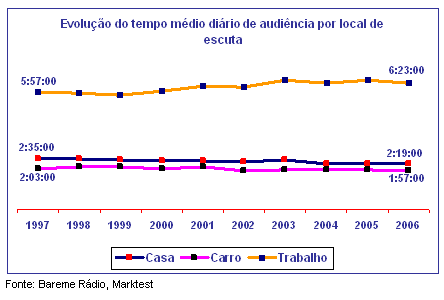
Isto abaixo significa que ouvimos rádio 6 horas no trabalho, duas horas e 19m em casa e menos duas horas no carro?

Isto não é contarditório com o que a Marktest disse a semana passada («A observação transversal dos vários períodos, mostra que a casa enquanto local de escuta tem uma curva notoriamente descencente em qualquer momento do dia e, por contraposição, o carro tem uma curva notoriamente ascendente mesmo fora dos períodos normais de deslocação. Ainda segundo este estudo, a perda de escuta em casa é claramente compensada quer pela transferência para o automóvel, quer pela tendência crescente da escuta no local de trabalho»)?

«Detalhando um pouco a abordagem, vejamos agora como se processa a evolução do tempo médio diário de audiência por local de escuta:

Atendendo a que o carro é o local onde mais indivíduos ouvem rádio hoje em dia, é particularmente relevante que o tempo médio setenha mantido próximo das 2h diárias ao longo destes 10 anos abordados. Por outro lado, o local de trabalho apresenta uma tendência de subida, reforçando valores já elevados, enquanto que em casa a ligeira descida verificada é bem menos significativa do que outros aspectos, nomeadamente o peso deste local no total da escuta de rádio, já abordado no artigo anterior.»
fonte: «4,7 milhões de Portugueses ouvem mais de 3 horas de rádio todos os dias», Marktest.com, 13/03/07