Blogia

Transistor kills the radio star?

«Podcast da TSF com 400 mil ‘descarregamentos’ em Fevereiro»

«Lançado em Janeiro de 2006, o serviço de Podcast da TSF registou no mês de Fevereiro o seu número mais alto de ‘descarregamentos’. No total, foram 399.765 os conteúdos retirados do site da estação pelos cibernautas, um valor bem acima do anterior máximo, os 220.363 registados em Janeiro deste ano.

Actualmente, a TSF disponibiliza mais de 20 conteúdos para o seu sistema de Podcast, entre programas semanais e diários, sendo que, de acordo com nota da estação, os programas mais procurados são as entrevistas diárias de Carlos Vaz Marques, em Pessoal e... Transmissível, a crónica Sinais, de Fernando Alves, os comentários Na Ordem do Dia, as sugestões de Evasões e as crónicas políticas de na Linha da Frente»

fonte: «Podcast da TSF com 400 mil ‘descarregamentos’ em Fevereiro», Meios e Publicidade, Hugo Real, 13 de Março de 2007

Origem da expressão «geração iPod»

«iPod Generation» aparece (pela primeira vez?) num relatório da Ofcom com o título «The iPod Generation; Devices and Desires of the Next Generation of Radio Listeners», elaborado por The Knowledge Agency e com data de 23 de Julho de 2004. Nesse relatório não é dada qualquer informação sobre a expressão, mas é uma feita uma caracterização desses ouvintes:

- a média dos possuidores de rádios digitais é de 51 anos. «Younger people are listening to the radio noticeably less than their parents» (18-30 anos)

- «Youth” defined as 18-30 year olds;› Old enough to make their own independent choices and have their own listening patterns;› Old enough to be able to afford at least some of the relevant technology; • Moderate, but not bleeding edge technophiles; – Interested in new technology; – Internet and mobile phone users; – All personally own two or more examples of new technology (MP3, digital camera, PC, Interactive TV, digital radio, etc). • All listen to at least 1 hour of radio per day (mix of stations)»

- “I gave up on radio quite a while ago... I’d much rather listen to my own music... because there’s far less chance of hearing music that I’m going to want to listen to on any radio station”. (20-30 year old working man, Cardiff)

Outros nomes para «geração iPod»

Berry fala em  «wirefree' generation» (Will the iPod Kill the Radio Star?, Richard Berry, Convergence 2006; 12; 144)

«(...) at the Radio Festival 2005.6 A presentation on research carried out for the BBC by Sparkler not only discussed a fall in radio listening amongst 16–29-year-olds in the previous two years but, like OFCOM, gave radio’s lost audience a name: the ‘digi-life generation’: an audience which has grown up knowing digital choice, computers, the internet and mobile telephones (Gallie and Robson, 2005).7 This is an audience which communicates via text messages (SMS) and instant messaging and for whom using technology is easy and second nature. It is clear that for radio as a business to develop it should recognize these fundamental changes in the lifestyles and expectations of the audience. My own conversations with students reflect what the industry is hearing in their research. Young people are disconnected by contemporary broadcast radio and seek out new forms online or choose their own music over radio. Most cite poor commercials, overly tight playlists and stations that do not target them directly as their reasons for not tuning in as often as the previous generation did. It would seem that the notion of audiences choosing the least objectionable – or the least worst – is over, with no radio being preferable to unsuitable radio (MacFarland, 1997: 17).» Berry, 149

Trata-se de um conceito mais cultural do que demográfico, ou seja descreve mais um período cultural e não tanto todas as pessoas que nasceram depois de um determinado período de tempo ou numa geração. De qualquer forma, insere-se numa certa tradição, com origem nos EUA, de catalogação de pessoas com determinadas características. Douglas Coupland escreveu «Generation X» em 1991 para descrever aqueles que tendo nascido depois de 1970 viveram a sua adolescência nos anos 80, com determinadas características agregadoras (ao nível das experiências, da música, etc). Sucedeu-se a Geração Y, para os nascidos a partir da década de 80.

Não fax sentido falar por exemplo em geração Xbox se a XBox não marcou uma geração

O que é o podcasting (convergência)

«Podcasting is not only a converged medium (bringing together audio, the web and portable media devices) but also a disruptive technology and one that has already forced some in the radio business to reconsider some established practices and preconceptions about audiences, consumption, production and distribution. Whilst Audible was established to provide speech content for these devices, the automation, free access and the radio-like nature of Podcasts contribute to the disruptive nature of the new medium. It is an application of technology that was not developed, planned or marketed and yet its arrival does challenge established practices in a way that is not only unprecedented but also unpredictable.»

fonte: Will the iPod Kill the Radio Star?, Richard Berry, Convergence 2006; 12; 144

«Podcaster and author of one of the many ‘how to’ books on the topic, Todd Cochrane, describes Podcasting as ‘Walkaway Content’ which is a neat and vivid way of describing it (Cochrane, 2004)» (Berry, 145).

Quando uma rádio queria oferecer iPods de prémio...

«Mr. Hanson also suggested that land-based radio had been too slow to respond to satellite radio, which offers access to dozens of commercial-free music channels for a monthly subscription fee and to digital music players, like Apple Computer's iPod. He said that he balked when a supervisor suggested running an on-air contest to give away an iPod loaded with 949 songs. (Zeta's frequency was 94.9-FM.) "I was like, 'Then they don't need to listen to Zeta anymore.' " Mr. Hanson wound up forgoing the contest.»

fonte: New York Times, «Fade-Out: New Rock Is Passé on Radio», By JEFF LEEDS, April 28, 2005

Rádios em crise com a música (EUA)

«Ratings for rock radio stations have been languishing for years. The share of the 18-to-34 age group that is tuning in to alternative stations has shrunk by more than 20 percent in the last five years, according to Arbitron, while stations playing rap and R&B or Spanish-language formats have enjoyed an expanding audience. As a result, many rock programmers aren't sure what to play. "The format in the last couple of years has gone through an identity crisis," said Kevin Weatherly, program director of KROQ, a closely watched alternative powerhouse in Los Angeles. "You have stations that are too cool, that move too quickly and are only playing the coolest music, which doesn't at the end of the day attract enough of the audience. Or you have the other extreme, dumb rock, red-state rock that the cool kids just flat out aren't into." (...) Some analysts fear that, when radio stations switch from alternative rock to programming aimed at older listeners, they may be making a sacrifice. "Radio has ceded the younger demographic to other media," said Fred Jacobs, president of Jacobs Media, a radio consulting company in Southfield, Mich., specializing in rock. "I just don't know how we're going to get back people who didn't get into the radio habit in their teens," he said, adding, "It really becomes problematic down the road."».

fonte: New York Times, «Fade-Out: New Rock Is Passé on Radio», By JEFF LEEDS, April 28, 2005


ser nº 1 no myspace mais importante do que rádio e MTV

«Bands are no longer dependent on top 40 playlists and MTV to get their music out. The under 25 generation shares ideas and music on the internet and social networking sites like My Space are changing the music industry.  "Today if you're number one on My Space, that's more important than MTV and radio combined," says author Gerd Leonhard» (fonte: «THE END: RADIO», CBC Newsworld, ?)

«Prosumer», por Alvin Tofler

«In the 1980 book, The Third Wave , futurologist Alvin Toffler coined the term prosumer when he predicted that the role of producers and consumers would begin to blur and merge (even though he described it in his book "Future Shock" from 1970). Toffler envisioned a highly saturated marketplace as mass production of standardized products began to satisfy basic consumer demands. To continue growing profit, businesses would initiate a process of mass customization, that is, the mass production of highly customized products» (fonte: wikipedia)

Consumidores querem mais protagonismo

«Encouraged by available bandwidth and interactive multimedia possibilities, consumers are now clamoring for new roles. Those Gadgetiers and Kool Kids* that we just mentioned are not only interested in consuming content in new ways – they also want to create, manipulate and mash it. Between July 2005 and July 2006, five of the ten fastest growing Web sites were portals for user-generated content: imageShack.com, Heavy, Flickr, MySpace.com and Wikipedia [“Social Networking Sites Grow 47 Percent, Year Over Year, Reaching 45 Percent of Web Users, According Nielsen//Netratings.” PR Newswire. May 11, 2006]. Consumers are clearly passionate about being editors, producers and directors. The falling prices of sophisticated media editing and recording equipment and software have put the tools of the trade within reach of almost any aspiring talent or wannabee. The result is a blurring and merging of the roles of producer and consumer, or a “prosumer,” as coined by Alvin Toffler [Toffler, Alvin. The Third Wave. Bantam Books. March 1980]».

fonte: «Navigating the media divide», IBM Institute for Business Value, 2007

* Expressão usada inicialmente num estudo da IBM, «Berman, Dr. Saul J., Niall Duffy and Louisa A. Shipnuck. “The end of television as we know it: A future industry perspective.” IBM Institute for Business Value. January 2006» cujas características essenciais são:

«Kool Kids, who also prefer interactive and mobile media experiences and rely heavily on content sharing and social interaction. It is these last two groups of consumers – the Gadgetiers and Kool Kids – that will likely lead the way with multichannel entertainment consumption.» (...) «Kool Kids think and act much differently than the other two segments. To them, devices and services are all about fashion and making a statement. Form matters more than function. However, they’re young – and their wallets are much skinnier than those of Gadgetiers, making price an issue. Their social networks tend to be faddish, rising and falling out of favor quickly». Ou «Kool Kids. Marcus, age 13, and Semana, age 15, are brother and sister. Both were exposed to high bandwidth networks as very young children and they experiment unflinchingly with media and platforms. While they have little disposable income, they follow all the latest gadget crazes. The mobile device is the centerpiece of their lives and they text message while doing one, two or three other tasks. Though their parents refuse to allow it in their presence, Semana and Marcus even do instant messaging on the TV set while watching favorite shows. Marcus uses his tech-savvy to try to bypass network blocks and content encryption in order to rip and share content. Likewise, Semana doesn’t worry about piracy warnings as she trades copies of CDs with her friends. Without thinking about it, both are heavily invested in media experiences and spend much time seeking TV episodes, current films and hard-to-find, cool niche content. Like practically all their friends, these teenagers have posted detailed profiles to several social networking sites, relying on those connections for media recommendations and most other aspects of their lives»

Necessidade de relativizar as previsões («adopção hesitante»)

«Although having the right kind of access and device is clearly a prerequisite for new media experiences, and very often an incentive to try new experiences, it is in no way a guarantee of actual consumer uptake. When a device enters the market, consumers may initially ignore some of its advanced features or use it in surprising ways. If the device is not easy to use, has limited functionality or does not really fit the user’s lifestyle, it will likely sit idle or underutilized. Examples of hesitant adoption are plentiful. Of the 15 million U.S. households with highdefinition television (HDTV) sets at year-end 2005, only 50 percent subscribed to HDTV content service plans. Likewise, of the 270  million Internet-enabled mobile phone users in Western Europe, only 20 percent were using their phones’ Internet capabilities.» NOTA: não se aplica ao iPod...

fonte: «Navigating the media divide», IBM Institute for Business Value, 2007

As duas principais tendências de ruptura com os meios convencionais

« (...) two trends as particularly disruptive to mainstream media: the rising popularity of user-created content and the move toward open distribution platforms. In fact, these two axes of change clearly delineate the old and new worlds of media. In the traditional world, content produced by professionals and distributed through proprietary platforms still dominates. But in the new world, content is often user-created and accessed through open platforms. These polarized tendencies mark the clear and present conflict between incumbents and new entrants.»

fonte: «Navigating the media divide», IBM Institute for Business Value, 2007

São os jovens que estão a impulsionar o mercado

«A new media world has arrived. Pioneered by teens and gadget-savvy professionals, it has quickly spread into virtually every consumer segment, and started to encroach on traditional media. The number of unique visitors to MySpace.com has now surpassed the 50 million mark – something akin to the number of U.S. households that tune into the Super Bowl. Every day, consumers around the world watch about 100 million videos on YouTube – putting that number in context, the top 15 British primetime television shows combined attract about 100 million viewers, as do the top 4 U.S. shows.»

fonte: «Navigating the media divide», IBM Institute for Business Value, 2007

O «mass-media model» Ouvintes passivos

INTRODUÇÃO AO PONTO 5« (...) with a small number of well-funded speakers and hordes of passive listeners. Within a short period, however, a combination of technology, business practices and regulatory decisions did in fact settle the model» (Benkler, 2006: 192)

A rádio como um meio muito controlado

«Radio, and latter television, was a more tightly controlled medium than was the printed press» (Benkler, 2006: 190)

BENKLER, Yonchai (2006). The Wealth of Networks: How Social Production Transforms Markets and Freedom. New Haven: Yale University Press

Rádios do EUA multadas por «subornos» (payola)

«Exasperated listeners weary of hearing the same songs over and over on the radio may have something to cheer about: a pair of innovative deals that could shake up the music playlists of some of the nation's largest radio-station chains.
Four major radio broadcast companies have tentatively agreed to pay the government $12.5 million and provide 8,400 half-hour segments of free airtime for independent record labels and local artists in separate settlements aimed at curbing the persistent practice known as "payola,'' according to sources.
Payola - generally defined as radio stations accepting cash or other consideration from record companies in exchange for airplay - has been around as long as the radio industry and was made illegal following a series of scandals in the late 1950s.
Two Federal Communications Commission officials, who spoke on condition of anonymity because final language has not been approved by the full commission, said the monetary settlement is part of a consent decree between the FCC and Clear Channel Communications Inc., CBS Radio, Entercom Communications Corp. and Citadel Broadcasting Corp.
The settlement between the government and the four broadcasters was reached in conjunction with a separate deal designed to lead to more airtime for smaller record companies and their lesser-known artists as well as local musicians.
The American Association of Independent Music, a group of independent record labels, has received a commitment from the same four broadcasters for the free airtime, the sources said.
In addition to airplay, the broadcasters and the independent labels have also negotiated a set of "rules of engagement'' that will guide how record company representatives and radio programmers interact.
The free airtime would be granted to companies not owned or controlled by one of the nation's four dominant music labels - Sony BMG Music Entertainment, Warner Music Group, Universal Music Group and EMI Group.
The practice of payola, or "pay-for-play,'' has evolved over the years and become more difficult to track.
In recent years, "independent record promoters'' have acted as middlemen to deliver payments to radio stations in exchange for airplay. Other forms of inducement include lavish prizes meant for listeners that wind up going to station employees; promises by record companies of concerts by well-known artists in exchange for airplay; and payments for promotional expenses and station equipment.
Under the FCC consent decree, broadcasters would agree to closer scrutiny in their dealings with record companies, including limits on gifts, a promise to keep a database of all items of value supplied by those companies, the employment of independent compliance officers to make sure stations are following the rules and even a new "payola hotline'' for employees to report infractions.
Broadcasters admit to no wrongdoing under the three-year settlement, which has not yet been made public»

fonte: «Stations To Pay $12.5M In FCC Settlement» Billboard.Biz, March 05, 2007, By Associated Press

Rádio temática ultrapassa pela primeira vez a generalista (Espanha)

«Nunca la radio en España había tenido tanta audiencia como en 2006, hasta alcanzar un total de 20.897.000 oyentes, unos 400.000 más que el año anterior. Sin embargo, esta evolución se produce gracias a un cambio en los gustos favorable a las emisoras temáticas, que compensa de sobra la pérdida de oyentes de las generalistas. Hasta el punto de que en 2006 hubo ya más oyentes de radio temática, concretamente 11.007.000 oyentes, un 5 por ciento más que el año anterior, frente a los 10.942.000 de las cadenas generalistas, que se dejaron casi 330.000 oyentes en el último año.
Según un estudio de audiencias del medio radio realizado por Mass Media sobre datos del EGM, el vuelco en el liderazgo de la radio española para las emisoras temáticas se produce tras cuatro años de cerrada pugna con las emisoras generalistas, en los que las diferencias entre unas y otras apenas alcanzaban el millón de oyentes. La radio generalista tuvo su apogeo en 1995, cuando totalizaba 13.894.000 oyentes. Ese año, las emisoras temáticas sólo contaban con 8.343.000 segudiores.
(...) El seguimiento de radio temática se realiza de forma abrumadora sobre radiofórmulas musicales (10.217.000 oyentes) y de forma muy reducida para las temáticas informativas (1.164.000 oyentes), según el informe publicado hoy, recogido por OTR/Press.
Si en oyentes gana la radio temática, en tiempo de escucha la situación aparece totalmente igualda, con 54 minutos de promedio diario de escucha, tanto en generalistas como entre temáticas. También en este caso ha ido descendiendo el tiempo de escucha en las primeras y subiendo en las segundas. En 2003 la escucha promedio de radio temática llegó al record de 55 minutos diarios, pero entonces la radio generalista llegaba a 59.

LA RADIO SIGUE SUPERANDO A LA TV EN MADRUGADA Y MAÑANA

En comparación con la televisión, la radio sigue ostentando hegemonía en audiencia en una parte significativa de tramos horarios. Concretamente, entre las dos de la madrugada y la una y media d ela tarde la hegemonia es de la radio, con audiencias que llegan a picos superiores a los 6,9 millones de oyentes a las diez de la mañana, con división entre generalista y temática en proporciones similares. El 37 por ciento de la audiencia de la radio es en la mañana. El mayor consumo en radio temática se produce por la tarde y el de generalista por la noche. Por perfil de oyentes, destacan los hombes de más dd 35 años de clase alta y media alta en radio generalista, y de 14 a 44 años de clase alta y media en radio temática. Por comunidades, destaca el alto consumo de centro y norte peninsular»

fonte: «La radio temática logra superar en número de oyentes a la generalista», Granada Digital, 08/03/2007, OTR PRESS 

NOTA: para os eventualmente interessados gostaria de alertar que rádio generalista em Espanha não é o mesmo que rádio generalista em muitos outros países (Estados Unidos, por exemplo) e que, tratando-se de uma espécie de corruptela histórica da expressão, estamos de falar de formatos adultos (Cadena Ser, Cope, ONce, etc.); ou seja de um segmento de ouvintes e não de programação para todos os ouvintes. Mais aqui, se interessar.

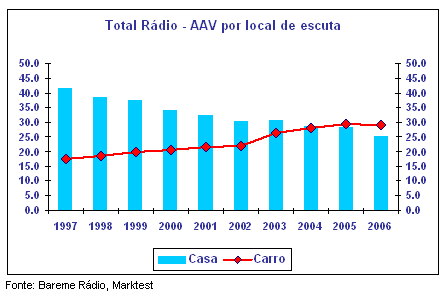
«Portugueses ouvem cada vez mais rádio no carro»

«A rádio em Portugal tem vindo a cimentar as suas potencialidades e a registar uma tendência de aumento do consumo no carro, segundo os dados do Bareme Rádio da Marktest. O estudo permitiu concluir que o consumo de rádio está cada vez mais «colado» aos ritmos de deslocação diária das populações, ganhando por isso a escuta no automóvel uma importância cada vez mais evidente. Consequentemente, refere o estudo, assiste-se à concentração da escuta em dois períodos do dia - entre as 08:00 e as 10:00 da manhã e entre as 17:00 e as 20:00 da tarde - períodos normais de deslocação casa/trabalho e vice-versa. A observação transversal dos vários períodos, mostra que a casa enquanto local de escuta tem uma curva notoriamente descencente em qualquer momento do dia e, por contraposição, o carro tem uma curva notoriamente ascendente mesmo fora dos períodos normais de deslocação. Ainda segundo este estudo, a perda de escuta em casa é claramente compensada quer pela transferência para o automóvel, quer pela tendência crescente da escuta no local de trabalho. Entre 1997 e 2006 o consumo de rádio em casa decaiu cerca de 39%, enquanto que a escuta de rádio no carro subiu, no mesmo período, 65%. O automóvel é desde 2005 o local onde mais portugueses ouvem rádio. Ou seja, a primeira evidência é a de que a rádio tem deixado progressivamente o lar e passado para o automóvel. »

fonte: Portugueses ouvem cada vez mais rádio no carro 07-03-2007 13:40:24

O texto da marktest


Indústria radiofónica não quer fusaõ no satélite

«Former US attorney general John Ashcroft is now rallying against the proposed merger between Sirius and XM, though onlookers are questioning his motivations.  Ashcroft was recently hired by the National Association of Broadcasters (NAB) to battle against the tie-up, part of a larger effort by the terrestrial radio group to dissuade merger approval.  In a letter to current attorney general Alberto Gonzales, Ashcroft pointed to a dangerous merger that "reduces the number of competitors from two to one," and warned that the plan "raises most serious competition concerns."  In the attack, Ashcroft also likened the proposed marriage to the unsuccessful merger attempt between satellite television providers DirecTV and EchoStar, a rejection that will continue to hover over the ongoing review process» (Digital Music News, 4/03/07, Ashcroft Jumps Into Radio Battle, Joins Terrestrial Camp)

Mais:

BusinessWeek "Ashcroft attacks Sirius-XM deal"

Wall Street Journal "XM: Ashcroft Offered Services To XM Before Being Hired By NAB"

canais na internet (EUA) podem acabar por causa da nova lei dos direitos?

Continuam as ondas de choque provocadas pelo anuncio de novas tabelas no pagamento de direitos de autor para os canais de streaming (basicamente: os aumentos podem chegar a mais de 100 por cento; antes o valor era calculado por uma lei de 2002, cada rádio na net pagava, por musica e por ouvinte, 0,07 centimos; lei essa que deixou de valer em 2005; a nova proposta fala em aumentos -retroactivos - de 00,7 para 0,08 centimos de dolar, crescendo até atingir os 0,19 centimos em 2010; mais a taxa fixa anual minima de 500 dolares; é citado o exemplo da AccuRadio, com mais de 300 estações, que gerou em 2006 receitas de 400 mil dolares; terá de com esta proposta de lei 600 mil dolares em direitos)

Há que os que resistem, para contrariar: «Faced with last week's Copyright Royalty Board decision, which threatens to shutter the huge majority of Internet radio operations in the U.S., webcast audiences are rushing to respond, signing online petitions and calling the attention of their elected officials to the Webcasters' struggle. There are already a number of destinations for Internet radio listeners to support Webcasters in their fight against this latest ruling. Below is a list of sites where Webcasters and audiences alike can discuss the ruling, contact members of Congress, and generally contribute to helping to keep Internet radio online» e há os que fazem contas: «Larger services that offer thousands of channels, such as the free Pandora, are also facing a huge spike in royalty costs. Kurt Hanson, publisher of RAIN and CEO of AccuRadio, went so far as to speculate that Pandora, which is based in the United States, could "disappear" as a result of the new rates. Overseas competitors like Last.fm, which is based in London and removed from the board's restrictions, could easily claim Pandora's market share» (fonte: Wired News, By Eliot Van Buskirk 08:00 AM Mar, 06, 2007)

Na Business Week: «The decision, due to take effect sometime during the next two months, could raise royalty fees paid by some online radio stations more than tenfold—enough to put many smaller stations out of business, Hanson says. Currently, most small Webcasters have paid royalties calculated as a percentage of revenue. Under the new rule, those outfits will begin paying on a per-song, per-listener basis. "The more intensively an individual service is used and consequently the more the rights being licensed are used, the more the service pays, and in direct proportion to the usage," according to the 115-page ruling.  Here's what the change will mean for AccuRadio. The station employs six full-time staff members and records about $500,000 in annual sales, mostly from advertising. Of that, Hanson pays record labels about $50,000 in royalty fees. The rule change, which will impose fees retroactively, will jack up royalty fees to more than $600,000 for 2006. Other Webcasters will be in the same boat. "I don't think any of the operators would break even," Hanson says. "Internet radio is in danger of becoming extinct," shouts a headline posted on the company's Web site, urging listeners to sign a petition or send a message to Congress. "The rates are so high that they exceed 100% of most Webcasters' total revenues!"»