Blogia

Transistor kills the radio star?

As novas opções da industria musical (streaming e telemóveis)

«By mid-2007, when the majors realised that digital downloads were not growing as quickly as they had hoped, they landed on a more adventurous digital strategy. They now want to move beyond Apple's iTunes and its paid-for downloads. The direction of most of their recent digital deals, such as with Imeem, a social network that offers advertising-supported streamed music, is to offer music free at the point of delivery to consumers. Perhaps the most important experiment of all is a deal Universal struck in December with Nokia, the biggest mobile-phone maker, to supply its music for new handsets that will go on sale later this year. These “Comes With Music” phones will allow customers to download all the music they want to their phones and PCs and keep it—even if they change handsets when their year's subscription ends. Instead of charging consumers directly, Universal will take a cut of the price of each phone. The other majors are expected to strike similar deals.

“‘Comes with Music' is a recognition that music has to be given away for free, or close to free, on the internet,” says Mr Mulligan. Paid-for download services will continue and ad-supported music will become more widespread, but subsidised services where people do not pay directly for music will become by far the most popular, he says. For the recorded-music industry this is a leap into the unknown.»

fonte: From major to minor Jan 10th 2008 From The Economist print edition

Os diferentes tipos de serviços de streaming musical

Apenas musica em streaming: PANDORA ou JANGO

«Pandora and Jango, for example, are commercial-free sites that let users enter an artist's name or a song title into the search bar on the Web site. Then the site creates a "radio station" that plays similar types of music. So type Miles Davis into one of these sites, and you might hear selections from Thelonious Monk and John Coltrane. You can rate songs to fine-tune what type of music is played. Since these are free streaming sites, users can't look up a specific song title and play it. And while the songs can't be downloaded, both sites have links that will take you to Apple Inc.'s iTunes or Amazon.com Inc. to buy a particular title.»

MOTORES DE PESQUISA:  SEEQPOD, SONGZA, SKREEMR

«They look specifically for audio recordings on Web sites, including personal pages and blogs. Examples include SeeqPod, Songza and SkreemR, all of which are free.They're not the best way to discover new music, but they can help you find a song you haven't heard in a while or a title someone recommended to you. (...) The search engines seek out songs available in digital formats on Web sites. Not all the songs have the best sound quality - some are recordings taped by a concertgoer.»

PAGINAS DE REDES SOCIAIS: IMEEM, LASTFM, ILIKE, My STRANDS 

«A number of music sites are integrating social-networking functions into their sites to share music. Some of the biggest players are imeem, Last.fm, iLike and MyStrands. These sites feature libraries of music and videos that users can browse through and play. Some songs are available only in 30-second snippets, while others are full-length recordings.Like Facebook, the popular social-networking site, users at these music sites can set up profile pages, add a photo, tell a little bit about themselves and declare their musical tastes. They can also make "friends" with other site users.»

fonte: Internet making it easy for music fans to stay tuned in By Joseph De Avila , The Wall Street Journal Monday, March 10, 2008

o que a net fez à (indústria da) música

«(...) The music industry has been transformed since Berry's teenage years. While total album sales continue to plummet - down 15 percent last year from 2006, according to Nielsen SoundScan - music is more ubiquitous than ever, thanks to digital technology.Sales of digital-music tracks from services like iTunes and Amazon.com continue to be a bright spot for the record industry. Last year, 844.2 million tracks were purchased, up 45 percent from 2006, according to Nielsen SoundScan. (...) to reach casual fans, several Internet sites have developed easy, typically free ways for music lovers to cut through the clutter: music search engines, music-streaming sites and music-based social networks. Some musical artists are using these sites to connect with their fans on a more personal level, too.» fonte: Internet making it easy for music fans to stay tuned in By Joseph De Avila , The Wall Street Journal Monday, March 10, 2008

«the results from 2007 confirm what EMI's focus group showed: that the record industry's main product, the CD, which in 2006 accounted for over 80% of total global sales, is rapidly fading away. In America, according to Nielsen SoundScan, the volume of physical albums sold dropped by 19% in 2007 from the year before—faster than anyone had expected. For the first half of 2007, sales of music on CD and other physical formats fell by 6% in Britain, by 9% in Japan, France and Spain, by 12% in Italy, 14% in Australia and 21% in Canada. (Sales were flat in Germany.) Paid digital downloads grew rapidly, but did not begin to make up for the loss of revenue from CDs. More worryingly for the industry, the growth of digital downloads appears to be slowing.»

fonte: From major to minor Jan 10th 2008 From The Economist print edition

(5.0 Intro) O pecado capital (inevitável?) de um velho meio chamado rádio

Ninguém imaginaria, há dez anos, quando se começaram a colocar os primeiros canais de streaming em simultâneo com a emissão hertziana (simulcasting) que isso se viria a revelar o pecado capital. Meditsch já tinha avisado: quando tiver imagem deixa de ser rádio. Mas o fascinio exercido pela descoberta, o avançar muito timida e lentamente e a própria força do novo meio - a Internet - fizeram com que se tornasse inevitável: ao princípio era apenas um endereço URL onde estava a emissão online, mas quando se associa a isso um texto, uma foto, vários textos, várias fotos, estamos a criar algo de novo.

Poderia ser algo de novo mas não radicalmente novo, apenas uma evolução, por exemplo. Acontece que a rádio, pelas suas características próprias - recorre apenas a um sentido - e porque a isso foi 'obrigada' para sobreviver depois do choque televisivo, tornou-se um acto de consumo secundário, em acumulação com alguma tarefa primária (conduzir, por exemplo) e - para que isso fosse possivel - extremamente passivo.

Quando a rádio nos 'pede' que passemos a ver (textos ou imagens), obriga-nos a fazer o corte consigo própria, com a sua estruturação mais sólida: e ver já não se compadece com acumulação. à medida que mais conteúdos engrossam a página da rádio, perde-se também a passividade.

Dir-se-á que haverá sempre espaço para um consumo áudio passivo e em acumulação. Mas a ideia deve ser substituída por uma outra: haverá cada vez menos - sobretudo se nos centrarmos na rádio musical. É que a Internet não interveio apenas no mundo dos meios de comunicação clássicos. A sua afirmação fez-se explodindo em diversas áreas, uma delas a da indústria musical. A partir do momento em que a música passou a poder ser digitalizada, guardada em com,putador e enviada facuilmente por ficheiros, sugiram também os leitores digitais de áudio - que vieram disputar um espaço onde a rádio era monopolista: o da escuta portátil e em acumulação. Não interessa, neste contexto, quem vai ganhar, mas há o que antes não havia, concorrência. Mesmo no carro, templo de domínio quase exclusivo da rádio, há cada vez mais conectividade com outros aparelhos - até televisão -, sendo que não demorará muito até que o auto-rádio seja um leitor multimédia ligado à internet.

A rádio, tal como a vemos e conhecemos hoje, ou seja o consumo passivo, ficará cada vez mais restrito a determinadas situações - sobretudo quando a ideia é ouvir música. Em alternativa há um novo meio, inventado a partir da Internet, e que a rádio potenciou sem imaginar as consequências, que põe todas essas características em causa.

Depois de cometido o pecado capital, a rádio - entendida como industria estruturada - não consegue parar e acentua a tendência: é que a ambição da página na net é proporcional ao investimento realizado (não só ao nível de servidores como de meios humanos afectos a esse trabalho); e como o negócio só é viável se rentável, a ambição nos conteudos será depois proporcional às estrategias que vierem a ser encontradas para levar os consumidores para essa página, para esses conteudos; já não será possivel parar!

Dir-se-á: é como a televisão; o video não vai matar a televisão, tal como hoje a conhecemos. Falso. O video, resultado da evolução trazida pela Internet, muda hábitos de consumo de televisão, mas não significa um corte radical na forma como se consome. Ver televisão ou ver videos na internet é e sempre será um acto primário. O video faz evoluir a televisão. O video faz criar um novo meio a partir daquilo que ainda hoje se chama rádio.

(ESTE MOMENTO É DE TRANSIÇÃO, ENTRE O QUE ERA - E QUE AINDA SE VÊ, CADA VEZ MENOS PURAMENTE - E O QUE VIRÁ A SER; É O MOMENTO DA COEXISTÊNCIA, DA CRISE DE IDENTIDADE, DAS DESCONFIANÇAS, DOS ENTUSIASMOS E DAS DEPRESSÕES, DAS PREVISÕES IMPOSSIVEIS E DOS FUNERAIS QUE NUNCA SE REALIZARÃO; É UM MOMENTO QUE NÃO VAI DURAR MUITO E QUE É UM PRIVILÉGIO VIVER; POR SER DE TRANSIÇÃO TORNA-SE MAIS NECESSARIO CONHECER OS CAMINHOS QUE SE PODERÃO TRILHAR NO FUTURO; É ISSO QUE O TRABALHO PRETENDE) 

A rádio continuará a ser passiva?

«Radio is in essence, a passive experience. This is a good thing. However, because the Internet invites so much interactivity, some people believe that radio should also be interactive. However, radio that requires or expects that I interact with it is not what I'm looking for. I like being able to do other tasks while enjoying radio. I can do my work, I can drive the car, I can make dinner, I can read, I can socialize with my friends. All while listening to radio. Radio relaxes me. Anything requiring interaction»

Um novo conceito de programação

«24/7 programming is so yesterday. If you really want a view of one aspect of new radio, keep in mind that the next generation has a short attention span. They are not like us. They won't carry a transistor radio or Walkman around and plug into live radio programming. They are used to listening in shorter segments and they're now accustomed to more variety -- which brings me to the next disconcerting reality of the new age. New radio will be TiVo. This generation -- the one we've driven off, neglected and insulted -- is big into time delayed entertainment. Don't knock it. We are, too. That's why many of us have TiVos or DVR devices. (I watched the Flyers-Maple Leafs game played in Philly from my Arizona home the other night because the time difference makes it hard for me to have a life and watch the hockey games. Flyers lost so I could advance past all the replays of Maple Leaf goals. Who wants live when you can watch when you want and control the experience?). The next generation will decide when to listen to new radio, start it, stop it, advance it, rewind it. Radio stations have lost that power with this generation. (Anyone hyper-ventilating, yet?)»

Rádio, «o negócio das imagens»

« Radio is no longer just audio. If you want to limit yourself to that definition, you lose because the next generation is over it. They want to see, hear and read whatever they want whenever they want it. Try to imagine that someday a new age radio company (I can dream, can't I?) says, we can do this. No longer just audio. We're in the picture business. We can deliver text. Video

Banda larga domina a net em Portugal

«Os dados mais recentes do estudo Bareme Internet da Marktest mostram que, no Continente, 93% dos lares com acesso à internet navegam através de ligações de banda larga. O relatório anual de 2007 do Bareme Internet, o estudo de base do Netpanel, contabiliza 1 456 mil lares em Portugal Continental que acedem à internet em banda larga, um número que representa 41.5% do universo de lares em estudo e 93.2% dos lares que têm acesso à internet (estimado em 1 562 mil lares). Uma análise evolutiva mostra que a penetração deste tipo de ligação aumentou mais de 11 vezes nos últimos cinco anos, passando de 3.6% em 2002 para os 41.5% agora observados.»

93% dos lares “ligados” acedem por banda larga Marktest.com, 13 de Março de 2008


Um pagamento por cada música (Pandora)

O modelo de funcionamento do Pandora: «We pay a licensing fee for every song that we stream, which was determined by the Copyright Royalty Board. And the royalty board just voted to almost triple those fees within the next couple of years. So overnight, they’ve made webcast radio pretty much impossible. It’s impossible, at these new rates, to really operate a radio station online»

Dois novos modelos da Sony Ericsson com rádio

«Os fãs de rádio nunca foram tão apaparicados pela Sony Ericsson! De uma vez, a empresa apresenta dois novos modelos, o R300i Radio e o R306i Radio, que combinam as frequências AM e FM num aparelho semelhante a? um rádio!
 
Os altifalantes de ambos os modelos estão adaptados à rádio e as teclas predefinidas mudam facilmente de frequência. O R300i Radio candybar tem câmara VGA; já o R396i Radio é um concha com dois altifalantes de alta definição e uma câmara de 1,3 MP. Ambos os modelos possuem Bluetooth.
 
A marca está persuadida de que o grupo de fãs de rádio está a aumentar e nada mais acertado do que satisfazer esse público com dois terminais móveis que podem oferecer uma melhor experiência de rádio. Ambos os modelos vão ser comercializados este ano: o R300i a partir do segundo trimestre por cerca de ? 110 e nas cores Antique Copper e Steel Black; o R306i a partir do terceiro trimestre, por cerca de ? 120 e nas cores Coffee Black e Shampagne White.»

«We7 é o futuro da indústria musical?»

«(...) the music industry is at a critical juncture: adapt or die. We7 is a music download website that hopes to set the tone for the music industry in the 21st century. It thinks it has found a way to make music available for free and yet still generate revenue for record companies and artists. People want to be able to access and use music in an ever greater number of ways, while artists and record companies want to ensure that they get paid when people use their product. It is now accepted that DRM is too restrictive and impractical to manage, so a new way is needed. (...) We7 was founded less than a year ago, when [steve] Purdham was exploring an investment in music download company OD2. He found himself in a room with VC John Tatham (who’s idea We7 originally was) and musician Peter Gabriel, who had founded OD2 back in 1999. (...) The turning point was last Christmas, when the majors realised that DRM was dead,' said Purdham. ‘Most tracks aren’t DRM protected anyway, with CDs and BitTorrent-type downloads being the source of the majority of music.’ (...) So if you can’t make people pay for music, how do you make money out of it? 'It’s all about choice,' says Purdham. 'Our philosophy is: come to the site, listen to the track and then decide how you want to pay for it. 'We have an ad-funded alternative, which allows us to target advertising at our users, who have to register in order to access our services. This ability to target is very valuable to advertisers. We can also dynamically graft audio ads to the start of the music file, which stay with you when you download it.' Of course, HEXUS.channel wasn’t about to just take Purdham’s word for it so we created an account and downloaded BB King’s Woke Up This Morning. On playing the MP3, we had to sit through a ten second audio ad for Altec Lansing speakers and then it was straight on to BB. We have to report that we were unable to make the streaming function work, but it’s unclear where the fault lies for that. »

fonte: «Is We7 the future of the music industry? Hexus Channel Scott Bicheno - 12 Mar 08

Mais empresas com acordos digitais (música)

«Digital distribution industry leader finetunes and Qtrax, the world's first free and legal peer-to-peer (P2P) music service, today announce that they have signed a digital licensing agreement. For more than four years, finetunes has been a pioneer in creating opportunities for independent labels in the digital music markets. Initially focused on providing digital solutions for the German independent labels, the Hamburg-based company now represents more than 1,000 record labels from around the world.» CNN Money.com, finetunes and Qtrax Sign Digital Licensing Agreement March 12, 2008

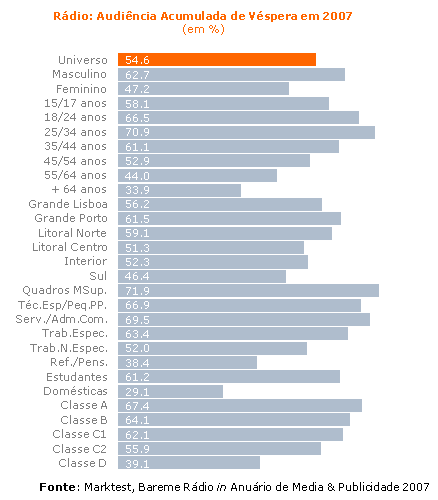
Os jovens são os que ouvem mais (Portugal)

18-24 66,5%

25-34: 70,9 %

Isto sim, é isto é que as rádios de música devem fazer

«Lincs FM will becomes the first radio station in the UK to launch an innovative new music download service, called Catch.
From tomorrow, listeners can text a five digit number while listening to the station. The station then sends back a text identifying the name of the artist and track currently being played.
A personalised web page is created where listeners can access a list of all their favourite music. They can download their chosen songs by entering their mobile phone number on the station's website.
The new service also includes a fully searchable online music store with access to over three million songs, while listeners can browse station playlists by show, hour or day and preview presenter recommendations.
Catch was founded in 2005 to work with radio stations by providing a mixture of free and paid services to listeners. Keith Briggs, Director of Operations and Presentation at Lincs FM said: “We are very excited at being the first station in the UK to roll out this service and we believe it’s something our listeners will get a lot of enjoyment from.”
Last year UBC Media launched a similar service named Cliq, whilst GCap also previously trailed a 'Hear it, Buy it, Burn it' service.»

fonte: «Lincs FM Catches Listeners Radio Today Industry News reported on Tuesday 11 March 2008.

«GWR will supply GMG Radio with a bespoke service that will enable listeners to its JAZZFM, Real Radio and Smooth FM stations to legally download music via the internet that they hear broadcast on air.The service, which will launch first on Real Radio in Wales, Scotland and Yorkshire at the end of January 2005, will mean listeners can download thousands of songs in CD quality to their computers in under two minutes, listen to them and burn them onto a CD if they wish. John Simons, Group Programme Director of GMG Radio, said: “This service will offer our listeners a whole new and instant way of buying the music they love.”»

«UBC Media plc (UBC:L) today announces that it is to name its Instant Music Buying Service ‘Cliq’. The service will allow consumers to instantly buy the music they like as they hear it on the radio. The system works by broadcasting, in a dedicated data channel, a real-time information service with track details and a “buy” button, alongside the radio station’s audio stream.   Cliq is broadcasting in trial form on the digital service of Heart 106.2 in London and UBC is preparing to launch commercially later this year.  The service currently operates on the ‘Lobster’ digital radio mobile phone available from Virgin Mobile.» «And don’t worry, if you’re a song or two behind, CLIQ gives you the option to buy not only the track being played on air but the recently played songs as well. As soon as you buy a song, it’s sent instantly to your very own online CLIQ account for you to download at your leisure; be that saving on to your PC or downloading on to your MP3 player.» 

emissão via net a pagar

XM OFFERS “ONLINE ONLY” SUBSCRIPTIONS

CBS Radio’s deal with AOL Radio, which we reported Friday, will put an end to the online radio partnership between AOL and XM. Now, XM is launching its own online subscription service called XM Radio Online. The subscription service is separate from the satellite service (though satellite subscribers can listen free online), and offers access to XM’s 80 channels of commercial-free music (plus Opie & Anthony, Oprah, etc.) for $7.99/month (with the first six months at $2.99/month). Competitor Sirius has had a subscription online radio service for some time. XM also has limited content deals with AT&T and Alltell wireless, iTunes (for podcasts), and some GPS services. 20 of XM’s channels are available on AOL Radio, but that will end May 1. The Washington Post wrote that Seven of the top 10 radio channels on AOL Radio on Friday were XM stations.

A Internet no carro (BMW)

«Available in Europe soon. Can the US be far behind? And no, it doesn't require WiFi or WiMax.

Click here for the video that explains it all. As CNet's Brian Cooley says, BMW is "the first car company to embrace a factory-optional Internet connection." As one correspondent noted to me, imagine if BMW owners could have their own branded internet radio station with format choices. BMW rocks, Jazz on BMW, BMW plays the classics. When your brand is BMW you certainly don't need Clear Channel.»

fonte: Mark Ramsey

Ainda os modelos de negócio

«A plethora of new and re-tooled sites are offering free ad supported music via streaming and download. Spiral Frog, Qtrax, imeem, We7, iLike...
...YouTube and others each offer their own platforms to listen to almost any song or video on demand and sometimes to even download it. Each service has made their own unique deals with labels and publishers for compensation. Some pay a fee per play or download. Others share a portion of ad revenue received; and rumors have a new MySpace music service trying to compensate labels with stock options.
»

Ainda a chegada do MySpace à musica via streaming

«Assuming our previous conclusion about that labels are asking for more per track than ads can realistically provide is correct then one of three things is happening.  Either the labels are lowering their expectations, Myspace is planning to subsidise their music service, or Myspace believes they can monetise the ads better than We7, QTrax, Imeem and the other providers in this market. I really hope it is the first of these.  Myspace subsidising the market might be good in the short term for consumers, but would be bad for the medium term health of both the music and social networking industries.  Similarly - if they are being more aggressive in their monetisation assumptions I would worry that they may end up losing money. (...)The best I have seen so far, by a mile, is Sweden’s Spotify - a company I haven’t talked about much here because they are somewhat in stealth mode.  The cat seems to be increasingly out of the bag now though.  This post from Varsavsky waxes lyrical about how great their service is. (fonte: Free ad-supported music coming closer to reality, 10/03/08)

O que é que qurem os jovens

The survey, commissioned by Robert Half International and Yahoo! HotJobs, examines the professional priorities of the most senior members of Generation Y or the “Millennials” -- those who have already started a career or will soon start one. More than 1,000 adults between the ages of 21 and 28 were polled for the project. The findings are available in a report, What Millennial Workers Want: How to Attract and Retain Gen Y Employees.

«Quanta escolha os consumidores querem?»

«researchers at the University of Iowa recently found that people who have only a little information about a product are happier with that product than people who have more information. "We found that once people commit to buying or consuming something, there's a kind of wishful thinking that happens and they want to like what they've bought," said Dhananjay Nayakankuppam, marketing professor at UI.» fonte: How Much Choice Do Consumers Want? emarketeer MARCH 10, 2008