Blogia
Transistor kills the radio star?

3.4.3.1 ainda é rádio?

A rádio convencional tem de se reclassificar?

«NAB President/CEO David Rehr wants to re-brand radio and TV to reflect "the new digital industry that we are creating."

In the keynote address of the convention this week, he said, "A new vocabulary will make our industry and our issues even more understandable to policymakers and the public."

Using Ibiquity as an example, he said that once the term "IBOC" was replaced in people's minds by "HD Radio," it was as if a light bulb went on. "People got it. Because they already knew what HDTV meant." He credited the name change as one reason "HD Radio is taking off."»

fonte: «Rehr: Analog Radio, TV Needs Re-Branding, Radioworldnewsbites, 20/02/07

Repensar a rádio (desde a origem)

«Radio is a classic modernist invention in the futurist tradition of the 1910s and 1920s, as evidenced by the early proclamations of the radio fantasists, such as Velimir Khlebnikov, Nicholas Tesla, Howard Armstrong, and cultural critics Bertolt Brecht and Rudolf Arnheim (Strauss, 1993). In the 1920s, before radio's style of electronic writing was fixed in the technical and public imagination, radio theorists imagined drive-in radio (the soundtrack to images projected on walls); internet-like linkages across continents as radio clubs; radio auditoria for public programs in different parts of a country; and radio libraries (Khlebnikov, 1993 [1922]).

The exercise of' rethinking radio - once the task of such artists and cultural theorists - is today in the hands of specialists versed in structuralism and poststructuralism, such as the British radio theorists Andrew Crisell (1986), Peter Lewis (1989), and Paddy Scannell (1996).

Yet radio is still more of a mechanism for bridging or contradicting pre-modern notions of countries and borders; for establishing linkages across epochs and peoples; for introducing unexpected variety or dissonance into presumed harmony than it is a medium of reflexive deconstruction. 

At first glance, digital radio technology pulls radio inextricably toward a postmodern consciousness: the process of production involves a simulacrum, in Baudrillard's terms, of sound as digits without a precise, external referent. (...)»

DAVID KING DUNAWAY, Digital Radio Production, New Media & Society, Vol. 2, No. 1, 29-50 (2000)
© 2000 SAGE Publications
  

O risco da rádio optar pelo video (e deixar de ser rádio)

De acordo com Mark Ramsey:

«Sirius will surely face competition from other delivery systems, but - as I have often said - when there are multiple ways to deliver content to consumers it's the strongly branded content - the good stuff, the cream of the crop - that will rise to the top.» OU seja, «When satellite radio isn't satellite radio...it's Sirius Backseat TV.» (fonte; MR, «When satellite radio isn't satellite radio...», 31/04/07)

«My only concern with Sirius Backseat TV: there are tons of ways for a substitutive product to overtake them in the marketplace. Yes, it's live streaming content while on-the-go, but - as the iPod has shown us - people are just as accepting of a cached solution (especially if it's without a monthly charge). With WiFi-enabled households becoming nearly ubiquitous, what's to stop a device to download new programs while your car is parked in the garage? I'm not saying that Sirius Backseat TV doesn't have potential, but ignoring the competitive risks is silly. But with Nickelodeon, Disney Channel and Cartoon Network on their side - as well as the key OEM partnership with Chrysler - Sirius might have a decent jump on the competition as demand for this type of service grows. (Orbicast, «Initial thoughts on Sirius Backseat TV», 31/03/07

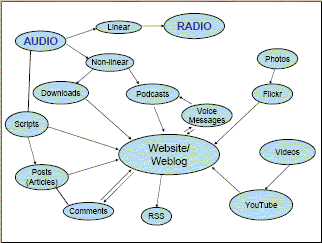
A diferença entre rádio (convencional) e o áudio on line

Project 

fonte: Multimedia meets radio, «10 ideas for a successful multimedia strategy» 27/3/07

Serviço personalizado de notícias nos AUdi (inovador)

«ZURICH, Switzerland, March 27 /PRNewswire/ -- SVOX, a global supplier of text-to-speech output solutions for the automotive and mobile industries, teamed with Audi and the Fraunhofer Institute for Integrated Circuits IIS to demonstrate during CeBIT a real-time transmission chain of the first live in-car reception of NewsService Journaline(R) service over Digital Radio DAB (Digital Audio Broadcasting) according to SVOX CEO Volker Jantzen.
NewsService Journaline is the basis for Audi's Personal News service now in final testing. This "teletext for radio" provides continuously updated information for immediate access. Drivers choose text news sorted by topics from a hierarchically organized menu. Jantzen reports that Audi considers to bring the service to market soon and make it available worldwide based on market acceptance.

The real-time transmission chain consists of the new "Fraunhofer Multimedia DataServer(TM) for DAB R4" by Fraunhofer IIS and DAB receiver technology by Atmel Corporation. The Fraunhofer Multimedia DataServer automatically aggregates content for NewsService Journaline and transmits it using DAB. The powerful SVOX text-to-speech system installed in the car then presents the text messagespreviously transmitted over DAB to the driver.
The service can be managed using the Audi multimedia interface and is easy to personalize. Based on individual preferences, the system chooses only news of interest to the driver. Topics of specific interest can also be bookmarked for an easy and direct access in future.»

fonte: «Audi - SVOX Powers In-Car Digital Radio News Service Developed by Audi and Fraunhofer IIS», Auto Spectator, 2007/3/29

ainda é rádio?

«(...) from Bridge Ratings: '48% of those accessing the Internet via wireless technology seek out Internet radio. The number of Internet radio listeners accessing wirelessly will grow to 77 million by 2010 as wireless technology penetrates the average U.S. lifestyle.' "Wireless" Internet radio is another name for...radio. "Wireless technology" represents not only the WiFi connection on your PC but also - increasingly - your mobile phone, your sixth-generation iPod (just wait), even your portable satellite radio - if it's equipped with WiFi. Bridge is projecting that almost 80 million folks will get at least some of their "radio" need satisfied by "radio-like" content coming to them across numerous distribution channels which are primarily modified versions of the very items they carry today: Your PC, your mobile phone, your WiPod, your XM/Sirius Net Radio - even your new Internet-equipped car "radio."» (Mark Ramsey, Hear2.0, 22/03/07, «The coming wireless Internet radio boom»)

Não, isto já não é rádio...

«O rádio digital não será mais o que é hoje, ou seja, um aparelhinho pra gente apenas ouvir. Ele poderá ter um pequeno display, onde poderemos ver o nome da música e do intérprete (convenhamos: Isso sempre fez falta. Quantas músicas bonitas, alegres ou tristes eu ouvi, e queria saber o nome da música ou do intérprete mas não deram, passou e nunca mais eu soube…). Bem, esse display poderá ser um pouco mais requintado e poderemos ver então a capa do CD (ops! quase digo “capa do disco”…) ou o que seria melhor: a cara do artista. Depois, na hora do noticiário, poderemos ver as fotos das notícias, como se fosse no jornal. Ou, então, até pequenos segmentos de vídeo, em baixa resolução, como, por exemplo, o repeteco do gol do timão. Goooooooooolllllll !!!!

Ei, eu disse “vídeo”? Mas eu não estava falando sobre rádio (digital)?

Mas a TV (digital) vai continuar sendo TV, com som e imagem. E, claro, com funções interativas. Como na Internet? Talvez sim, talvez não, talvez diferente. E imagem de alta definição e som envolvente (surround). Ou então uma imagem mais normal, mas num aparelhinho que vai parecer um livro – você carrega pra lá e pra cá, pára num canto para tomar um lanche, abre o tal “livro”, e pronto: começa a assistir o seu programa favorito, seja ele um noticiário ou o capítulo de hoje da novela. Bacana. E também vai ter uns receptores ainda menores, que você vai poder carregar no bolso – seja para assistir programas numa pequena tela que não chega a dez centímetros de tamanho, seja apenas para ouvir o som, enquanto espera alguma coisa. Sim senhor! TV sem imagem, apenas som… Ei, mas não estávamos falando sobre TV… digital?

Onde termina uma coisa e começa a outra? É, estamos vivendo num mundo em que velhos conceitos não valem mais. Antigamente as coisas eram mais simples. Pão pão, queijo queijo, já dizia o ditado. Eram homens de um lado e mulheres de outro. Hoje em dia as coisas estão mais difusas, vocês entendem, não é?

Vejam por exemplo a proposta do DAB (Digital Audio Broadcasting), na Alemanha. Originalmente concebido para ser um rádio digital (ou seja, basicamente áudio), agora estão começando a transmitir jornais para serem lidos no receptor. Proposta parecida ao do DMB (Digital Multimedia Broadcasting), na Coréia: em vez de áudio, o que se transmite são programas multimídia, de video clips a joguinhos eletrônicos. E o que dizer do DVB-H (Digital Video Broadcasting for Handheld), onde o receptor é mais parecido com um pequeno computador de mão? Mais ou menos como os tais terminais de telefonia celular 3G. Ei, mas não estávamos falando de rádio, quero dizer, de televisão digital? Ah, sei lá. Esse mundo está cada vez mais confuso.»

fonte: Takashi Tome, «TV Digital, Rádio Digital e outras esquisitices no ar». 14/03/07

O video na rádio

«(...) Anyhow, the debate has moved on and the new mantra is that radio journalists don't do video. Apparently, it's one thing to encroach on the territory of print journalists by producing text for the website, but they draw the line at video. That's TV, they claim. Sadly, they still haven't grasped multimedia and don't understand convergence.  Web video is not television - the grammar is completely different. But don't take my word for it, check out the video segments that TV news stations are shovelling onto the Web - a lot of it just doesn't work. But if done properly, online video can target niche groups and exploit the long-tail in ways that are impossible for traditional broadcast media. There is a smilar relationship between podcasting and traditional radio.

(...)BBC Five Live is rising to the challenge by providing images to accompany many of its sporting programmes. I have heard that they are turning Mark Kermode's film reviews into video podcasts. No doubt, some of my colleagues will accuse Radio Five Live of making "cheap television." Pay no attention: for the most part, they are the same people who predicted no-one would ever read a news article online. »

(fonte: Multimedia meets radio, «Why video is a must for radio stations», 19/03/07)

Novos e velhos meios (o hibridismo de McLuhan na actual convergência)

«McLuhan entendia que todo meio novo trata, num primeiro momento, de integrar os meios precedentes e se referir a eles. O termo hibridização foi cunhado na década de 60 para caracterizar as mudanças provocadas pela grande penetrabilidade da televisão. Trinta anos depois, permanece atual e oferece uma oportunidade especiamente favorável à observaçao dos componentes e propriedades estruturais da dinâmica do processo em curso. (...) Por esse conceito é possível entender hoje que as mutações emergentes por hibridização desencadeiam um realinhamento do sistema de comunicação, abrindo caminho para a convergência de processos e práticas. É nesse ambiente de modificações e reciclagens, onde uma forma não subsiste sem a outra, é que estão sendo moldadas na contemporaneidade as bases do processo de convergência ou integração entre novos e velhos meios» (Nélia Del Bianco, in Teorias do Rádio, 2005: 160-1) 

Definir um novo meio chamado rádio

«If we take the classic definitions of radio, as laid out in key texts like Crisell’s Understanding Radio (1986), then we can classify lots of Podcasts as ‘radio’. Yet in some ways to identify Podcasts as ‘radio’ might be ignoring some of the qualities of each medium and perhaps terms like ‘radiogenic’ or ‘radioesque’ are more useful. Black (2001) contributes to this in his discussion of radio streaming on the internet and the debate over what it should be called, asserting that: Listeners have a lot to do with it. A medium’s identity stems in part from how it is received and treated by its users. Listeners may of course be nudged in this or that direction by the industry. But if, for whatever reason, Internet audio is treated as if it were radio, then to some irreducible extent it is radio. (Black, 2001: 398)» (...) If broadcast radio is a ‘push’ medium and internet radio is a ‘pull’ medium, then that raises an interesting debate as to how Podcasting is defined, given that it lies somewhere in between. Whilst the listener selects the content they want to subscribe to, the content arrives by a ‘pushed’ mechanism and the user ultimately decides when it is played (‘pull’). Podcasts are therefore defined as content with the lazy benefits of push media but with all personalization features of pull media. This makes Podcasting ‘personalized media’ or, as BBC ‘In Business’ presenter Peter Day would have it, ‘Radio-Me’, meaning a medium that is more accessible than web radio and more in tune with the needs of some audiences than broadcast services (Day, 2005). Like a lot of radio, Podcasts are consumed alone and, like radio, they tend to be linear in their nature in that the content is heard as though it were live but with the added convenience of being able to pause or rewind if desired. It is this feature that led many industry observers to call it ‘TiVo for Radio’ (Day, 2005).» (Berry, 155-156)

«Podcast pioneers Curry and Winer disagree about what Podcasting will do to radio. Curry feels its effect will be profound whilst Winer is more sceptical, arguing in his weblog: It’ll become radio and vice versa. Airwaves are just another method of distribution . . . What will change is who’s talking and who’s listening. Now the conversation will flow in all directions, with broadcasters listening to people they used to think of as ‘audience’. Blogs changed the architecture of written-word-journalism in the same way. (Winer, 2004)» (Berry, 158)


A entrada do vídeo na rádio

«(...) Las emisoras de radio comerciales estadounidenses han vislumbrado el futuro, y está, entre otras cosas, en el vídeo. Por ello, el estereotipo de locutor de voz aterciopelada como Stryker, desplomado en la silla del estudio y desmelenado, tal vez cambie radicalmente. (...) Por todo el país, las emisoras de radio incluyen vídeos en sus ciberpáginas, desde una simple cámara en la cabina de emisión para cubrir exclusivamente acontecimientos como la Super Bowl hasta videoclips, noticias y actuaciones musicales sólo para Internet. "Ahora es un medio visual", opina Dianna Jason, directora general de mercadotecnia y promociones en Power 106, una emisora de hiphop de Los Ángeles. Si bien antes se decía que el vídeo había matado a la estrella de la radio según la canción de Buggles, cuyo vídeo fue el primero emitido en MTV en 1981? ahora se presenta como inesperado salvador de un sector que afronta múltiples retos. En la era de YouTube, podría parecer que lo único notable a este respecto es que la radio haya sido inusualmente lenta en adoptar la era interactiva. Pero ahora muchas de las principales empresas radiofónicas intentan mantener su estatus cuando la atención del oyente se dispersa en muchas direcciones: i-Pods, móviles, radio por satélite y diversas ofertas de emisión y descarga de música por empresas como Yahoo y AOL. "Muchas de nuestras emisoras empiezan a introducir el vídeo y a generar nuevas corrientes de ingresos", comenta Joel Hollander, director ejecutivo de CBS Radio, la segunda empresa radiofónica de EE UU, después de Clear Channel Communications. "Espero que el vídeo ayude a la estrella de la radio. A lo mejor la radio salva a la estrella del vídeo". Más del 90% de los estadounidenses siguen escuchando la radio tradicional. Pero la cantidad de tiempo que permanecen sintonizados a lo largo de la semana se redujo 14 horas a lo largo de la pasada década, según los cálculos de Arbritron. Los ingresos del sector se han estancado, y el índice Bloomberg de acciones radiofónicas caía un 40% en los pasados tres años. Ahora el vídeo sólo aporta una diminuta fracción de los 16.000 millones de euros que la radio genera en publicidad. Pero podría representar la tan necesitada nueva fuente de crecimiento en un mercado de vídeo en Internet en rápida expansión, en el que todos, desde Google hasta los periódicos, pasando por las televisiones, quieren estar. Ejecutivos y figuras de la radio consideran que sus vídeos serán distintos porque aprovechan la ventaja tradicional del medio al usar personajes en directo y acontecimientos locales para captar oyentes. Y la radio y el vídeo encajan mejor de lo esperado. En su libro Understanding media, el teórico cultural Marshall McLuhan escribe que “el efecto de la radio es visual”.Siguiendo la clave de You-Tube y el auge de los vídeos caseros, el objetivo no es ofrecer un producto pulido, de calidad televisiva. Una emisora de rock, 94.7 FM de Portland, Oregón, empezó el año pasado la serie Vídeos de contrabando, en la que prestan a un oyente una cámara de vídeo para que grabe para la ciberpágina un clip de la actuación de un grupo nuevo. “A veces es un poco tosco, pero es lo que queremos”, comenta Mark Hamilton, director de la cadena, perteneciente a Entercom Communications. “No queremos que sea perfecto”. Los productores de Adam Carolla, el locutor matutino de Los Ángeles cuyo programa se difunde en muchas emisoras de CBS Radio, graban con regularidad vídeos reales de Carolla y algún invitado para colgarlos en Internet. Clear Channel, cuya sección de Internet está dirigida por Evan Harrison, vicepresidente ejecutivo, ofrece una elaborada programación en vídeo en las ciberpáginas de sus 1.200 emisoras. 6.000 vídeos musicales están disponibles para su descarga, pero también ha venido produciendo contenido visual original que las distintas emisoras pueden presentar en sus páginas y los dj, promocionar en antena. Por ahora, las nuevas empresas de vídeo nacidas de la radio apenas si empiezan a generar ingresos. Los directivos del sector resaltan que, por el momento, sus programas de vídeo podrían considerarse experimentales y sólo una faceta ?junto con los blogs y los archivos de sonido por suscripción y el reciente servicio denominado Radio HD? de cómo se está adaptando el sector. (...)»

fonte: «La radio (visual) se pasa a Internet», El Pais, RICHARD SIKLOS (NYTimes) - New York - 10/03/2007


Um receptor dos novos tempos? (Tv e rádio)

A Sony, no Japão, acaba de lançar um receptor de televisão e rádio. Para além da questão da convergência (sempre que a rádio consegue convergir com plataformas tecnologicamente mais evoluídas é bom), poderá ser este um sinal dos novos tempos? da rádio com imagem?

Video, a próxima paixão?

«"It was a truly simple idea; video on the radio," he said. "What we wanted to do, basically, was rip off the E! network. So we did a live stream from the red carpet at the Grammys, and 140 of our radio stations picked it up. Not that it was revolutionary idea - it's been done on TV - but it blurred the lines on what radio can do, and can deliver."

He noted that this kind of programming worked across the company's stations' formats. "Radio tends to be very vertical with formats, but this was horizontal," he said.

He also noted that the radio promoted the webcast, which then was used to promote the TV network's broadcast of the awards ceremony. "The webcast was a Trojan horse to promote the TV broadcast," he said. "And it was radio that promoted the webcast. Stations were talking about it all week. And then the web drove viewers to the TV broadcast."»

fonte: radio Ink, What's The Big Idea?, 19/03/07 

O video pode ser uma solução para a rádio?

Este artigo do New York Times (reproduzido pelo IHT) parece indicar que sim: a partir da fusão da Sirius com a XM, e a consequente eliminação de canais repetidos, sobraria mais espaço e dinheiro para investir na emissão de imagem/Informação

Por um lado, «The first phase of the business — beaming dedicated music, sports and talk-radio stars like Howard Stern and Opie and Anthony directly to consumers — has not proved to have a clear advantage over old technology like free radio and newer ones like the iPod. So now satellite companies are looking into what other services they can offer to make them appealing to motorists». ALém disos, «that trying to create a better iPod than Apple is a losing proposition.”

Alguns esforços já foram feitos:
«Although XM and Sirius offer radio, in theory, the systems could be adapted to distribute any kind of data. And, indeed, both companies have made limited steps in that direction. Subscribers can already choose to have selected stock quotes, as well as news and sports headlines, beamed to the tiny screens on their receivers.
Both companies beam weather data to aviators and boaters through services that cost upwards of $50 a month. Later this year, XM will extend that by beaming weather information to a hand-held unit for hikers and hunters.
But Sirius has also made tentative steps toward offering video. At trade shows, Sirius has displayed prototype systems for sending video to back-seat displays like those now used by in-car DVD players. And the company recently, if vaguely, outlined plans to deliver some form of video programming aimed at children later this year.»

«The future services Mr. Parsons foresees are more modest. One, invisible to users, involves using the satellites to keep the data on in-car navigation systems constantly and automatically up to date. Another is a trick the iPod learned long ago: displaying album cover art when songs are playing. But there are limits to what even a combined satellite radio company can do. Satellite systems effectively do not allow two-way transmissions, ruling out services such as e-mail. And without enormous reinvestment, the systems are not likely to approach the transmission speeds of WiMax, a new wireless technology being developed by Nortel Networks and others that will probably start operating within the year. Those systems, like cellphone networks, will pass moving users from tower to tower and offer transmission speeds comparable to high-speed, wired connections in homes. Susan Kevorkian, an analyst with IDC, said that the satellite radio connections with automakers would give them a significant advantage over WiMax, at least in the short term.» 

fonte: Can Video Help Save the Satellite Radio Business?», IHT, 26/02/07 IAN AUSTEN

A rádio não se pode esquecer do video

«La radio, especialmente en Estados Unidos, se está convirtiendo poco a poco en un medio visual. ¿Contradicción? No. Un recurso más de supervivencia. Ahora que muchas estaciones tienen páginas web, las usan para ofrecer cobertura visual.
Es así, las estaciones de radio comienzan a poner programas de video en sus páginas Web: comedias musicales, clips de noticias y acontecimientos especialmente pensados para conservar relevancia. Allí, se inician también en una estrategia que hasta hace poco les era extraña: la interactividad. La radio llega tarde a la era interactiva, pero ahora aprovecha su cara en la red para incorporar todo aquello que puede atraer publicidad, público y ganancias. Lejos de matar a su antecesor,entonces, parecería que el negocio de la transmisión de imágenes se convierte ahora en salvador de la vapuleada radio tradicional.»

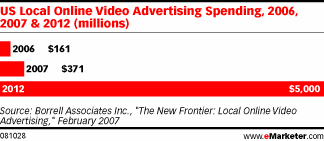
Mais: «The Internet does change everything. Another barrier between media has fallen. Local television stations are now competing with local radio stations and newspaper sites for online video ad revenues. According to a new report from Borrell Associates, "The New Frontier: Local Online Video Advertising," local online video advertising will more than double this year, increasing from $161 million in 2006 to $371 million.

Although local online video advertising currently accounts for less than 5% of all local online advertising — which is expected to hit approximately $7.7 billion in 2007 — Borrell analysts predict that in five years it will exceed $5 billion and account for more than one-third of all local online advertising. The main driver? Increasing competition between local online newspaper, radio and TV sites, each attempting to poach one another's business.

Fonte: «Local Online Video Advertising Forecast to Double», E-Marketer FEBRUARY 16, 2007

Uma definição (simples) de rádio

«(...) from broadcasting, which means sending a radio signal to an entire population in a particular geographic area at a particular time»

Para uma definição futura de rádio

«Nesta conjuntura, a ameaça não é a Internet em si, mas a Internet enquanto novo suporte para a rádio, que assim pode perder ouvintes no seu suporte tradicional, para ganhar novos ouvintes on-line. O que ainda não se sabe, é se com os avanços da tecnologia, dos programas informáticos e o consequente aumento da utilização da Internet, os internautas irão ouvir as estações que estão na rede e disponibilizam a escuta das suas emissões em tempo real, ou se passarão a escutar rádio cuja existência se limite à rede e que graças às possibilidades tecnológicas, reconverte o conceito de rádio. Essa reformulação do conceito pode decorrer da adopção de um esquema de múltiplos canais, da total ausência da presença humana, ou por outros factores relacionados com a discursividade do próprio meio, que modificam o habitual esquema de recepção da comunicação radiofónica e irão desenvolver novas maneiras de usar a rádio graças ao potencial da Internet.» (Cordeiro, Paula, «A rádio de modelo multimediático e os jovens» in http://bocc.ubi.pt/pag/cordeiro-paula-radio-modelo-multimediatico.pdf (pág. 2 e 3)

ou

«Tradicionalmente conhecida como um meio imediato e irrepetível, a rádio, com o advento da Internet, pode redefinir-se. A introdução de sistemas multimédia vem alterar a natureza da rádio, podendo transformá-la de tal forma que nos obrigue a reequacionar o conceito, questionando a validade da definição do que é a rádio e a sua comunicação (...) (pag1). O conceito de rádio na Internet está ainda por definir, mas uma rádio com texto e vídeo, foge ao modelo tradicional, actualizando um formato com cerca de oitenta anosde existência e fornecendo ao utilizador, que é também o ouvinte, um amplo conjunto de potencialidades, que até aqui seriam impensáveis. (2) (...) A rádio afasta-se do seu conceito original e assume uma configuração multimédia que só a Internet pode oferecer. A convergência das tecnologias instaura novos formatos para velhos conteúdos, e obriga ao progressivo desenvolvimento do sistema de comunicações. Num futuro próximo, a rádio na Internet poderá ser banalizada a partir do momento em que o sistema digital se generalizar. A inovação mais recente, o sistema digital de radiodifusão (DAB – Digital Audio Broadcasting), abre perspectivas até aqui nunca pensadas para a rádio, pela flexibilidade de um sistema inovador, cujos limites ainda não são conhecidos. (pag7)»

fonte: Paula Cordeiro, «Rádio e Internet: novas perspectivas para um velho meio», Universidade do ALgarve, 2004

A ideia de transição

«Thirty years ago, music in your pocket meant a transistor radio with tinny mono sound. Fifteen years ago, you'd have a Walkman cassette player with stereo headphones and tape hiss. Now, thousands of clear, digital songs fit on an iPod Nano the size of a credit card.

Every form of media experiences the same transition: fidelity that starts out expensive and big gets cheaper and smaller. And those transitions are happening faster than ever»

fonte: «If you wanted to watch ‘Superman,' which would you choose now?», USA Today, By Kevin Maney, 30/08/06

Deixem de chamar rádio, por favor

«One key theme of the event, starting with Ralph Guild's introductory comments and reinforced heavily by the media buyers' panel, is that the product category should no longer be called "radio" but rather "audio information and entertainment."

This new category definition, of course, includes both satellite-delivered and Internet-delivered  radio. Along with AM, FM, and HD delivery, it's all going to be competing for the same ears and same advertising dollars.

Prospects for growth in "traditional" radio were not seen as promising by anyone (except perhaps in the statements of the radio group heads). BearStearns's Victor Miller observed that radio audience has declined 10% over the past six years and that revenues in current dollars have declined in four of the past five years (with the one "up" year looking good only because it was compared against the comps of 9/11).

For example, many speakers saw opportunities ripe for the taking in the world of digitally-delivered radio. CBS Radio CFO Walter Berger noted  that delivering programming to office workers at their PCs via the Internet offered the opportunity for "incredible value creation."»

fonte: «Net radio holds best opportunities for broadcast groups, panels say», RAIN, 5/7/06

Agências de publicidade substituem rádio por áudio

Sinal dos tempos...

«Natalie Swed Stone, US Director of National Radio Investment at OMD, announced that her agency was adopting the term "audio" to reflect the direction they believe the "radio" market is headed. Matt Feinberg, Senior VP and Director of Interactive Broadcast for Zenith Media, said that he agreed with Ms. Swed Stone's argument. "We realized a couple years ago that [this industry] is more than radio," Feinberg said. "The lines are so blurry that no one knows where to go and what to do. If you try to define it by traditional styles, you'll go insane." "Changing the name from radio to audio is more all encompassing and I think its a move in the right direction," Feinberg added.
Swed Stone predicted that the traditional defintion of "radio" will soon be a component part of this new "audio" designation. "By the way, ' radio' isn't a cool word," Swed Stone somewhat triumphantly noted to the audience. "'Audio' is a cooler word."

fonte: «ad agencies dropping radio for audio as industry shifts», RAIN, 26/5/06, http://www.kurthanson.com/archive/news/052606/index.asp