
Mais optimismo sobre o futuro!
«Dan Mason: “Radio is reinventing itself as a reach medium.”
 |
After sitting out of the public debate over Arbitron’s People Meter rollout, CBS Radio CEO Dan Mason is going on the record with research-fueled reasoning backing electronic measurement. He says “Our commitment is to lead the radio industry in proving the value and power of local radio and also proving the value of radio reach.” »
O futuro da rádio passa pela acumulação ou pelos conteudos primários?
«The GRN is plumping for T-DMB, rather than DAB+, because its members believe that multimedia services will play an important part in the future of radio. Unless radio becomes interactive and adds pictures, they say, it will die a slow, but inevitable death. "Digital radio cannot only be digital sound - it needs to have the right functionalities to compete with other digital offerings," says Anichini. These include a screen, rich data, synchronization between data and sound and high audio quality. I am one of those who believe that radio’s unique advantage is that you can listen to it whilst doing other things. The challenge facing mobile TV, in contrast, is to convince consumers that it is not a “sit-back” medium. Nevertheless, the GRN perceives mobile TV as a real threat to the future of radio. For this reason, they argue that radio needs to be in DMB-equipped mobile phones. (...) This leads us to the other question mark against the French strategy: is multimedia really the future of radio? Despite massive investment, commercial broadcasters in the UK have so far failed to launch any truly successful services. Multimedia is undoubtedly a sexy addition to radio, but can it really compete with the sophisticated services already available on the Internet?»
Mike Mullane on 04 December 2007 Re-thinking radio's digital future, Multimedia meets radio
França recusa DAB e avança para T-DMB
« (...)His comments come as France appears poised to adopt T-DMB technology for digital radio services, even though it was designed for mobile TV. It is an audacious move backed by the Groupement pour la Radio Numérique (Association for Digital Radio), a group of broadcasters whose members have more than 95 per cent of France's domestic audience. GRN members have already started trial services in Paris, with a nationwide commercial launch planned for Christmas 2008. The French authorities will provide frequencies in the VHF (Band III) and Band L range. The GRN is plumping for T-DMB, rather than DAB+, because its members believe that multimedia services will play an important part in the future of radio. Unless radio becomes interactive and adds pictures, they say, it will die a slow, but inevitable death. "Digital radio cannot only be digital sound - it needs to have the right functionalities to compete with other digital offerings," says Anichini. These include a screen, rich data, synchronization between data and sound and high audio quality. I am one of those who believe that radio’s unique advantage is that you can listen to it whilst doing other things. The challenge facing mobile TV, in contrast, is to convince consumers that it is not a “sit-back” medium. Nevertheless, the GRN perceives mobile TV as a real threat to the future of radio. For this reason, they argue that radio needs to be in DMB-equipped mobile phones. Samsung will provide the phones. However, Nokia, which prefers the rival DVB-H technology, is unlikely to follow suit. Instead, the Finnish giant is offering a free Internet Radio download for all Nokia phones running the Series 60 operating system. The service, which allows users to browse for radio programmes by genre, language, country, or name, will be installed on new phones. The fact that GRN broadcasters are demanding more bits for DMB services will further restrict competition. However, Nokia's Internet Radio could have a significant Long Tail effect by allowing small stations squeezed out by the GRN a real opportunity to reach new audiences. This leads us to the other question mark against the French strategy: is multimedia really the future of radio? Despite massive investment, commercial broadcasters in the UK have so far failed to launch any truly successful services. Multimedia is undoubtedly a sexy addition to radio, but can it really compete with the sophisticated services already available on the Internet? Many outside France, including foreign regulators and receiver manufacturers, have condemned the GRN’s controversial decision to adopt T-DMB for radio services. But perhaps the French are the ones who are seeing furthest into the future. If you build a network capable of transmitting DMB audio, it is easy to convert it to deliver DMB video. However, if you build a DAB+ network, there is no migration path to the brave new world of multimedia services. I suspect this is a question of culture, rather than technology. Different choices - T-DMB or DAB+ - may be appropriate in different countries.»
fonte: «Re-thinking radio's digital future», Mike Mullane, 4/12/07
Mais: «Sachant que les expériences de RNT lancées en Espagne, en Italie et en Allemagne n'ont pas rencontré un franc succès public - la Grande-Bretagne a depuis longtemps adopté une autre norme que celle retenue par la France -, Christine Albanel n'a pas manqué de souligner, mercredi 5 décembre : "La France est l'un des premiers pays européens à se lancer, et je ne doute pas que nous ferons rapidement école." Ce qui pourrait participer à la "massification" de la radio numérique.»; Le numérique offrira des possibilités nouvelles à l'auditeur.
RETOUR EN ARRIÈRE :
permet d'écouter, depuis le début, une émission alors même qu'elle est en cours de diffusion.
PAUSE :
possibilité d'arrêter puis de reprendre l'écoute là où on l'avait laissée.
TÉLÉCHARGEMENT (OU PODCAST) :
permet d'enregistrer un programme et de l'écouter à n'importe quel moment.
SERVICES SUPPLÉMENTAIRES :compléments d'information (titres et interprètes, bibliographies, photos et vidéos, etc.), météo, horoscope, applications interactives...
MAIS:
Mais: «According to Wikipedia: "DMB was developed in South Korea under the national IT project and the world's first official DMB broadcast started in South Korea in 2005, although trials were available much earlier." Trials are also being run in Germany, Italy, Norway, Indonesia and other places.
DMB and DAB+ are almost identical. However, the need to allow for images means DMB is about 35% less efficient than DAB+, reckons DRT. The French will therefore get fewer stations or a lower audio quality than they would have got with DAB+.
Steve Green, who runs Digital Radio Tech, reckons the only solution to the radio problem is to provide "over the air" (OTA) software updates so that radios can be upgraded to cope with whatever new systems are introduced. This type of approach works with Wi-Fi radios.»
Franceses não querem mais escolha?
«British consumers have bought six million DAB radios because they want to listen to services which are not available on either AM or FM. It is a familiar argument and one that has become the mantra of countless analysts, consultants, broadcasters, regulators and journalists. I have spread the same message through conference speeches, articles, e-mails and blog posts. But now we are all being asked to think again, as France questions whether listeners really do want more choice. Although DMB audio is less efficient than DAB+, this is only a problem if your objective is to extend choice. But the GRN believes that French listeners are already well served. "Significantly increased programme offering is not a strong consumer demand," says Radio France's Sylvain Anichini. "In France, there is already a very diverse offering in most places."» fonte: «Re-thinking radio's digital future», Mike Mullane, 4/12/07
35% dos jovens (8-12) dos EUA têm telemóvel
«The Nielsen Company today released the findings of an in-depth study on the mobile media and cross media behavior of U.S. "tweens" (ages 8-12). The report estimates that: 35% of tweens own a mobile phone. (...) While text-messaging and ringtones remain the most pervasive non-voice functions on the phone, other content such as downloaded wallpapers, music, games and Internet access also rank highly among tweens. According to Nielsen, 5% of tweens access the Internet over their phone each month. While 41% of tween mobile Internet users say they do so while commuting or traveling (to school, for example), mobile content such as the Internet is also a social medium for this audience: 26% of tween mobile Internet users say they access the web while at a friend's house and 17% say they do so at social events. The report, "Kids on the Go: Mobile Usage by U.S. Teens and Tweens," was conducted by Nielsen Mobile and BASES, two services of Nielsen. It also provides insights on teen and tween use of specific content brands, genre preferences, overall use of leisure time and demographic profiles. The full report will be released on December 14.The Nielsen Company today released the findings of an in-depth study on the mobile media and cross media behavior of U.S. "tweens" (ages 8-12). »
fonte: «35% of U.S. Tweens Own a Mobile Phone, According to Nielsen», 3/12/07
Jornais que lançam rádios
e
«The San Diego Union-Tribune's SignOn San Diego site is set to officially launch its all-San Diego-music all-the-time streaming radio station Monday» The San Diego Business Journal reports Harry Martin, better known as "Happy Hare," is among the crew of veteran radio personalities recently hired by The San Diego Union-Tribune's newest Internet radio station (they now have two). Martin, credited as being among the first to bring his own zany style of platter chatter to the airwaves in the late 1950s, welcomes the chance to develop his latent talk show talent in a format he calls "newsic," which combines news talk and music each Wednesday afternoon on SignOn Radio, the paper's second Internet radio station. SignOn Radio, an eclectic format, was launched in October, about a year and a half after "Amplify SD," the Union-Tribune's unplugged station plugged exclusively into the local indie rock scene. It's unique among major U.S. daily newspapers, since none have followed suit.
O entusiasmo pelo Pandora continua...
«I’ve “discovered” the new Internet radio: specifically Pandora. I love this! Nothing to download, it’s intuitive to use, I choose the tracks I want, I choose the artists, I choose the order, I can make a mix. It’s wonderful! 'But now Internet radio is back in a different form; some don’t call it radio but rather “music discovery” or “social radio.” For me it has taken the place of the staticky old box. Traditional radio was always hit-or-miss for hearing music that I liked, but these services have made it so much easier, as they allow you to filter out what you don’t want to hear and discover new things you might not ever hear on the radio.'» (I Just Discovered the “New” Internet Radio)
Receber por ouvir rádio...
«Et que diriez-vous d'être payés en plus pour le faire? Concept innovateur. Du jamais vu. Inscrivez-vous aujourd'hui. Cliquez ici. Chaque fois que la fenêtre sera ouverte chez un de vos visiteurs, vous toucherez une commission pour chaque minute d'écoute de l'auditeur sur l'une de nos radios web. Le montant à la minute est variable. Vos gains peuvent augmenter très rapidement selon l'achalandage de votre site web. N'hésitez pas à vous inscrire. C'est gratuit.» (http://www.jesuispaye.com/?op=promo&ParainId=9405)
A internet pode ser muito boa a divulgar nova música se...
«not only is online radio inexpensive to target (in some cases as easy as downloading a submission form, as is the case with Pandora), but it brings excitement, variety, and most importantly, NEW MUSIC into a medium that has exposed the public to less and less new music for years (I am speaking primarily of commercial radio). Online radio is a medium that is continuing to gain momentum and listeners, which means, of course, that the labels are looking for their cut of the profits. In March, the United States Copyright Royalty Board announced new royalty rates for webcasts, effective to 2010. The CRB endorsed the proposal of the RIAA-associated Sound Exchange royalty organization, which represents the major and some indie labels. The new rates would force webcasters to pay for each song streamed to each user, and increase over the next few years as follows: (details from Wired magazine)
2007: $.0011 to stream one song to one listener
2008: $.0014
2009: $.0018
2010: $.0019
These rates would put the smaller Webcasters that do not have significant advertising revenue out of business. And last week, Bloomberg announced that Yahoo and AOL may abandon Web radio as well with the raise in rates (“We’re not going to stay in the business if cost is more than we make long term,” Ian Rogers, general manager at Yahoo’s music unit, said in an interview). The rate increase is not a done deal, however. Webcasters have launched an appeal of the rates, which begins in February.
I’m all for musicians being paid fairly and taking advantage of all revenue streams, but from a marketing standpoint, does it really make sense to impose rates on a developing outlet like this that will essentially kill all but the largest players? Check out more opinions here. »
fonte: KING, Michael, The Trouble with the Future of Radio, 3/12/07
O esforço da Nokia na 'internet radio'
«Discover and listen to radio shows broadcasted over the internet with the Nokia Internet Radio service now available. The application can be downloaded for free from http://www.nokia.com/internetradio and will also be embedded in upcoming Nokia S60 3rd edition devices."Most new music discovery occurs while you're listening to the radio," said Tommi Mustonen, head of the Nokia music business. "By offering the Nokia Internet Radio service on mobile devices, the radio experience becomes more accessible, giving people new ways to find music."With hundreds of internet radio stations to choose from worldwide, the station directory of Nokia Internet Radio makes music discovery effortless - browsing can be done based on station name, genre, country or language. To find out what hits are hot around the world, hourly updates of the top ten most popular internet radio stations are also available in the station directory. Plus, there is no need to search for your top stations time and again because adding them to the list of 'Favorites' makes them easily accessible. Moreover, the audio quality is enhanced by selecting appropriate streaming servers that match the speed of the current network connection. The Nokia Internet Radio application is currently available for download to the following devices: Nokia N82, Nokia N91, Nokia N95 and Nokia N95 8GB. The application is planned to be available later on further devices and will be embedded in selected upcoming Nokia S60 3rd edition devices. Please visit http://www.nokia.com/internetradio for the list of the latest compatible devices.»
fonte: «Discover New Music With Nokia Internet Radio», CNN Money December 03, 2007
Pub na Internet ultrapassa a da rádio já em 2008 (mais previsões)
«[Internet] Es el medio que más crece en términos publicitarios desde hace años y, a partir de 2008, tiene muchas posibilidades de superar a un clásico como es la radio a escala mundial. La previsión de ZenithOptimedia apunta a que internet acaparará en todo el mundo una inversión de 30.428 millones de euros el año próximo y la radio, 25.786 millones. Ya ha sucedido en países como Reino Unido y, de cumplirse las previsiones, también será en pocos meses una realidad a escala global. Según las estimaciones de ZenithOptimedia, internet se convertirá en el año 2008 en el cuarto medio de comunicación por inversión publicitaria, con 44.583 millones de dólares en todo el mundo (30.428 millones de euros, un 9,4% del total de la tarta publicitaria), por detrás de la televisión (123.079 millones de euros, un 37,9% del total), la prensa (86.927 millones, un 26,8% de la inversión) y las revistas (38.511 millones, el 11,9% del total).Así, el medio online podría superar por primera vez a la radio, que acaparará 37.782 millones de euros (7,9% del total). Por detrás se sitúa el medio exterior, con 18.526 millones (5,7% de la tarta), y el cine, 1,488 millones (0,5%). En España, sin embargo, está lejos de cumplirse estas previsiones, ya que el desarrollo de internet queda aún por detrás de los países más avanzados. El año pasado, internet tuvo una inversión publicitaria de 160,3 millones de euros, apenas un 2,2% del total (7.149,5 millones de euros), según Infoadex. Otros datos que maneja la industria mejoran esta proporción, pero siguen siendo menores: según cifras del sector, internet ya ocupa algo más del 5% del total de la inversión en publicidad española. Ese porcentaje, con todo, queda aún muy por debajo de mercados europeos más avanzados -como Dinamarca, Noruega, Suecia y Reino Unido-, donde la publicidad en la web supera el 15% de la inversión total. Para estos países, las estimaciones son que en 2010 internet concentrará más del 20% de la inversión.»
fonte: «Internet superará en 2008 a la radio como canal publicitario», Cinco Dias, 4/12/07
(conc) «A rádio como um media de futuro»
É a opinião de Gustavo Cardoso (Obercom):
«(...) A rádio é considerada por muitos autores como um meio de futuro e também eu creio que o que assistimos é à sua vitalidade e não ao seu desaparecimento, daí que concorde com Enrico Menduni sobre a rádio como um media de futuro. (...) a “Internet não matou a rádio mas deu-lhe uma terceira vida”. Uma vida diferente das anteriores, é claro. Mas uma nova vida sem dúvida. Uma vida alicerçada no facto de a rádio ser o media que mais facilmente se adapta à Web 2.0.»
fonte: CARDOSO, Gustavo, «A Terceira Vida da Rádio», editorial Obercom,
Sobre o Jango (the next big thing... in social music)
«(...)I recently found a service that satisfies what was lacking for me in LastFM: Jango. Less feature-rich than Last.FM (I didn’t need all those features anyway), Jango is instant gratification from the moment you visit the site. You can start listening to songs in their entirety immediately, without even signing up. Not having to sign up hooked me into trying it out, and I’ve been using it daily ever since. You simply type in an artist, and a song starts playing.

Jango's personalized stations
The music matching system on Jango is okay, but it could use some work. For instance, it seems to think because I like Steely Dan and James Taylor, I’ll also like the Beach Boys. No. And while I am a frequent listener of Mary J. Blige, I want R. Kelly out of the mix. Unfortunately, even though I click on the sad face to tell Jango never to play the offending song again, “Trapped in the Closet” continues to haunt me.» (fonte: «Last.FM, Jango, Pandora Trounce Music Discovery via Radio», 29/12/07
Um Zune no natal para substituir o iPod (por causa do rádio)?
«As the holidays approach, I am very close to putting a Microsoft Zune on my wish list. Yes, I have a very nice iPod with all my favorite songs that I frequently use while working out, and during long walks/runs. But like many of you, I also like the option of listening to the radio - whether it's checking out what my clients are doing, tuning in the competition, or spending time with NPR and various play-by-play sports. And my iPod won't let me do that. But the Zune will, and the reviews of this next generation device are actually pretty damn good. Microsoft has made the inevitable improvements, and some of the features of the Zune mean nothing to me (how am I going to find other Zune owners to share music with?), but I would like an FM tuner. I'm not alone. Our Tech Poll last year revealed the top feature that Apple iPod owners want on their next player is an FM radio:
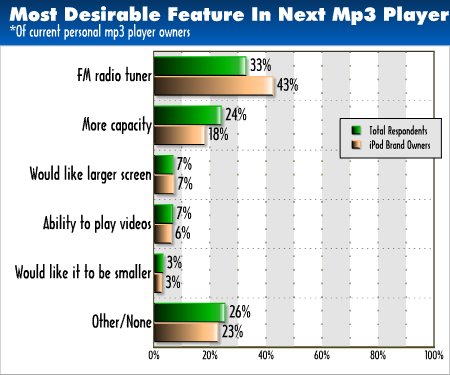
So why shouldn't I have an iPod-like device that has a great-sounding built-in FM tuner? In spite of the obvious decreases, we know that the top source for music discovery is still FM radio. That's how many people still get turned onto the music they ultimately buy on iTunes. So why would Steve Jobs allow me to move away from the iPod family? And why would he allow Microsoft to get a leg up in a market where he owns the category killer? I don't know, but I'm tired of waiting. I'm thinking Zune.», fonte: Dark Side of the Zune
Wi-fi em Manhatan
«(...)CBS Mobile Zone’ will provide free WiFi service through more than 20 city blocks extending from Times Square north to Central Park South and from Sixth Avenue west to Eighth Avenue. “Certain locations already are up, and the whole area is expected to be outfitted by month’s end, CBS said…“Users who access wireless in the CBS zone will first get to an advertising-supported homepage hosted by the network. The page will feature local and national news, wallpapers, ringtones, maps featuring local restaurants and entertainment options and social networking and search options» (fonte: «CBS to provide free WiFi in midtown Manhattan» RAIN 29/11/07
O monopolio da rádio no carro está ameaçado
«Among the different listening locations, car radio listening seems to be the last bastion against the Time Spent Listening (TSL) onslaught new media poses. But how certain can we be that radio will maintain its in-car primacy? When asked whether they listened to radio more or less than they did 1 to 3 years ago, Respondents to Paragon Media Strategies’ Youth Radio Survey had a negative Net 3% momentum (More minus Less). The negative trend is most pronounced at Home and Work: down a net of 9% each. Graph 1 That makes sense given the intrusion iPods, streaming, and CDs pose in those locations. Only in the privacy of the car does radio post a net increase of 11%. But before we break out the champaign, let’s look which mediums 14 to 24 year olds listen to most while in their cars. Graph 2 While radio enjoys a plurality over other mediums people listen to most in their cars at 48%, CDs (27%) and the iPods (19%) compete for the primary in-car audio medium. During Paragon’s focus groups last year, we heard many respondents naturally referring to iPods as what they go to first while in their car. This trend may accelerate with more common use of iPod car adapters. Therefore, the advantage radio has had for people in their cars may not be as safe as once thought. 14-24 year olds think of consumer-generated new media as much as or more as they think of radio when deciding what to listen to in their cars.»
fonte: Car Radio Listening: The Last Bastion Against TSL Erosion? Paragon Media Strategies 29/11/07
Comprar um rádio? Não; comprar algo que também tem rádio!
«Alguém tem dúvidas de que a rádio é um meio fascinante cheio de futuro?»
Eu tenho! «Meio fascinante» e «oásis»????