Blogia

Transistor kills the radio star?

A internet, a rádio e a década de 20

« (...)It's what happened back in the 1920s when the record industry first faced off against a new cutting-edge medium: Radio. "The music industry was very afraid of radio in the '20s," says Rob Bowman, Grammy-winning music historian and professor of ethnomusicology at Toronto's York University. "If you look at 78s from that period, they often have printed on the label, 'Not licensed for radio play.' Radio was an eminently superior medium, and the music industry thought radio was simply giving away their product -- 'Why would people ever buy 78s if they could hear them all day for free?' was the line of reasoning." It took nearly 20 years for the record industry to come around, he says. (...) Like a stuck 78, history has kept repeating for the record industry, which rarely responds well to technological change. "If you look back at the history of selling records, tapes and CDs from the 1890s to the present, you'll see waves of incredible expansion and then troughs of crisis." And of course, it's happening now as the music industry struggles to deal with the paradigm shift posed by the Internet.  "I look at the Internet now in the same way as radio in the '20s," Bowman says. "But (the record labels) are too afraid to turn, in some ways. You get people who are entrenched in a particular business model. So when there's a paradigm shift like we're seeing, and it means that dozens of your employees -- and maybe even you -- are going to become redundant, you're probably going to try and fight that. That's a natural instinct. "It's easy to say, 'What a bunch of idiots, they should have seen this coming and they should have done that.' And yes, all of that's probably true. "But it's not surprising. It's unfortunate, but not surprising." The record companies might do well to absorb at least one lesson from the days of 78s and radio. "A lot of those companies that were around back then don't exist anymore," Bowman says»

fonte: «Internet is the new radio»,London Free Press, Sun, November 25, 2007, By DARRYL STERDAN, SUN MEDIA
As vendas digitais de música não vão substituir o CD tão cedo

(não acredito, mas...)

«A new study from Jupiter Research has found that, though digital music sales will continue to grow over the next five years, those sales won't be enough to offset the loss from declining CD sales. In five years digital will account for more than one-third of music sales, says Jupiter, with spending on digital music rising to $3.4 billion by 2012. But with CD sales continuing to fall, "That means digital music sales will not compensate for lost CD sales in five years," said Jupiter VP/Research Director David Card. "Nor will they return the overall industry to growth. But that's where the growth is."
Downloads will be replacing CD purchase for "many -- but not most -- music buyers," according to the report, while Napster- or Rhapsody-style subscription services "will appeal primarily to niche audiences."»

fonte: «Study: Digital Won't Replace Lost CD Sales Any Time Soon», Radio INk, 21/11/07

CORDEIRO, Paula (2007), «Estratégias de programação na rádio em Portugal». Tese de doutoramento, Faculdade de Ciências Sociais e Humanas, UNL (não publicada)

Lista de sites com música online

«While most of these resources are geared for artists and musicians, I don’t know many audio engineers that don’t have a side music project in the mix. Regardless of your career path, there are bound to be a few sites on the list that you find valuable. Do you know of a site that is not listed below? Have you had any success with any of these? Let us know in the comments section below

«Um milhão de visitantes de sites de música»

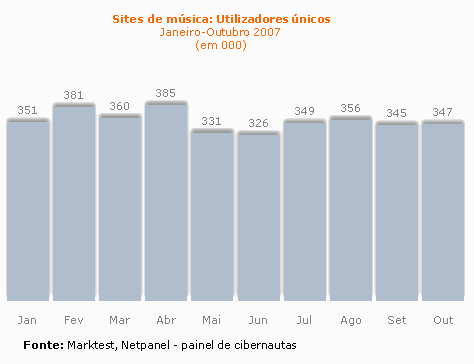
«De Janeiro a Outubro de 2007, foram 1 157 mil os residentes no Continente com 4 e mais anos os que visitaram sites de música, quando em suas casas navegaram na internet. Este número corresponde a 38.3% dos internautas portugueses.

Estes indivíduos visitaram perto de 35 milhões de páginas destes sites, tendo-lhes dedicado mais de 596 mil horas de navegação, uma média de 31 minutos por utilizador.

Nestes dez meses, Abril foi o mês com maior actividade nos sites de música, que receberam 385 mil utilizadores únicos.

fonte: «Um milhão de visitantes de sites de música», Marktest.com, 22/11/07

Rádio recupera em publicidade?

«Nos primeiros dez meses do ano, a totalidade do investimento publicitário nos meios cifrou-se nos 3.581.272 mil euros, a preços de tabela, segundo dados divulgados pela MediaMonitor.A televisão continua a ser o meio a captar mais investimento publicitário e que regista em Outubro o um valor próximo do mais alto do ano, com 270.615 mil euros. De resto, todos os meios vêm o seu investimento aumentar no mês de Outubro, sendo que a imprensa sobe para os 75.712 mil euros e o outdoor para os 23.013 mil euros, a preços de tabela. A rádio também regista uma subida, para os 18.323 mil euros, assim como o cinema: 2.253 mil euros»

Isto sim, é pensar digitalmente através da rádio (notável!)

«(...) I heard a good example of this at a recent conference in Copenhagen. BBC Radio Five Live’s Brett Spencer told delegates how a rather large insect had gate crashed a commentary position during a test match in Australia. One of the commentators told listeners he had taken a picture of the creepy-crawly with his mobile phone and was uploading it onto a BBC blog. He invited budding entomologists to visit the blog and advise the commentary team whether or not they needed to worry about the six-legged intruder. Many people took up the invitation and posted comments on the blog while continuing to follow the cricket (the game, not the insect) on the radio. The match commentary was interspersed with remarks about the alarming entomological advice that was arriving on the weblog. That level of “sit up interactivity” would be more difficult to achieve on a TV show. I’m not saying it’s impossible, but it’s not really what the telly is about. (...)Blogs bring audiences closer to presenters, journalists and other programme-makers, which not only builds brand loyalty, but also makes public service broadcasters more accountable.»

fonte: «Blogging about the cricket», Multimedia meets radio, 22/11/07

Internet nos carros; o futuro está aí... (2010)

«When Audi showed off the Cross Cabriolet Quattro concept car at the Los Angeles Motor Show, one of the key features was a prototype of streaming internet radio direct to the car. It's a glimpse into a future that's not too far away - a future that could come sooner than you think Prototypes are one thing, but when will such a system see the light of day? The answer is 2010, according to the Center For Automotive Research (CAR). CAR conducted supplier interviews that indicate 2010 - which is just over 2 years away - to be when customized and/or on-demand content will be streamed to vehicles»

«iLike», recomendação e personalização de música

«iLike is a service to help you organize your music, share your music tastes, and discover new music through your friends. iLike provides a buddy-list for your iPod - it helps you discover new artists based on what you're already listening to, and it helps you browse your friends' music libraries and share music suggestions with each other»

Aceder ao Pandora fora dos EUA

«(...) My second try was with the excellent Secure Tunnel solution which I use for some time now that allowed me to watch Hulu and download from NBC Direct as well. I activated Secure Tunnel in Opera and Pandora would load and play fine as if I was a user from the United States»

Sobre a Secure Tunnel solution

Os jovens e os conteúdos gerados por outros

«The Demand for User-Generated Content: Content may be king, but industry-created content has got stiff competition. User-generated content is in tremdendous demand across the generations, with half of all consumers (51%) watching and/or reading content created by others. And, while Millennials are at the forefront of this trend, Xers, Boomers and Matures are also participating.• 51% of all consumers are watching/reading personal content created by others; the number jumps to 71% for Millennials.• 55% of Millennials and 42% of Xers read blogs, while 62% of Millennials and 41% of Xers watch YouTube or other video streaming sites.• 40% of all consumers are creating their own entertainment, such as editing movies, music and photos. Millennials may be the majority of the creators at 56%, but Matures are also participating – 25% of them report creating their own entertainment.»

fonte: «Are You Readyfor the Future of Media? Highlight’s from Deloitte’s 2007 State of the Media Democracy Survey» 25/06/2007


Ideias sobre a geração iPod e o marketing

«Marketers are fascinated by Gen Y's youngest cohort, the Millennials -- and with good reason: They are an important market today and will become even more important as they graduate, start jobs, marry and establish households.
How to communicate effectively with Millennials is the topic of many research studies. We are told what they read (magazines) and what they don't read (newspapers), which brands they love (Apple) and which ones they hate (anything "too corporate"), devices they use (iPods and cellphones) and don't use (CD players). There are articles on how they communicate (Facebook) and don't communicate (e-mail) and where they get their news ("The Daily Show"). We learn that they are not like us in their views of the world (they've never experienced a presidential election without a Bush or a Clinton in the running). Most ominously, we are informed that they have lived in a media-saturated world from a young age. Consequently, they are clued in to -- and tuned out of -- marketers' most ingenious means of influence
»

«A rádio foi um iPod antes da Apple inventar o iPod»!!!

«In a way radio was an iPod long before Apple invented iPods.
After all, radios were portable analog music devices that allowed baby boomers to carry their music around with them 24 hours a day.
The iPod of today gives the listener total choice -- the music they want, when they want it and in whatever (or no) special order.
Back then, the predecessor to the Apple iPod was a transistor radio and an entire generation grew up with their radios to their ears -- just as today, ear plugs and all.
The forerunner to the "iPod" lacked the level of choice that today's Apple device has, but it had something even more valuable to young baby boomers -- air talent.»

fonte: Radio: the anchestor of the iPod 20/11/07

As auto-estradas da informação bloqueadas em 2010?

«The internet is being stuffed with multimedia assets, and broadband pipes are powering the action.  For artists, labels, and everyone in-between, that allows broader expression, and deeper connections with fans. But internet capacities could become strained within a matter of years, according to a recent report from the Nemertes Research Group.  The alarmist finding outlines traffic jams by 2010, unless ultra-expensive infrastructure upgrades are made.  "Our findings indicate that although core fiber and switching/routing resources will scale nicely to support virtually any conceivable user demand, internet access infrastructure, specifically in North America, will likely cease to be adequate for supporting demand within the next three to five years," the report asserts»


A música é um conteúdo determinante nas redes sociais

«As social networking destinations continue to explode, the rules are being rewritten on music promotion and discovery.  But questions continue to linger on the best ways - if any - to monetize the action. Most younger users are dialed into at least one social network, and music is usually threaded throughout the experience.  In fact, 39 percent of all social networkers embed music into their profiles, according to a recent UK-based survey by Entertainment Media Research.  Users of MySpace and Bebo have much higher rates, at 63 and 65 percent, respectively. Incidentally, Facebook lagged behind in its association with music, though the company is quickly beefing its music component.  Overall, surveyed users indicated that social networks are a primary source for music discovery, an unsurprising discovery.  But users also indicated a receptivity towards network-based purchasing, at least in the survey.  In total, 46 percent of respondents wished for an easier way to purchase music discovered on a network. That sounds encouraging, though an early-stage experiment involving MySpace and Snocap has been rocky.  Meanwhile, executives frequently question survey results related to music purchasing, especially from younger users.»

fonte: «Social Networking Surge Continues, Monetization Questions Remain», Digital Music News, 18/11/07


Outro serviço de 'música social' (só EUA)

Tem origem em Israel, está em versão beta e chama-se Meemix. É apenas destinado a utilizadores dos EUA.

«Imagine a world of music - sorted by the songs you love. Imagine broadcasting the soundtrack of your life to an audience around the globe. Feel the magic and find your rhythm at MeeMix. Internet radio that gets you»

Sprint acaba com pacto para desenvolver o WiMax

«Sprint Nextel and Clearwire called off a plan to join forces to build a nationwide high-speed wireless network using WiMax technology. The companies said they could not come to agreement on terms of the deal, announced in July.
Sprint had positioned WiMax as a way to let customers surf the Web on laptops, cell phones and other portable devices at speeds up to some five times faster than cellular networks now offer. The company had intended to launch mobile broadband services in initial markets by year-end and planned a larger rollout encompassing 100 million customers by the end of 2008.
Sprint says this week it remains committed to developing WiMax and is on track for a soft launch this year in the Chicago and Baltimore/Washington markets, with commercial launch in 2008.
A source told The Washington Post one of the things the companies could not agree on was how many cell towers each company should build to support WiMax and the pace of that deployment. Now that Sprint is “hobbled” with WiMax, there’s a question as to how fast other companies, such as Intel and Motorola, can roll out the technology, analysts told the Post. One said the Sprint news “was not a death knell” for WiMax, but is certainly a sign that its rollout is further out than previously believed.»

fonte: «Sprint, Clearwire End WiMax Collaboration», Radioworld, 16/11/07


Um novo serviço de música social (Jango)

«Does the "social radio" market -- which features well-established players like Pandora and Last.fm -- need another entrant? The gang behind Jango seem to think so. The site, which has been in beta for the past few months, opened up for full access Monday, and says it has 70,000 users already. Co-founder and CEO Dan Kaufman is the former CEO of Dash, a mobile-shopping startup that flamed out in 2001 (not that we should hold that against him, of course). I have to say one thing about Jango.com: it's pretty simple to use. When you hit the site you get a search box and a list of "stations." You can choose a station, which is a pre-mixed selection of artists, or you can type in an artist's name  -- at which point you are taken to a user page, without even having to sign up (you can create an account from the user page by just typing in your email and a password). My page is here.  By choosing an artist's name, you effectively create a "station" based around them, which can be made up solely of that artist, or artists that are similar. Jango suggests musicians and bands that it thinks you might like based on your choice, and then you get to choose from Jango's list and add that artist to your station -- or you can type in your own choice and add that. And that's about it. You can click to buy a track through Amazon, and you can see who else is listening to a particular artist or station. The site doesn't have some things that Last.fm and Pandora do. It doesn't have a widget, for example (like the one I have in my sidebar), although the company said that's coming. But it is far easier to figure out and use than Last.fm, I think, which I find confusing and non-intuitive. And when it gets right down to it, one of the keys to such a site is the music recommendation part: in other words, how does it do in terms of suggesting related songs or artists you might want to listen to? (...) And when it comes to competing with Pandora at least, Jango has one killer feature: it's available to Canadians, whereas Pandora is not -- it cut off access to Canuck users earlier this year because it hadn't acquired the appropriate licenses.»

fonte: «Jango joins the "social radio" scene», Globe and mail, Mathew Ingram,

O Dab é uma desilusão (GB)?

«We have the worst of both worlds. DAB could offer better sound quality, but the quality has been reduced below FM levels to make room for more stations, and it's still falling. DAB could offer better programs, but the broadcasters are on a hiding to nothing if they switch people from a few profitable FM stations to many unprofitable DAB stations (expensive to run, small audiences, very little advertising).

Finally, the UK's DAB system is old and technically obsolete, and I think it will eventually have to be replaced with the new world standard, DAB+. That was the point of my original attack. At the time, I thought that switching to the much more efficient DAB+, which will allow more stations and higher quality at lower cost, was DAB's best hope. Now I wonder if even that will be enough

Pandora, a rádio que te ouve...

Curiosa definição: já não somos nós que ouvimos a rádio, é a rádio que nos ouve (Pandora...):

«Pandora: Web Radio That Listens to You»: «The magic of Pandora derives from a simple principle: a song listeners enjoy should lead to other songs they'll enjoy. Pandora is an Internet music service with an unusual twist: you merely select a song or artist you like and the system builds a playlist of additional songs based on those musical characteristics.»