Blogia

Transistor kills the radio star?

HERRERA, Susana (2006), Internet y las nuevas formas de participación de los oyentes, Comunicação e Sociedade, vol. 9-10, 2006, pp. 83-90

HERRERA, Susana (2006), Internet y las nuevas formas de participación de los oyentes, <em>Comunicação e Sociedade</em>, vol. 9-10, 2006, pp. 83-90

«Um rádio com quatro rodas»?

«Detroit Radio Advertising Group President and CEO Bill Burton came up with the fabulous motto "An Automobile Is a Radio With Four Wheels" many years ago and it is and has been the most dramatic statement of radio's out of home dominance. We mean no disrespect to Bill or his fine organization as we look ahead to changes that may be on the horizon, but an automobile could one day be the Internet with four wheels. »

Comunidade de ouvintes na Mega FM

«Para comemorar o 10º aniversário, a Mega FM lança um novo site que será apresentado no dia 21. Criado pela equipa de web design do Grupo Renascença, apresenta um novo formato, uma nova imagem, mais interactividade, apostando numa maior comunicabilidade com os ouvintes da rádio. Destaca-se a criação de uma comunidade de ouvintes online, a Mega VIP, um espaço onde os ouvintes podem partilhar fotos, fazer amigos e ainda ter acesso a passatempos, Meet n Greets, (possibilidade de se encontrarem a sós com as suas bandas preferidas) e promoções. Segundo Nelson Cunha, director de programas da Mega Fm «um dos objectivos é promover a interactividade entre os ouvintes que têm a Mega FM como a sua rádio preferida, e tomam o site como o ponto de partida para novos contactos e experiências»

Mesmo na net a rádio não é um hábito

«(...) First, in the 18-34 demo, this youngest surveyed segment spends far more time listening to “personal music” (CDs, MP3s) (46%) than to AM or FM broadcasts (27%). Second, the computer is the most popular “player” for 18-34’s “personal music” (as opposed to stereos or CD players), which shows they’re comfortable with the PC as a music source. Yet this demo only spend 12% of listening time with online radio, so perhaps there’s an opportunity for webcasters to grow with this audience segment. (...) Why is listenership not growing faster? The biggest reason given: 78% said they’re “just not in habit yet,” which is a behavior that can change. More alarminly, 69% said Internet “buffering” issues made it too annoying to listen.

fonte: RAIN NEWS 04/17: RAIN SUMMIT RECAPS, for more from the RadioNext study, click here.

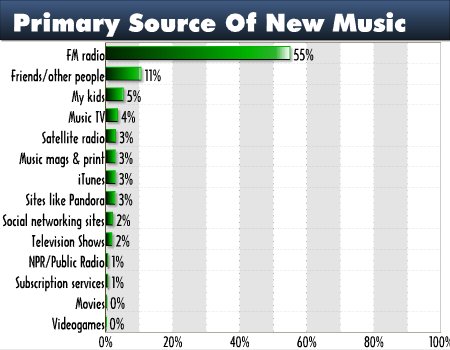
Como é que a maior parte dos norte-americanos descobre música?

«(...) as we see in our new Tech Poll, let's not forget about how the vast majority of Americans still find out about new music:

08_music_sourcetots_blog

Now, critics will chime in that this survey is a self-fulfilling prophesy because it is conducted among radio listeners.  But since 90%+ of the U.S. falls into that category, there's not much of a skew to this data.  Hey, if it makes you feel better, subtract 5 or 10 percentage points from FM radio and look at this chart again.  If I was a new band with music to expose and sell, my chips would still be on good old FM radio.  Why the record industry would criticize the incredible power of this traditional medium defies logic» (fonte: The Selling of Music - 2008 Style Jacobsblogs, 17/04/08 

A rádio não faz vender discos?

«(...) the impact of radio play on sales of sound recordings using a sample of American cities. The results indicate that radio play does not have the positive impact on record sales normally attributed to it and instead appears to have an economically important negative impact, implying that overall radio listening is more of a substitute for the purchase of sound recordings than it is a complement.»

Liebowitz, Stan J., "Don't Play it Again Sam: Radio Play, Record Sales, and Property Rights" (January 5, 2007). Available at SSRN: http://ssrn.com/abstract=956527

O WiMax põe a net em todo o lado; e a rádio?

«Universal WiMax would make it seamless for consumers to have Internet-based music, information, communication with them everywhere. The advantage that radio transmission now has -- it's everywhere and it's free -- would be reduced to one thing. It's still free. But consumers would likely pay a premium to get Internet on-the-go.
That's why Internet streamers could be the next broadcasting revolution when their delivery system is put into place.
(...) I'm thinking -- and you may be, too -- that terrestrial radio companies might be ready to get into the content business. That's pictures, video, text and audio and become a new age broadcaster. How exciting is this? The salvation of Internet streamers is the arrival of a WiMax network. But some broadcasters seem to have a hard time seeing that the salvation of a dying radio industry is also this new form of wireless accessibility. Not transmitting a terrestrial stream over the Internet. That's so 20th century! But creating new content for the delivery system of a new age
fonte: Jerry Del Colliano, Watch WiMax Inside Music Media, 17/04/08

O WiMax e a rádio

«(...) WiMax is even better than WiFi -- that very local wireless way computers and phones can connect to the Internet.
WiMax would give consumers high-speed access to the Internet using phones, mobile devices and laptops. Mobile video might benefit the most because WiMax would allow high quality pictures to be transmitted over the air.
(...) The eventual construction of a high-speed, wide-area quality wireless link to the Internet has tremendous repercussions for the traditional radio industry that would just like all technology to go away and let it return to transistor radios.
Universal WiMax would make it seamless for consumers to have Internet-based music, information, communication with them everywhere. The advantage that radio transmission now has -- it's everywhere and it's free -- would be reduced to one thing.
It's still free. (...) If automakers are including WiFi capability in some new cars, can you imagine what WiMax -- a much wider range signal from transmitter to transmitter -- would mean to terrestrial radio operators?»

Jerry Del Colliano, Watch WiMax Inside Music Media, 17/04/08

Mais criadores de conteúdos (e consumidores); EUA

«In the US, eMarketer projects that the number of user-generated content creators will rise from 77 million in 2007 to 108 million in 2012. The content is being read, seen and heard, too. The number of consumers of user-generated content will increase from 94 million in 2007 to 130 million in 2012. “US Internet users are creating and consuming user-generated content in record numbers,” says Paul Verna, eMarketer Senior Analyst and author of the new report, User-Generated Content: In Pursuit of Ad Dollars, “across an ever-expanding range of online content that includes video, audio, personal profiles, avatars, photo sharing, Wiki entries and product reviews.” (fonte: «Can User-Generated Content Generate Revenue? eMarkeeter APRIL 17, 2008

Março, o pior mês de receitas publicitárias (EUA)

«Radio revenues were off 8 percent overall in March, the RAB reports, with local down 8 percent compared to March 2006 and national more than doubling that, with a 17 percent dip. Local and national combined for a 10 percent decline.

The 8 percent overall decline is the sharpest for 2008 so far: Revenues were off 6 percent in January and 2 percent in February.

National revenue has fallen by double digits in three of the last four months: It was off 12 percent in December, 13 percent in January, and 1 percent in February. Local revenue's 8 percent dip in March followed dropoffs of 4 percent in December, 5 percent in January, and 4 percent in February

Qual é a importância de ouvir na 'rádio'?

«And of course, anyone can make great radio: from newspaper companies, tv, even banks and restaurants. The only difference with this form of great radio… is that you’ll not hear it on the radio

A presença de animadores (e vozes)

«Many radio stations have focused recently on ‘more music’, and less local presenter involvement - particularly the commercial radio operators. It seems a little peculiar to me that radio has taken away the main differentiator between it and my iPod: after all, my iPod plays a better choice of music that I can find anywhere on the radio. (.,..)There are millions of young people enjoying speech radio every day, though some might not think they’re listening to the radio; after all, a good bit of speech radio, prepackaged and made available as a download, is what most people call a ‘podcast’. I believe that radio’s future depends on great content. If programmers focus their attention at the bits between the records, and less slavishly on following their music testing, then we can ensure radio’s future. If radio is just to become a non-stop ‘music aggregator’, then last.fm and services like it will always do that job better (even if last.fm’s algorithms need rather a lot of work).»

Rádio 2.0: colaborativa e participativa

«If your definition of “2.0″ is a much more collaborative experience, where many people provide the content you’re looking for, then Radio 2.0 was born with the advent of the request show or the phone-in. Of the ‘old media’, I’d claim that radio has always been the most democratised, most involving media there is. If your definition also includes “giving control to th audience”, then (quite apart from the superficial control that request shows give the audience), again radio has a good story to tell. Listen-again services, like the BBC provides with their BBC iPlayer for Radio, have succeeded in takng radio away from being an uncontrollable linear stream of content to one that is more malleable. It’s particularly good for niche programming - if you look at programmes like Radio 1’s Essential Mix, you see that it has nearly as many listeners online as onair. The iPlayer provides the long-tail and discoverability of content that is the issue with an old-fashioned linear stream.»

«A internet não compete com a rádio»!

(uma visão optimista...)

«Bob Pittman may be known to most of the world as an Internet visionary, but he was a broadcaster first and he told the NAB Show Radio Luncheon yesterday that it is frustrating to hear people talk about radio as if there’s something wrong with the business. “Radio is mobile, it’s easy to use, it has a lot of choice,” Pittman said. Repeating comments we’d heard him use previously when talking about new media, he said what makes a great consumer business is convenience and brand – and “radio wins on both counts.” The one-time radio programmer noted, “I think there are probably no better brand builders in the world than radio programmers.” Despite all of the hype about the Internet replacing broadcasting, Pittman, who is currently an investor in radio and TV groups as well as new media, insisted “the Internet is not television or radio.” People still turn to broadcasting for entertainment, while they use the Internet to manage their lives.» fonte: Pittman: Internet does not compete with radio and television, RBR 15 April, 2008

«Satisfazer as necessidades dos ouvintes em formas novas e excitantes»

«It must be NAB's role as a lobbying arm that predisposes it to see PR as a hammer and every challenge as a nail. You don't reinvigorate by saying you will. You reinvigorate by doing what's reinvigorating. When that happens, you don't need to "remind" listeners of anything. Nobody wants to be "reminded" of stuff they already take for granted. They want to hear about what's new. And that, my friends, is radio's true challenge. Radio can make much more headway with its audiences in a new media world by grabbing opportunities which satisfy listener needs in new and exciting ways. This is what CBS did with last.fm. This is what Radio One did in its dive into social networking.» Mark Ramsey

É um blogue? Não é uma rádio!

«CBS Radio re-launched their legendary NY rock radio station WNEW recently. It's a group blog about music, it's a last.fm group (built by the combined scrobbling history of all of the group members), it's an internet radio station, and it's available over the air on HD2 at 102.7 (you need an HD radio to get it).(...) Maybe the golden years of the 70s and 80s are long over, due to the iPod and other forms of portable music and the changing dynamics of the music industry. But I think radio does understand what it has to do in order to hang onto its audience and bring new listeners (younger more technologically inclined) into the fold.» It's A Blog, No It's A Radio Station, Wait It's Something Altogther New Fred04.15.2008

Jovens enviam 29 SMS por dia

«Os resultados de Março de 2008 do Barómetro de Telecomunicações da Marktest indicam que os jovens entre os 15 e os 24 anos enviam diariamente uma média de 29 mensagens escritas.  Os resultados do trimestre móvel de Março de 2008 do Barómetro de Telecomunicações indicam que 5,9 milhões de residentes no Continente com 10 e mais anos costumam utilizar o serviço de mensagens escritas (SMS). A utilização deste serviço tem crescido, com o número médio de mensagens enviadas a mais do que duplicar nos últimos dois anos. De facto, os dados do Barómetro de Telecomunicações para Março de 2006 contabilizavam uma média semanal de 34 mensagens enviadas, um valor mais de duas vezes inferior à média de 77 mensagens enviadas por semana em Março de 2008. Em média, por semana, são enviadas 77 mensagens, o que corresponde a cerca de 11 por dia, mas uma análise deste indicador mostra comportamentos muito diferenciados, sobretudo entre os jovens. O target dos 15 aos 24 anos mostra ter uma padrão muito diferente da média, com valores que mais do que duplicam este número. A partir dos 25 anos, a utilização desta forma de contacto cai significativamente, observando-se valores bastante abaixo da média»

Jovens enviam 29 SMS por dia Marktest.com, 15 de Abril de 2008

O que pensa a industria (EUA) sobre o presente e o futuro da rádio

«(...)Rehr continued, "We know that the world has changed. Consumers have more options than ever before. The media landscape is rapidly changing. We’re being buffeted by forces larger than our industry. Some in the business are a bit disoriented. Some are overwhelmed by the changes taking place. Frankly, some are not optimistic about broadcasting’s future."
After noting that "broadcasters can be a bit of a cynical bunch," Rehr said, "I’m afraid that some people in this business have been staring so long at the door that’s closing, they haven’t seen the new door that’s opening. The digital door." (...) Listeners still want what they’ve always wanted. Technology hasn’t changed that -- it has just changed the devices of delivery. This is not to diminish the challenges or uncertainty of the radio business. In fact, I think one thing that’s changed is that many in the industry have been so worn down by the battles and buffeting, that they themselves have forgotten the magic of radio. But we have not forgotten." (...) being local, in and of itself, is not what defines radio’s value. It’s the accessibility and the connection with radio personalities. And it’s being everywhere and available to everyone. A radio is not a jukebox.(...) "If you’re listening to radio, you want to hear a human voice sharing that same moment in time that you are. There is power in that personal bond. A CD doesn’t have that connection. An iPod doesn’t have it. No, our model is not broken."» Rehr: ’Radio Remains Relevant’, Radio Ink, 15/04/08


São os operadores da net que apostam mais na tecnologia

«America’s AccuRadio has partnered with FlyTunes to create an interface for the iPhone and iPod Touch to enable over 320 channels to stream to the wi-fi enabled devices.
AccuRadio is an Internet only broadcaster and reaches almost a million listeners per month with hundreds of channels of rock, pop, jazz, classical, oldies, country, urban, latin, vocals and world music
»

Mais de um terço da escuta de rádio não é analógica

«According to the Radio Next study, released today at RAIN’s Las Vegas Summit, 38% of time spent listening to “radio” is via delivery modes other than terrestrial AM and FM broadcasts. That is, listening to satellite radio, cable radio, Internet-only webcasts, online simulcasts of AM/FM programming and podcasts accounted for well over a third of the total time spent with radio among respondents. Sponsored by Solutions Media Group, Ando Media, and this publication, the study also indicates all of online streaming (Net-only webcasters plus AM/FM streams) accounts for 16% of total radio listening (split evenly between the two); satellite radio and cable radio each account for 11%. Given that the study was conducted online and based on self-reporting, “the results are certainly a bit more ‘ahead of the curve’ than we’d see today in a study of the general population as a whole,” RAIN publisher and research vet Kurt Hanson admitted. “Nonetheless these results can certainly be considered a bellwether of where radio is headed in the near future.” And while AM/FM listening levels may be declining year to year, when growth of other modes of radio listening are taken into account, “listening to radio in all of its forms is almost certainly growing significantly,” Hanson also said.»

fonte: «RADIO NEXT STUDY: 38% OF RADIO LISTENING IS INTERNET, SATELLITE, OR CABLE RADIO”», RAIN, 14/04/08