Blogia

Transistor kills the radio star?

Um iPod sem fios (e o streaming)

É uma mera especulação, mas há quem diga que pode ser mais do que isso...

«a WiFi-equipped iPod would be able to stream music from Internet radio stations and even purchase and download songs Over The Air (OTA) from the iTunes Music Store. The problem with streaming is that it's only as good as the WiFi access point that you're connected to. I don't know about you but my MacBook Pro seems to have consistently poor Airport reception. If the iPod is going to rely on WiFi it's going to have to be well implemented. The bandwidth required for audio streaming is relatively small (less than 1Mbit/second) and you don't need much local storage when streaming, other than a little space for the cache. Streaming video on the other hand, requires requires 2-3Mbit/second of bandwidth.

Two things would be needed in a wireless iPod:

1) The iPod user interface is going to need a tune-up. If the iTunes Music Store is going to offer streaming radio stations and possibly even television the UI needs to be overhauled. It seems only logical that Apple would create a version of iTunes that runs on the iPod. People are familiar with iTunes from using it on their desktop machines and if they're not iTunes users, placing it on the iPod gives more exposure to Apple's flagship music application.

2) Wireless networking preferences will need to the added to the iPod to control the configuration of access points. Some form of data entry (either clickwheel based scrolling or a touchscreen/stylus combination) will be needed to enter credentials at protected hot spots.

A wireless iPod could also be the forbearer to a new subscription version of the iTMS where subscribers could download all the music they want for a flat fee per month. There are several of these subscription music services already on the market (Rhapsody, Napster, Yahoo, AOL, Virgin) and Apple may be considering ways to extend it's market dominance in digital music into subscriptions as well. (...)»

fonte: «Coming to an iPod near you: streaming and subscriptions», ZDNet, Posted by Jason D. O'Grady, 28/08/06
Sprint (EUA) quer instalar rede de Wi-Max

e é a primeira empresa de telemóveis a anunciar uma coisa destas...

«Sprint Nextel Corp. announced that it plans to develop and deploy its fourth generation nationwide broadband mobile network using WiMax. Backed by Intel, Sprint plans to launch its 4G network in test markets in late 2007, and then expand to the top 100 U.S. Markets in 2008. "None of us today can envision our lives without wireless connectivity or the Internet," said Gary Forsee, president and CEO of Sprint Nextel, in a statement. “...We will have a unique broadband capability for meeting the growing access and mobile Internet needs of businesses, governments and consumers when and where they want.” Sprint will pour $1 billion in 2007 and between $1.5 billion and $2 billion in 2008 into the new mobile broadband network. The company will be working together with Intel, Motorola, and Samsung to implement the 4G network. There has been no word on how much this will cost the consumer, but a WiMax infrastructure will be considerably less expensive to build than traditional networks

fonte: «Sprint Plans to Roll Out WiMax Network», VOIPNews», Marin Perez on August 9th, 2006

PPM arranca em Filadélfia

«Arbitron announced today that it has begun installing its Portable People Meter (PPMSM) system among Philadelphia-area consumers for the all-electronic radio ratings service, which is scheduled to replace the current paper and pencil diary method that the company has employed to collect radio audience estimates in Philadelphia since the late 1960s. Arbitron is recruiting a panel of 2,040 consumers (age 6 and older) to carry the Portable People Meter, a cell phone-sized device that automatically detects inaudible station identification codes. The first release of radio ratings will take place after the completion of an audit report by the Media Rating Council® (MRC) and a review of the audit report findings with the MRC radio committee. The MRC audit process in Philadelphia currently is under way.»

fonte: «Arbitron Installs First Households For Rollout Of Portable People Meter Ratings Service In Philadelphia», 31/08/06, Arbitron

Rádio e telemóveis de mãos dadas (Visual Radio)

Mais do projecto «Visual radio» 

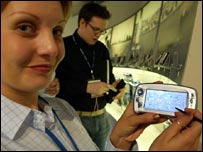
 «(...) According to Reidar Wasenius, of Nokia Multimedia, Finland, radio and mobiles go hand in hand. Many new generation mobiles already have radios in them and more people carry a phone than a radio. Visual Radio, which started in Europe in March 2005, is a system of direct two-way interaction between the listener and the radio station.

Image of a Nokia phone
Visual radio lets you interact with the radio station
A broadcaster can create other content to display on the phone at the same time as being tuned to their FM radio station. This combines GPRS technology for transfer, data and existing FM technology. Using traditional FM is controversial however, when part of the radio industry is encouraging and investing in digital take-up. But the combination of two existing systems appears to be a simple solution. When questioned about the choice of FM and not digital, Mr Reidar said that "FM rocks and it works". Nokia also wanted to use conventional technology so give access to the mass market of billions of FM listeners. The phone would show the artist and title of the music with an option to buy the track and download it as a track or ringtone.

'Red button radio'?

For the first time this would deliver impulse buying to the radio. It would be possible to see the presenter, check a weather map, read about the current programme topic or take part in a phone vote or a competition. This is the equivalent of TV's red interactive button. So far a dozen stations across Finland, UK and Germany have installed the additional server the system requires and all users have to do is to have enabled their mobile phone handset. The station will have to update the information. Its inventors, Nokia, and marketing partners Hewlett-Packard, are very exited about visual radio. They hope to reach some of the estimated 760 million mobile phone users worldwide. Many users upgrade regularly, so it is easy for a manufacturer to introduce a new system. Michael Mullane from the European Broadcasting Union, Switzerland, said that people wanted more choice and radio-on-demand, alongside additional programme information. According to Mr Mullane, "radio has never sounded so good" and is "a vibrant medium with a rosy future". James Cridland from Virgin Radio, which is only on AM frequencies in many areas of the UK is seeing a drop in AM listening. (...)»

fonte: «Future looking 'rosy' for radio», BBC News, 11 September 2005, By Ian Piper and Chris McWhinnie
BBC Monitoring, in Amsterdam

Um futuro «cor de rosa» para a rádio?

«The internet delivers thousands of traditional stations and even more music streams and podcasts - downloads for personal MP3 players.

With these broad changes afoot, delegates at the International broadcasting Convention (IBC) in Amsterdam have been considering what it all means for the future of radio.

They conclude that radio has a rosy future as it enters a new era, where sound is accompanied by pictures, textual information and other content.»

fonte: «Future looking 'rosy' for radio», BBC News, 11 September 2005, By Ian Piper and Chris McWhinnie
BBC Monitoring, in Amsterdam


Televisão já não é a preferida

«Navegar na Internet é a ocupação preferida de 40 % dos jovens portugueses depois do jantar, revela o estudo «Crianças e Jovens: A sua relação com as tecnologias e os meios de comunicação», realizado pelo Centro de Investigação e Estudos Sociológicos (CIES) do ISCTE, com a PT.COM. A televisão aparece em segundo lugar com 30% das preferências, à frente dos jogos (12%).. Mas se tivessem que optar apenas por um meio de comunicação, o inquérito, realizado on line no portal SAPO durante um mês (1353 respostas), indica que 70% optariam pela Internet e que a TV seria primeira opção para apenas 20%. Menos folgada é a escolha quando colocados perante a opção entre Internet e telemóvel. A maioria (505) continua a preferir navegar na Web, mas já há um numero significativo (43%) que optaria pelo telemóvel (...)»

fonte: Expresso/Economia, «televisão já não é a preferida», João Ramos, 26/8/06 (pág. 14)

O podcasting televisivo (mas só com som...)

Números do podcasting em Portugal:

«registamos uma média mensal de 26 mil dowloads do programa 'Caixilhos & Laminados' da Rádio Comercial, cerca de 16 mil para os 'Apanhados' da Cidade e 14 mil para o 'FMHistérico' da Best Rock», salienta o mesmo responsável [Carlos Marques,  director de Multimédia da Media Capital Rádios] (...) As três rádios deste grupo [Antena 1, Antena 2 e Antena 3] iniciram as emissões de podcasting em maio, sendo os mais procurados o 'Há Vida em markl', o 'Portugalex' e o 'Mix Show'. A Tsf, também pioneira no podcasting, já registou mais de 80 mil acessos desde Janeiro com o programa «Pessoal e transmissível» (...) O podcasting também está na mira das televisões nacionais. Tanto a Sic como a RTP disponibilizam alguns programas em áudio, mas só com a massificação dos dispositivos que possibilitam a leitura de ficheiros de video se deverá consolidar essa aposta. Desde Julho do ano passado foram vendidas 24 mil destas unidades , que representam um aumento de 4091% face ao ano anterior, de acordo com a Gfk. A RTP prevê lançar uma série de programas em videocasting no último trimestre deste ano (...)»

fonte: «Tv entra no podcasting», Manuel Posser de Andrade, Expresso/Economia,  26/8/06 (pag. 15)

Um em cada dez portugueses já usa LAD (?)

«Um em cada dez portugueses já usa o leitor digital portátil (MP3) para ouvir música (...). Os numeros falam por si: nos ultimos dois anos foram vendidos 693 mil leitores digitais de Mp3 em Portugal, segundo dados do Gfk Group. Só no ano passado venderam-se mais 245% de leitores de música digital do que no ano anterior, num total de 45 milhões de euros (...)

fonte: «Tv entra no podcasting», Manuel Posser de Andrade, Expresso/Economia,  26/8/06 (pag. 15)

Os problemas do iTrip

Excertos de um texto da BBCNews sobre os problemas criados pelo iTrip (desenvolvimento destes textos):

«(...) As these gadgets have to be tuned to an FM frequency, using one in the congested airwaves of a major city disrupts the user's listening pleasure. Chris Price, publisher to Techdigest.tv, used to have an iTrip to listen to his iPod while driving. But for a year it has languished unused - he grew fed up with local and pirate radio stations cutting in as he drove around London. It's completely useless in London as there are so many FM frequencies in use. I kept having to retune the thing each time to find a free FM frequency. Sometimes I'd get snippets of a station, sometimes it just took over. Obviously this is less of an issue if you live in the back of beyond." (...) "If I stopped at the lights next to someone with their iTrip using the same frequency, I could overhear the other driver's music or simply static. But it's not that likely - it would have to be the exact same frequency, and there are about 100 to choose from," says Mr Price. And by the same token, they can disrupt ordinary radio broadcasts. Many users tune into low or high FM frequencies, well away from major radio stations. But these ends of the dial are commonly used by public radio, given over to talk and news programming.»

fonte: «Transmission Breakdown», BBCNews, 20/7/06

PS - tenho os mesmo problemas no Porto com o iTrip, uma vez que as frequencias padrão estão ocupadas; alguém tem uma solução?

Um novo modelo de carro apenas com pub na net

«It's a "radical experiment," said Mark-Hans Richer, Pontiac's marketing director, conceding the effort won't generate as much awareness as TV and other traditional mass media. But it's a calculated risk, because Pontiac is targeting mostly younger men for the niche model. "We know where the bull's-eye is," he added, "so it's easier."

Mr. Richer might be a pioneer, but he's not the only one. A large part of the auto industry seems to be in the toe-dipping phase of a marketing transition that could see it go from a $20 billion traditional advertiser to a leaner, meaner player more dependent on interactive and direct tactics»

fonte: «Pontiac G5 Blazes Trail to Internet-Only Advertising», AdAge, By Jean Halliday, Published: August 27, 2006

(curiosamente, tem ligação de kjack para leitores de audio digital... http://en.wikipedia.org/wiki/Pontiac_G5)

Os planos da Media AUdit/Ipsos se...

«If the Media Audit/Ipsos Smart Cell Phone measurement system is selected by the radio industry for radio ratings, the largest Designated Market Areas (DMA) will be the first to be surveyed. The company is currently conducting tests of the system in Houston.

The tests are the lead-up to the full market test, and the company will start recruiting for the full market test in the fall. The results of those tests will be released this winter. If The Media Audit/Ipsos system is selected as the electronic radio ratings service, New York, Los Angeles and Chicago will be the first three markets to be surveyed after the completion of the full market test in Houston. The company plans to provide the service to 12 markets in 2007 if adopted.

The Media Audit/Ipsos system uses a Smart Cell Phone to capture the ratings data, so there is no hardware to manufacture for listeners to carry»

fonte: «Media Audit, Ipsos Plan First Measured Markets», Radio Currents Online, 7/8/06

Transformar LAD em rádios digitais...

é a aposta da BBC, que estará a trabalhar num aparelho capaz de transformar os leitores de mp3 (e de outros formatos) em recpetortes de rádio digitais:

«Currently plans are at an early stage and there are no firm details for the capabilities of the gadget or how much it will cost. There is also no timetable for when the add-on radio might appear. "It's important for to us to make sure that people can listen to digital radio on their own terms," said a BBC spokesman. (...) "We have a duty to make sure digital radio is relevant and clearly portable MP3 players are a massive area of growth," he said. The plug-in gadget would not be limited to playing the BBC digital radio stations. Versions might also be available for mobile phones and cars

fonte: «BBC plans clip-on digital radio», Friday, 11 August 2006, 13:10 GMT 14:10 UK , BBC News

Uma previsão óbvia

«Internet radio will greatly benefit from pervasive Wi-Max or wide-area wireless access, which will bring Internet radio to portable devices, including car radios, by 2008»

fonte: «Bridge: HD Radio Will Impact Satellite Growth; Wi-Max in Cars by '08», RWonline, 24/8/06


Um canal exclusivo para telemóveis

« (...)a TMN reforça a sua oferta de Mobile TV com o lançamento em primeira-mão do canal Futebol Mobile TV. Dedicado integralmente às notícias e imagens do futebol nacional, o novo canal é uma parceria TMN e Sportinveste Multimédia. O canal Futebol Mobile TV apresenta as antevisões de cada jornada do campeonato português, onde se incluem resumos de confrontos anteriores entre as equipas e, após cada jornada, o resumo de todos os jogos da bwinLIGA. Único canal móvel dedicado exclusivamente ao futebol, proporciona 24 horas de informação, com classificação, melhores marcadores e muitas notícias (...) (do press release da TMN)

O iPod tem de convergir?

«(...) The iPod remains an amazing phenomenon but its heydays are over unless, as happened before, it reinvents itself with a new line such as a much-rumoured cameraphone. Tomi Ahonen, a mobile expert, claims that with a fall in total market share (of players and phones) from 80% to 14% in 18 months, the iPod is "wilting away before our eyes"(...)».

fonte: Guardian, Dump your iPod, the mobile's taking over, Victor Keegan, August 24, 2006

Telemóveis (e convergência) vencem iPods

«Well, the war is finally over: and the mobile phone has emerged as the winner on two key fronts. For most buyers it will be the device of choice for playing music and taking photographs. I have been trying out some of the latest mobile phones and there has been a big increase in the quality and quantity of the tracks they play, while mobile phone cameras - especially with the release of 3- and 5-megapixel models, such as the Nokia N80 and the LG KG920 - are now as good as the standard digital cameras of a couple of years ago.

There will always be lots of people wanting dedicated cameras or iPods, but the majority of people in future will opt to have all these functions on one device rather than two or three. They already are. It is no coincidence that in the first quarter, when Apple suffered a sharp drop in iPod sales (blaming it, implausibly, on seasonal factors), the International Federation of the Phonographic Industry said that half of all digital music sold in 2005 went directly to mobile phones (including ringtones).

The decline of iPod sales continued in the second quarter, while sales of music-enabled mobile phones soared. Nokia alone, a late entrant to music, plans to ship 80m music phones this year (almost double last year's iPod sales). Sony Ericsson is enjoying success with its popular Walkman phone, as is Motorola with its Razr, while LG's Chocolate was Carphone Warehouse's biggest ever seller.

fonte: Guardian, Dump your iPod, the mobile's taking over, Victor Keegan, August 24, 2006

A relação entre a escuta de rádio e os LAD

- Quanto mais rádio se ouve menos música nos LAD (mp3)

«According to a new Bridge Ratings consumer study the number of songs stored on MP3 players varies by amount of weekly radio listening. The study found an inverse relationship among those consumers who spend less than the average amount of time per week listening to radio of any kind (terrestrial, satellite, internet).

According to the study of 2900 persons between 12 and 64 years of age, the average weekly radio listening is 34 hours per week. This includes listening to terrestrial, satellite and internet radio. Listeners who spend less than the average 34 hours a week with radio of any kind tend to have more songs on their digital music players. The average user of a high-capacity digital music device stores only 349 songs the study found. One in four players holds between 100 and 499 songs, while 25 percent have 500 songs stored on them. 59% of those surveyed said their digital music player holds fewer than 100 songs.

Light users of radio average 410 songs while average or heavier consumers of radio average 289 songs.

The Bridge Ratings study was conducted during July and August of this year.»

fonte: «New Bridge Study Examines Radio Listeners' MP3 Players», Bridge Ratings; tambem aqui.

Loja britânica on line deixa de vender rádios analógicos

A Dixons, loja de produtos electrónicos on line, anunciou que deixará de vender rádios analógicos. Rádios só mesmo digitais (DAB). Sinais dos tempos...

«“The growth in demand for digital radios is further evidence that we’re living in the digital age,” said Nick Wilkinson, Group managing director for Dixons. “The snap, crackle and pop of the traditional wireless is rapidly being replaced with the crystal-clear sound of digital audio broadcasting.”

He added: “The traditional radio has been a huge part of home life in the UK, through good times and bad, over the last 100 years. Some of the most pivotal events in our history have been communicated to UK homes from analogue radio transmitters to wirelesses in homes around the UK. There is probably no other piece of technology that conjures such a powerful mental image as the old wireless perched on the mantelpiece with the family gathered around it
.”»

Primeiros ecos do PPM em Houston

«“Instead of waiting as long as a month for a ratings report that only reflects the average audience for the previous three months, radio station executives will now have a single week of reliable audience ratings to see how a programming strategy is working. And thanks to the reliability of the PPM ratings, programmers won’t have to resort to home-brew, back-of-the envelope extrapolations of Arbitron data that can lead to misleading conclusions about the behavior of the radio audience. With PPM, when you run a strong promotion, make a personality or format change, you'll have credible audience feedback within weeks."» (Gary Marince, VP, Programming Services, Arbitron Inc)

fonte: Radio Ink, «Radio One Softens Stance On Houston PPM», 25/8/06

o Wi-Max e a desvalorização das rádios AM/FM

É a opinião (excertos) de Corey Deitz (a merecer boa atenção):

«One of the scenarios I see coming together is the devaluation of AM and FM radio stations as technologies like WiMax take hold (...) WiMax will help to migrate Internet Radio from desktops to autos and other portable devices. WiMax radio signals (carrying broadband content at 70 megabits per second) should initially have a range of 30 miles. So, theoretically, an Internet radio station made available through a WiMax transmitting station centered in the middle of any American city will have the power to easily cover a 60-mile circumference, easily providing enough reach to rival most AM and FM stations being measured by Arbitron. (...) So, when the time comes when any enterprising programmer can create an Internet radio station which has the reach potential of terrestrial AM and FM properties, what does that do to their value? Well, I’m no financial genius but it seems to me it lowers their value – substantially. Before Internet radio, satellite, cell phones, and podcasts, AM and FM stations were considered non-renewable resources. In other words: the radio spectrum could hold only so many and no more could be created. (...) But, Internet radio stations can operate on low overhead which means they can also take more chances in specialized programming. They do not need as big an audience as a terrestrial station to be successful. An Internet radio station also doesn’t need 12 minutes of commercials each hour to be profitable, like many AM and FM operations. (...)And, although much weight has been put on HD Radio as part of the future saving grace of AM and FM, at least one question arises: will HD Radio infrastructure outpace WiMax infrastructure – and even if it does, will it matter?»

fonte: http://radio.about.com/od/opinionpieces/a/aa082206a.htm (3 paginas)