Blogia

Transistor kills the radio star?

Uma rádio (Canadá) a pensar já na audição móvel pela net

«A Canadian radio station has added a Web site aimed at cellphone and PDA users, timed to take advantage of a Wi-Fi rollout happening in its market. “Recognizing that a handheld world calls for a handheld point of view, the Edge reconfigured its consumer Web site to fit the dimensions of a handheld screen, optimizing users' view and capabilities,” CFNY(FM) station said in its announcement, adding that Toronto is “on its way to becoming the largest wireless hotspot in North America.” The station is owned by Corus Entertainment. The site is www.edge.ca/wifi. The site offers club and concert listings and text. It’s available through wireless hotspots on any handheld device that supports a Wi-Fi connection. A new Wi-Fi network in downtown Toronto is being implemented in five stages with completion by year’s end. For six months people with wireless-capable devices will have free access to the Web inside within that area. PD Alan Cross said radio “is the original wireless technology,” and that there is a “natural fit between what we do and the new technical realities the Internet presents.”»

fonte: «Station Jumps on Wi-Fi With Targeted Web Offering», RwOnline, 18/9/06
 

Os anúncios não afastam os ouvintes?

«A study released Thursday at the NAB Radio Show determined that radio retains an average of 92% of the listeners who are tuned in to a station one minute before the beginning of a commercial break. The study, which compared PPM listening data against Media Monitors advertising tracking data, surveyed 93,876 commercial breaks, studied breaks that varied in length from one to six minutes. Interestingly, the study found that the percentage of tune-out is worst in the middle of a break, regardless of how long the break length. However, the drop off between each minute tends to be fairly moderate, regardless of the break's length.

For example, the study found that 93.3% of listeners stick around through the first minute of a four-minute break, drops to 87.7% by the third minute, but jumps back to 89.7% by the fourth minute (...)»

fonte: «Study: Listeners Stick Around Through Commercial Breaks», Radio Ink, 22/9/06

Quem tem iPod não vai comprar ao iTunes?

«Despite the success of Apple iTunes, few people stock their iPod with tracks from the online store, reports a study. The Jupiter Research report says that, on average, only 20 of the tracks on an iPod will be from the iTunes shop. Far more important to iPod owners, said the study, was free music ripped from CDs someone already owned or acquired from file-sharing sites. The report's authors claimed their findings had profound implications for the future of the online music market.  (...)However, the report into the habits of iPod users reveals that 83% of iPod owners do not buy digital music regularly. The minority, 17%, buy and download music, usually single tracks, at least once per month. On average, the study reports, only 5% of the music on an iPod will be bought from online music stores. The rest will be from CDs the owner of an MP3 player already has or tracks they have downloaded from file-sharing sites(...)».

fonte: «iPod fans 'shunning iTunes store'», BBC on line, 16/9/06 


Creative baixa preços em Portugal

«A Creative Labs decidiu baixar entre 20 e 30 por cento os preços de cinco modelos de leitores MP3 para consolidar a liderança daquele mercado, anunciou o director-geral em Portugal. Luís Oliveira disse à agência Lusa que a redução de preços reflecte em parte a descida dos preços internacionais das memórias, mas visa, principalmente, reposicionar para o mercado geral os cinco modelos das linhas Zen V e Zen V Plus, que têm funcionalidades de áudio, vídeo e fotografia e se enquadravam na gama média. O director-geral da Creative em Portugal assinalou que as vendas de leitores de MP3 no mercado nacional "dispararam a partir de meados do ano passado" e a expectativa é de que cresçam 40 por cento em 2006. "O objectivo da Creative é consolidar a quota de mercado e a sua liderança do mercado português, num segmento de elevado crescimento", precisou o director-geral em Portugal. Luís Oliveira adiantou que a quota da Creative Labs no mercado de MP3 é da ordem dos 30 por cento em termos de volume de negócios. Luís Oliveira indicou que o volume de negócios da Creative Labs em Portugal se situou em 17 milhões de euros no ano fiscal que terminou a 30 de Junho, adiantando que os leitores MP3 e os seus acessórios, como colunas portáteis e auscultadores, representaram cerca de dois terços da facturação (..)» (Lusa, Creative baixa preços MP3 para consolidar liderança em Portugal, Lisboa, 20 Set)

Comparação (audio) entre dois carros

... feita por Mark Ramsey

«(...) First, the 2006 Volvo. Nice, solid car. But what's up the the audio technology? No satellite radio options, no iPod hookup, no navigation screen. Frankly, I could have bought this car in 2002 and had the same audio options as they offer now.

Meanwhile, the saleswoman kept jibber-jabbering to me about safety. One feature after another that essentially added up to "if the car rolls over, you won't die."

Then I drove the Prius. Top-of-the-line version. Fancy navigation screen. Plug for the iPod. Whichever satellite radio provider you want, all operated from the nav screen. Bluetooth for hands-free mobile phone. Impressive. Especially in comparison. No chat about safety - but frankly I've never seen a Prius with a massive dent in the side (...)»

fonte: http://www.hear2.com/2006/09/a_tale_of_two_c.html


Novas do Zune

«Microsoft is declaring that a portable music player can be a decidedly social experience. Microsoft said yesterday that its Zune player, which it plans to release in time for the holiday season, will include wireless technology to allow Zune owners to share their favorite songs and playlists with one another easily. The company hopes the Zune will help it upstage Apple Computer in the digital music market. “With Zune, we are not simply delivering a portable device,” said J Allard, vice president for design and development at Microsoft. “We are introducing a new platform that helps bring artists closer to their audiences and helps people find new music and develop new social connections.” Yesterday was the first time the company had shown off the device publicly since reports about it began to trickle out in the spring.  With the Zune, Microsoft said, users will be able to wirelessly send other Zune owners a full-length song, which the recipient can listen to three times within a three-day period. After that, the recipient will need to buy the song to play it again. By focusing on the sharing of music, Microsoft hopes to differentiate its device from the industry-leading iPod, which has no wireless or sharing features.  Bryan Lee, corporate vice president of Microsoft’s entertainment business, said in an interview that the company saw digital music sharing as an extension of other social technologies like MySpace and XBox Live, Microsoft’s online game technology that connects players with one another. “It turns people into street teams,” (promoters who try to popularize music through word of mouth), Mr. Lee said. Microsoft declined to be more specific about the timing of the Zune’s introduction and did not reveal its price, saying only that it would be competitive with that of other music players. The various iPod models cost $79 to $349. Microsoft’s announcement came two days after Apple said it would sell full-length movies for download to PC’s and video iPods, and announced iPod models with more storage space and a lower starting price.»

fonte: «Music Player From Microsoft Offers Wireless Song-Sharing», New York Times, By LAURIE J. FLYNN, Published: September 15, 2006 

A nova tendência: vender rádios

Clear Channel Communications, the nation’s largest radio operator, is now considering selling some of its 1,200 stations in smaller markets after years of acquiring everything in sight, according to industry analysts. The Corporation">CBS Corporation did the same thing recently and now says it is looking at further station sales. The Walt Disney Company struck a deal this summer to get out of the radio business altogether, and in May, Susquehanna Broadcasting, the nation’s largest privately held radio group, was sold to another broadcaster.

Diversificar a oferta: trânsito na hora

A Clear Channel assinou um acordo com a BMW: vários modelos de topo a sair no próximo ano já trarão - sem custos acrescidos - informação na hora de transito (em 44 cidades):

«Clear Channel Radio said Thursday it will provide data from its Total Traffic Network to the navigation systems for most 2007 BMW vehicles--including the X5, M5, M6 models and the 3, 5, and 6 Series lines. The service, which is set to kick in for new BMW buyers later this month, offers real-time traffic information for 44 cities in the United States. The service will be included in the cost of the navigation system, so there will be no monthly fees. This is Clear Channel's first partnership with an auto manufacturer, but the radio giant's Total Traffic Network has been paired with other services, among them WeatherBug and Microsoft's MapPoint

fonte: «Clear Channel to offer traffic updates to BMWs» CNet News.com, 8/9/06

A perda de ouvintes na rádio convencional

Citações de um artigo do New York Times:

«The radio industry keeps losing people like Danny C. Costa, a senior at Boston University who grew up listening to radio in New York and New Jersey. For the last few years, Mr. Costa has tuned out radio in favor of Web sites where he can get access to downloads or videos he heard about from friends. He prefers these to the drumbeat of the Top 40. He burns his favorite songs onto CD’s or copies them onto his iPod. “I just sort of stopped listening to radio, because I had access to all this music online,” Mr. Costa said. While more than 9 out of 10 Americans still listen to traditional radio each week, they are listening less. And the industry is having to confront many challenges like those that have enticed Mr. Costa, including streaming audio, podcasting, iPods and Howard Stern on satellite radio».

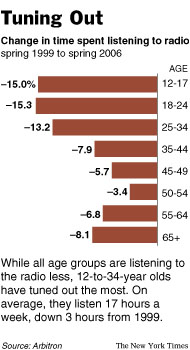
« The amount of time people tune into radio over the course of a week has fallen by 14 percent over the last decade, according to Arbitron ratings.   

«Larry R. Glassman, a surgeon who does lung transplants and commutes between Cold Spring Harbor and Manhasset, N.Y., each day, used to tune into radio for his 40-minute drive, particularly to hear his classic rock favorites. But now he subscribes to XM Radio, and recently had an XM receiver installed in a new boat. “Some of the programming I just flip over,” he said, adding that he would listen to XM in surgery if he could. Instead, “I use the iPod in the operating room.” Mr. Glassman, who is 51, said he turned a deaf ear to radio primarily because of the advertising and because he finds the playlists of his favorite stations too mainstream and limited»
fonte: «Changing Its Tune», New York Times Online, RICHARD SIKLOS, Published: September 15, 2006 


YouTube faz acordo com Warner

«O YouTube, site de compartilhamento de vídeos gratuitos pela internet, e a gravadora Warner Music Group (WMG) anunciaram nesta segunda-feira (18/09) um acordo para oferecer, na biblioteca do YouTube, vídeos, entrevistas, programas e clipes dos artistas da WMG. Com o anúncio, a Warner se torna a primeira empresa de conteúdo a passar seus vídeos pelo YouTube, unindo a popularidade do serviço na internet com programas de direitos autorais reservados. O YouTube pretende criar, até o fim de 2006, um sistema que possibilite a publicação de vídeos pela empresa, garantindo o pagamento de direitos autorais. O novo sistema já está sendo desenvolvido e, segundo o YouTube, oferecerá aos grupos de mídia ferramentas de identificação com direitos autorais de seus vídeos, identificação de áudio, bem como a possibilidade de autorizar e distribuir os vídeos publicados no site. O acordo diz que ambos irão dividir o rendimento sobre publicidade nos vídeos publicados e os usuários poderão acessar simultaneamente vídeos e áudios dos artistas da Warner. Os vídeos da Warner estarão disponíveis no YouTube até o final do ano, quando o serviço online deve lançar o novo sistema de proteção aos direitos autorais»

fonte: «Warner Music vai distribuir conteúdos no YouTube até o fim do ano», PCWORLD,IDG Now!, 18-09-2006

(Nota: alguns dias antes a Universal Music anunciou que pretende avançar com uma acçlão judicial contra sites como o YouTube)

Há cada vez mais lojas de música on line em Portugal

«Muito recentemente, registou-se esta coincidência abre mais uma loja portuguesa de discos on-line - a Zebra - e, ao mesmo tempo, uma das mais importantes cadeias de lojas de música - a Valentim de Carvalho - anuncia que, até 2007, pretende reduzir o número de estabelecimentos para dez. Já tiveram 100. Entretanto, nos planos da Flur, distribuidora independente com casa aberta em Lisboa, está "passar as vendas para suporte digital até 2007". Artur Ribeiro, da Jo-Jo's e CDGO, não tem dúvidas: "As grandes lojas de discos têm os dias contados".

O panorama de lojas de música on-line criadas em Portugal é crescente. Actualmente, a oferta é garantida por editoras, distribuidoras e lojas físicas que optam por estender as vendas ao suporte digital (ver guia rápido), até "porque já é um mercado comum que garante uma boa fatia das vendas de discos", comenta José Moura (...)

fonte: «Mercado de lojas de discos on line cresce em Portugal», Cláudia Luís, JN, 18/9/06

(NOTA: Há alguma confusão neste texto, uma vez que mistura venda de música em formato digital - como o iTunes - e venda on line de formatos físicos, como o LP ou o CD; a Zebra, por exemplo, é uma loja de vendas on line de discos convencionais...)

Os portugueses e os sites de música

«De Janeiro a Junho de 2006, foram 754 mil os residentes no Continente com 4 e mais anos os que visitaram sites de música, quando em suas casas navegaram na internet. Este número corresponde a 46.3% dos internautas portugueses.

Estes indivíduos visitaram perto de 24 milhões de páginas destes sites, tendo-lhes dedicado mais de 295 mil horas de navegação, uma média de 23 minutos por utilizador»

fonte: «754 mil visitam sites de música», Marktest, 7/9/06 (via NetFM)

O dilema da rádio musical face à nova oferta

Um ponto da situação:

«The announcement of two new online music services points to what the radio industry is facing. Given a choice, which way will the public go? Listening to a "local" radio station that's offering plenty of music with little relativity (as the majority of stations do today), or listening to an online music source with plenty of music and little relativity.

We've reached a state where radio has diminished it's local content to a point that's matched by the jukebox delivery of online music sites. Both, radio and these web sites that feature music, play popular songs. Both stay away from additional elements which cost money to produce, and both create a bond with the audience»
fonte: «Online Music Services vs Radio», Audiographics, 30-08-2006

Cinco anos de Cotonete

«O Cotonete, o primeiro portal de rádios onde cada ouvinte pode criar uma emissão à sua medida, tem a partir de hoje uma nova cara para celebrar os primeiros cinco anos de vida completados esta semana. Mais oferta de estilos de música e de novo a possibilidade de cada ouvinte poder escolher músicas por tema e autor são as principais novidades desta renovação de um projecto que já aloja mais de 30 mil rádios pessoais e que tem tudo pronto à espera da rádio do futuro. (...) «Somos únicos nesta oferta de conteúdos temáticos. A BBC só arrancará com este serviço em Janeiro do ano que vem» [Carlos Marques, director geral de multimédia da Media capital Rádios] (...) Os negócios multimédia da MCR representam 7,5 % das receitas do grupo e cresceram 50% no último ano» (...). Até 2004, o Cotonete deu a possibilidade, aos seus utilizadores, de escolherem para as suas web radios, música a música, entre a maior base de dados portuguesa de música. mas a legislação europeia, na ausência da nacional, impôs em 2004 que quem queria fazer uma rádio pudesse apenas escolher o estilo de música preferido: soul, jazz, pop, fado, dança, alternativa. E não era possivel saltar um tema. «A maior novidade deste aniversário é que já negociámos direitos com duas editoras para se voltar a escolher música a música», conta o responsável. (...)»

fonte:  «Cotonete celebra cinco anos de rádio a la carte», Ana machado, Público, 15/9/06,

Nokia «Internet tablet» (com radio via net)

«What's particularly compelling about the Nokia 770 Internet Tablet is that it's not only the first to be billed as an "Internet Tablet," but also its software is built entirely from open source components. Parts of it come as a result of direct community participation via the Nokia 770's community site.

Once booted, users are greeted with a slick interface with direct access to several applets, including a Google search window, contact list and a music player preset to AccuRadio HitKast. It also has a Web shortcut pointing to the "Tableteer," which points to a homepage intended for 770 users with support and update information Included.

Boot time was surprisingly long -- roughly 10 seconds. However, potential buyers need to understand that this device is not a PDA nor is it a laptop. Think of it as somewhere in between.

Users are able to manage and rearrange these applets as desired, although the process for doing so seems a bit disjointed. Until the applets are properly aligned -- something that doesn't come automatically -- you're unable to perform other tasks with the device.»

fonte: «LinuxWorld Product Review: The Nokia 770 Internet Tablet», By Jason Gilmore, 21 Aug 2006 | SearchOpenSource.com


Uma visão optimista sobre o futuro da rádio

Diz Kurt Hanson, do RAIN:

«Despite continuing press reports of radio's 'death,' the truth is that radio is in the middle of the most amazingly fertile period of innovation and growth in its history

In addition to the thousands of traditional AM and FM stations broadcasting in markets across the U.S., new forms of radio are now coming to consumers — to over 10 million people a week via satellites, to over 30 million people a week via their PCs, via cable TV systems, and increasingly via 3G and WiFi wireless signals that can be picked up on PDAs and cell phones — and soon on MP3 players and in-dash car audio system).» (fonte: «Book launch party at NAB Radio Show!»,


Nielsen quer medir rádios nos EUA?

Seria surpreendente se isto se confirmasse, mas para já fica a indicação:

«Reuters reports that a turf war could be brewing as TV ratings service Nielsen Media Research said yesterday it was in talks with the radio industry about possibly tracking listening audiences.

A spokeswoman for Nielson – which is owned by VNU – said, "We are in discussions with the evaluation team to see whether it makes sense for Nielsen to enter the measurement of radio.”

Nielsen's move comes as Arbitron is trying to win industry approval for its portable people meter. Additionally, Arbitron is also facing competition for its ratings business from Media Audit/Ipsos and their Smart Cellphone system.

Nielsen split with Arbitron in March, ending an agreement reached in 2000 which gave Nielsen an option to commercially deploy the portable people meter for TV measurement.»

fonte: «Nielsen In Talks About Radio Ratings», radio Ink, 11/9/06

PPM detecta sinais não codificados

O PPM da Arbitron recebe habitualmente duas grande criticas: que é complicado trazer um aparelho que não serve para mais nada e que só detecta as rádios que codificam um sinal interno. Ora a esta - e principal - acusação acabam de responder com a possibilidade de detectarem tambem as rádios que não se condificarem:

«Arbitron has announced that it is field testing the addition of an audio matching capability to the Portable People Meter electronic ratings system which would allow the PPM to track audiences to radio stations that choose not to encode their signals.

Arbitron says the dual-function meter is capable of identifying a radio station using two methods of detection using existing Portable People Meter hardware»

fonte: «Arbitron Field Tests A PPM That Tracks Unencoded Radio Stations», Radio Ink, 14/9/06

Rádio serve para conhecer nova música

«The survey found that Americans rate radio as their primary source to learn about new music. When asked which ways they learn about new music, 63 percent said by listening to the radio. In comparison, 43 percent said it can be through talking with friends, 41 percent cited watching television, 24 percent cited reviews in newspapers or magazines, and 16 percent cited the Internet»

fonte: «Radio Listening Remains Strong», 14/9/06, Radio Ink

«Escuta de rádio continua forte»

(o título traduz a notícia da Radio INk; a mim parece-me que 27 por cento de pessoas a dizer que ouvem menos é relevante) 

«Despite the availability of various new media to receive music and news, only a little more than one in four Americans (27 percent) say they are now listening to the radio less than they did five years ago. According to a survey commissioned by American Media Services, about half (51 percent) said their radio listening hasn’t changed during the past five years, and 21 percent said they are now listening more.
When asked to look ahead five years, only 11 percent said they expect to be listening to the radio less than they do now. Nearly three out of four (74 percent) said they expect to listen about the same, and 13 percent said they expect to listen more.
“Radio plays a vital role in American life. Reports of radio’s death seem greatly exaggerated,” said Ed Seeger, president and chief executive officer of American Media Services, which commissioned the survey.
The survey found that Americans rate radio as their primary source to learn about new music. When asked which ways they learn about new music, 63 percent said by listening to the radio. In comparison, 43 percent said it can be through talking with friends, 41 percent cited watching television, 24 percent cited reviews in newspapers or magazines, and 16 percent cited the Internet»

fonte: Radio Ink, 14/9/06, Radio Listening Remains Strong