Blogia
Transistor kills the radio star?

3.0.1 "A geração iPod"

A rádio tem futuro entre os mais jovens

De um (surpreendente? inesperado? suspeito?) estudo da Bridge ratings («The new study of 3314 kids between the ages of 8 and 12 [TWEENS]conducted during February/March and June/July 2007 indicates that though exposed to many of the new technologies their older counterparts have been, AM/FM radio still provides a high level of satisfaction.»)

- The truth of this study is that while many of today's 15-19 year olds are spending more time with their digital music players, cell phones and the Internet for the same experience their predecessors got from AM/FM radio, Tweens - those between 8 and 12, are still experiencing radio and loving it.

-The data suggests that radio still has a chance with the teens and young adults of five to ten years from now. (...) For the future of the radio business, radio still has potential among 8-17 year olds. Teens may be a more difficult transition since the radio industry has provided little in the way of content over the last 10 years to nurture teen listening, but this study proves that it isn't too late for Tweens to be nutured by radio.

Talvez o que mais surpreenda seja este quadro: «Tweens use of media hinges largely on access of that media during a typical day. As one might suspect, TV has the largest reach into this demographic - as does radio. 21% of the Tween panel has access to a cell phone daily with only slightly more gaining access to a device that will allow them to Instant Message or Text.

fonte: «Tweens are Radio's Future: Let's Treat 'Em That Way», Bridge Ratings, July 25, 2007
Jovens do Canadá ouvem muito menos

«(...) Canadians spent an average of 18.6 hours a week listening to the radio in 2006, a drop of half an hour from 2005, according to annual statistics reported by the Canadian Radio-television and Telecommunications Commission. (...) Average weekly listening time - which includes mornings, at work and while driving, the three points of the day when most people tune in - has fallen substantially from eight years ago, when Canadians averaged 20.5 hours of radio a week, the regulator said. "Since 1999, the overall per capita weekly radio listening levels decreased by almost two hours," the regulator said. "The most notable decreases have been in the teen demographics and for adults aged from 18 to 34, where weekly listening levels have decreased three to four hours."

fonte: «Time with radio on the decline», Report on Business.com GRANT ROBERTSON, August 1, 2007

Ideias sobre a geração iPod (e o lugar da rádio)

« (...)But it also seems that the idea of buying a radio is "anathema" to the kids. For them, radio is something that comes free with another device. Winter revealed some alarming research about the "iPod generation", many of whom have no interest in local communities and are distrustful of mainstream media. Some 27% of them think radio is outdated. But despite this level of disengagement, 30% said they would spend more time with radio in future. So how to reach out to them? Parfitt said teens want to be taken seriously and not stereotyped, want aspirational role models from the media, as well as a spirit of "mucking about". And radio should be aware of its strengths. While MP3s allow listeners the music they have already chosen - music recovery - radio is better for music discovery. And in the talk field, radio offers company and connection, rather than the self-immersion of the iPod world. Young listeners still appreciate radio's liveness, spontaneity and unpredictability. Nevertheless you can smell the unease in the auditorium: the world is changing fast and the teens of today are the first to grow up with this dizzying and rapidly evolving array of technologies, and no one knows for sure what will turn out to be merely a fad and what will bring fundamental change to consumer habits.

fonte:  «Radio Festival - day two», Guardian Unlimited, 

Metade do tempo livre é a ver televisão

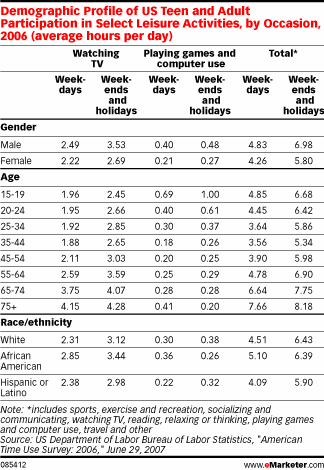
« On an average day, nearly everyone in the US ages 15 and older engages in some sort of leisure activity, like watching TV, using a PC, socializing or exercising, according to the US Department of Labor's Bureau of Labor Statistics' "American Time Use Survey." Watching TV accounted for about half of leisure time, on average, for both men and women. Socializing accounted for about three-quarters of an hour per day for both sexes. Time spent reading for personal interest and playing games or using a computer for leisure varied greatly by age. Those ages 75 and older averaged 1.4 hours of reading per weekend day and 0.2 hours (12 minutes) playing games or using a computer for leisure. Individuals ages 15 to 19 read for an average of 0.1 hours (seven minutes) per weekend day and spent one hour playing games or using a computer for leisure.

Demographic Profile of US Teen and Adult Participation in Select Leisure Activities, by Occasion, 2006 (average hours per day)

fonte: «TV Consumes Half of All Leisure Time», eMarketer, JULY 9, 2007

Jovens, os mais ligados em rede

«existia uma divisão por idades: apenas 29,6% das pessoas maiores de 50 anos tinham acesso à Rede, contrastando com os 55,4% dos indivíduos com idades compreendidas entre os 25 e os 49 anos de idade, 56,8% da faixa etária de 18 a 24 e 53,4% dos jovens de 9 a 17 anos. No conjunto, no acesso à Internet, a população adolescente era o dobro do grupo de maiores de 50» (castells, 2004: 289)


Mais na Internet, menos na televisão

«Nos Estados Unidos, os espectadores de televisão por cabo igualaram os dos canais abertos, com 50% de audiência no ano 2000, e está previsto que os superem nos próximos anos. Além disso, os jovens norte-americanos vêm menos televisão agora do que antes: entre 1985 e 2000, os menores de dezoito anos reduziram em 20% o número de horas em frente ao televisor. Esta mudança atribuiu-se em parte ao facto de os jovens passarem cada vez mais tempo a navegar na Internet (The Economist, 2001: 60)» (Castells, 2004: 226) 

A Internet potencia a interacção social

«A Internet parece ter um efeito positivo na interacção social e tende a aumentar o grau de exposição a outras fontes de informação. Di Maggio e outros (2001) informam acerca dos resultados de diversos inquéritos de participação pública que indicam que os utilizadores da Internet (uma vez controladas outras variáveis) lêem mais livros, assistem a mais acontecimentos artísticos, vão mais ao cinema, assistem a mais espectáculos desportivos e fazem mais desporto que os não utilizadores.» (Castells, 2004: 151) 

«(...) o conjunto de dados disponíves não sustenta a tese de que a utilização da Internet conduz a uma menor interacção e a um maior isolamento social. Mas existem alguns indícios de que, em determinadas circunstâncias, o seu uso pode agir como substituto de outras actividades sociais. (...) é difícil chegar a uma conclusão definitiva sobre os efeitos que a rede pode ter sobre o grau de sociabilidade» (Castells, 2004: 154) 

Mais tempo na Internet e a fazer várias coisas (multitasking)

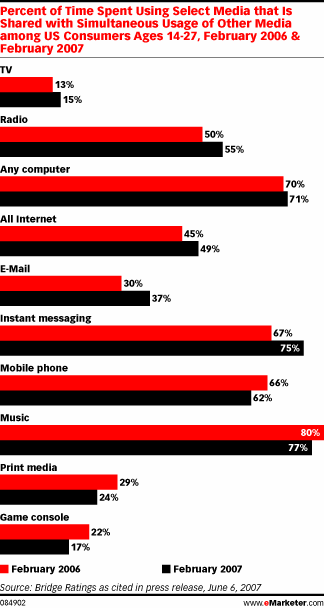
«Multitasking is driving up the total amount of time that US teens spend with media, according to a Bridge Ratings study conducted in March to May 2007.
US consumers ages 13 to 17 spend more time with media overall than other age groups do, and their total media time has grown by more than two and a half hours per day since May 2004.

Time Spent with Media* per Day among US Consumers, by Age, May 2004-May 2007 (hrs:mins)

Bridge attributes this change to Generation Y's skill at consuming two or more of types of media simultaneously.

Percent of Time Spent Using Select Media that Is Shared with Simultaneous Usage of Other Media among US Consumers Ages 14-27, February 2006 & February 2007

Among teen Internet users, 7.3 million of the total 9.4 million online in 2006 watched TV while online, and 6.9 million listened to the radio, according to eMarketer calculations based on data from a BIGresearch survey.

US Teen* Internet Users Who Use Other Media While Going Online, 2006 (millions)

Although multitasking extends across all age groups, teens are generally more likely to multitask media than adults.

eMarketer Senior Analyst Debra Aho Williamson says more research is needed to discover exactly how multitasking affects consumers. "The media and advertising industries must move beyond simply acknowledging that multitasking takes place," Ms. Williamson says, "and support research initiatives that can establish which media are most likely to be 'foreground,' or primary, media, and which are more likely to be in the background. In addition, more research must be done to show marketers whether advertising that only receives partial attention is still effective."»

fonte: Generation Y Multitaskers Boost Media Time», eMarketeer, JUNE 21, 2007

Canadá: audiências entre os mais jovens a cair

«OTTAWA -- A new study has found that Canadians -- especially teens and young adults -- devoted less time than ever listening to their radios for entertainment in 2006. Statistics Canada reports young people aged 12-24 appear to be switching to digital music players and online music services. On average, Canadians tuned in to their radios for 18.6 hours during "measurement week" in the fall of 2006, down from 19.1 hours a week in 2005 and about two hours less than in the fall of 1999, when radio listening peaked. Among young adult men, listening fell to 13.7 hours from 15.1. Among their female counterparts, it slipped to 14.6 hours from 15.4. Senior women continued to be the most ardent radio listeners, tuning in for 22.7 hours per week -- virtually unchanged from 2005 -- while listening by senior men edged down to 19.5 hours a week from 20.3»

fonte: «Radio listening dropping off», London Free Press, June 27, 2007, By CP

Jovens 18-34 preferem Internet à televisão

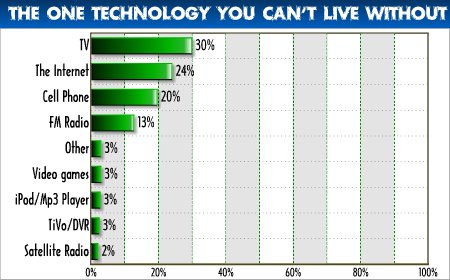
«If you had a choice - if you had to live with just one device or technology - what would it be?  Would you choose the Internet?  Or TV?  Or your iPod?  Or FM Radio? That was the hypothetical question we posed to 25,000+ Rockers in this year's Technology Poll, and the winner may surprise you. Television came out on top - despite all the hype about new technology and how everything's changing.  It's a real tribute to how the TV networks (not to mention HBO, Showtime, etc.) have produced compelling, habit-forming programming.

Tech_cantlive_tots_07_450

Radio is still in the hunt, of course, powered mostly by its morning and personality-driven shows.  But we have a long way to go in the content department if we're going to remain vital and competitive with new - and old - media.»

fonte: Jacobs Media, The One Thing, 12/06/07

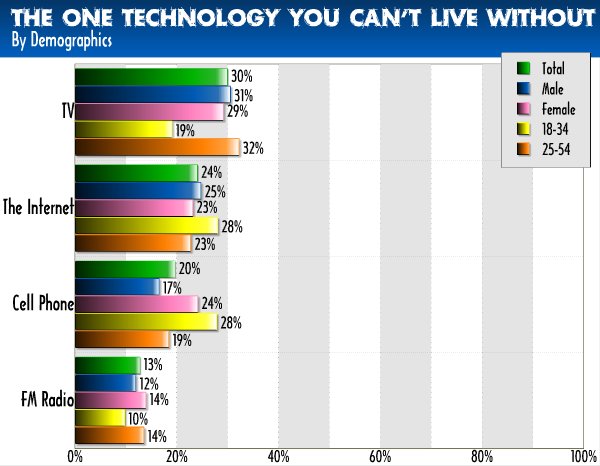
Mas entre os 18/34 a questão é bem diferente: 28% para a Internet, 19% para a televisão

Tech Survey III:

Internet: A diferença fundamental entre pais e filhos

«If analysts are taken aback by the rapid growth of Internet usage among, adults, that incidence pales in comparison to the proportion of teenagers who use the Net- currently some 91 percent! Teenagers also go online more frequently than do adults, and tend to stay online for longer periods of time. If the Net is just becoming a comfortable addendum to the adult media world, it has already become an indispensable focal point of the teenagers' world of communications. It is relied Upon for self-expression, information and entertainment» (Barna, 2001: 32) 


18-24 ouvem podcasts

«According to a recent comScore study, podcast listening (as measured by who downloads what from iTunes) is dominated by Men. And 18-24's are twice as likely to download a podcast as anyone else.

Here are some summary stats:

Podcasting

fonte: Mark Ramsey, «Who listens to Podcasts?», Hear2.0

A internet é a antítese da TV (diz Don Tapscott)

«Many people think the new media and television are analogous because they both involve screens. For example. the term screenagers has been used to describe today's youth. TV viewers and Net surfers alike have been called couch potatoes. (...) Those who say that the Net is all about a bigger crop of couch potatoes not only have a cynical view of humanity, but they ignore the budding experience with interactive technologies. Unfortunately for these commentators and fortunately for kids, the similarities between the two technologies end with the screen. In fact, the shift is more like from couch potato to Nintendo jockey.

Tv is controlled by adults. Kids are passive observers. In contrast, children control much or their world on the Net. It is something they do themselves; they are users, and they are active. They do not just observe, they participate. They inquire, discuss, argue, play, shop, critique, investigate, ridicule, fantasize, seek, and inform. This makes the Internet fundamentally different from previous communications innovations, such as the development of the printing press or the introduction of radio and television broadcasting. These latter technologies are unidirectional and controlled by adults. They are very hierarchical. inflexible, and centralized. Not surprisingly, they reflect the values of their adult owners. By contrast, the new nedia is interactive. malleable. and distributed in control.(...) This distinction is at the heart of the new generation. For the first time ever, children are taking control of critical elements of a communications revolution» (25-26)  

Hábitos da geração iPod

«(...) To youth-market researcher Max Valiquette, this combination of smallness and technological muscle is part of an accelerating cultural shift away from home-based entertainment toward a brave new world of portability, allowing consumers vastly greater control over what they listen to and view.

"One, you don't have to wait for what you want to hear," says Valiquette, 30, an iPod user and president of Youthography, a research firm based in Toronto. "Two, it's not the volume of songs but the navigation -- by mood, genre, popularity, artist, et cetera -- that's the real genius here."

Valiquette also notes that the ability to control one's listening habits has steadily expanded since the Sony Walkman debuted in 1979, making headphones a commonplace accessory. From mix tapes to custom-made CDs, the "know-me-by-my-music" mentality of older music lovers is being taken to new heights by the iPod generation, he says.

"You don't sit around a coffee shop anymore saying, `If you dig that tune, you'll dig this, too,' " Valiquette says. "You pull out your iPod instead and say, `Hey, listen to this.' "»

fonte«All shook up», Boston Globe, Joseph P. Kahn, April 5, 2004

Menos tempo a ouvir ráido, mas mais ouvintes jovens?

«City analysts have warned that the UK's commercial radio stations are losing younger listeners to social networking websites. Sites such as MySpace and Facebook as well a general increase in web usage mean younger listeners are spending time elsewhere. According to Credit Suisse analyst Simon Baker: "The proliferation of internet-based entertainment has precipitated one of the most significant changes, if not the most significant change, in the way the younger demographic consume media. It should be of increasing concern to radio groups." Rajar's most recent figures show that year-on-year commercial radio listening hours for the 15-to-24 age group are down by 3% despite the number of listeners increasing by 6%. The RadioCentre head of research Alison Winter said: "There is an increase in the number of young people listening to radio, but they are not tuning in for as long. I don't think this is because of increased web usage, our previous research has shown web browsing and listening to the radio are frequently complementary activities."

fonte: «Younger audiences up, but listening hours down», Broadcast.com. Yvette Mackenzie 17 May 07 (via Netfm)

«Geração iPod» gosta de música clássica?

«Britain's iPod generation is becoming hooked on classical music with new figures revealing a huge surge in youngsters listening to radio station Classic FM. Driven by the success of film scores for blockbuster movies like Lord of the Rings and Harry Potter and determined efforts to sex-up the classical music industry, a section of Britain's youth appears to be tuning in to Mozart. The surprising figures revealed in the latest set of radio results show half a million under 15s are now tuning in to Classic FM each week, overturning the conceived wisdom that classical music is something people predominantly turn to in older age. Classic FM, which recently won the top award at Britain's radio oscars the Sony Radio Academy Awards last week, saw a massive 52 per cent increase in the number of under 15 listeners on the previous quarter. (...) Classic FM claims that a large number of children are also using the station as an accompaniment to their revision for school exams and homework as it helps them 'relax' and 'concentrate'. Figures are also boosted by youngsters learning musical instruments at school and those sitting music exams. The station's overall figures for the first quarter of 2007 of over six million listeners a week released yesterday by industry body Rajar, does not include under-15's. If they are included the station boasts 6.5 million listeners a week. The station has also been targeting younger listeners with two programme strands completely dedicated to children with Simon Bates during the morning school run at 8.10am and a kids request show at 3.45pm.»

fonte: «Ipod generation boosts classical music radio station by 500,000 listeners», Daily Mail, PAUL REVOIR 10th May 2007

O digital divide («conflito de gerações»)

«The "digital divide". What exactly is it? The answer, it seems, is not the gap between rich and poor, but the difference in the way young people and adults view the internet.At last month's UK Kids Online seminar, the grown-ups were wheeled out. Beverley Hughes, the minister for children, young people and families, talked about how kids use computers to "engage in social networking and to create unbelievably comprehensive personal music collections, [they are] also a valuable tool for their studies". She also, like most adults, fretted more about the risks than the opportunities

Um terço dos jovens (GB) ouve rádio através do telemóvel

«One in three people now listen to radio via the internet, according to new research from Sony. Not only are millions listening to radio in new ways, but new technology is changing what people listen to. Some 15 per cent of people now use the internet to listen to shows and stations outside their terrestrial broadcast areas. Another 18 per cent of people have used the internet to listen to a radio show after it was broadcast by downloading from a radio station website. Internet listening is most popular in the 35-44 age group (41 per cent of whom listen this way), and in the 24-34 age group (40 per cent). The ICM poll also found that internet listening is more popular among men (36 per cent of whom listen via internet) than women (25 per cent). (...) 21 per cent listen via an MP3 or other digital music player, despite many consumers' devices not having an integrated radio tuner; - 12 per cent listen via a mobile phone with built-in tuner, as more and more have this facility; - 82 per cent listen via a conventional analogue radio set.

Studies of young people found they now listen to radio via television sets, and via DAB digital radio sets. The research also found that a third of young people now listen to radio via mobile phones. Additional key findings include:

- 33 per cent of young people 18-24 listen to radio via their mobile phone - far more than other age groups. Just 12 per cent of those aged 25-34 listen via mobile, and 15 per cent of those 35 to 44

- Young people are more likely than any other age group to listen to radio via television sets (57 per cent), and DAB digital radio sets (52 per cent).

- Listening via MP3 and other music players is also less popular among those 18 to 24 (26 per cent) than those 25 to 34 (27 per cent).

The research also found that young people really value radio quality. When researchers asked people if they would pay more for specialist radio sets in order to enjoy high-definition radio, with higher sound quality, young people were most enthusiastic.

Some 31 per cent of 18 to 24-year-olds said that they would pay more if the service were available, compared with a figure of 16 per cent for the population as a whole.
Steve Dowdle, MD, Sony UK, says: "This research shows just how different the radio listening habits of young people are, and also suggests where the future of radio is likely to be. “We can see that young people are keen on new technology, though internet radio seems to appeal to them less than some other age groups."»

fonte: «One in three listen to radio via Internet». UTalk.Marketing.com, 01/05/07

Cansaço do iPod promove retorno à rádio terrestre?

São essas as conclusões do ultimo trimestre da Bridge Ratings:

«In 2006 Bridge Ratings' consumer analysis began to reflect a slow reversal of attrition by both groups. 12-21 year olds were less likely in these 2006 studies to abandon terrestrial radio as they were in the 2004 studies. This behavioral change hinged on two factors: 1) renewed interest in terrestrial radio and/or its Internet simulcast and 2) "iPod fatigue" among a significant number of 12-21 year olds who in 2004 consumed much less terrestrial radio because nearly 80% of their time-spent-listening to traditional AM/FM radio stations had transferred to MP3 player use. By 2006 our panel had greatly reduced their weekly use of their MP3 players returning to terrestrial radio listening patterns similar to those this group used in 2004.»

(Sample size: 5102 persons 12+ Survey dates: 02/15/2007 - 04/10/2007; Markets included: Los Angeles, Portland OR, Dallas, Phoenix, New York, Boston, Washington DC, Miami-Ft. Lauderdale, Denver; Methodology: Random digit phone dialing, mall intercepts; Population estimates courtesy of the U.S. Census Bureau)

fonte : «Digital Media Growth Projections - Updated 04/25/2007», Bridge Ratings

Podcasts e iPods nos jovens

According to the latest study by Arbitron and Edison Media Research, The Infinite Dial 2007: Radio’s Digital Platforms:

«Podcasting attracts a youthful audience. One out of six who have ever listened to an audio podcast are 12-17 years old, and more than half ( 52 percent) are under the age of 35». (pág 10)

«More than half of teenagers own an iPod or other portable MP3 player. Fifty-four percent of respondents age 12-17, and nearly four in ten adults age 18-34 currently own an iPod or other portable MP3 player» (pág 14) 

«Contrary to commonly held beliefs, people who listen to digital radio platforms do not spend less time listening to AM/FM radio. Some industry insiders assume that people who use new digital platforms listen less to AM/FM radio. Once again, we find that people who use digital audio platforms do NOT listen less to AM/FM radio. Among respondents in our study, the average time spent listening per day to AM/FM radio was 2 hours, 37 minutes compared with 2 hours, 45 minutes a day among those who use radio's new digital platforms (listened to online radio in the last month, or subscribe to satellite radio, or have ever listened to an audio podcast). Despite the growth reported in alternatives, such as the iPod, online radio and satellite radio, the time spent listening to AM/FM radio by users of digital radio platforms has not changed versus a year ago.» (pag 13). «Radio sees the most impact on listening from iPod/digital audio player owners age 11-24. Among 12-17s and 18-24s, 18 percent in each age group say they are spending less time with over-the-air radio due to time spent with an iPodlportable MP3 player» (pág 16)