Blogia
Transistor kills the radio star?

3.0.1 "A geração iPod"

A televisão não é a preferida dos jovens em ESpanha

«El consumo medio diario de televisión y radio en España es de cinco horas y media por persona, según el miembro del grupo de investigación Civértice y especialista en pantallas de ocio digital, Jesús Juan Pardo.

En una conferencia ofrecida en la apertura del Foro Univ 2008 en la Universidad de Navarra, este experto desmitificó la idea de que los jóvenes son los que más televisión ven y señaló que su consumo no llega a las dos horas y media «porque la opción televisiva no 'cabe', ya que tienen que estudiar, estar con sus amigos o hacer deporte, y además cuentan con otros medios como Internet, el mp3, los teléfonos móviles o los vídeojuegos».»

fonte: «El consumo de radio y televisión por persona y día en España es de 5,5 horas»,La voz de la galicia/ efe, 8/11/2007
O peso dos mp3/iPods entre os ouvintes de rádio

Conclusões essenciais do estudo Broadcast Architecture, da Broadcast Architecture, apresentado no NAB Europe 2006:

1) In a sample of close to 5000 people, 36.3% of adults aged 15 to 60 own an Ipod or MP3 player. - 39.6% Male / 32.6% Female; - 47.9% of 15 to 29-year-olds; - 44.9% of 15 to 34-year-olds;

2) Since acquiring an Ipod or MP3 player, 18.8% (total), 26.6% (15-29), and 23.3% (15-34) indicated that they are listening less to music on the radio now.

3) Deveria o iPod ter rádio? «One thing I don’t like about my Ipod and/or MP3 player is that it doesn’t provide me with local news and information: DISAGREE 46.9% 45.8% 46.6%, AGREE 51.8% 53.5% 52.6% TOTAL 15-29 15-34»

4) O maior problema do iPod é não musica nova? «One thing I don’t like about my Ipod and/or MP3 player is that it doesn’t expose me to new music: DISAGREE 55.0% 53.5% 54.9% AGREE 44.2% 46.3% 44.7% TOTAL 15-29 15-34»

Tudo e o resto aqui: http://www.nab.org/AM/europe/2006/presentations/GettingYouthInt.pdf

O caso da rádio espanhola, que desistiu dos jovens

«La red ofrece cabida a usuarios con intereses más diferenciados que la audiencia radiofónica y así, por ejemplo, mientras las emisoras españolas convencionales hace mucho tiempo que han perdido la batalla en la incorporación como oyentes de los niños y los más jóvenes, Internet logra convertirlos en usuarios con una mayor facilidad[1]. Algunos sectores de población, como los más jóvenes, alejados de la radio tradicional se incorporan ahora a la oferta de la red, lo cual provoca esta multiplicación de direcciones sobre las temáticas más variadas; en definitiva, genera una necesidad de ofertar nuevos contenidos.»

fonte: fonte: RODERO ANTÓN, Ema La radio en Internet», Tercero Congreso de Periodismo Digital, 2002, pag 2


[1] Según los datos de audiencia de Internet ofrecidos por el EGM en la última oleada (octubre-noviembre de 2001), el 21 por ciento de la población española es usuario de Internet mientras que el 45 por ciento oye la radio. El perfil de usuarios de Internet por edades es el siguiente: entre 14 y 19 años: 17%, entre 20 y 24 años: 21%, entre 25 y 34 años: 32%, entre 35 y 44 años: 17% y entre 45 a 54 años: 9,8%. El perfil de los oyentes de radio según la misma fuente es este otro: entre 14 y 19 años: 8%, entre 20 y 24 años: 10%, de 25 a 34: 21 %, de 35 a 44 años: 18%, entre 45 y 54 años: 14%, de 55 a 64 años: 12% y 65 años o más: 15%. Estos datos demuestran que el 70% de los usuarios de Internet son jóvenes (de entre 14 y 34 años) frente al 39 % de la audiencia de radio para el mismo tramo de edad.

Um novo conceito para a rádio do futuro: «interchangeable»

«Anna maintained that young people "are listening to more radio than ever." And it took me a while to realize that by "radio" she meant all forms of radio - satellite, terrestrial, podcasting, and especially Internet. They are, in other words, interchangeable [intermutável, substituível, que alterna] to that audience. Thus they should be interchangeable to you, your station, and your strategic plan»

fonte: «A Glimpse into Radio's Future, courtesy of the Zandl Group», Hear2.0, Mark Ramsey, 30/10/07

Os «early adopters» e a geração iPod

«No modelo da difusão das inovações de Everett Rogers23, os inovadores e os «early adopters» representam a vanguarda no que respeita à adopção de novas ideias, tecnologias, produtos ou serviços»

(http://www.cecl.com.pt/investigadores/jrosa/reloaded.html#Ref07)

Utilizar «iPod generation»?

«O «nome guarda-chuva» que parece actualmente acolher mais seguidores é o de «Web 2.0». O facto de este ter sido proposto pelo presidente de uma empresa de manuais de programação, Tim O’Reilly (cf. O’Reilly, 2005), não constitui um bom «cartão-de-visita», pelo menos num contexto de rigores académicos do qual se deve afastar tudo o que aparente ser um slogan saído duma campanha de marketing. É, além disso, uma expressão tão vaga que dela não se infere qualquer diferença a não ser a abstracção do número: de 1.0 para 2.0 -- algo que não ocorre com outras expressões que com ela competem, como a de «web semântica» ou «web social». Fortes reservas, sem dúvida, mas que preferimos suspender invocando um argumento com tanto de nominalista como de pragmático -- mais vale um nome que diz pouco mas que sugere muito do que um outro que responde em vez de estimular o questionamento. «Web 2.0» tem como vantagem o facto de apontar para uma mudança em curso, uma mudança comparável à que começou há cerca de década e meia, apesar de nada nos dizer acerca dessa eventual mudança, obrigando-nos por isso a identificá-la… ou, no pior dos cenários, a negar a sua existência»

Uma utilização muito mais à letra: «Natalie Coughlin, Olympic champion and world record holder over 100m backstroke and in line for several prizes at Beijing 2008, is the Apple of the eye of the iPod Generation.»
http://www.swimnews.com/News/displayStory.jhtml?id=5660

Bandeiras vermelhas sobre a escuta de rádio entre jovens (EUA)

Conclusões do Youth Radio Study, da Paragon Media Strategies («Paragon Media Strategies surveyed 474 Millennials age 14-24 via internet survey.  Many of the findings can be used for benchmarks as we chart how the young’s (14-24 year olds) new media usage impacts radio listening.  One caveat: because the survey was conducted on line, we’re more likely to be dealing with early adopters to New Media».  «The teens and young adults in the Youth Radio Study represent the next generation of 25-54 listeners.  There are some red flags in this study about respondent’s radio use and also some constructive information about how radio can generate more radio listening from them»):

* 73% of respondents say a majority of their music listening time is spent listening to music on sources other than radio (CDs, MP3s, iPods, streaming, satellite radio, etc).
* Radio maintains a strong 41% of 14-24's time listening to recorded music.
* Throughout the study, females 19-24 indicate their use of radio is significantly more than the other three age/gender groups.
* Listening to music on sources other than radio is pronounced among younger and male respondents.
* iPods and personal mixed CDs are the major threats to radio time spent listening (TSL).
* 78% have iPods, and half of them (49%) are now listening less to radio (18% are listening more).
* 68% of iPod owners have personalized playlists; they are creating their own content.
* Over three-quarters listen to personalized music CDs (mix CDs), and a third of them (32%) are now listening less to radio (19% are listening more).
* Listening to audio over the internet is also an important reason among those who say they're listening to radio less.
* There is a lot of churn in radio tuning. 44% are listening more and 40% are listening less to radio than before»

:

A rádio está a desaparecer das casas dos mais jovens (EUA)

«Young people's opinion of radio -- top-of-mind for Radio Show attendees -- was particularly illuminating. There's a "deep dive" session scheduled for Thursday, but the initial presentation showed that radio is not prevalent in young people's homes. Rather, in-car is the primary location for radio listening, with iPods beginning to encroach. It was clear that some young people still use and love radio, but there are many lessons for radio broadcasters to learn from how 18-28-year-olds use media on the whole»

fonte: «Report Reveals Young Americans' Media Habits», Radio Ink, 27/9/07

Uma geração marcada pela tecnologia

«Many informants expressed the idea that their community and/or society was defined through technology - almost a tecnological determinism. Whereas radio had defined their grandparents' generation and televison their parents' generation, they were defined by the internet» (McMillan e Morrison, 2006: 85)

«Jovens adultos continuam a afastar-se da rádio» (EUA)

«The quarterly status report for how well the industry is keeping listeners in an increasingly fragmented media world shows radio held steady in the Spring with a 14 rating. While that’s the lowest-ever, it’s steady with Winter’s 12+ number

Um rádio sub-12 no Canadá

«(...) Radio, on the other hand, has little dedicated specifically to children's programming. That changes when Edmonton-based KidRadio.ca goes live at 6 a.m. Monday. Like any regular radio station, KidRadio features 24/7 programming that includes music, a morning show, commercials, and eventually, specialty and educational programming. What sets KidRadio apart is that it caters to children 12 and under - and don't bother trying to find it on your radio dial. (...) Preston said launching the station online, as opposed to traditional radio airwaves, was simply logical. "To start a terrestrial radio station you need a substantial amount of money, and for the Internet you don't, and there are also the concerns of CRTC regulations," he said. While Canadian radio broadcasters must meet federally mandated Canadian content programming requirements to keep their licences, web-based broadcasters are not limited by such rules. Unlike satellite radio, which boasts a wide variety of youth channels, KidRadio is aimed at an Edmonton audience. Morning show Breakfast Toonz, hosted by local teens DJ and Kaity, includes weather and traffic updates (for the parents). Preston said KidRadio has also been working with the Edmonton Public School Board to provide educational content, which will eventually be slotted into programming. There are also plans to add kid-targeted cooking, health and fitness shows.» (fonte: «Edmonton-based web radio for kids launches»Jennifer Fong, Edmonton Journal, September 16 2007

18-34, os que consultam mais páginas de rádios (EUA)

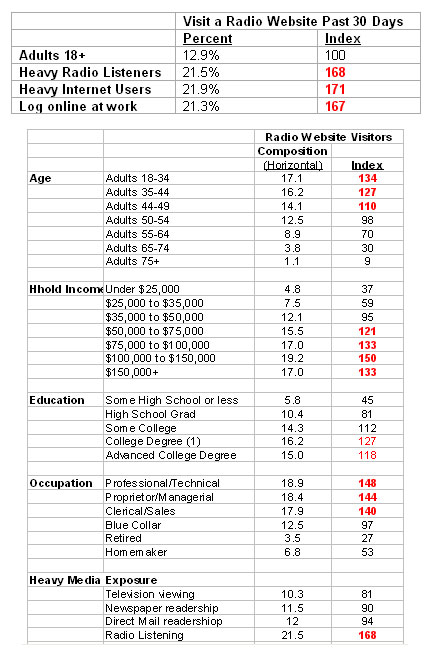
«Nearly 75% of all adults log onto the Internet and nearly 1 in 5 (18%) of online users visit a radio website over the period of a month. A profile of radio website visitors shows that well educated, upper income, white collar workers in addition to younger people tend to be more likely to visit radio websites. These findings come from a recently released telephone study of 118,211 randomly selected adults conducted by The Media Audit between January 2006 and April 2007 in 88 markets across the nation.

fonte: «One in 5 Internet users visit a radio website» RBR, Carnegie, Setembro 07


«As audiências analógicas vão continuar em queda entre os jovens»

Das poucas certezas que este relatório tem: «Analogue audiences will continue to decline especially among younger listeners as radio broadcasters adjust by offering a wider variety of content, higher availability on multiple platforms and through multiple standards. Radio listeners will become more demanding in terms of the variety of content they seek and ways of accessing it»

fonte: Public Radio in Europe, Conclusions and Outlook, EBU/UER, Junho 2007

Alguém que está a viver 'o segundo choque'

«"Because of satellite radio, more affluent people are going to use that service, so we have a smaller piece of the pie to slice up with the people remaining, who are not so affluent," said Bob Pettit, general manager of WCBM, the Baltimore talk-radio station at 680 AM. "The younger people are going to the new technologies. Radio used to be a very effective way to reach people aged 18 to 34. Now, not so much." As a result, Pettit said, national advertisers are not turning to the old medium the way they once did, leaving the field to cheaper, and often local, ad buyers. In turn, the stations are obliged to charge less money because their demographic is poorer, he said, leaving the stations with less revenue.»

fonte: MADIGAN, Nick, «Radio may survive this, too», Baltimore Sun, August 26, 2007

A importância de estudar a geração iPod

«The reality is they, the iPod Generation, are the mainstream media users of the future and their concepts of media, and radio in particular, is determined by their ability to control it, to have it when and where they want, in a mobile and flexible form» (Shaw, 2005: 18)

Ouvir a rádio no telemóvel (GB)

Listening figures for both have increased exponentially in the last year, with 6.09 million people in the UK listening to shows available solely on digital radio compared to 905,000 four years ago. Meanwhile, 4.4 million people over the age of 15 claiming they have listened to radio on their phone, a 27 per cent rise in the last year, with the largest group of mobile-phone radio listeners aged between 15 and 24. This latter statistic is something of a surprise, as the reception quality of analogue radio on mobile handsets is notoriously patchy, but it seems likely that youngsters are listening to radio on their phones for relatively short periods of time, perhaps while waiting for a bus, or to check on sports results at weekends. (...)»

fonte: «How digital radio came of age», Telegraph, Claudine Beaumont, 25/08/07

Já agora:

«Given that the mobile phone already allows for diverse means of communications; voice, text, video etc, it’s not too difficult to see how a multimedia, or cross-media, handset which expands the general ability to create and share content can become omni-present within ten years. Multimedia as a concept has remained poorly defined but if we talk about cross-media, the meeting of two distinct media – like radio and television, or voice telephony and text emails, it becomes easier. The key for radio is access and mobility. In Ofcom’s research 79% of people stressed being able to access radio on the move, when and where they wanted. And interestingly despite all the recent hype about mobile TV – recent UK audience research shows mobile TV is not popular – largely because it does not allow them to do other things[1]. They want TV on computers and the ability to choose what to watch, when it suits, but for the future enhanced audio based content – like Nokia’s Visual Radio – may fit commuters’ needs[2]. Businessweek estimates mobile phone radio could be worth $70 million in 2005 and that radio could be the trigger for mobile content sales.» (Shaw, 2005: 9) 


[1] Entertainment Media Research (EMR), November 2005, shows 70% of those surveyed did not want mobile TV on their phones – half said they now did others things while watching TV – like surfing the net and checking e-mail. Reported in The Guardian, financial pages, 7/11/05.

[2] Businessweek online, ‘Dial R for Radio on your Cell’, Olga Kharif 22/3/05/

Jovens e tecnologia; impossível de separar

«(...) "Nearly two-thirds of the young people surveyed said they think that the Internet, instant messaging, cell phones and other technologies make people happier, and 61% said those things make them feel closer to their family," said eMarketer senior analyst Debra Aho Williamson. "You simply cannot separate young people from technology; it is part of who they are."

Select Media and Technologies without which US Teen and Young Adult Consumers Could Not Live, April 2007 (% of respondents)

Respondents generally said living without technology would be stressful. Nearly half of young people never turn off their mobile phones, even when they're trying to relax or "chill out."

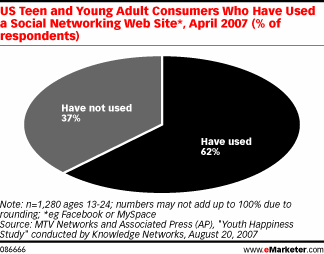
US Teen and Young Adult Consumers Who Have Used a Social Networking Web Site*, April 2007 (% of respondents)

Harris Interactive asked kids and teens in October 2006 what things made them happy. Having a PC made more than half of both groups happy. Mobile phones were more important to teens than to children.

Things that Make US Child and Teen Internet Users Happy, October 2006 (% of respondents in each group)

fonte: «Internet Keeps Young People Upbeat», eMarketeer, AUGUST 27, 2007

Ouvir rádio no carro... dos pais

«A única rádio que [Ben, «um adolescente de 16 anos que cresceu com a Internet» (pág.3)] ouve é a NPR, quando os pais a sintonizam nas viagens de automóvel» (Anderson, 2007: 4) 

A queda não é só na rádio, mas também na televisão

Jovens dos EUA vêem mais televisão (mas qual televisão?)

Jovens dos 18-24 estão a ver mais televisão do que há um ano, de acordo com um estudo agora revelado. Parece contraditório com a tendência de uso da Internet. Mas como explica um responsável pela empresa que fez o estudo «the reason our two trend analysts give is because of the programming itself. It’s not even a question of them giving up video games or talking on their phones. It speaks to more of the programming resonating with the audiences».

Além do mais, ver televisão é um conceito que tem de ser posto em causa. Uma coisa é ver televisão ao vivo, outra coisa é ver conteudos da televisão na Internet: «Watching TV live is considerably more of a social event for them than it is for you and me. It would be like every Thursday we’ll watch “Grey’s” at so-and-so’s place at 9. Yet they have no problem streaming shows. They all have broadband connections. And they’re also very comfortable with it. They also have more of a nontraditional schedule, so if they won’t be home or near a TV at certain times, they'll go online to watch a certain show

fonte: «Fact: College kids now watch more TV», Media Life Magazine, Jul 26, 2007