Blogia
Transistor kills the radio star?

3.0.1 "A geração iPod"

A rádio e as audiências dos jovens

«In 1995, about 95% of the 14-to 29-year-olds listened to the radio at least once every two weeks. Three-quarters of that population listened to the radio every day. The average daily listening time (between 5 a.m. and midnight) was 117 minutes. Over the years, radio listening time has been declining slightly, but radio still competes actively with television for the prime position in adolescent media preferences (Berg & Kiefer, 1996; Keller & Klingler,1995; Munch & Boehnke, 1996).»

 (Boehnke, 2002: 195)

Uma geração que cresce sem saber o que é a rádio

«The other big audience challenge is youth. Most of my generation grew up with radio. Memories of that first car, that first cigarette, that first pint of heavy, are for many of us inextricably bound up with particular pieces of music, particular radio programmes or DJs. Today, while television can still capture children up to their early teens and the challenge is simply getting them back in their twenties, for radio, is there a generation growing up who are simply not introduced to the habit and may thus not get the point as they mature. Two thirds of today’s young mobile users have their phones on and within easy reach for between 21 and 24 hours a day. I earnestly hope that radio- possibly using the mobile as delivery medium - can capture at least some of that time», Stephen A Carter (Chief Executive, Ofcom), The Radio Festival - Certainty or Security? The Path to Digital 04|07|05

A queda das audiências entre os jovens

« (...) despite its obvious strengths, radio listening amongst 15–24-year-olds has fallen over recent years in both the UK and the USA, with various factors being blamed for falling audiences. In 2004, the UK’s Broadcast and Telecommunications regulator – OFCOM – commissioned a report into the so called ‘iPod Generation’ and the report made uncomfortable reading for traditional broadcasters. The report revealed what radio academics already knew from talking to students, that the medium was no longer offering them what they wanted and that ‘younger people are listening to the radio noticeably less than their parents’ (OFCOM/The Knowledge Agency, 2004: 5). Not only that but they are fussier in their listening habits and choices and they were turning off ‘faceless presenters’ and a ‘playlist culture’ in favour of their own music, in their own way (OFCOM/The Knowledge Agency, 2004). It seems as though the ‘wirefree’ generation is growing up without the radio habit enjoyed by the previous generation and that offers a threat to broadcast radio (Carter, 2005).» (Berry, 2006: 148)

Mais um estudo que confirma a queda entre os jovens

«Important listening shifts have been taking place in recent years: Overall, the percentage of both men and women listening to radio at least once per week gradually decreased between Spring 2002 and Spring 2006. The biggest declines took place among Teens, Men 18-24 and Women 18-24. For both Teen boys and girls, the largest dropoff was from 7PM to midnight, down 9% over those four years, though afternoons and weekends also were off 4% to 5%.» fonte: Radio Today 2007, Arbitron, pag 97

«Owing to numerous media alternatives available, overall time spent listening (TSL) has slipped 13% between 1998 and 2006, but less than an hour in the four years from 2002 to 2006. The largest erosion since 1998 for men has been with 18-24s, with a decline of 17%; for women, the largest decline has been among Teens, whose TSL has decreased 23%. »

fonte: Radio Today 2007, Arbitron, pag 91

“14-24 year olds are actively designing radio that’s not on the radio

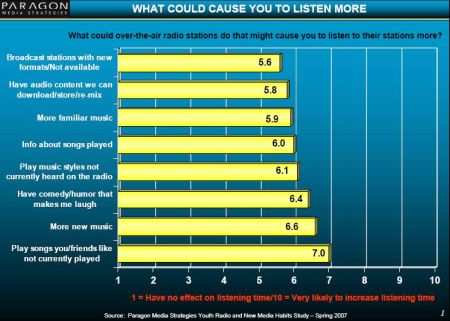
«In the 2000s it’s the music that young listeners are sharing among themselves that radio seems to systematically ignore. Herein lies a great new format opportunity. “Paragon Media Strategies research into Youth Radio makes clear that there is a body of music that has reached gestation. Whether it be called ‘Indie’ music or ‘music that my friends and I like that isn’t on the radio,’ there’s a format out there. Check out Last.FM and see what this generation is doing in forming their own library.“Concentrating on this body of music—which also contains a lot of new music—would address pleas research respondents make to radio, and it would shore up one of radio’s big unique selling propositions: introducing listeners to new music

14-24 year olds are actively designing radio that’s not on the radio. The average (median) young adult has 500 songs on their computer, 400 songs on their MP3 player, and 50 CDs. 14-18 year-olds have more than double the number of songs that 19-24s have on their computers and MP3 players… Young music consumers are already creating their own ‘radio stations’ by creating playlists on their iPod.»

fonte: «A Once In A Generation Format Opportunity», Paragon Media Strategies, 17/01/08

Os jovens são grandes consumidores de video

«(...) Who is watching all this homegrown video?

Harris Interactive asked US adult Internet users about the types of online video they would like to see more. The supply of UGV was apparently sufficient for most of those surveyed, since it drew the lowest response rates. However, young adults were most likely to want more user-generated video.

Online Video Content Categories that US Adult Internet Users Would Watch a Lot More if Available, by Age, November 2007 (% of respondents)

An even more detailed picture of UGV viewer demographics came from the "Annual Gadgets Survey 2007" by the Pew Internet & American Life Project, which profiled active adult users of video-sharing sites where many UGVs are hosted. Pew found that more than half of these site visitors were 18 to 29 years old. (...)»

fonte: «Who's Watching User-Generated Video?», eMarkeeter, JANUARY 24, 2008

O que querem os jovens ouvintes

«(...) Young people have voted again and again in this race that they want to own their music not rent it or listen through a glorified subscription or ad-supported service.
The labels -- a group that would cause me to do the opposite of what they do -- is simultaneously selling music to cellphone companies so their customers can have a phone full of music included with the price of the phone. That's a loser with young people.
Last.fm -- now with the ability to play what you say instead of what terrestrial stations like "Jack" want to play -- is also a non-starter.

These ideas and concepts are the creative result of older and in some cases out of touch people who do not understand the young consumer. These products are what they think young people should listen to vis-a-vis their dying record businesses. They are not, however, what young people want. In the months ahead, the painful truth will become evident even to them.

Here's what the entrance and exits polls -- so to speak -- are telling us about the next generation, the record business and new forms of listening:

1. They want to own their music (I use the term own loosely to include paid and stolen music). Rental services like Napster and Rhapsody have not resonated. The labels want young consumers to rent. Cell phone companies can't see why adding a few extra bucks to the monthly bill for all the music in the world won't be a winner. I'll give you two reasons: one is the iPod -- the choice of the next generation and it isn't going away any time soon. And, two, the next generation can steal music without a problem. Who needs rental?

2. Young listeners don't like radio because they have alternatives, but radio has sucked since the 80's -- at least that's when the term "radio sucks" emerged. No one says, "iPods suck" -- at least not yet. But young people show signs of iPod fatigue. Properly read, this means they are not giving up their iPods, they'd just like to be entertained every once in a while.

3. Internet radio will be the smash hit we all think it can be once it can be received everywhere on every device. It's beginning to happen now, but most people don't listen to Internet radio on the go. And by Internet radio I don't mean terrestrial radio "lite" or another version of an HD subchannel. I mean real entertainment. Internet radio is the killer app.

4. Keep an eye out for some form of mash-up music sharing. We're seeing this in video where users can take pictures and send them along to a friend to add music or whatever. Control freaks like record and radio execs will do just about anything but enable a generation to fool with their artists rights. Admirable? Not when their customers do it anyway.

5. Young consumers have iPods -- they have hard drives loaded with music bought and stolen. They also want to be entertained. Instead the labels and their cohorts keep trying to invent the next thing but this generation is going to tell you what the next thing is. And what is it? Entertainment. They want to be entertained. They want to participate in the entertainment. If I'm in radio reading this I am jumping for joy -- that's a core radio skill -- but it will have to be transfered to where the next generation lives and it's not on the radio band.»

Os jovens são aqueles que mexem nos conteúdos

«The Pew study also captured demographics for active video-sharing site users. As might be expected, they skewed younger.

Demographic Profile of US Adult Internet Users Who Actively* Visited Video-Sharing Web Sites, December 2006 & December 2007 (% of respondents in each group)

"The fact that younger Internet users are far more likely to be regular visitors to video-sharing sites points to a fork in the road,” said David Hallerman, senior analyst at eMarketer.  "On the one hand, marketers looking to target the under-30 demographic can more reliably find them on these video sites. "On the other hand, the door is open for big content providers—mainly the TV networks, both broadcast and cable—to bulk up their online offerings, both in quantity and quality," Hallerman said. He also said that such counter programming could help attract the over-30 audience, which is accustomed to traditional TV content. Such content could draw ad dollars from marketers who want online-video ad inventory that is consistently appropriate for marketing, as opposed to a lot of user-generated content found on video-sharing sites. »

fonte: «Young Adults Hit Online Video Sites», eMarketeer, JANUARY 15, 2008

Rádio não tem CVC; resta o carro

«Radio is often relegated to a secondary media choice, and an alarming number of Bedroomers do not have (or rarely use) an AM/FM radio in their homes. In some of the interviews, radio is a nonfactor until the required trip to the car. For those who don’t have a radio in their primary dwelling, its role in their overall media/entertainment scheme is minimal. For everyone else, there is typically more enthusiasm about other entertainment choices and newer technologies. Radio’s lack of CVC (control, variety, and choice), combined with perceptions of excessive commercials and being “old school”—often drops its status among other media. As noted, most of the meaningful radio discussions in these interviews occurred when we visited the respondents’ vehicles. To that end, radio’s traditional listening locations are being threatened by new devices. Portability has been usurped by personal MP3 players, in-home radio listenership is overshadowed by myriad gadgets, and even in-car listening is being challenged by current and future MP3 connectivity.»

«Bedroomers»

A proposito deste estudo, os autores chamam bedroomers aos jovens (18-28 anos):

«Additionally, interviewees were single, college students, young professionals, married, and married with children. Living situations included respondents in dormitories, students living off-campus, in apartments, homes, fraternity houses, and living with parents. We found that much of their time with technology was spent in their bedrooms, which not only gave us the name for this study—The Bedroom Project—but also the name “Bedroomers” for this generation»

Jovens europeus já preferem internet à televisão (e reduzem consumo de outros meios)

«Os europeus já preferem a Internet à televisão. De acordo com um estudo de preferências dos media, realizado pela Associação Europeia de Publicidade Interactiva (EIAA, na sigla em inglês), os jovens, principalmente, passam mais tempo na Internet do que em frente à televisão. Esta é a primeira vez que a televisão fica relegada ao segundo lugar no estudo, realizado anualmente desde 2003. Realizado com mais de sete mil pessoas, em dez países europeus, o estudo mostra que os jovens entre 16 e 24 anos agora passam dez por cento a mais do tempo ligados à Internet do que em frente à televisão. O estudo revela ainda que 96 por cento dos inquiridos reduziram a utilização de outros meios de comunicação por causa da Internet, tendo sido a televisão a mais prejudicada: 40 por cento dos europeus vêem menos televisão e 28 por cento lêem menos jornais. Por outro lado, o estudo indica que a televisão online se está a tornar mais popular, tendo aumentado o visionamento de filmes e telediscos online, pelo menos uma vez por mês, em 150 por cento desde 2006. A isto se deve também a expansão da banda larga: 81 por cento de todos os utilizadores de Internet já usam este tipo de conexão. Actualmente, 57 por cento dos europeus acedem a Internet regularmente, por semana; o equivalente a 169 milhões de pessoas, um aumento de seis por cento em relação ao ano anterior. Desde 2006, o número de pessoas com mais de 55 anos que utilizam a rede aumentou em 12 por cento e o de mulheres subiu oito por cento.Também a frequência com que os europeus acedem à rede aumentou: 75 por cento dos utilizadores de Internet ligam-se à web entre cinco e sete dias por semana, um aumento de 61 por cento em comparação com 2004.»

fonte: «Europeus já preferem Internet à televisão, cienciapt, 12/12/07

Audiências começam a preocupar-se com 18-24 anos

«Arbitron’s Pierre Bouvard says there’s been big progress among 18-24s, and they plan to begin applying those lessons and techniques to 25-34s. Their plan will go into motion next month, when Arbitron’s internal software systems will begin working to increase sampling rates and incentives paid to panelists in the demo. Bouvard predicts Philadelphia and New York will “start to see some growth” by the end of the first quarter» fonte: «"25-34 is going to be our focus."», Inside Radio, 4/1/08

62 por cento dos jovens EUA usam telemóvel para diversão

«NEW YORK (Hollywood Reporter) - About 38 percent of U.S. consumers are watching TV shows online, 36 percent use their cell phones as entertainment devices and 45 percent are creating online content like Web sites, music, videos and blogs for others, according to a new-media survey from Deloitte & Touche. The findings of the online survey of 2,081 Americans, conducted October 25-31, were provided to The Hollywood Reporter before their official release next month. The "State of the Media Democracy" notes that in Deloitte's first edition of the survey just eight months earlier, 24 percent of consumers used their cell phones as entertainment devices, meaning that usage has soared 50 percent.

About 62 percent of "millennials" (consumers 13-to-24-years-old) are using their cell phones as entertainment devices, up from 46 percent in the previous study conducted February 23-March 6, 2007. And among Generation X consumers (25-to-41-year-olds), the number grew to 47 percent from 29 percent in the earlier survey.

About 20 percent of consumers said they are viewing video content on their cell phones daily or almost daily. The percentage of consumers watching TV online jumped from the 23 percent figure reported in the previous study. Roughly 54 percent of those surveyed said they are making their own entertainment content through editing photos, videos or music, 45 percent said they are producing that content for others to see, and 32 percent said they consider themselves to be "broadcasters" of their own media. "I think for advertisers one of the conclusions is you don't make decisions to advertise either on television or the Internet when you want to hit all the demographics, but rather you need to have a multiplatform strategy," said Ken August, vice chairman and national sector leader for Deloitte & Touche's media and entertainment practice, which commissioned the study. "It shouldn't be an either or proposition."»

fonte: «Americans more wired: survey» Reuters, Gail Schiller Fri Dec 28, 2007

Telemóveis e redes sociais

«(...) Given the popularity of mobile phones and social networking among teens, it is not a giant leap to expect them to use the two technologies together. Early data suggest that is the next step. "Mobile social networking is predominantly a young consumer’s game," said John du Pre Gauntt, senior analyst at eMarketer. He cited a June 2007 M:Metrics study that found that users under 25 were the most active on mobile social networks, accessing sites daily or several times a week. "The next question is whether early adopters gather at mobile-only social networking destinations or if they are extending their existing social networking relationships to mobile," Gauntt said. "Here, the evidence is well in favor of the latter."» fonte: Teens Primed for Mobile Social Networks, eMarketeer, JANUARY 3, 2008

«Social networking is an activity that 37% of US adult Internet users and 70% of online teens engage in every month, and the numbers continue to grow. eMarketer projects that by 2011, one-half of online adults and 84% of online teens in the US will use social networking»

A rádio perdeu a batalha das ruas para os iPods

Do estudo Bedroom Project («No demographic presents more challenges—and more untapped opportunities—to broadcasters than 17- to 28-year-olds»:

«(...) one of the harder hitting findings in "The Bedroom Project" is the gnawing reality that radio may be losing the "location" battle to other media.  Among our 17-28 year-olds:

  1. Radio in the home has become tertiary to the array of other gadgets and media, from computers to video games to good old television.
  2. On the street, radio has all but lost the battle to iPods (and mobile phones).  The only people walking around with Sony Walkmans are radio programmers.
  3. In cars, radio still rules, but iPod connectivity will challenge its dominance.  And the automakers are quickly making it possible for most new car buyers to plug their mp3 players into their vehicles' sound systems.

(http://jacobsmedia.typepad.com/jacobs/2007/10/location-locati.html)


Um estudo de 2000 com jovens dos 12 aos 24 anos (EUA)

«Why is this important when all anyone cares about is 25-54? These are the years when media habits and loyalties are formed; These are the years when music becomes so much more important to most; These are the years when radio usage typically increases dramatically; All will eventually turn 25

CONCLUSÕES:

-12-24 are the years when people dramatically increase their radio listening. The evidence suggests that this current cohort of 12-24s are not increasing by nearly as much as previous groups

fonte: Radio's Future:Today's 12 to 24 year-olds, Junho 2002;  How the survey was conducted:729 Total Interviews Ages 12-24 Interviews Conducted 5/26 - 6/8, 2000

35% dos jovens (8-12) dos EUA têm telemóvel

«The Nielsen Company today released the findings of an in-depth study on the mobile media and cross media behavior of U.S. "tweens" (ages 8-12).  The report estimates that: 35% of tweens own a mobile phone. (...) While text-messaging and ringtones remain the most pervasive non-voice functions on the phone, other content such as downloaded wallpapers, music, games and Internet access also rank highly among tweens. According to Nielsen, 5% of tweens access the Internet over their phone each month. While 41% of tween mobile Internet users say they do so while commuting or traveling (to school, for example), mobile content such as the Internet is also a social medium for this audience: 26% of tween mobile Internet users say they access the web while at a friend's house and 17% say they do so at social events. The report, "Kids on the Go: Mobile Usage by U.S. Teens and Tweens," was conducted by Nielsen Mobile and BASES, two services of Nielsen. It also provides insights on teen and tween use of specific content brands, genre preferences, overall use of leisure time and demographic profiles. The full report will be released on December 14.The Nielsen Company today released the findings of an in-depth study on the mobile media and cross media behavior of U.S. "tweens" (ages 8-12). »

fonte: «35% of U.S. Tweens Own a Mobile Phone, According to Nielsen», 3/12/07


Os jovens e os conteúdos gerados por outros

«The Demand for User-Generated Content: Content may be king, but industry-created content has got stiff competition. User-generated content is in tremdendous demand across the generations, with half of all consumers (51%) watching and/or reading content created by others. And, while Millennials are at the forefront of this trend, Xers, Boomers and Matures are also participating.• 51% of all consumers are watching/reading personal content created by others; the number jumps to 71% for Millennials.• 55% of Millennials and 42% of Xers read blogs, while 62% of Millennials and 41% of Xers watch YouTube or other video streaming sites.• 40% of all consumers are creating their own entertainment, such as editing movies, music and photos. Millennials may be the majority of the creators at 56%, but Matures are also participating – 25% of them report creating their own entertainment.»

fonte: «Are You Readyfor the Future of Media? Highlight’s from Deloitte’s 2007 State of the Media Democracy Survey» 25/06/2007


Ideias sobre a geração iPod e o marketing

«Marketers are fascinated by Gen Y's youngest cohort, the Millennials -- and with good reason: They are an important market today and will become even more important as they graduate, start jobs, marry and establish households.
How to communicate effectively with Millennials is the topic of many research studies. We are told what they read (magazines) and what they don't read (newspapers), which brands they love (Apple) and which ones they hate (anything "too corporate"), devices they use (iPods and cellphones) and don't use (CD players). There are articles on how they communicate (Facebook) and don't communicate (e-mail) and where they get their news ("The Daily Show"). We learn that they are not like us in their views of the world (they've never experienced a presidential election without a Bush or a Clinton in the running). Most ominously, we are informed that they have lived in a media-saturated world from a young age. Consequently, they are clued in to -- and tuned out of -- marketers' most ingenious means of influence
»

Audiências de rádio entre o público mais jovem continuam a descer (EUA)

«Summer book Persons Using Radio (PUR) numbers declined to their lowest level since Arbitron began keeping statistics in Fall 1998. Radio usage dropped in every cell except 50-54s. Steepest declines continue to be among teenagers and young adults, as their attention is increasingly diverted to other media. That’s especially true among males, with Men 18-24 and 18-34 cells posting the biggest year-over-year declines. But the crowded media world is also taking a toll on the 25-54 money demo, which fell 15.1-14.9. There’s also a disturbing trend among female demos. In the Summer book not a single female cell saw an increase in listening. All but two (50-54 and 65+) declined. Compare that to male demos. While older women mirror the trend of listening less, the Summer book shows Men 45-64 were listening to the radio more» (Inside Radio, via Hear2.0)

E a reflexão de Mark Ramsey: «Listener who grow up with access to digital media are forever changed. They will not "grow into" us - we must "grow into" them. Or else the radio will eventually become your father's Oldsmobile». O texto total é este: «(...)the attitudes about radio and the usage of radio among persons under 35 - and especially under 25 - are dramatically different. Listener who grow up with access to digital media are forever changed. They will not "grow into" us - we must "grow into" them. The problem is this: It's easier to score 25-54 when a format scores 35-54 because it's easier to score 35-54 than younger. But if the entire radio industry begins to chase persons over 35 - as it is doing right now - then this is a one-way journey for us all. In a sense, radio is like smoking: If we don't create the habit when kids are young, we won't have the habit at all when they get older. And creating that habit is about more than targeting their music needs. We need to target the entire portfolio of their interests if we're to be viewed as relevant.This is one of those realities which will sneak up on us slowly until one day when we stand back and realize that but for one or two stations in any given market we no longer have a foot in the future