Blogia
Transistor kills the radio star?

3.0 O segundo choque

A indústria discográfica em Portugal e a rádio (em Neves, 1999)

(em construção) 

Em Portugal,os melhores anos da indústria discográfica musical (1985-1997, no estudo de José Soares Neves, estiveram associados ao fim do duopólio da rádio, [a]o surgimento das ‘rádios livres’ e sua posterior legalização (pág 14), e se a nível mundial também se verificou um crescimento, foi maior em Portugal;

- a industria musical portuguesa, à semelhança do que acontece globalmente, também vive uma situação de oligopólio (em 1997, seis companhias totalizavam 83,5% da facturação total, das quais apenas uma nacional, ainda que a posição das independentes se tenha vindo a reforçar, 159)

- a queda na venda dos singles, em Portugal, começou no início da década de 90 (Neves 103)

Em Portugal consumo de música e audição de rádio confundem-se.  Neves destaca dois inquéritos à população, no âmbito da sociologia (feitos em meados da década de 90), que mostram que a rádio é o meio principal para escuta de música, sobretudo entre os mais jovens (é marginal o número daqueles que ouvem música sem ser através da rádio) (208)


- A rádio desempenha, juntamente com outros factores, a função de gatekeeper (na linha do pensamento de Paul D Lopes ou Ciane, citados por Neves), mas no processo de promoção/difusão das musicas não há apenas um gatekeeper. Neves fala num «processo em diversos patamares» (a decisão sobre a edição e a escolha dos temas; o acesso à promoção pública e a sua distribuição junto do consumidor final). «Destes três momentos-chave depende em grande parte a carreira que um dado título realiza. Com efeito, na actualidade, os principais problemas colocam-se não na fase da produção, mas da circulação, uma vez que, se aquela está relativamente facilitada, esta está crescentemente congestionada. Daí a importância da actividade de promoção e marketing, particularmente junto da rádio. E, deste ponto de vista, as majors possuem as melhores condições para a colocação dos seus produtos devida aos processos de trabalho utilizados e à extensão dos recursos materiais e humanos de que dispõem» (Neves, 142).


- A industria discográfica funciona em oligopólio, o que lhe dá muito mais força para, mais do que negociar, impor (Neves, 40). Mesmo assim há quem fale em «dependência mútua» na relação entre aestações de rádio e as companhias fonográficas, devida a interesses comuns (Neves, 41, citando Malm e Wallis), «uma integração envolvendo um grau crescente de dependência mútua, baseada mais em interesses comuns do que em relações de propriedade (Neves 73). «Dependência mútua porque, como notam os autores [Krister Malm, Roger Wallis, Big Sounds from Small Peoples, Londres, Constable, 1992], as estações emissoras necessitam de mais e mais música gravada para alimentar os seus programas, tal como a indústria necessita destes para publicitar os seus produtos (Neves, 73). Ainda assim, «a dependência mútua atrás referida deverá ser “cruzada» com a estratégia da indústria globalmente considerada [em especial das majors], a qual consiste em procurar vender o máximo de cópias do mínimo de produtos, o que, dada a expansão da rádio aos níveis local e mundial, permite concluir que o aumento do tempo de emissão se fez difundindo a mesma música» (Neves 74) Um exemplo é dado por Steve Chapple e Reebee Garofalo, ao analisarem as rádios de formato «Top40», conhecidas também por CHR: ao reduzirem o leque de músicas transmitidas e apostando insistentemente mais numas do que noutras (o Top 10), «a rádio integrou-se mais especificamente no tecido da indústria da música. Para que os discos tivessem um grande êxito teriam de ser tocados na rádio; e, com as execuções constantemente repetidas no Top 40, o êxito dos discos passou a ser feito à força» (Neves 74). Neves cita Frederic Dannen que escreveu sobre os “promotores independentes”, «cujo trabalho, situado entre os departamentos de promoção das companhias e os responsáveis radiofónicos pelas listas, consistia em conseguir que um dado título nelas entrasse, e aí permanecesse, como forma de conseguir construir um hit. A perspectiva era a de que as pessoas não compram música pop que nunca ouviram, sendo que, por cada single no Top 10, poderia ser vendido um milhão de álbuns» (Neves, 75). É a dependência/necessidade da entrada de um tema na lista do Top40 que leva a que surja o «payola», já conhecido desde os anos 60 nos EUA, data das primeiras investigações «em torno de eventuais pagamentos efectuados a disc jockeys  no sentido de garantirem airplay para determinados temas (…)» (Neves 75). Por outo lado, até que ponto, campanhas de spots na rádio, promovendo artistas que também estarão a ser divulgados em airplay, não é uma forma de payola (ou pelo menos de cimentar boas relações)? Importa no entanto saber se as rádios que decidem o que passam (que escolhem, de uma lista de edições novas) ou se, na verdade, é a indústria que decide o que passa a rádio (através de estratégias de pressão e/ou sedução). Neves cita Baskerville, para quem os directores de programas ou autores das playlists, «aqueles que determinam o que as estações de rádio emitem são provavelmente os mais poderosos indivíduos na indústria musical. Eles são os gatekeepers. Aqueles que eles permitem, podem prosperar. Aqueles a quem são negados direitos de emissão, provavelmente nunca sairão da obscuridade no campo da música popular» (David Baskerville, op. Cit., p.365).  

A conquista de airplay (numero de vezes que uma mesma musica passa numa determinada rádio) faz parte das estrategia de marketing; a antecipação de temas, em single, que inda não estão à venda, é parte dessa mesma estratégia (não é pelas receitas do single, a não ser em casos de grande sucesso) mas pelo airplay conquistado. Outras estratégias: a disponibilização de elementos de merchandising que, por exemplo, vão aparecer nos passatempos radiofónicos ou levar jornalistas ao estrangeiro, conseguindo tempo de antena para as suas reportagens, para ver concertos (entrevistas) de músicos que estão a ser promovidos;  

- A construção de programas com tops é a representação máxima da relação passiva entre industria e rádio ( industria fornece os dados, a rádio ilustra)

- na década de 20, quando a rádio apareceu, a industria manifestou grande desconfiança, na medida em que receava que a audição gratuita levasse à quebra no consumo dos discos; rapidamente a industria apercebeu-se  que os dois media (como lhes chama Neves, 72) se complementavam. Para este autor, «é um dos principais veículos de difusão musical e o principal suporte promocional da indústria» (73).


- A auto-edição, por oposição ao envolvimento/empenho da editora (feito mais oumenos em função das esperanças depositadas nas possibilidades; A auto-edição ganha força com a realidade digital, permitindo focalizar em nichos e potenciando aquilo que sempre foi uma estratégia das editoras, a «identificação entre consumidor e produto
(3.) O fim do Top of the Pops

O impacto do segundo choque não se reflecte apenas sobre a rádio e a rádio musical em concreto. A televisão é também vítima disso e- por causa das audiências medidas minuto a minuto – de uma forma mais dramática.

O fim do programa «Top of the Pops», a 30 de Julho de 2006, é disso um bom exemplo: transmitido ininterruptamente há 42 anos na BBC2 (1 de Janeiro de 1964, com Rolling Stones e Beatles), acabou devido às fracas audiências (de uma audiência mundial de 15 milhões de pessoas, na década de 70, pouco mais de um milhão assistiam nos últimos tempos ao programa (Madonna, Robie Williams e Rolling Stones)

(3.1) Digital Music Awards

A indústria musical parece rendida aos benefícios que a digitalização em curso irá provocar. Os Digital Music Awards (5ª edição em 2006) ainda estão no início, mas serão cada vez mais importante à medida que mais artistas usem a Internet ou os telemóveis para se promoverem, em vez da rádio ou da tv. Os prémios distinguem:

- as páginas oficiais dos músicos;

- as páginas de fãs e blogues;

- inovações na rede, como utilização do telemóvel ou podcasts ou lojas digitais de venda;

O número de músicas em cada play list (França)

Do Observatoire de la radio 2004-2005, alguns dados interessantes sobre ascprincipais rádios musicais francesas:

A Nostalgie tem a play list mais extensa, com 585 temas; a Europe 2, a menor, com 199 canções. Outras rádios como a RTL2 (com cerca de 350) ou a funradio ou a NRJ  situam-se à volta dos 250 temas.

http://www.ipfrance.fr/doc/112276.pdf#search=%22observatoire%20de%20la%20radio%20%22

A perda de ouvintes na rádio convencional

Citações de um artigo do New York Times:

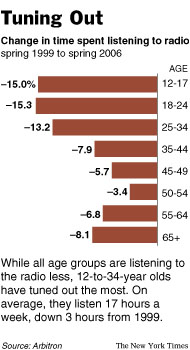
«The radio industry keeps losing people like Danny C. Costa, a senior at Boston University who grew up listening to radio in New York and New Jersey. For the last few years, Mr. Costa has tuned out radio in favor of Web sites where he can get access to downloads or videos he heard about from friends. He prefers these to the drumbeat of the Top 40. He burns his favorite songs onto CD’s or copies them onto his iPod. “I just sort of stopped listening to radio, because I had access to all this music online,” Mr. Costa said. While more than 9 out of 10 Americans still listen to traditional radio each week, they are listening less. And the industry is having to confront many challenges like those that have enticed Mr. Costa, including streaming audio, podcasting, iPods and Howard Stern on satellite radio».

« The amount of time people tune into radio over the course of a week has fallen by 14 percent over the last decade, according to Arbitron ratings.   

«Larry R. Glassman, a surgeon who does lung transplants and commutes between Cold Spring Harbor and Manhasset, N.Y., each day, used to tune into radio for his 40-minute drive, particularly to hear his classic rock favorites. But now he subscribes to XM Radio, and recently had an XM receiver installed in a new boat. “Some of the programming I just flip over,” he said, adding that he would listen to XM in surgery if he could. Instead, “I use the iPod in the operating room.” Mr. Glassman, who is 51, said he turned a deaf ear to radio primarily because of the advertising and because he finds the playlists of his favorite stations too mainstream and limited»
fonte: «Changing Its Tune», New York Times Online, RICHARD SIKLOS, Published: September 15, 2006 


«Escuta de rádio continua forte»

(o título traduz a notícia da Radio INk; a mim parece-me que 27 por cento de pessoas a dizer que ouvem menos é relevante) 

«Despite the availability of various new media to receive music and news, only a little more than one in four Americans (27 percent) say they are now listening to the radio less than they did five years ago. According to a survey commissioned by American Media Services, about half (51 percent) said their radio listening hasn’t changed during the past five years, and 21 percent said they are now listening more.
When asked to look ahead five years, only 11 percent said they expect to be listening to the radio less than they do now. Nearly three out of four (74 percent) said they expect to listen about the same, and 13 percent said they expect to listen more.
“Radio plays a vital role in American life. Reports of radio’s death seem greatly exaggerated,” said Ed Seeger, president and chief executive officer of American Media Services, which commissioned the survey.
The survey found that Americans rate radio as their primary source to learn about new music. When asked which ways they learn about new music, 63 percent said by listening to the radio. In comparison, 43 percent said it can be through talking with friends, 41 percent cited watching television, 24 percent cited reviews in newspapers or magazines, and 16 percent cited the Internet»

fonte: Radio Ink, 14/9/06, Radio Listening Remains Strong

Para compreender melhor a relação música-rádio-ouvintes

«listeners have tastes, radio has genres», diz Mark Ramsey

A rádio renasceu na net e no satélite?

«Internet and satellite radio have capitalized on broadcast radio's inability to give listeners what they truly seem to want - variety, voices of knowledge and authority, some sense of excitement, and the ability to hear what they want, whenever they want. Radio, as we know it, has been reborn. "The new radio formats are all about choice," says Spin magazine Executive Editor Doug Brod. "In a sense, this very choice may eventually bring about the end of the album as we know it. No longer do listeners have to buy entire albums when they can just pick and choose particular songs to download. This very efficiency is already having a tremendous impact on the art of the album-making. Artists can now release only a few songs at a time." Though its methods of delivery are changing, radio has once again become a key player, not just in shaping the way that we hear music, but in shaping the way that it is being made. If that's not a revolution, then it's certainly the seed of one.»

fonte: The Buffalo News, «The REBIRTH of RADIO», By JEFF MIERS, 7/23/2006

O futuro da rádio não é brilhante...

«Radio has a bright future! Really?

Having spent a few decades working in radio when its future was bright, when a programmer concentrated on one station, when competition was strong between all stations in any market, when jocks were given the leeway to communicate with their audience, and when stations had a local news staff - I'll report that things aren't looking so bright now

diz o eidtor do Audiographics, 13/7/06, http://www.audiographics.com/agd/071306-1.htm

BBC acaba com o Top of the Pops por causa da concorrência digital

«The BBC in a statement said that "The decision to bring the show to an end after 42 years has not been taken lightly and over the past few years every effort has been made to maintain the quality and distinctiveness of the show".

"Over recent years the show has faced ever increasing competition from multi-media and niche musical outlets which enable viewers to consume music of their choice any time night or day in a way that Top of the Pops simply cannot deliver in its current weekly format."»

fonte: «BBC axe Top of the Pops following rise of digital downloads», Pocket-Lint, Stuart Miles, 20/6/06


A pergunta clássica: isto ainda é rádio ou uma jukebox?

O editor do site Audiographics esteve a ouvir um dos canais HD2 dos EUA e saiu desiludido, uma vez que é apenas um computador pré-programado e muitos jingles a promover a estação:

«Since Saturday, 6/17, I've been streaming WSMJ-HD2 through its online link. That it is solid music won't be challenged here. Though I will challenge calling it "radio."

Here's what I've uncovered about Clear Channel's WSMJ-HD2. It has just 18 liners positioned [frases promocionais] between every other song, except at the top and bottom of the hour when, sometimes, you'll hear three songs in a row. These are the positioning statements they use:

The artists that gave birth to the cool - played 24/7 on Jazzville, 104.3 HD2
Jazz - America's own music, Jazzville, 104.3 HD2
When you hear music, after it's over, it's gone, you can never capture
it again - Jazzville 104.3 HD2 (...)

When the above play through, they repeat. That's enough said about the programming of this new, exciting, HD2 radio station.

You decide if this is "radio," or some variation of jukebox music. Then, ask why a person would spend money to buy a new receiver to listen to what's offered. Not being a jazz aficionado, I won't comment on the music other than to say the playlist was repeated. But, so what? Songs have to repeat, eventually» (http://www.audiographics.com/agd/061906-1.htm)

Mark Ramsey desenvolve, sem chegar a uma conclusão:

«It's an interesting point, and it's central to our HD radio plans (not to mention the plans for Internet radio and, dare I say it, good old-fashioned terrestrial radio).

When you take out (or never put in) the personality, when you lack the voices that connect us to the music and each other, when there is no promotion, no news, no traffic, no weather, no contesting, no feeling that what you're hearing is in any sense "live" or, for that matter even "living,"...

...is that really "radio"?

Is that what we want "radio" to be?

Is that what the audience comes to us for?» (http://www.hear2.com/2006/06/what_is_radio_a.html)

(via NetFM)


Ouvintes de rádio satisfeitos nos EUA

«A new survey from audio strategy firm hear2.0 finds that the vast majority of terrestrial radio listeners are satisfied with the job that the medium is doing. One thousand radio listeners between the ages of 12 and 54 were surveyed, with 74 percent saying they were satisfied by what radio has to offer.

Hear2.0 EVP Harve Alan said, "Given that some media prognosticators claim radio is dead or dying, we were pleasantly surprised at just how strong radio is; even with the youngest age groups." He added, "With only one format falling below 70% satisfaction and despite ongoing challenges from new media the American public still loves their terrestrial radio.  This research illustrates the power of radio to entertain, inform, and satisfy."»

fonte: «Study: Radio Listeners Satisfied», FMQB, 7/6/06

»O fim da rádio»

A canadiana CBC está a produzir uma série de programas sobre o fim dos meios tradicionais.

«O fim da rádio» está aqui (o programa pode ser visto on line - já não digo o mesmo quanto a ouvir...)

Tópicos para o guião do programa:

Internet radio (Podcasts, satellite radio, mashups and downloads, mp3, p2p, wma, burning, ripping, streaming. So many busy new music activities and listening methods, and none of it coming from the good old fashioned radio. What's a poor broadcaster to do?  If radio is dying, what do we need to know about what's replacing it? "Soma FM started because I couldn't find a station that played music that I liked," claims Rusty Hodge, the program director of internet radio station Soma FM. One of the most popular of the thousands of internet stations broadcasting online, Soma FM offers listeners a choice of seven unique radio stations)

Podcasting (Other musicians are finding ways to reach out to their fans directly. Michael Butler started sending out his band's music to fans across the world in a podcast. (see glossary) It evolved into The Rock and Roll Geek Show, a weekly podcast all about the latest rock/metal music from independent artists)

Satellite radio (Canada's newest satellite radio project, XM Satellite Radio is hoping to find listeners who will actually pay for their service.  Satellite radio offers one hundred channels of digital quality music, sports, entertainment, news and information that's completely mobile. You can listen to it in your home, your car or at the park)
Digital radio (CHUM FM thinks the future is in digital radio. "DAB Radio is the next level of radio. It delivers CD quality sound and it also gives radio the opportunity to stream information back and forth," says Farina. And he points out that CHUM FM is still the most listened to fm radio station in Canada)

Music to the masses (Ralph Simon, Chairman of the Mobile Entertainment Forum says people's listening habits have changed. "People don't want to be tethered in front of a computer to get their music download. They want immediacy. They want it now. They want to be able to experience something because a part of this whole new music world is, it's called a "show me" culture.")

KCRW: Trying it all (KCRW is a traditional radio station, 89.9 on the dial in Los Angeles, that offers all the alternatives - podcasting, streaming, downloading, simulcasts, video, music sales - as well. And it's working. Subscribers are paying to listen from every U.S. state and around the world)

O que a rádio (convencional) deve fazer para reagir à ameaça?

Três dos conselhos que o presidente da NAB dá á industria radiofónica (e televisiva) para reagir à «concorrência»:


1.       « Exploiting “every new technology – on every new platform.” According to Rehr, broadcasters must move quickly to increase distribution channels for their content with the goal of being omnipresent in the culture, going “everywhere to everyone, through every device.”
2.       Promoting the benefits of DTV and digital radio. He urged broadcasters to show consumers “the exciting possibilities of digital television before the DTV conversion, not when the DTV transition is upon us. But right now.” It is the broadcaster’s responsibility to inform viewers that “the most pristine signals they can receive” are over-the-air digital television. The NAB will be announcing a consumer DTV education program, he said.
3.       Promoting greater competition among the cable, satellite and telecommunications companies.
Fonte: « NAB president: It’s time to go on the offensive» Apr 26, 2006 2:08 PM

A rádio hertziana vai ganhar à concorrência

... diz o presidente da NAB, National Association of Broadcasters: «To our competitors I say, ‘We will beat you,” he said during the Monday morning address delivered from the Las Vegas Hilton. “Radio’s history is one of meeting new competition head on and coming out on top. That hasn’t changed. All we seek is a level playing field.

(fia-te na virgem, neste caso na história... e não corras - comentário meu!) 

fonte: «David Rehr Warns Radio’s Competitors: ‘We Will Beat You’», Radio Ink, 26/4/06

A rádio é importante para os norte-americanos

(directamente da terra dos estudos, mais um...; feito com mil entrevistas no universo da população dos EUA)

«Survey: Radio is Important to Americans
Charleston, SC - Apr 19, 2006 - Americans rate the importance and relevance of local commercial radio very highly, despite the entry of high-technology competition, a national survey commissioned by American Media Services shows. The survey found that 78 percent said radio is important in their everyday lives, and 91 percent said radio is important in American life in general. Nearly three-quarters (74 percent) said they listen to radio at least once a day. The telephone survey of 1,004 American adults was conducted April 13 to 15, 2006, by Omnitel. The survey is considered accurate within plus or minus 3 percentage points.

The new findings complement those in AMS’ initial survey in January: 64 percent said they were listening to radio as much as, or more than, they were five years ago. In the AMS survey, 57 percent of men and 49 percent of women said they listen to radio at least daily. The availability of music, news and reports on weather and traffic continues to be the most often cited reasons for listening to the radio, with 98 percent of respondents saying they listen to radio for one of those features.

Additional statistics:

  • 78 percent usually tune to a local radio station when they get in their car
  • More people had a favorite local radio personality in their local markets (37 percent) than a favorite television personality percent (32 percent), newspaper personality (7 percent) or personality on a local internet site (1 percent)
  • When asked what about the different qualities that make a good radio personality, they ranked four as most important: 89 percent said they liked to listen to someone who makes them think, 82 percent said one who makes them laugh, 79 percent wanted a personality they could trust, and 76 percent said a good radio personality has strong ties to the local community
  • Overall, 41 percent of respondents said they liked to listen to stations that have a good balance of music, news, weather and traffic information. That rated above playing their kind of music (26 percent) or making them laugh (3 percent).
  • Of those respondents who had a "favorite media personality," 37 percent said their favorite personality worked on the radio, while 32 percent said their favorite worked on television.
  • 61 percent of those likely to change stations during commercial breaks do so in a minute or less.»
  • fonte: http://beradio.com/currents/radio_currents_041706/index.html#ams

    Uma previsão animadora (de finais da década de 90...)

    «A pesar de las aciagas predicciones de la segunda mitad de los años noventa, la radio está de regreso y, en muchas maneras, mas fuerte que nunca. Las ganancias están aumentando y la audiencia es constante. A medida que avanza un nuevo siglo vemos también como las fortalezas tradicionales de la radio siguen realzando el atractivo del medio. Ahora también es posible acceder, por medio de un teléfono celular, a estaciones de radio por Internet. Lo que hace de la radio parte esencial de esta época es su capacidad para llegar hasta nosotros mientras hacemos otra cosa. Podemos escucharla en el trabajo, en el automóvil o mientras hacemos ejercicio»

    (Hausman, Benoit e O'Donnell, 2001: 351) 

    «A rádio é uma causa perdida?»

    «During a Tuesday morning conference call with Wall Street analysts, Emmis CEO Jeff Smulyan addressed the question, “Is radio a lost cause? Standing up for the radio business, Smulyan replied, “It's not a lost cause, because we reach almost every American. If you look at leading forms of media, they are incredibly fragmented, and narrow. We reach almost every American, almost every day, where they live. We're relevant to them. They use us as companions. They use us as a source of entertainment. They rely on us for information, especially in critical times. For some reason, this is a business which has the perception that it's over. It's not over. It's a business that's been able to produce 45 cents on the dollar and still does. It's not over, but it's struggling."

    He continued, "What I've seen over the thirty some years I've been in this business is that every industry has its ups and downs, but the basic relevance of this industry has not diminished. It is a fragmented world. It is a world where people have lots more choices. But we can't find another business which reaches people where they live, and which has such universal distribution, and which we think has the ability to be leveraged into some new areas."(...)»

    fonte: «Smulyan On Radio: “It's Not Over”», Radio Ink, 19/4/06 


    O segundo choque é bom para a rádio...

    «All those new digital media platforms that sometimes seem to bedevil radio managers — Internet radio, satellite, podcasting — are really new forms of radio and are a “testament to the popularity of radio programming.” So says Arbitron in releasing a new study it did with Edison Media Research.

    “The proliferation of digital broadcast platforms such as Internet radio, satellite radio, HD and podcasting is a testament to the popularity of radio programming,” the research company stated in announcing the release of “The Infinite Dial: Radio’s Digital Platforms.”

    Edison Media’s Larry Rosin said, “Our research shows that regardless of the platform consumers see all these options as merely being new forms of ‘radio.’”

    The phone survey involved approximately 1,900 people»

    fonte: «Study Sees New Media as ‘Expansion of Radio Market’´, RWonline, 13/4/06

    O estudo: http://www.arbitron.com/downloads/digital_radio_study.pdf

    Outras conclusões:


    «Para onde vão os ouvintes da rádio?»

    Um estudo da Bridge Ratings sobre a erosão dos ouvintes da rádio convencional. Conclusões:

    «Bridge Ratings reports that audience erosion from terrestrial radio is due to generally less time spent with AM/FM radio and more time spent with a variety of digital media. This includes MP3 players and iPods, Internet radio, satellite radio and CDs. 

    1. Terrestrial audience erosion to alternative audio entertainment continues to occur in young demographics.

    2. Podcasting is beginning to siphon listening.

    3. MP3 device usage can consume as much as 80% of a radio user's audio entertainment during initial ownership weeks and months. This number tends to be generally lower among 30+ women and 35+ men.

    4. MP3 player fatigue is slowing overall as the market continues to expand due to consumer interest in these devices. Fatigue with MP3 players remains high among those consumers who have owned the devices longer than 6-8 months.

    5. Competition for traditional radio time-spent-listening is more severe. Time spent listening to terrestrial radio is fighting for its share of time with a multitude of digital devices. Even television has regained viewership based on this quarter's data. The most often given reason for this by our sample: better programming and new shows. Meanwhile, music-specific radio stations are vying for the attention of their constituencies as MP3 players continue to be more pervasive than ever (75 million sold). Podcasting is beginning to show evidence of cannibalizing radio's time-spent-listening.

    6. Satellite radio also suffers from attrition! For the first time, we are seeing satellite radio consumers who have been subscribers for longer than 6 months are actually spending less time than they were six months ago with their satellite service of choice. According to our panel, during the second quarter of 2005 average time spent listening to satellite radio was 16 hours per week. During this most recent study during the period of January 1 through March 31, 2006, weekly TSL for satellite radio among subscribers of 6 months or longer was down to 12.6 weekly hours»

    Sobre o estudo:

    «This study, which has been tracking such behavior since January, 2004, once again reveals behaviors assumed to be taking place.
    After a recovering Quarter 4 of 2005 for terrestrial radio where positive signs that terrestrial radio was experiencing positive Time Spent Listening and Weekly cume audience tune-in, the first quarter of 2006 showed just the opposite in overall listener behavior.  AM/FM radio listening among 18-34 year olds was significantly off fourth quarter 2005's pace as its increase in weekly quarter hours to "other media" than radio jumped from 50 to 60 quarter hours affecting the trend for both 12-24 and 25-49 year old metrics»

    fonte: «Bridge Study: "Where Are My Listeners Going?"», Radio Ink, 7/4/06. O texto original aqui.