Blogia

Transistor kills the radio star?

A rádio como fonte privilegiada para a nova música

«In the midst of this musicFIRST fiasco, radio's role in breaking music and artists continues to be minimized.  Of course to those of us in radio, this nearly "1984" spin about the truth is mind-boggling.

But now, consumers weigh in on the topic.  A new Pew study - "The Internet and Consumer Choices" - reveals what radio people have known since Alan Freed.

Here is a sample from the Pew report:

- The Internet is a great tool for connecting consumers with artists and music info, "But it doesn't strongly influence how they buy."

- 56% of music buyers say they find out about music through online sources (a band's website or streaming samples of songs).  But more than half of music buyers say that online information had no impact at all on their purchasing decision.

- Yet, 83% of music buyers say they find out about music "from hearing a song on the radio."

So, it makes you wonder why the marketing "strategies" on the label side continue to veer away from broadcast radio.  An artist interview on a satellite radio may not reach any more listeners than the cume of a Boise radio station, but that's what excites them.

This is more proof that radio is still the prime source of how consumers discover music.  Too bad the music business isn't doing research, and instead is letting their anger and emotions dictate policy decisions.»

fonte: JACOBS; fred, Music discovery, 16/06/08

Experiências falham; riscos da transitoriedade

«UBC Media Group plc (“UBC” or “the Company”) has today announced the closure of the loss-making mobile phone version of its Cliq music downloading service and will instead concentrate on providing a business-to-business solution to manufacturers of connected devices, including Wi-Fi digital radios like Imagination Technologies, with whom it has an existing relationship. (...) Commenting on the closure of the Cliq mobile service, Chief Executive Simon Cole said: “I remain convinced that transactional revenues will be an important part of the radio industry in the future.   For a variety of reasons, including the delay by manufacturers in bringing DAB connected devices to market, we have tried to lead this process in the interim on the JAVA mobile phone platform and have not succeeded.  However, the technology, intellectual property and pending patents that we have developed during this process remain within the business.   We believe we can exploit these without the need for the high risk, high cost exposure to a consumer service “»

«A “BUY” button on a car or kitchen radio would be a much bigger proposition. Much more listening takes place on these, leading to more purchases… But these devices, to date, haven’t been equiped to communicate with music stores online. This is what UBC will be working on in future, it seems. On PCs the biggest problem is the competition from “free”. On mobile phones you’ve got DRM issues and data transfer costs. UBC could have hung on until they'd sorted out DRM-free deals with the majors, and Virgin Media had threatened illegal downloaders to within an inch of their second-lives... but hanging on costs money.» (Cliq - R.I.P.)

«Sorry to hear UBC have shut-down their mobile phone music download service Cliq. I believe Simon, Pascal and the guys at UBC have the right idea but perhaps they’re pursuing it on the wrong platform. Yes mobile phones are ubiquitous but they are essentially communication devices. You’ll use your phone to take some pictures or listen to some music but it’s dominant use is to communicate with phone calls and text. RAJAR shows the amount of people who have ever listened to radio on a mobile phone is just over 10%. They don’t break out how many people have done so in the past week. They don’t include mobile phone usage in digital listening weekly reach. They probably don’t like having to compute really small numbers! Radio on the other hand is specifically a media consumption device.  Better yet, it’s an audio media consumption device. If we could work a way of people consuming even more audio using their radio, be that buying music or otherwise, the relevancy of the device and the data transmission capabilities of DAB are a perfect marriage. Think about it.»

«The fact that the music was encrypted with DRM, meaning that I had a limited number of devices to playback the music was the main reason, but the £1.25 price point is unattractive when iTunes is selling the same songs for 79p. That's a 58% premium! I believe that un-encrypted downloads are the only longterm solution that's going to be accepted by the public. We're already seeing that with iTunes beginning to unlock some of its inventory. Play.com is already up and running selling mp3s in the UK, with EMI the first of the big four record companies working with them. Amazon has announced it'll be selling downloads later this year, and it'll undoubtedly have done deals with all the majors, and Napster in the US has gone down the mp3 route for its sold tracks (subscriptions obviously work differently).»

«Cliq was originally a service using DAB data to let you buy any song you heard on any participating radio station. It was rather clever, though for the life of me I couldn’t work out how to earn any money out of it. Then, it became a service using a Java client for mobile phones, again, allowing you to download any song you heard on a participating radio station. This was rather clever too: less technically clever than the DAB version, but slightly easier to earn revenue from. UBC have called it a day, pulled the plug, and Cliq will henceforth be a business-to-business service for broadcasters and manufacturers alike. (...) There is clearly a market for something that, when you hit a button, buys the song you’re listening to. Radio remains the main way that people discover new music; it’s only natural that it retails it.»

HENDY, David (2000), Radio in the Global Age, Cambridge: Polity Press

Lojas de música cada vez mais ´portáteis'

«Problem : You purchased the new digital Alanis Morrissette album at work, but now you want to listen to it on your home computer.  Now what? Solution : When you purchase MP3s from stores like AmazonMP3, Napster, Wal-Mart they’re instantly added to all your computers and your Music Locker  (with album artwork!) using LockerSync. It’s now easier than ever to automatically get all your purchases on all your computers! Step 1 : Download LockerSync on all your computers Step 2 : Buy MP3s from your fave MP3 store or download songs and watch them automatically go to all your computers»

Ser radio-centric ou audience-centric (pensar na rádio ou na audiência)

Perante a opção da industria norte-americana de Pôr os receptores FM em todos os telemóveis, Kurt Hanson alerta:

«There are (at least) two ways you can view radio's future. Either that FM/AM "chips" need to be installed in every device that moves, whether it resembles a "radio" or not - or that radio as an industry needs to translate its content to everything that moves in original ways, and those are unlikely to be in the same form as that content currently lives on air. I am squarely in the latter category.  Most broadcasters seem to be in the former one. The idea of sticking radio into every mobile device is radio-centric, not audience-centric. And if there's anything - ANYTHING - you should learn about the rapid pace of technological change, it's this: It is being driven by newly empowered audiences, not by the mega-industries serving their own interests.

So while you may want a radio inside every mobile device, your audience says they don't need this because they already have a radio - in fact, several - everywhere - thank you very much. What they want is for you to transform your "radio" content into a new experience worthy of the gadgets that experience lives in

Pôr os receptores FM em todos os telemóveis

«Put FM radio in cellphones and everyone will benefit.
That’s the gist of a report commissioned by an NAB technology advocacy program.
“Cell phone service providers, radio broadcasters and handset manufacturers all stand to benefit from the expansion of FM-capable cell phones, a platform that could reach 257 million American subscribers,” NAB stated in a summary.
President/CEO David Rehr said the trade group is “confident that implementation of a new FM-radio feature would result in rapid penetration.”
The report was commissioned by an NAB program that is pushing for advanced services for radio and TV on all devices, called NAB FASTROAD.
Only about 8 percent of U.S. cellular handsets sold last year were FM-capable (although that’s still 12.5 million sets), and almost all of these were GSM phones, the authors found. (...)» FM Receivers Belong in Cell Phone Handsets, NAB Report Says  RWnewsbytes 13/06/08

«Os jornais não têm futuro? Ou é o jornalismo que não tem futuro?"

«(...) O que me inquieta é saber como sobreviverá o jornalismo". (...) "Acreditei sempre que os jornais impressos sobreviveriam", concretizou o editor sueco, "mas começo a ter dúvidas". "O nosso problema não é saber se vamos conseguir manter-nos tal como somos hoje, porque isso não sucederá", concretizou George Brock. "O que me preocupa é saber se o jornalismo escrito consegue sobreviver como jornalismo que investiga, aprofunda e enquadra".

«"Já não somos os guardiães do templo, os gatekeepers, pois os leitores entraram no círculo do poder", reconheceria Lisbeth Knudsen, director do dinamarquês Berlingske Tidende. "E isso está a acontecer porque é a tecnologia que está a determinar os caminhos da inovação nas nossas empresas, não é o jornalismo que, ao reinventar-se, consegue determinar qual a melhor forma de inovar".
Isto é tão mais importante quanto a forma como os cidadãos "entraram no círculo do poder" apresenta as mais diferentes facetas. Por um lado, ao terem ganho o direito de livremente afixarem na rede aquilo que pensam, intrometeram-se num espaço de comunicação antes reservado aos jornalistas. Por outro lado, ao serem chamados pelos próprios jornalistas a sentarem-se na primeira fila, nomeadamente por via dos comentários às notícias, ajudaram a criar um espaço que começou por ser de debate mas que também se foi transformando em espaço de informação.

«Mas se até aqui não deixa de existir um papel para os jornalistas, que têm sempre de seleccionar e editar, aquilo que temem observadores como Andrew Nachison, do iFOCOS, é que gradualmente se perca entre os cidadãos a noção de que necessitam de jornalistas e de bom jornalismo para aceder à informação de que necessitam. Por um lado, motores de busca como o Google facilitam imenso o acesso às fontes originais, ou reempacotam a informação com base naquilo que os próprios órgãos de informação produzem - roubando, de caminho, cerca de metade do mercado publicitário que migrou da imprensa escrita para a Internet, o que cria dificuldades adicionais às empresas jornalísticas. Mas, por outro lado, o que mais o preocupa são "os novos centros de produção de informação que podem tornar redundantes os jornais e dispensável o jornalismo".
Exemplos? Os sites oficiais das mais diversas instituições que tendem a ser desenhados de forma a colocar em destaque "notícias", mas que também disponibilizam os documentos originais. Alguns blogues mais sofisticados e influentes, como os que nos Estados Unidos virtualmente se profissionalizaram. E, por fim, todos os que produzem informação e opinião de qualidade, como sucede com muitos think-thanks. "Tenho a sensação de que não sabemos como vão as novas gerações ter acesso à informação, se vão continuar a confiar na 'marca de qualidade e independência' que lhes é assegurada por alguns títulos de referência, ou se utilizarão cada vez mais as redes da Web 2.0 e os sites das fontes primárias", precisou Nachison»

fonte: FERNANDES, José Manuel, «Os jornais não têm futuro? Ou é o jornalismo que não tem futuro?», Público,12 /06/08

As dificuldades dos canais de streaming na negociação com as editoras

«Warner Music Group and Last.fm are at loggerheads over attempts to renew a revenue-sharing deal that allows users to listen to full-length tracks for free on the music recommendation website. The company, which became the first major music label to arrange a deal with Last.fm in February 2007, pulled its full catalogue from the site on Friday but gave no official reason. Behind the scenes, Warner is thought to be frustrated with the deal, which offers a lower share of advertising revenue than comparable agreements with other music websites. Warner owns a stake in the social music service Imeem, as well as a new joint venture with MySpace and other major music labels that is due to launch this summer. One source familiar with the situation told MediaGuardian.co.uk that music labels "do like Last.fm, but want to get paid". They are said to be frustrated that Last.fm has not introduced a proposed premium subscription service, which would allow users to stream unlimited songs for about £5 per month. Last.fm's current streaming service lets users listen to songs up to three times.  "Even if Warner manages to negotiate a better deal, that would mean the other labels want the same, so Last.fm is in a bit of a bind," said Dan Cryan, a music analyst with Screen Digest. "They either need to pay more to the labels, or demonstrate that they add value, either showing that they help increase sales or have a genuine promotional role. But there are a clutch of similar sites that could do this and pay more to the labels."»

fonte: «Warner Music Group and Last.fm at loggerheads over deal» Jemima Kiss guardian.co.uk, June 12 2008

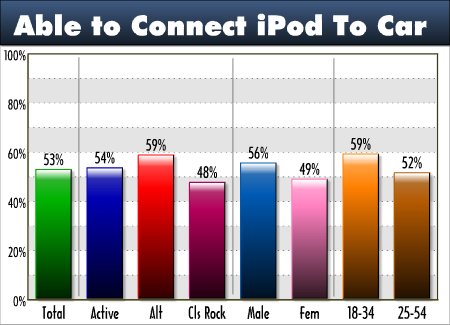
Mais de metade dos que têm iPods ligam-nos aos (seus) carros

Our Tech Poll clearly shows the impact that iPods are having on the driving experience.  While iPod ownership continues to soar, more than half of these consumers say they can connect these devices into their cars.  It's more proof that radio continues to fight a difficult "location war," especially in its long-time bastion - the car.

08_ipod_carconnect_demos_blog
*Among iPod Owners
fonte: «iPods & Cars», FRED JACOBS, Jacoblog, 13/06/08

Perfil rádio 2007 (e 2004) por idades

15-17 anos: 5% (5%)

18-24: 14% (14%)

25-34: 22% (21%)

35-44: 19% (19%)

45-54: 15% (15%)

55-64: 14% (12%)

+64: 14% (14%)

(fonte: Carat, Anuario de Meios 2007, Briefing, pág 201; fonte: Carat, «Briefing 2005», Briefing, pág 208)

O problema dos pagamentos às músicas que passam na rádio (EUA) net e FM

«Internet broadcasters have long paid royalty rates to stream music on their Web sites, but traditional radio stations have not had to pay because, they argue, exposure on their radio stations leads to increased record sales and profits for artists. (...) Nonetheless, Rep. Zoe Lofgren, D-Calif., argued that it was unfair that radio stations, which made $16 billion in revenue last year, did not have to pay anything when Internet radio stations are at risk of going under due to new rules regarding royalty payments. "Internet radio companies generated $150 million [last year] and they paid at least 50 percent and some paid 100 percent of their revenue," Lofgren said. "Meanwhile, the broadcast industry generated $15.5 billion and they paid nothing." (...) One of those Web radio stations that opposed the CRB rates was Pandora, which said last year that the CRB's rates could force it to shut down. Under the revamped current rates, Pandora would owe $18 million by the end of 2008 Tim Westergren, Pandora founder, said in a Tuesday phone interview. Westergren and other Internet radio advocates were on Capitol Hill this week pushing members to help stations that face extinction under the current structure, he said. "We've been walking and talking with people from the House and Senate side," he said. "We're always searching for champions."» (fonte: By  Chloe Albanesius Terrestrial Radio Facing Rates Similar to Web Radio, PAC MAG,

Rádio (via streaming) chega ao iPhone

«Now the new AOL-CBS tag team is joining forces with Apple and the popular iPhone. AOL Radio for the iPhone will give users immediate, free access to over 200 stations, including CBS Radio stations around the country. WFAN/New York, 1010 WINS/New York, KROQ/Los Angeles and WXRT/Chicago are among the many CBS stations available now via AOL Radio.

A rádio mais ágil: canais temporários para emissões alternativas

Num dia como hoje, com dois momentos importantes na emissão (por exemplo da TSF) ao mesmo tempo, e uma vez que apenas um deles é possivel de ser emitido em directo(o debate quinzenal no parlamento), o segundo (a conferência de imprensa da selecção) podia recorrer a canais alternativos de streaming, com anuncio na antena principal de que há duas emissões em directo, uma hertziana outra online

Mais sobre a queda de audiências entre os mais escolarizados

«Once I published this article in Radio & Records noting the difference in listening between college grads and non-college grads, I have been rightfully asked the following question: "Has it always been this way?" So I looked at the diary data from the sample of diarykeepers from our longstanding series of studies with Arbitron.

In 1998: Non-College Grads ages 25-54 listened to an average of 102 Quarter-Hours per week

College Grads ages 25-54 listened to an average of 86 Quarter-Hours per week

In 2008: Non-College Grads ages 25-54 listened to an average of 100 Quarter-Hours per week

College Grads ages 25-54 listened to an average of 70 Quarter-Hours per week

In addition, the portion of 25-54s that are College graduates increased from 33% of 25-54s to 41% of 25-54s.  What does this mean? That nearly all the 25-54 losses in TSL over the last decade are coming from college grads. The Non-grads are listening virtually the same amount.» Has Radio Lost the College Grads? Larry Rosin Edison Media research 10/06/08

Caminhos para a rádio clássica (consumo passivo-activo)

«Today’s relaunch of AOL Radio (in beta) embraces that aspect of radio in many ways. First and foremost is its partnership with CBS Radio, which is replacing XM Satellite as the provider of music for 150 radio stations on AOL Radio (AOL itself continues to program another 200). Along with providing much of the music people can listen to for free, (...) (...) Two more suggestions: 1) Make personal music recommendations based on my listening habits; 2) Integrate with CBS-owned Last.fm for more music choices and social recommendations»

AOL Radio Relaunches, Now Powered By CBS: Going After Local Ads Erick Schonfeld 10/06/08 tecrunch.com

O problema de comercialização dos canais de musica

«Today’s relaunch of AOL Radio (in beta) embraces that aspect of radio in many ways. First and foremost is its partnership with CBS Radio, which is replacing XM Satellite as the provider of music for 150 radio stations on AOL Radio (AOL itself continues to program another 200). Along with providing much of the music people can listen to for free, (...) CBS Radio’s ability to sell local ads was major reason why it won the partnership deal, especially with online music royalties increasing sharply. Lisa Namerow, the general manager of AOL Radio, tells me:

The royalties have gone up significantly. We had to reevaluate our business. We needed to partner in order to monetize radio better. We have grown advertising year-t0-year 100 percent, but with the increasing cost of royalties, we need to do a better job by leveraging local markets and advertisers. CBS has a string foothold in that local sales market, with over 140 sales teams.

That statement is an eye-opener for any music service hoping to make money from advertising. If AOL Radio, with three million unique listeners per month (according to Namerow), is having a hard time, how are smaller ad-supported music startups supposed to survive? And affiliate links are not going to cut it. Every song on AOL Radio has a link to iTunes or Amazon, yet Namerow cautions that “those commerce links are a very minor revenue source.”

(...) Two more suggestions: 1) Make personal music recommendations based on my listening habits; 2) Integrate with CBS-owned Last.fm for more music choices and social recommendations», AOL Radio Relaunches, Now Powered By CBS: Going After Local Ads Erick Schonfeld 10/06/08 tecrunch.com

«Mesmo na net, a rádio é local»?????

«Even on the Web, radio is local»

Novo iPhone sem rádio FM; e depois?

«Putting FM receivers in everything mobile is the goal of folks like Jeff Smulyan at Emmis but Steve Jobs at Apple is really only interested in applications that can be used worldwide, and hes pretty ruthless about applying that test. A U.S.-style FM radio wouldnt do much good in places where they use different standards, as they do in Europe and Japan. And the current HD chip wouldnt begin to fit in there. So the new 3G-capable phone that Jobs previewed yesterday may be a disappointment to Smulyan but you look at Jobshistory and youre not surprised» «Laura’s MIA», Taylor on radio-info, 10/06/08 [No Japão as estações emissoras de radiodifusão sonora em Frequência Modulada operam na banda dos 76 MHz até aos 90 MHz. Na Rússia a banda é igual. Nos Estados Unidos, a banda é dos 87.8 MHz até aos108.0 MHz e na Europa dos 87.5 aos 107.9 MHz. Acresce a isto que a rádio digital tem padrões diferentes no Japão, EUA e Europa.]

Mais:

«No 3G music downloads for iPhone: According to Apple’s iPhone 3G product page, the mobile version of the iTunes music store will remain accessible only over the phone’s Wi-Fi connection, and will not take advantage of the new 3G capability. I guess it shouldn’t come as a shock that the wireless version of iTunes (dubbed "iTunes Wi-Fi") should remain a strictly Wi-Fi service. Still, it does seem like Apple has missed an obvious opportunity to allow users more ways to purchase music. With services such as Napster Mobile and Rhapsody already allowing wireless music downloads over 3G networks for many iPhone competitors, Apple’s reluctance to jump on board likely comes down to an unwillingness to share per-track revenues with AT&T. After all, when you own the music service and the hardware, why concede any profit to a wireless carrier if you can help it? Only Apple knows for sure why music downloads have been locked out of the iPhone’s 3G capability, but personally I’m disappointed to not see it included. The iPhone is so close to becoming a great music discovery tool, but limitations such as this and lack of Flash audio support are big barriers for online music fans. Oh, and don’t get me started about the lack of streaming Bluetooth audio. »

«NAB and most radio CEOs do not understand Apple CEO Steve Jobs' thinking in continuing to exclude FM radio from the increasingly popular iPhone. Radio people think that if you build it, they will listen. As I frequently point out, you have to take a closer look at the next generation and why they will reject radio -- even on an iPhone. (...) Of course there are technological issues that keep Apple from readily including FM on iPhones not the least of which is the fact that U.S. FM is not compatible in parts of Asia and Europe where different standards exist. (....) There are plenty of reasons to leave FM off the iPhone. If I am right -- and I could be misreading it -- radio as we know it has seen its better day. While a minority of listeners might want to use their Blackberries or other smart phones as radio receivers, it is in fact -- a minority. (...)It means its leaders must invent radio as we don't know it» .Jerry del colliano, The FM-Free iPhone  Inside Music Media 11/06/08

Quando a rádio me avisar da música que vai tocar

Parece utopia, nesta altura, mas não vai demorar muito até que, a partir de uma base de ouvintes registados (ou de uma comunidade social...), e perante artistas, géneros ou mesmo músicas em concreto, cada um de nós possa ser avisado da música que vai tocar daqui a 10 minutos; aquela que me interessa... para eu ir ouvir. (por email, por SMS, etc)

Menos utopico: essa musica ficar disponivel para streaming durante «x» tempo, (podcast?) ou (com 24 horas de antecendencia?) ser anunciada a lista das musicas que vão passar; Um google alert para as musicas que me interessam? Se aparece nessa lista de anuncio, posso receber um google alert a dizer que determinada rádio no Japão a vai passar; isto tanto é válido para as musicas muito conhecidas como - E SE CALHAR SOBRETUDO - para as da cauda longa, aquelas que se ouvem raramente. O google alert é/será a forma (uma das formas) de controlar a escolha (demasiadas opções). Escolha e controlo são coisas diferentes. ter os conteudos (a música, as vozes, a criatividade etc) é importante, mas mais importante será pegar nesses conteudos, organiza-los, e disponibiliza-los aos ouvintes de uma forma acessível.

«A música via streaming é a nova rádio»

Ernst-Jan Pfauth Leonhard: “Streaming music is the new radio”, The Nextweb.com 7/06/08