Blogia

Transistor kills the radio star?

Uma rádio «free form» com dificuldades nos EUA

«The firings of two KPIG disc jockeys last week may seem like a small thing, but it was front page news in the Santa Cruz Sentinel Saturday---and rightly so.

KPIG-FM (107.5) is one of the nation's last bastions of freeform radio, where music is chosen with some panache and integrity. It was one of the first roots rock music stations in the country and, despite corporate ownership, has maintained some quality in playing serendipitous rock, bluegrass, blues and country. (...)»

fonte: Mercury News, «KPIG RADIO CUTS STAFF: THE CORPORATE SWINE GNAW AWAY AT QUALITY AGAIN», Saturday, July 08, 2006, Brad Kava, 11:20 AM

Mais sobre a KPIG e o free form: http://radio.about.com/b/a/257701.htm?nl=1

O que fazem na net os ouvintes de rádio

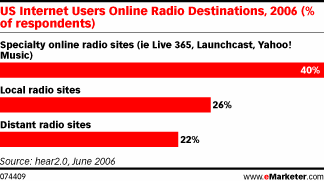
if they listened to a local radio station, a radio station from somewhere else or a specialized Internet radio site, such as Live 365 or Launchcast/Yahoo Music. Amazingly, 40% of them said they tuned in a specialized Internet radio site, compared to only 26% who listened to their local radio online.

There is little loyalty shown by radio listeners online. In fact, the local sites were barely preferred over non-local radio sites online(...)»

fonte: Emarketer, «What Do Listeners Listen To When They Listen To Radio Online?» JULY 14, 2006


Não uma cidade, mas todo um estado com wifi

«America's smallest state is seeking to become its first to offer a wireless broadband network from border to border. Backers of Rhode Island's $20 million project say it would improve services and make the state a testing ground for new business technologies. It also comes at a time when Rhode Island's capital of Providence is stepping up efforts to lure business from Boston, about a 50-minute drive away, in neighboring Massachusetts, where office rents are among the nation's most expensive. The Rhode Island Wireless Innovation Networks (RI-WINs) should be fully in place by 2007, providing wireless connectivity throughout the state, whose land mass of about 1,045 square miles is only slightly more than double the size of metropolitan Los Angeles. (...) The Rhode Island network is a hybrid of WiMax and Wi-Fi technologies that would deliver real-time connections at a minimum speed of 1 megabit per second (Mbps), allowing users to download a typical Hollywood-length film in about 100 minutes. The system will be supported by 120 base antennas placed throughout the state. © 2006 Reuters Limited. All rights reserved.»

fonte: «Rhode Island embarks on statewide wireless network» ZDNet News, April 28, 2006

Mark Ramsey questiona: «And that will precipitate the arrival of the Internet in cars, which is already on the drawing board in Detroit. And that will create a broad range of new opportunities for radio, all of them online. And it will create a serious new threat to radio, entirely online. Are you ready? Or are you still pitching HD?»


Tv portátil sobreavaliada

«half of all people who subscribe to video-enabled cell phones - by far the most deployed of the new mobile video technologies - never use those devices for viewing video»

fonte: «Study Finds Mobile Video More Hype Than Reality - For Now», Media Daily News, Joe Mandese, Tuesday, Jul 11, 2006 9:00 AM ET

por isso é que Mark Ramsey pergunta «How do I watch TV on my phone when I'm busy making calls?»

A penetração dos LAD nos EUA

«one in five Americans ages 12 and up now owns a portable MP3 player, a new statistical high. Also, one in 20 Americans in that age group now owns more than one portable music player. There is also increased interest among younger consumers in watching video on their players, but even more interest in their players doubling as a radio»

fonte: «Portable MP3 Player Ownership Continues To Rise», FMQB, June 29, 2006

O LAD da Microsoft

«Our esteemed colleagues at Engadget seem to have scooped the first look at Microsoft's Argo PMP, which ruffled a few Mac feathers when I reported on it yesterday.

I have to say, it looks nice; the 16:9 screen looks like it'll top the current 'video-capable' iPod (or the 'widescreen' iPod, which doesn't look like it'll be released any time soon), and while the controls look a bit on the iPod-ish side, the whole thing does have a nice, simple look to it.

If anything, it promises several things; to match the iPod in terms of a credible media player, to work in conjunction with an online music download service, it has wif-fi, it's rumoured to work with the Xbox 360, it offers a 16:9 aspect ratio for video -- and more importantly, it's not an iPod. I'll not hold my breath waiting to see if it has a video line-in, but you never know.

And remember folks -- competition is healthy, even if it does come from the guy with the bigger boat.»

fonte: http://www.pvrwire.com/2006/07/11/microsoft-argo-first-look/

E agora Edgard, «Will podcasting become Argocasting?»

Um receptor wi-fi para o satélite EUA

Não sei o que é mas convém estar atento:

«Bear Stearns analyst Bob Peck said Sirius’ subscriber adds were “significantly higher than our 565k estimate.” He also expects that Sirius will maintain its subscriber momentum into the Summer—driven, in part, by an expected push into offering a Wi-Fi enabled receiver.

In a note to investors this morning, Peck wrote: “The technological gap between the two has largely narrowed to an extent that the features available on one platform are virtually comparable to those on the other.”

The next stage in this development, he says, will be Sirius’s next-generation receiver: a “live wearable satellite radio-cum-MP3 player. . . that could feature WiFi access (as Sirius becomes agnostic to the method of distribution.)”

Peck says such a device could be released by the end of this summer.»

fonte: Billboard Radio Monitor, Satcasters Add 1 Million Subs; WiFi Link Next?, July 06, 2006, By Tony Sanders

Brasil digital: na AM e no HD

«A Rádio Clube FM - uma emissora de S.Paulo, Brasil - deu inicio à transmissão em HD Radio em Fevereiro deste ano. Segundo aquela estação, a rápida evolução dos sistemas de radiodifusão digitais mostrava que era necessário «actualizar tecnologicamente a emissora Clube FM e adquirir a experiência necessária neste tipo de operação».
Na escolha do sistema HD Radio pesou o facto de este permitir a transmissão simultânea de sinais analógicos e digitais. O ouvinte recebe os dois sinais da emissora na mesma frequência, mas um não interfere no outro.» fonte: A Rádio em Portugal

«Harris said Rádio Globo has expanded its use of Harris 3DX products for high-power AM transmission in Brazil. The transmitters will be used at sites in Rio de Janeiro and São Paulo and will also be outfitted with Harris Dexstar exciters for HD Radio broadcasting. Rubens Campos is general director of Rádio Globo. He said in the Harris announcement, "Going digital, especially on the AM band, is the only way that radio can grow its audience." The company has a 3DX-50 transmitter at the Belo Horizonte site broadcasting analog and HD Radio signals since last September.» fonte: RWOnline


O novo iPod fala?

«The new iPod will tell you what it is about to play, removing the need for users to look at the screen while selecting music, and making the device safer and easier to use while driving, cycling or in badly-lit locations.

Crucially, the talking machines could give the iPod a badly-needed new competitive edge in the hotly-contested digital music player market.

The iconic machines were last week reported to have lost some of their sheen, with consumers following a series of technical problems and controversy surrounding the working conditions of those who make them. To make matters worse, software giant Microsoft is said to be working on its own iPod-bashing digital music player. »

fonte: «Apple pips its rivals with the iPod that talks» Scotsman, Richard Gray, 9/7/06

Oferecer a rádio de satélite nos telemóveis

«XM Canada will offer subscribers its service over cell phones. The satcaster has an agreement with telecom company Telus to offer subscribers satellite radio content over cell phones.

XM Canada President/COO Stephen Tapp said it's the first offer of streaming real-time satellite radio programming to Canadians.

Twenty XM Canada channels will be offered over some Telus cell phones for $15 per month. Initially, the service will be available on the LG 8100 and Samsung A950 phones.

The deal is similar to one signed last year between Sirius and Sprint. »

fonte: «XM Canada Branches Out to Cell Phones», RWOline, 7/7/06


O lento crescimento do podcasting

«(...) according to research released on Wednesday by Nielsen//NetRatings, which found that just 6.6 percent of the U.S. adult online population--or less than 10 million users--have recently downloaded an audio podcast (within 30 days of the survey). Even fewer folks have actively pursued the newest of the new medium--just 4 percent of adults, 5.6 million users, have recently downloaded a video podcast. According to Nielsen//NetRatings, at the moment, those figures place podcasting among the more niche Web activities, such as blogging, and a long way from more popular activities like online shopping or bill paying.
In typical Internet fashion, podcasting is being adopted first by younger, more tech savvy demographics. The youthful end of the adult world, 18-24 year-olds, are nearly twice as likely to be active podcast consumers, while adults 45 and older fall mostly below the podcasting curve. (...)

fonte: «Nielsen: Podcasting Remains a Niche Activity», Mike Shields, JULY 12, 2006 -

Internet retira pub local das rádios?

A discussão segue nos EUA: empresas como a Google ou a Yahoo permitem corresponder informação (em sentido geral) com publicidade, através de pesquisas especializadas e locais. Uma ourivesaria de Tampa tem uma alternativa aos meios clássicos para difundir a sua publicidade: 

«Although the potential for competition from local search has been around for a couple of years, Yahoo! and Google's local search programs are only now making the rounds in radio industry trades. One scant mention comes at the end of a story at Radio & Records in 33 words: ""We now fear that in 2007 Yahoo! and Google local tools may siphon 2%-3% of local advertising share. We see risk of further downside of 10%-15% by year's end, even after declines of 20% to date."»

fonte: «Local Search Will Damage Radio Industry», Audio Graphics, 12/7/06 

O futuro da rádio não é brilhante...

«Radio has a bright future! Really?

Having spent a few decades working in radio when its future was bright, when a programmer concentrated on one station, when competition was strong between all stations in any market, when jocks were given the leeway to communicate with their audience, and when stations had a local news staff - I'll report that things aren't looking so bright now

diz o eidtor do Audiographics, 13/7/06, http://www.audiographics.com/agd/071306-1.htm

Previsões de crescimento para o satélite (EUA)

«Satellite radio will boast 19.5 million subscribers by 2010 with about 17% of all U.S. households tuning in to at least one of the two pay radio services, primarily because consumers like commercial-free music and the ability to listen to their favorite channels no matter where in the country they are»

fonte: Study: Satellite Radio To Grow -- Slowly, July 12, 2006, By Paul Bond, The Hollywood Reporter

You Tube disputa tempo e atenção

«Every day, more than 80 million videos are viewed on YouTube, the Internet's latest instant phenomenon that is an online diary for the digital generation.

That's some 2.4 billion clicked-on videos every month -- postings that range from a teenager bemoaning her parents who won't let her go hiking with her boyfriend to U.S. soldiers capturing scenes of combat in Iraq.

But can YouTube make money from these millions of mouse clicks? Is there a business plan that ensures the 1 1/2-year-old San Mateo start-up is not just another Silicon Valley one-click wonder?»

fonte: «How will YouTube make money?» San Jose Mercury News, 12/7/06, John Boudreau

RFM vende músicas

«A RFM, rádio do Grupo Renascença, assinou um acordo com a MúsicaOnline, com o intuito de disponibilizar para venda as músicas que têm lugar na grelha da emissora. "A RFM passa a ser a primeira rádio nacional, e uma das primeiras da Europa, a dar a possibilidade aos seus ouvintes de adquirirem as músicas que ouvem e que gostam", informou a estação em comunicado.

O sistema, em funcionamento desde ontem, pode ser acedido através do site http://www.rfm.pt/queMusica_MO.asp?, onde está colocada uma listagem das músicas tocadas na rádio. Fruto do acordo com a MúsicaOnline, loja de download de música lançada o ano passado, os ouvintes da RFM podem assim descarregar para computador ou Mp3 as suas canções favoritas.

“É frequente os nossos ouvintes perguntarem-nos os nomes das músicas que tocamos e onde as podem comprar. Agora, o site da RFM passa a responder a estas solicitações de uma forma muito mais completa, já que, para além de poderem ficar a saber os nomes das músicas de que gostam, também as podem comprar”, referiu António Mendes, director de programas da RFM.»

fonte: «RFM vende música online», Meios e Publicidade, Hugo real, 13/7/06

Música portátil vai ultrapassar a música on line

«Wireless over-the-air (OTA) music services offer mobile phone users a convenient way to buy music and provide the music industry with an exciting new distribution channel. While adoption remains low today, IDC forecasts that U.S. wireless music services will have over 50 million users and generate more than a billion dollars in revenue in 2010, just 5 years after appearing in late 2005.

"Wireless OTA music services offer music fans a convenient source of music and bring the music industry new opportunities to reach consumers and drive revenue. Wireless music services are still in their infancy in the U.S., but are expected to quickly gain traction during the forecast period. By the end of this year, the number of U.S. OTA customers will be approximately half that of online music service users, but may surpass them by the end of the forecast period," says Susan Kevorkian, program manager, Consumer Markets: Audio.

According to an IDC survey, a total of 22% of respondents indicated that they would buy at least one track from their service provider within the first three months of availability, assuming they had an appropriate handset. Eight percent of respondents age 25-44 indicated they would buy four or more tracks. It’s this 25-44 age group that IDC analysts believe could be the core base of wireless over-the-air service users, in particular those who may be new to digital music services. (...)»

fonte: «IDC Says Wireless Mobile Music Users Could Surpass Online Music Service Users by 2010», IDC, 15 Jun 2006

Ouvintes de música clássica mudam-se para a Web

«As Classical programming continues to become more scarce across radio dials, a community of enthusiasts and experts is moving online to fill the void.

Laurel Ornish,
a veteran Classical music supporter and one-time on-air personality at WRR-FM in Dallas, is part of this resurgence of the popular format on the Net. Ornish says that, "since the deregulation of radio in 1996,... most classical-music radio stations around the country... have had their formats switched to something more mass appeal."

Ornish claims
that after much research, she found that demand for the format had not disappeared. Instead, she saw the move away from classical music as more of a corporate decision instead of a popular one. As a response, Ornish launched ClassicalTexas.com to attract fans of the format that she was convinced were still passionate as ever about classical music.

Ornish says
that after attending presentations on streaming technology at an NAB conference, she was convinced of the potential of this medium to "step in and take up the slack with niche formats, such as classical and arts, that were going by the wayside in terrestrial radio."

ClassicalTexas.com offers a number
of interviews with prominent classical music personalities conducted by Ms. Ornish herself that are available for listening on the Net or for download as a podcast. There is also a 4-hour program of music curated by Ornish and powered by Live 365 that is available to stream from the ClassicalTexas site. »

fonte: RAIN, http://www.kurthanson.com/archive/news/071106/index.asp

Aumento do consumo da net em casa

«Nos primeiros seis meses de 2006, os portugueses dedicaram à internet cerca de 94 milhões de horas, uma média de cerca de uma hora por utilizador. Estes números correspondem a um crescimento de 30.8% face ao semestre homólogo do ano anterior, quando se contabilizaram cerca de 72 milhões de horas de acesso à internet»

fonte: «Consumo doméstico de internet aumenta 30%».; Marktest, 11/7/06

Confirma-se: a música em mobilidade deixou de ser um exclusivo da rádio

(só com um modelo)

«Nokia has recently crossed sales of one million units of its 3250, a music-focused mobile. The RAZR-like sales curve is impressive, and reaffirms analyst projections of strong music-focused mobile sales. The device first hit markets in March, sporting 1 gigabyte of total storage, a 2 megapixel digital camera, and little extras like an airplane listening mode. The phone comes pre-packaged with the S60 3rd Edition software and Symbian OS, and support for a variety of codecs, including MP3, WMA, M4A, AAC and eAAC+. "S60 3rd Edition introduces a new level of flexibility and security, enabling easy creation of devices and applications targeted to mass markets," commented Heikki Norta, a senior vice president at Nokia.»

fonte: «Nokia Crosses One Million Units on 3250 Music Phone», Digital Music News, 12/7/06

Quem tem este modelo vai ouvir música na rádio? a resposta parece-me óbvia...