Blogia

Transistor kills the radio star?

«A rádio tem poucas músicas de que gosta? Faça uma!»

Aqui está uma frase que por agora pode parecer estranha mas que se tornará banal:

«Not enough favorite songs on radio? Start own station»

Esta notícia conta a história de alguém que se cansou de não conseguir ouvir as músicas de que gosta na rádio e criou uma estação para si e para outros (não apenas na net mas também através de uma frequência de FM de 5 mil watts, que mesmo assim chega a mais de um milhão de pessoas). Algumas frases relevantes:

«"Their play lists are so limited," he said. "Did you realize Led Zeppelin has more than three songs? Everyone I talked to was just sick of it. The music is just not being played anymore and there are a lot of baby boomers out there." So he struggled through red tape with the Federal Communications Commission for 7½ years for permission to start his own radio station. In August, after countless headaches and spending about $70,000 of his own money, he won that right. The reward: playing his beloved golden oldies all day long. He estimates that ClassX, his new radio frequency at WMWX-FM 88.9 and on the Web at www.classxradio.com, reaches thousands of listeners daily. (...) He continuously builds the playlist and hopes to reach 20,000 songs in another year. By then, he also would like to move the radio studio to the west side of Hamilton County, where the signal is the strongest. The station's 225-foot-tall antennae is located 30 miles away in St. Leon, Ind. It has the potential to reach 1.8 million people with a 5,000-watt signal that reaches northern Kentucky to the south, Liberty Township and Blue Ash to the east, Franklin to the north and Batesville, Ind., to the west. But he estimates he reaches the most listeners by steaming audio through the Internet.»

fonte: The Enquirer, «Not enough favorite songs on radio? Start own station», 24/12/06, JENNIFER BAKER
UM carro com HD de série

«BMW was the first to offer an OEM HD Radio on its 2006 7-series models. They added it to the 6-series in '06, and then announced that HD Radio would appear on the 5-series models in '07. Well, that group will soon include BMW 3-series owners as well. Starting with the Hardtop Convertible, HD will start showing up in 3s in 2007 as well, for around $500. »

fonte: «BMW 3-series to come equipped with HD radio?», Posted Dec 23rd 2006 4:14PM by Frank Filipponio, AUtoblog

Mas primeiro não será necessário isto?

«STMicroelectronics and Ibiquity Digital have an agreement to design an HD Radio ASIC chip compatible with ST’s AM/FM in-dash tuner. The goal is to provide receiver manufacturers a complete HD Radio chipset, with samples expected in late 2007 and volume production in 2008. The companies say the chipset would offer high system integration and low power consumption, and enable extended features, such as multicast capability and extended data services.»

fonte: «STMicroelectronics, Ibiquity Developing In-Car Receiver Chipset», 21/12/06, Rwonline

Números da rádio na Internet

«Traditional radio is carving out a bigger piece of the Internet radio pie. According to a J.P. Morgan report, terrestrial radio’s share of total unique visitors hit a new high in November, now at 33.1% compared to 66.9% for Internet operators. Overall, the number of unique visitors to Internet radio in the past 12 months is up 44%, according to a J.P. Morgan report, to 55 million. Since November 2005, the Internet audience has grown at a 3.1% monthly compounded rate. Growth in November was driven by sites run by both terrestrial and Internet radio operators, “though terrestrial had the slight edge,” the authors stated. “The terrestrial operators broke a string of two consecutive declines to grow their unique visitors about 5% sequentially, while the Internet operators rebounded after three straight months of declines to grow close to 2%.” The authors state that, “On a year-over-year basis, growth is much stronger, reflecting the terrestrial operators’ recent investments into their digital/online operations. Unique visitors to the terrestrial operators’ sites are up more than 110% year over year, while the Internet operators’ sites are up about 25% year over year.”»

fonte: «Terrestrial Radio’s Share of Internet Radio Listening Hits New High», RWonline, 21/12/06

Muitas opções de escolha é demasiada escolha?

Mark Ramsey acha que sim:

«Words of warning for those who think a zillion channels of anything - satellite, hd, or Internet radio stations - will give more people more of what they want and make them happier as a result. Too much choice is a turn-off. Read this piece from Australian TV (or see the Windows Media version of the TV story) How do we cope with too much choice?  Simple. We avoid the options. So when you hear marketers - especially marketers in the audio information and entertainment (a.k.a. radio) space tell you a piece of technology is good because it offers up "a lot more choice," tell them to do their homework»

fonte: Hear2.0, «The dangers of "too much choice"», 21/12/06

A rádio wifi

«Adiós a las radios Am/Fm y al DAB móvil vía satelite. La radio Wi-Fi para internet es la verdadera revolución en el audio doméstico. No tiene rival en cuanto a contenidos, es fácil de usar, versátil, económica y suena de maravilla. La radio Wi-Fi para internet está destinada a ser el dispositivo imprescindible del 2007. Acoustic Energy ha lanzado la primera radio Wi-Fi que permite escuchar mas de 10.000 emisoras de radio online de todo el mundo. Puedes tener la radio en cualquier parte de la casa u oficina y utiliza tu conexión normal de internet via Wi-Fi. Es la primera en dar acceso, desde cualquier rincón del mundo, a más de 10.000 emisoras de radio on-line. La compatibilidad con los 3 formatos más comunes: mp3, Windows Media y Real Player, deja a la radio Wi-Fi de AE sin competencia! Sin tener que pagar cuotas ni subscripciones, sin problemas de recepción, sin ruidos de fondo ni fronteras.»

fonte: «Llega la Radio Wi-Fi»; Nodos.com, 21/12/06, Jesus Garcia

Acabar com os animadores de rádio?!

«RADIO DJs could become a thing of the past with new technology which can personalise stations for music fans across the globe, experts said today. The University of Edinburgh researchers are developing the world's first "personal DJ", which would offer music commentary on-line tailored to a listener's taste. Instead of a DJ providing a voice-over, millions of nuggets of music trivia would be stored on a database and played to the listener using voice-generating software. Those behind the project believe their work could become a commercial reality by the end of next year. And with one in four people in developed countries thought to be tuning in on-line at the moment, experts say the new system could prove a real money-spinner. (...) Nick Wright "More and more people are listening to music on the internet - whether this means new internet radio stations or traditional radio stations streamed on-line," he said. (...)"For instance, if you like Bon Jovi, we could tell you about other work band members have written or produced.- (...) Although the voice is synthesised, the speech sounds natural. Different accents can also be recorded. (...)»

fonte: «Technology could spell the end for radio DJs» Manchester evening news, 21/12/06

O satélite na Europa

«Worldspace Satellite Radio, a satellite digital radio service serving Africa and East Asia, has announced its support for the satellite digital radio (SDR) standard recently adopted in Europe. After a comprehensive review lasting nearly two years, the Satellite and Earth Stations and Systems (SES) technical Committee of the European Telecommunication Standards Institute (ETSI) approved the technical specifications of SDR. Combining terrestrial repeater networks and satellite platforms, the standard permits the most efficient use of the allocated spectrum, maximizing digital capacity while maintaining service quality, even in difficult reception environments such as urban centers. Worldspace Europe contributed technological proposals to the SDR working group from the beginning of the ETSI process. "With the SDR standardization, a significant step for satellite radio in Europe has been achieved," said Noah Samara, Worldspace CEO. "As a leader in the global satellite market, we not only recognized the importance of SDR technology but also understood the positive impact it would have on the industry as a whole."»

fonte: «Worldspace Supports new European Satellite Radio Standard» Beradio, 20/12/06

Satélite é standard nos carros da Ford

« Ford says it will be the first major auto maker in Canada to include satellite radio as standard equipment on its new vehicles. The company announced yesterday it will install Sirius Satellite Radio receivers in almost all Ford and Lincoln cars and trucks by the end of next year. The radios will come with a six-month trial subscription to Sirius's 110 channels, which regularly costs $15 a month. DaimlerChrysler offers Sirius radios as a factory-installed option or standard feature in most of its new vehicles. General Motors offers XM radios from Sirius's rival, Canadian Satellite Radio Holdings Inc., as an option or a standard feature.»

fonte: «Ford will make satellite radio standard feature», 19/12/06, The Star

700 mil portueses fazem downloads para telemóveis

«O Barómetro de Telecomunicações da Marktest contabiliza 766 mil portugueses que utiliza o serviço de downloads do seu telemóvel. São 766 mil os portugueses com 10 e mais anos que faz downloads diversos através do seu telemóvel, um valor que representa 10.3% dos possuidores deste equipamento nesta faixa etária. A idade é a variável mais discriminante na análise deste indicador. Cerca de 60% dos indivíduos que acede a este serviço tem menos de 25 anos. A utilização do serviço de downloads atinge valores superiores junto dos homens - 11.8% dos que possuem telemóvel afirmam fazer downloads diversos, face aos 8.8% de mulheres nas mesmas condições. É entre os jovens dos 10 aos 14 anos que encontramos os valores mais elevados: 26.0% dos jovens possuidores desta faixa etária diz fazê-lo, assim como 23.3% dos possuidores entre os 15 e os 24 anos. Os valores caem drasticamente depois desta faixa etária. Por regiões, observam-se taxas superiores à média na Grande Lisboa (11.0%), no Interior Norte (14.4%), no Sul (11.9%) e nas Regiões Autónomas (11.9%). A análise por classe social é a que revela comportamentos mais homogéneos, com valores um pouco inferiores à média junto dos indivíduos das classes alta e média alta (9.1%) e um pouco superiores na classe média (10.9%) e média baixa e baixa (10.4%).»

fonte: «766 mil portugueses fazem downloads através do telemóvel», Marktest.com, 19 de Dezembro de 2006

Uma análise pessimista da música na rádio

«It’s just not happening on terrestrial.  They’re programming for an audience that doesn’t exist.  In an era of personalization, of media speaking TO YOU, terrestrial is broadcasting to a theoretical person research says exists, but doesn’t.  People WILL listen to music handpicked by human beings, but will it be on FM?  Highly doubtful.»

fonte: «2006», Lefsetz Letters,  11/12/06

Problemas da publicidade radiofónica

«One of radio's traditional problems has been that young, hot-shot creative types make their big money and reputations by writing television commercials, not radio commercials. They won't write radio spots. Another problem for radio has been that the adminisrative costs of planning buying radio has been so unprofitable, that agencies don't want to bother with it. Therefore, Google's radio efforts will be successful with small spenders, like their AdWords search ads have been sucessful with small and mid-range advertisers, but will not be successful with the big money.»

fonte: «Google's Radio Plans», 17/12/06

Como trazer os jovens de volta à rádio ?

Afinal o problema existe...

«How can the industry build the habit of using radio into today’s youth and reach 12 to 24 year olds before they become addicted to iPods? Several programming consultants discussed those questions at Arbitron’s annual consultant meeting. Carolyn Gilbert, president of Clear Channel’s Critical Mass Media, said that radio traditionally follows the money and targets older listeners. Larry Rosin, of Edison Media Research, said radio hasn’t tried to reach 12 to 24-year-olds because it’s focused on the 25-54 demo. “There’s so many places for them to go, I think we’re kind of screwed,” said Fred Jacobs, president of Jacobs Media. He warns that if radio doesn’t start attacking the problem, the industry will have a hard time attracting youth to work in the industry. Rosin said Edison Media’s “30 Under 30” competition, reported here last week as his company’s efforts to find younger talent to work in all facets of radio, has received a “good response” with 150 nominations so far. »

fonte: rwonline, «Consultants Debate How to Lure Youth Back to Radio», 15/12/06

Desenvolvimentos:

«Jacobs Media President Fred Jacobs added, "We got away with ignoring them because there was no money there. Since we were the only game in town, they wound up eventually finding us. But today, ere are all kinds of places for them to go. If they don't grow up with us, why would they come to us?" Jabobs added, "We are kind of screwed. We stand to lose a couple of generations."
Arbitron Senior VIce President for Business and Marketing Development Bill Rose added, "Consumers take their media choices with them as they age. How much are we as an industry investing in getting young people into our business? We don't speak that language anymore, and we need to."»

Mark Ramsey concorda que a rádio tem ignorado este público. E que há uma ameaça concorrencial. Mas considera que a culpa não é da rádio:

«(...) this change in the nature of things - and in our future - was inevitable. Our challenge now is to create and target audiences in whatever media they want to be created and targeted in. Our challenge is to build audiences, young and old, and link them to advertisers. That challenge will never change. But nobody ever said we'd be meeting that challenge by using a radio tower.» (Hear2.0, 16/12/06)

Concentração radiofónica prejudica ouvintes

«LOS ANGELES, Dec 13 (Reuters) - A music industry watchdog group released a report on Wednesday saying that radio ownership consolidation has harmed the listening public. The report, released by The Future of Music Coalition, said radio consolidation at the national and local levels has led to fewer choices in radio programming and harmed the listening public and those working in the music and media industries, including DJs, programmers and musicians. Station ownership by radio giants like Clear Channel Communications Inc. (CCU.N: QuoteProfile , Research), the leading U.S. operator, increased significantly with the passage of the 1996 Telecommunications Act, which eliminated the national radio ownership cap and revised limits on how many stations a company can own in a local market. In a statement, Peter DiCola, FMC research director, said the Telecommunications Act has backfired in terms of the U.S. Federal Communications Commission's goals of increasing competition, localism, and diversity in radio. The report said the top four radio station owners have almost half of the listeners and the top 10 owners have almost two-thirds of listeners. The report also said the "localness" of radio ownership, or ownership by individuals living in the community, has declined between 1975 and 2005 by almost a third. The report said that across 155 markets, radio listenership has declined over the past 14 years, a 22 percent drop since its peak in 1989.»

fonte: «Watchdog says US public hurt by radio consolidation», 13/12/06, reuters

Massificar as audiencias da rádio na net

«Cambridge Consultants is preparing to blow wide open the rapidly emerging global internet radio market with a new platform technology designed to massively undercut its competitors. The Cambridge Science Park-based firm believes the low-power internet radio’s sub-$15 (£7.60) electronic bill of materials (eBOM) will rewrite the economics of the sector and create a global market opportunity.
Recent research from radio audience tracker, Bridge Ratings, shows that one in five people in the US – almost 60 million residents – are listening to internet radio at least once a week, a figure that increased 40 per cent in the last year alone.
Head of consumer products at Cambridge Consultants, Duncan Smith, said: “Combined with the existing infrastructure of Wi-Fi and broadband, we believe that the internet radio market is poised to explode as soon as the right product price/performance point is achieved. The Iona platform more than meets that target.”
The Iona Wi-Fi portable radio is based on just two silicon chips and will be launched at CES 2007 in the US at the beginning of January.
Cambridge Consultants believes it could lead to consumer products retailing for around £25 to £30 – under half of most of today’s internet-ready ‘kitchen radio’ type products.
The radio technology is designed to operate without a PC and to be as accessible and easy to use as current portable FM radios.)(...)»

fonte: «Internet radio power play launched», Business Weekly, By Lautaro Vargas, 13 December 2006,

«Over the past year or so, however, there has been talk about a new take on another technology -- Internet radio -- that has the potential to disrupt both the world of satellite radio and good old terrestrial radio. It's called WiFi radio, or wireless Internet radio, and some say its time could be coming soon, thanks to cheaper radio chips and the increasing penetration of public wireless networks.

Internet radio has been around since the Web first started becoming popular in the late 1990s, thanks in large part to the development of the MP3 music-compression standard. When high-speed connections started to become commonplace, people began to share the songs they had downloaded, setting up what amounted to private radio networks with software such as Winamp.

Traditional radio stations also started streaming their music over the Web, and still do, although in many cases their ability to do so has been hampered by copyright regulations, which restrict what they can play over the Internet. (Unfortunately, the licensing agreements that allow radio stations to play songs on the radio don't always allow them to "broadcast" the same music over the Internet.)»

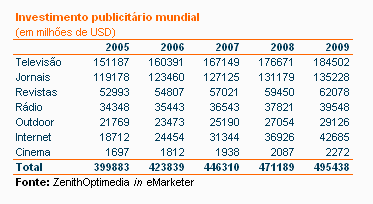
2009, o ano em que a publicidade na net passa a rádio

«A ZenithOptimedia prevê que o investimento publicitário na Internet cresça 28.2% em 2007, mais de sete vezes o esperado para os outros meios (3.9%). Segundo os valores publicados pela eMarketer, o mercado publicitário global valerá 446 mil milhões de dólares em 2007, sendo a televisão o maior destino dos investimentos dos anunciantes, com 37.5% de quota, ou 167 mil milhões de dólares.

A agência também prevê que o share de investimento da Internet cresça de 5.8% em 2006 para 8.6% em 2009, ultrapassando o outdoor e a rádio»

fonte: «Publicidade na internet vai aumentar», 14/12/06, marktest.com

LAD incorpora rádio

«Lanzados a principios de este año, los modelos europeos de las series Sansa e200 y c200 no incluían sintonizador de radio FM debido al aumento de costes por exigencias de impuestos. Sin embargo, la demanda de los consumidores ha hecho que Sandisk haya tomado la decisión de ofrecer estos dispositivos tanto con la opción de FM como sin ella con la menor diferencia de precios posible.
Tanto la serie insignia Sansa e200 como la Sansa c200 con funcionalidad FM integrada estarán disponibles en tiendas próximamente. Todos los reproductores incluyen una ranura de expansión para tarjetas de memoria flash, permitiendo a los usuarios añadir hasta 500 canciones adicionales mediante una tarjeta microSD de 2GB1; amplia duración de la batería, extraíble y recargable2; visualización de fotografías; grabación de voz con micrófono incorporado, y gestión de derechos digitales (Digital Rights Management) no propietaria para permitir a los usuarios comprar canciones desde diversas fuentes de música digital»

fonte: «Sandisk incorpora radio FM en sus reproductores MP3», VNUNet.es, [13-12-2006]

O WiMax desenvolve-se na GB

«Ofcom, the UK's the broadcast regulator, has tagged WiMAX mobile wireless as a likely source of revenue for the public purse. It has announced "the UK's largest single release of radio spectrum, which could be used for a range of new services such as mobile broadband and advanced wireless services". (...) But it's no secret that WiMAX operators are expected to pounce. "Ofcom's research into the bands has identified a number of potential uses of the spectrum," the regulator announced. They include:

  • mobile broadband wireless services, offering high-speed, high-capacity mobile data connections using technologies such as WiMAX;
  • mobile multimedia services, such as mobile television;
  • advanced mobile services using technologies such as UMTS and its evolutions; and
  • mobile broadcast, such as wireless cameras for outside broadcasts and temporary or portable video links.

fonte: «Ofcom helps inflate the WiMAX hype bubble», The register, Guy Kewney, Newswireless.net, Published Monday 11th December 2006 11:07 GMT

Uma rádio a criar canais de música na net

Até agora tivemos empresas fora da rádio a criar canais de música em streaming (PAndora, Cotonete, LAst Fm, Yahoo); agora é a vez da rádio criar ela própria esses espaços, integrando-os. Diz PAula Cordeiro: «O projecto procura fazer frente e assumir-se como uma alternativa ao sucesso da Last.fm e representa, de acordo com o director de marketing da Xfm, uma primeira fase da estratégia que o grupo vai desenvolver, no sentido da criação de serviços de rádio personalizados e interactivos. Será que a rádio está finalmente a perceber que o caminho é o da ligação dos seus ouvintes numa comunidade online de partilha de interesses, com serviços personalizados e interactivos?...» (Net fm).

«The move comes as GCap, the UK’s largest commercial radio broadcaster, is looking to interactivity and social networking tools to help it offset declining ad revenues and respond to the popularity of online radio outfits like last.fm.» («XFM to launch personalised internet radio station», e-consultancy)  

Procurar nichos com o HD e a net

«Clear Channel Radio recently unveiled niche programming initiatives that will take advantage of both online and HD formats. The initial targeted content plays will be catered towards auto racing fans and the gay and lesbian communities. Early advertising interest has come from big-name brands like American Express, AOL, and New Line Cinema, and other targeted plays are scheduled to follow. "Our listeners represent a wide range of lifestyles and interests, and they expect content on their terms," said Evan Harrison, executive vice president of Clear Channel Radio. The auto racing initiative, called Race Day, includes NASCAR-related news, stats, schedules, exclusive photos, and behind-the-scenes information. The concept, which is tied into a Fox terrestrial radio station and companion website, will feature online, podcast, and streaming radio content. (...) In a similar fashion, Clear Channel is also spinning Pride On Demand, an initiative that will be programmed by members of the gay and lesbian community. (...) Pride On Demandis currently accessible on-demand or via streaming formats within 12 markets, and a number of HD2 multicasts will carry the show in Chicago, Hartford, Miami and West Palm Beach.»

fonte: «Clear Channel Spins Niche, Multi-Format Programming», Digital Music News

Sobre o primeiro «receptor» WiMax

« Intel Corp. moved one step closer to developing its own mobile WiMAX solution on Wednesday when the company announced it had completed the design of its first WiMAX baseband chipset for use in laptops and other mobile devices. According to Intel's executive vice president and chief sales and marketing officers Sean Maloney, the new WiMAX Connection 2300 is a combination of the company's new chipset design and the previously announced single-chip, multi-band WiMAX/Wi-Fi radio. The chipset design was demoed on Wednesday during Maloney's keynote at the 3G World Congress and Mobility Marketplace in Hong Kong, where he showed a Centrino Duo mobile laptop with mobile WiMAX (IEEE 802.16e-2005), Wi-Fi (IEEE 802.11n), and high-speed downlink packet access (HSDPA) 3G capabilities successfully accessing the Internet at broadband speeds over a mobile WiMAX network. According to Dave Hofer, director of wireless marketing for the mobile platforms group at Intel, the announcement of Intel's WiMAX Connection 2300 will help further speed the deployment of mobile WiMAX, which is already moving along at a steady pace he said. "Our aim with WiMAX is to provide personal anytime/anywhere broadband connectivity," said Hofer. "This is a step along the way. We're at a point where, in 2007 and 2008, you're going to start seeing product samples."»

fonte: «Intel Develops Mobile WiMAX Chipset», PC Mag, 12/7/06