Blogia

Transistor kills the radio star?

Afinal o iPod não é inimigo da rádio

A propósito da decisão da Apple de colaborar com as estações HD, eis as declarações de alguém com responsabilidade nas rádios dos EUA:

«Clear Channel President/CEO John Hogan said, "Apple has been a strong supporter of radio, previously making an FM tuner available for the iPod, and we view their support of HD digital radio as an enormous opportunity." Apple offers the iPod Radio Remote as an iPod accessory for $49.

Hogan continued, "With substantial gains in online and on-demand programming already under our belt, there should now be no doubt of radio's ability to constantly evolve and embrace new technology. The iPod is not a competitor to radio -- it is a collaborator in connecting with consumers on a continual basis."»

fonte: «Clear Channel Encodes For iTunes Song Sales Via HD Radio», Radio Ink, 07/09/07
 

iPod trabalha com HD (EUA)

«Apple has unveiled new technology that enables US high definition radio listeners to "tag" songs that they hear on FM stations for subsequent purchase via iTunes. iTunes Tagging technology, which was developed by Apple in conjunction with iBiquity Digital and major US radio broadcasting groups, was unveiled across the US this week together with the latest iPods.  Apple vice president of iPod product marketing Greg Joswiak said: "When a song plays on your HD Radio that you like, a simple push of a button will tag it and later give you the chance to preview, purchase, and enjoy it with iTunes and your iPod." The US initiative follows a similar scheme in the UK put together by UBC Media. The Cliq service displays the tracks playing on the radio and allows consumers to buy them immediately. Cliq is available on new DAB radio sets and also via Java enabled mobile phones. UBC Media chief executive Simon Cole welcomed the introduction of the iPod tag service: "This is great news for us and for the digital radio industry globally. "Importantly, it confirms our very strong and long-held belief that radio has a huge part to play in the future of digital music sales and that those sales represent new revenue opportunities for radio". »

fonte: «Apple launches radio tagging system», Broadcastnow.com, Yvette Mackenzie, 07/09/07

Mas, atenção, é preciso que as estações emitam um código hertziano: «and Clear Channel has already announced that it will encode all its FM HD broadcasts for the service». E ha tambem que garante, como se lê na newsletter da Inside Radio de 06/09/07 que: «Polk's HD Radio connection with the iPod will require stations to encode their HD signals to allow consumers to use the "tagging" feature for buying music on iTunes. Inside Radio has learned eight radio groups have already committed to encoding. Insiders say this alliance between radio, receiver manufacturers and Apple puts radio on the forefront of music delivery and turns would-be competitors into collaborators»

Outra chamada de atenção: a tecnologia não permite a compra, mas apenas marcar determinadas músicas, que poderão ser compradas, quando se ligar o iPod ao computador (ou seja, depois). «Well, it's not exactly a "push-to-buy" function... it's more of a "push to 'bookmark,' so later, when you hook your iPod up to your computer, you're reminded of the songs you tagged, and then you can buy them through iTunes" service. In fact, the iPod itself is really only used to carry these "bookmarks" from the radio to the PC»

Já Mark Ramsey chama atenção para outra questão (com a tradicional ironia, quando fala de HD): «HD radio has been reduced to being a storefront for iTunes? So I listen to my HD radio, tag the songs I like, download them to my iPod, and listen to my iPod rather than my HD radio, right?And who makes the money in this transaction? The people who own the store, the people who license the music, or the station that tags the songs?»

As audiências mais baixas no PPM

«(...) For years, Arbitron Inc. has measured radio ratings based on paper diaries filled out by listeners. But it's now in the early stages of moving to a new electronic system, called the Portable People Meter. Already in use in Philadelphia and Houston, the system will be rolled out more widely soon.

[Photo]

The People Meter, a pager-sized device that automatically registers what radio station survey participants are listening to, is already yielding more specific -- and, in some cases, surprising -- data. The results from the first two markets indicate that people flip among stations more frequently than they say, that men listen to significantly more radio than women and that employed people listen a lot more than people who don't work. While the diary system pointed to some of these findings, it typically missed how broad they are. In the markets that have switched to the electronic ratings, rock and classic rock rank higher than before, while hip-hop and other urban music generally don't stack up as well. Perhaps most important, radio stations typically pull in a bigger audience than they thought, but that audience spends less time listening to them.»

[chart] 


fonte: «New Way to Count Listeners Shakes Up Radio», Wall Street Journal, By SARAH MCBRIDE, September 6, 2007;

Começar a digitalização com uma mentalidade analógica

Parece que se empezó la digitalización con una mentalidad analógica, esto es, el desarrollo de un estándar para cada medio (excepto en el caso japonés) cuando cada vez parece más claro que el futuro apunta hacia una concepción de estándares multimedia adaptados a una recepción multiplataforma. Por ser éste un período de transición, los cambios suelen quedar reflejados en la proliferación de estándares hasta el punto de que algunos declinan justo cuando empezaban a despuntar. Además, a diferencia de la televisión, la ausencia de una fecha fija para el apagón analógico (switch off ) obliga a una coexistencia entre ambos paradigmas, el analógico y el digital, lo que a menudo provoca más confusión y podría llegar a convertir a la radio en la principal competidora de sí misma.»

fonte: BONET, Montse, «La radio digital, estándares tecnológicos y plataformas de distribución», Portal de la Comunicación In-Com-UAB, A modo de conclusión

(5.2) Quando poder está a rádio disponível para ceder?

«Nadie puede asegurar qué sucederá en el futuro, pues la audiencia tiene mucho todavía por decir. La variedad de plataformas de distribución de audio que tan sólo hemos apuntado supera el ámbito de la tecnología y plantea interrogantes sobre los límites de la escucha radiofónica, los nuevos contenidos y las potenciales nuevas audiencias, para redundar en definitiva en la posibilidad de nuevas líneas de negocio. Los oyentes empiezan ya a tomar sus propias decisiones en cuando a programación y sobre su entorno de escucha (USADO), aún siendo evidente que los productores de esta industria cultural todavía mantienen el control sobre los contenidos. Sirva como ejemplo, entre otros, el podcasting, gracias al cual los individuos eligen contenidos, no emisoras, lo cual plantea ciertas dudas sobre las formas de identificación y diferenciación de empresas o el control de los contenidos»

fonte: BONET, Montse, «La radio digital, estándares tecnológicos y plataformas de distribución», Portal de la Comunicación In-Com-UAB, A modo de conclusión

Um futuro incerto na rádio

«Estamos asistiendo a uno de los cambios tecnológicos más sustanciales en materia de telecomunicaciones y radiodifusión en casi un siglo, la digitalización, pero de momento, y especialmente en el ámbito radiofónico, existe bastante confusión, muchos lugares comunes y una radio digital cuyo futuro sigue todavía bastante desdibujado. En buena parte, ello es lógico puesto que se necesitan unos 10-15 años, o incluso más (Paila, 2005:29) para conseguir que una nueva tecnología alcance un punto en el que pasa de ser utilizada tan sólo por los innovadores y los primeros usuarios (early adopters ) hasta que resulta imparable, lo cual podría suponer su presencia en el 20% del mercado masivo (Corneliussen, 2004:3).»

fonte: BONET, Montse, «La radio digital, estándares tecnológicos y plataformas de distribución», Portal de la Comunicación In-Com-UAB, Introducción

Defender a velha ideia de rádio, a todo o custo

Se não houver um canal/uma plataforma de distribuição (como o FM ou DAB) a rádio não existirá: 

«Without a dedicated transmission network, radio may risk being subsumed by other platforms dominated by television or other services. Radio broadcasts may lose prominence if offered as a supplementary service by aggregators controlling the menus, EPGs, and technical parameters of transmission.» 

fonte: Public Radio in Europe, Conclusions and Outlook, EBU/UER, Junho 2007, pág 2

Falta saber qual será esse modelo:

«Radio in the future is a multiplatform phenomenon. Radio will be available on a wide range of technical devices, from racks and hifi’s over stand alones and portables to handheld and pocket receivers. Everything digital - from television and computers to cell phones, mobiles and PDA’s, will be able to carry sound and thus radio along.• From one-standard to many-standards: There will be no single, winning standard for digital radio. DAB/DMB, DRM, DVB all have their strengths and weaknesses, which will make more of them co-exist. Manufacturers will secure dual, triple and eventually multi-standard radio sets for the consumers. And the consumers will not have to navigate through a jungle of frequencies or abbreviations, as the tuners will have easy-to-navigate browsers on displays with the station brands»  

fonte: «Public Radio in Europe, Conclusions and Outlook, EBU/UER, Junho 2007, pág 6


Para que o DAB sobreviva (e suas limitações)

«Countries with a significant investment in DAB and an installed base of consumer equipment will proceed with DAB. However, the emergence of new standards may create confusion and disrupt digital radio implementation in some countries as regulators and planners re-evaluate the potential of each technology. Enabling regulation is not yet in place in many countries. The rate of technology migrations will increase and users will become accustomed to shrinking product life cycles, multi-standard devices, and hybrid functionality. Without significant economic or technical obstacles, radio broadcasters have flexibility within the DAB family of standards to offer a combination of services. The key issue will be management of the installed base of receiving equipment. Multiple platforms will coexist. DAB and DRM technologies can be implemented in a complementary way.

Consensus of all key industry players is necessary to drive radio digitalisation: Government regulators, public service and commercial broadcasters, network operators, and automobile manufactures. Marketing and coordination at national and international levels has not been sufficient in many cases.»

fonte: Public Radio in Europe, Conclusions and Outlook, EBU/UER, Junho 2007, pág 1

«DAB transmission was widely considered as expensive and uneconomic especially for commercial and community stations, when the costs were compared to analogue transmission or to alternative digital broadcasting systems. - DAB also had problems with coverage. In the UK and Denmark, it had become obvious that community radio and small commercial stations were not suited to the existing coverage patterns of DAB multiplexes. All the Irish respondents agreed that DAB coverage would not be compatible with the needs of local radio stations»

fonte: Public Radio in Europe, Conclusions and Outlook, EBU/UER, Junho 2007, pág 3

«As audiências analógicas vão continuar em queda entre os jovens»

Das poucas certezas que este relatório tem: «Analogue audiences will continue to decline especially among younger listeners as radio broadcasters adjust by offering a wider variety of content, higher availability on multiple platforms and through multiple standards. Radio listeners will become more demanding in terms of the variety of content they seek and ways of accessing it»

fonte: Public Radio in Europe, Conclusions and Outlook, EBU/UER, Junho 2007

Alguém que está a viver 'o segundo choque'

«"Because of satellite radio, more affluent people are going to use that service, so we have a smaller piece of the pie to slice up with the people remaining, who are not so affluent," said Bob Pettit, general manager of WCBM, the Baltimore talk-radio station at 680 AM. "The younger people are going to the new technologies. Radio used to be a very effective way to reach people aged 18 to 34. Now, not so much." As a result, Pettit said, national advertisers are not turning to the old medium the way they once did, leaving the field to cheaper, and often local, ad buyers. In turn, the stations are obliged to charge less money because their demographic is poorer, he said, leaving the stations with less revenue.»

fonte: MADIGAN, Nick, «Radio may survive this, too», Baltimore Sun, August 26, 2007

A fé de que a história se repita... (a rádio é imortal...)

«"I've been in the radio biz for over 35 years -- radio was supposed to be dead by now," he [Edward C. Kiernan, general manager of Baltimore's top-rated talk-radio station WBAL, 1090 AM, and its FM counterpart, WIYY, known as 98 Rock] said, ascribing its supposed demise to the advent of television, to the fact that cigarette advertising was removed from the airwaves, to record players, cassette tape recorders, eight-track tapes and, more recently, compact discs. If none of these things killed radio, he suggested, then iPods and satellite radio won't either.» E a Internet?

fonte: MADIGAN, Nick, «Radio may survive this, too», Baltimore Sun, August 26, 2007

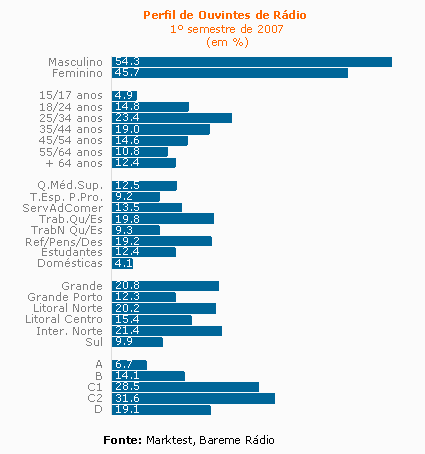
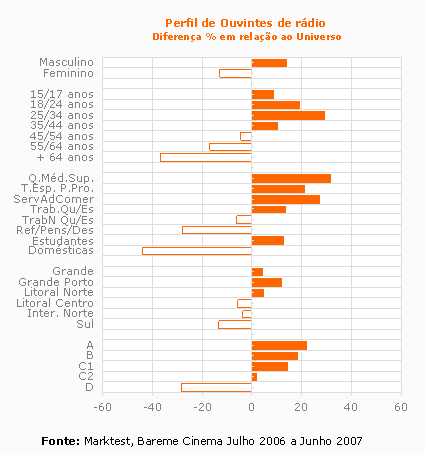
Geração iPod em Portugal ouve mais rádio

Contrariando a tendência mundial (pelo menos no ocidente...):

- 43,1% dos ouvintes de rádio em Portugal têm entre 15 e 34 anos

e ouvem mais rádio do que a média nacional (sobretudo entre os 25 e os 34 anos)
A análise tem como base os resultados do primeiro semestre de 2007 do estudo Bareme Rádio da Marktest, que analisa o comportamento dos residentes no Continente, com 15 e mais anos, relativamente ao meio rádio. («Quadros médios e superiores com maior afinidade com a rádio, 23/08/07)

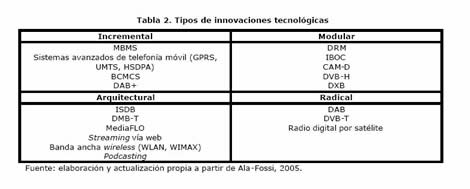
Para categorizar as inovações tecnológicas na rádio

Ala-Fossi recorre às categorias criadas por Henderson and Clark  (incremental, modular, architectural and radical innovations) para descrever o que está a acontecer à rádio [«Architectural Innovation: the reconfiguration of existing product technologies and the failure of established firms», Administrative Science Quarterly 1990]

«Despite its obvious limitations, technology assessment approach offers us some very useful conceptual tools. Because all innovations resulting technological development are not similar, technology assessment categorizes them according to two main dimensions. First, how much the technologies in the new innovation differ from the existing technologies and second, how much the configuration of the technologies in the new innovation differs from the present configurations. In this way, all the innovations can be categorized in to four types. Incremental innovations are for example small improvements of the existing products, while modular innovation will mean that the innovation will totally change certain parts, but they can still be integrated to the original product. Architectural innovations are mostly about combining already existing elements in a new way, while radical innovation means simultaneous development of new technologies and creating new configurations or combinations of these technologies. (Mäkinen & Nokelainen 2003, 25-27) With a similar categorization it is possible to evaluate also the new technologies for digital audio delivery in relation to the traditional radio broadcasting and to each other.» (ALa-Fossi, 2005:3)

A autora espanhola Montse Bonet, a partir das notas de Ala Fossi, criou o seguinte quadro:


Quando acontecerá o switchover analógico da rádio?

«My argument here is that at the moment we are still as far from the analog shutdown of radio as it was thought back in late 1990’s: it will take at least 10 to 15 years from the present day. Although the EU has recently proposed that TV broadcasting in its member states should be switched in to digital by 2012, there are at least two reasons, why the process with radio is probably going to take longer time (Hedges 2005a; EU 2005; IHT 2005; Coonan 2005). ¹ First of all, those countries (Germany, Netherlands, Norway) which already have set a date for the digital switchover of radio, have scheduled it to happen four to seven years after the supposed digital switchover of TV. (WorldDAB 2005b; Marcuslund 2005a; Marcuslund 2005b) This is probably a realistic approach. (...) The second reason is that probably none of the European countries will to be able to meet their official deadlines for the TV digital switchover. At least according to the Informa Telecom & Media’s recent report, this will be the case. The report predicts also that some countries, like Italy and Spain will not be able to shut down their analog television networks before 2020. (...)  It is more than likely that analog FM radio is an important part of the future of radio broadcasting at least 10 years from now. FM radio station is relatively inexpensive to build and operate, and this is why it suits well also for small-scale radio. The number of existing analogue FM receivers is huge, their price is low and the sound quality on FM is good enough for the majority of people. In addition, services on analog radio are usually free of direct charge and easy to use. (Ala-Fossi & Stavitsky 2003, 71; Ala-Fossi 2005, 33, 44-47; Coonan 2005)» (Ala-Fossi, 24-26)

«1 In the US, the Congress is willing to shut off analog TV already at the end of 2006, four months after concluding the currently ongoing channel selection process. In Japan, there is a law according to which analog TV broadcasting will end in July 2011. (McAdams 2005; Hara 2003)»

A internet ao serviço da rádio (2005)

«Internet radio has certain social strengths, because it is possible to create services even for very small and scattered groups all over the world without large initial investments. Although it has become the main delivery system for thousands of web-only radio operators and an important supplementary platform for practically all radio broadcasters, it has still problems with copyright  issues. When compared to broadcasting, perhaps the main economic disadvantage of Internet radio is that every new listener means more expenses for the program operator. This is why BBC is probably going to prevent foreign users to listen its domestic channels over the web. (Laven 1998, 6-8; Bagharib & Tan 2004, 2; Ala-Fossi 2005, 40-41; Colker 2005) Another disadvantage of Internet radio has been it's weak mobility and portability. While mobile phone approach may still be too expensive to use, a wireless broadband network with fixed rates can become a practical solution for listening live or streaming Internet radio outside of your home or office.» (Ala-Fossi, 2005: 23-24)

O que aconteceu nestes 10 anos

«(...) last ten years have been a period of rapid growth of the Internet and mobile communications, which has challenged not only the traditional ideas of radio broadcasting and audio delivery, but also those unique, new extensions for radio broadcasting which DAB was able to promise. Lately, the Internet and mobile phone networks have provided a basis for new nonbroadcast or hybrid audio services (e.g. Podcasting, Visual Radio)» (Ala-Fossi. 2005: 2)

«Hybrid systems are discussed here only very briefly. Visual Radio is Nokia’s architectural innovation, which combines traditional analog FM radio and synchronized visual GPRS data delivery via GSM network (Hedges 2005c). Motorola’s iRadio is another architectural innovation, which makes it possible to listen Internet radio recordings from mobile phone memory via car or home stereo (Klein 2005). In addition, there are some software innovations which aim at bringing podcasting services directly into mobile phones through wireless mobile networks. While Melodeo counts on downloading podcasts from the Internet directly to the phone memory, Pod2Mob software will instead stream the selected podcasts to an applet on the users cell phone (Melodeo 2005, Pod2Mob 2005)» (Ala-Fossi, 2005: 19)

A rádio em tempo de transição

«Unlike ten years ago, the idea of the future of radio is now less obvious and clear. The media we know as radio is currently moving through a period of rapid technological transition and it seems that although the future of radio is still digital, there will be multiple simultaneous platforms of digital audio delivery» (Ala-Fossi, 2005:2)

ALA-FOSSI, M.: 'Mapping the technological landscape of radio: where do we go next?'. First European Communication Conference. Amsterdam, 24-26 November. CD-ROM. 2005.

ou

Ala-Fossi, Marko: Mapping the technological landscape of radio: where do we go next? Tampere: University of Tampere, Department of Journalism and Mass Communication, 2005, 36 p., processed.

O podcasting está a arrefecer? OU só os podcasts?

De acordo com este texto parece que sim («It appears that podcasts are not picking up steam, and rather, podcasting is actually slowing down. There is not enough incentive for people to jump exclusively into podcasting because of tight competition from video, blogs, big media and a lack of clear monetization methods. However, it does not mean that podcasts are not here to stay. One great thing that we already received from the podcasting revolution is choice. Media companies were forced to micro chunk and give us their content on our terms. We now can consume it in whatever way that we prefer, whenever we want it», via Clube de jornalistas).

A mim, que há muito defendo a ideia do podcasting, como ferramenta de distribuição de programas/notícias da rádio convencional, não me surpreende (por oposição aos podcasts feitos mais ou menos amadoristicamente e que têm poucas oportunidades face à concorrência):

«E então teremos podcasting não apenas de programas mas também de notícias, de modo a que se concretizará o sonho de Bertold Brecht: o receptor não será mais o sujeito passivo da comunicação, mas aquele que escolhe o que quer ver e ouvir, o que constrói o seu próprio noticiário, o que intervém.
Com o podcasting, com este ou outro nome, com esta ou outra forma de eu poder escolher o que quero ver e ouvir
»

A rádio deixa de ser exclusiva no carro

«(...) the dream of turning cars into digital communication hubs didn't die. Now, car makers and technology suppliers are rallying to take another shot. Car makers and inventors have been trying to develop a safe way for drivers to manage their digital clutter and connectivity angst while on the road. Ford Motor Co., for example, hopes to generate some buzz with a system called "Sync," developed in collaboration with Microsoft and rolling out this fall on about a dozen Ford, Lincoln and Mercury models. Ford's effort to develop a new kind of onboard entertainment system grew out of the frustration of a small group of Ford engineers with the auto industry's tendency to lag behind personal electronics trends, says Gary Jablonski, manager of infotainment system engineering for Ford in Dearborn, Mich. "Customers want the same stuff in their cars that they see in Best Buy," Mr. Jablonski says. "We are generally a year behind." Their idea: Develop a system, using a variant of Microsoft's Windows CE software, that can link to various digital devices using either Bluetooth wireless technology or a USB port. Then, no matter what kind of device is involved, the system can operate it using a voice-recognition system or the buttons, knobs or touch screens provided for the car's basic audio system. If I had a Sync equipped car, my morning drive might go like this: I would plug the iPod into a USB port in the storage bin under the center armrest, and pair my BlackBerry with the car's audio system using Bluetooth (that is, if my phone has the right kind of Bluetooth.) To get the iPod to play, I could tell the system, "play genre jazz" and the iPod would start playing tunes in that category. (...) The marketing research firm J.D. Power and Associates earlier this month released an outline of its latest survey of consumer interest in new automotive technology, which offers some encouragement and some caution for products such as Sync. The good news is that half of the consumers polled for Power's 2007 emerging technologies study said they'd be interested in paying as much as $100 to get a USB interface in their next car. Asked if they'd pay $150 to get an iPod interface, about 43% of the respondents said yes. (...)»

fonte: «Eyes on the road», WSJ, JOSEPH B. WHITE, 27/08/07