Blogia

Transistor kills the radio star?

«O futuro parece brilhante»

«"The long term prospects for our business look very bright if, and only if, we aggressively seize on the opportunities that new technology and changing market needs are pointing out to us," says Greater Media CEO Peter Smyth. He predicts radio will be the "center point of a web of communication channels" in the coming decade, as listeners turn to radio for recommendations, resources and reflections of their city.» fonte: SAXE, Frank, "Looking towards radio's long-term future", Inside Radio, NAB Radio Show, Setembro 07, pag 6

Manu Chao: transformar a página numa «pequena rádio»

«(...) talvez tenhamos de mudar o conceito de obra: um CD retrata o artista num determinado momento, mas isso pode ser ampliado. Embora La Radiolina [o seu disco de 2007] tenha 20 temas, agora quero seguir na mesma onda. Vou transformar a minha página na internet numa pequena rádio que vai difundindo as novidades. No final, La Radiolina pode vir a ter 30 ou 40 canções». (MANRIQUE, Diego, «Manu Chao, a vida livre» Visão/el País, 6/09/07, pag 101) 

Mais um exemplo de que outros estão a fazer o que era esperado que a rádio fizesse

«FOX Interactive Media and a few FOX O&O’s have launched a few local music websites in connection with MySpace. The sites are an experiment to see if there is an audience for content that focuses on local bands, concerts and fans. The first round of sites include mymusictwincities, mymusicboston and mymusichouston, with MySpace pages for each (example). The sites include streaming audio, video of performances, concert calendars and links to the bands’ MySpace pages.

Hey, wait a minute. A TV company building LOCAL music sites ? Promoting ‘Battle of the Bands’ ? I thought local Radio stations should own this space ? Especially local Rock stations that target 18-34 and 18-49 demos. This should be a major wake-up call to local Radio.What FOX is doing is just another example of the fast moving, digital land grab at the local level. Team Rupert sees that Radio is not taking full advantage of their local powers of driving new online businesses. Especially with music. (...)»

fonte: «FOX Local Music sites, Philly Rock Wars, WYSP», Mel Taylor, September 13th, 2007

A grande questão é que, com isto, se antecipa uma das grandes tendências: para os públicos, para os novos públicos?, não há reconhecimento das características dos meios clássicos: ou seja, está na net e ponto final.Vem de uma coisa chamada televisão? E depois? Vem de um jornal? Mas não está na net? Então é net. (a questão é que, para competir na net, a rádio devia potenciar as suas maisvalias e os terrenos que conhece melhor e não o está a fazer)

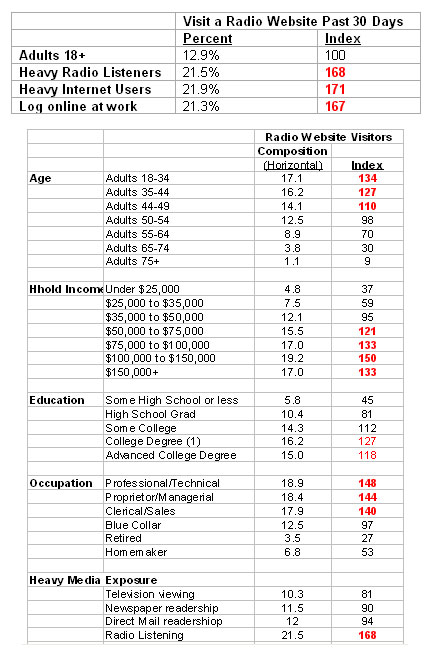
18-34, os que consultam mais páginas de rádios (EUA)

«Nearly 75% of all adults log onto the Internet and nearly 1 in 5 (18%) of online users visit a radio website over the period of a month. A profile of radio website visitors shows that well educated, upper income, white collar workers in addition to younger people tend to be more likely to visit radio websites. These findings come from a recently released telephone study of 118,211 randomly selected adults conducted by The Media Audit between January 2006 and April 2007 in 88 markets across the nation.

fonte: «One in 5 Internet users visit a radio website» RBR, Carnegie, Setembro 07


Fundador do Pandora diz que vai à falência

«That's the word from Pandora's founder, Tim Westergren. Pandora is a web radio service that learns what you like as you listen more. Westergren was interviewed at dailytech.com by Tom Corelis: "The new rates would bankrupt us, along with every other webcaster in currently in operation. Without a doubt, for us it’s a really misguided decision...These rates essentially don’t rely on the understanding of the economics of web radio."»

fonte. «Pandora Founder: New Webcasting Royalty Rates "Would Bankrupt Us"», RadioABout.com

Hi5 em Portugal

«Os resultados do estudo Netpanel da Marktest mostram que o domínio hi5.com foi responsável por 17% de todas as páginas visualizadas em Agosto pelos internautas nacionais, que acederam a partir de suas casas. As férias também servem para encontrar amigos na net… De acordo com os resultados do estudo Netpanel da Marktest, o domínio hi5.com foi o que em Agosto mais aumentou em páginas visitadas a partir do lar, crescendo duas vezes e meia face ao mês anterior. Este domínio foi responsável por 17% do total de páginas visualizadas durante o mês, o que constitui um valor muito significativo. »

fonte: «Hi5 representa 17% das páginas visualizadas em Agosto a partir do lar», Marktest.com, 11 de Setembro de 2007


iPods e outros gadgets são perigosos para a condução?

Nos EUA há quem pense que sim:

«Lawmakers in a dozen states are trying to ban drivers from using video games, computers and fax machines in cars in a new wave of driver-distraction legislation. Since January, states including Texas, New York and Arizona have considered bills that would limit the use of car electronics that go far beyond cellphones, according to the National Conference of State Legislatures. Most bills would require violators to pay fines ranging from $50 to $600. So far, only one of this year's proposals has been enacted — in Tennessee. States also are trying to track how much of a threat electronic gadgets such as iPods and front-seat movie screens pose to safety. Statistics are scarce because it's difficult for police to determine whether an accident was caused by a distraction in the car, but legislators say electronics clearly are grabbing drivers' attention. "I got in a cab and the cabdriver was watching the fights on a TV he had in the front seat," says New York state Sen. Carl Marcellino, whose bill to prohibit drivers' use of display-generating electronics passed unanimously in the state Senate June 21. "Cars are becoming an extension of the workplace and an extension of the home."» (fonte: «New hazard: Driving while wired», By Christina Crapanzano, USA TODAY, 05/07/07)

A queda das audiências da rádio não se deve à Internet?

Há, pelo menos relativamente aos jornais, quem pense que não (que caíriam de qualquer forma):

«The dark truth for newspapers is that their sales would be in serious decline even if Tim Berners-lee had never invented the internet and Metro was still an idea on the whiteboard. As the Telegraph website's Burton says: "No one has shown me evidence that the internet is making us lose print sales." And those newspapers that enthusiastically embraced free web content early on, such as The Guardian, find their combined web and print circulations in a healthier position than had they continued only to force-feed readers with slabs of Times New Roman. The Guardian's circulation would have fallen far further if it hadn't built up brand loyalty among students with its cluster of excellent sites» (Rob Blackhurst , The freeloading generation, British Journalism Review, Vol. 16, No. 3, 57 (2005))
 

As dificeis relações entre rádio e indústria musical

«MediaPost has detailed analysis of several analysts' projection for Internet radio revenue, which could someday rival terrestrial radio. Online advertising is the fastest growing segment for newspapers and radio alike, growing by 16 percent during the first quarter of the year. Advertising via online radio has several advantages over terrestrial: it's interactive to spur purchases or other actions, it adds a visual element (banners etc.) to compliment the audio messaging, and it can be used to sell music.
Internet radio should be the music industry's best friend, but instead the two groups are constantly sparring. Radio stations are offering "click to buy" options for recently heard tracks to encourage sales, but the copyright holders group is doing everything it can to prevent the growth of online radio. Sooner or later the music industry will realize that Internet radio can generate much more revenue through advertising and direct sales than iTunes ever could and will play nice» (fonte: «», John Gartner, Marketingshift, 7/09/07)

Vantagens da publicidade da rádio on line

«Advertising via online radio has several advantages over terrestrial: it's interactive to spur purchases or other actions, it adds a visual element (banners etc.) to compliment the audio messaging, and it can be used to sell music.» (fonte: «Internet Radio Pays for FM Stations», John Gartner, Marketingshift, 7/09/07)

«Ouvir sem ouvir»

«If there is something that characterizes the evryday relationship with the radio it is taht nobody sits down to listen to it, and many times, people do not pay attention to the broadcast (...). The distracted way of relating to the radio, manifested in the attitude of 'listening without listening' or keeping the radio on as 'background music', constitues a cyclic mechanism of withdrawal-connection that characterizes communication practices in domestic sphere» (Winocur, 2005: 323)

Quem manda no carro

«In the car, monopoly is exercised by the driver, although sometimes he or she is willing to make concessions to the other people in the car» (Winocur, 2005: 323)

WINOCUR, Rosalía. Radio and Everyday Life; Uses and Meanings in the Domestic Sphere, Television & New Media, Vol. 6, No. 3, 319-332 (2005). Sage

A rádio ainda serve para promover nova música?

«(...) While there are now multiple ways to access music, radio still has a special place in the heart of the music fan. In 2006, with the exception of oldies and rock formats, all music formats showed ad revenue growth on a national basis. Adult contemporary and contemporary hit radio went up 3 percent. The urban format went up 9 percent. The two fastest growing music formats were Spanish adult contemporary (33 percent) and Spanish contemporary (18 percent).

“What appeals to people is the immediacy of it,” said George Nadel Rivin, an accountant with Miller Kaplan & Arase who has made a specialty of tracking data for the broadcasting industry. “When I have the same several songs on an iPod I am always looking for new music and something I can get excited about that is fresh and new.”
iPods. MP3 players. Laptops. Satellite radio. All cut into the listening time of commercial radio.
In the 1996 film “That Thing You Do” the members of the fictional band The Wonders jump about with youthful enthusiasm with the first radio airplay of their song. If director Tom Hanks set that scene in 2007, the band members would more likely jump with joy at their 1000th download or 100th friend at their MySpace page.  “Anyone with a computer is not favoring terrestrial radio these days,” Wisely said» (fonte: But How Relevant Is Radio Music?, By Mark Madler, San Fernando Valley Business Journal, 03/09/07)

Os consumidores do futuro vão condicionar tudo (intro)

«(...) Tomorrow’s consumer will certainly be different than yesterday’s, and even the day before that. The key to figuring out the future of technology trends, according to NBC Universal president of research and media development Alan Wurtzel, consumers want the media that they grew up with. “The consumer is behaving a little differently than they ever did before. I don’t know if you’ve noticed, but things are getting a little crazy out there,” he said at the CTAM Summit here. A large reason for this is the emergence of generation Y (ages 15-28) into the consumer market and their acceptance of new technology.» ( fonte: «NBC U Research Head: Generation Y Taking Over», By Jason Braff -- Multichannel News, 7/26/2007)

O primeiro rádio DAB de bolso

«O iAudio D2 da Cowon é o primeiro mini rádio DAB do mundo. Apesar de ter o tamanho de uma caixa de fósforos, o iAudio D2 tem um tuner DAB full band III, além de rádio FM. Ele também toca músicas em formatos e toca vídeos MP4 e XviD com a sua tela touchscreen de 2.5?. O iAudio D2 vem com 4 GB ou 8 GB de capacidade, e se isto for pouco para você, ele também tem um slot para cartões SD HC. Segundo a Cowon, a bateria dura até 52 horas tocando arquivos MP3, 10 horas de vídeos e 12 horas escutando rádio DAB. A versão com 4 GB está à venda na Advanced MP3 Players da Inglaterra por £169.99 ou £189.99 com um cartão SD de 4 GB. E se você preferir, a Cowon também tem uma versão do D2 sem a funcionalidade de rádio DAB. (fonte: «O Rádio DAB de Bolso», IPJornal, 04/09/07) 

Esforços para levar a internet (móvel) aos carros

«"As the number of Wi-Fi hot spots grow, so too do the possibilities of where they can be placed. No longer do they have to be in fixed locations such as coffee shops or libraries; planes, trains and automobiles are turning into wireless Internet access points. New technology WiMAX is expected to further accelerate adoption...
"Autonet Mobile Inc. builds the Wi-Fi box Mr. Dyer uses and also makes them available through Avis Budget Group Inc. car rentals. Autonet wants to eventually put Wi-Fi into every car... Amtrak is looking to provide coverage to its trains. AMR Corp.'s American Airlines plans to provide its passengers with Wi-Fi access by next year...
"Seen speeding the adoption of Internet access in vehicles is wireless technology WiMAX, which is similar to Wi-Fi but with longer range. Sprint and Clearwire Corp. are partnering to build a nationwide network.
"Sprint recently held a technology summit in which partner Nokia Corp. demonstrated the applications of WiMAX in a Ford Motor Co. Mustang fitted with Nokia N800 tablets embedded in the back of the car's front-row headrests, with clips of 'Terminator 2' and 'Harry Potter and the Order of the Phoenix' wirelessly streaming from a remote personal computer. While the demonstration used a Wi-Fi signal, Nokia said WiMAX would fill the gap down the line.
"'It represents how the in-vehicle experience will look in a year,' said Claudine Goldsmith, head of marketing for Nokia's U.S. automotive group. She noted that even at 70 miles an hour, the car could maintain a steady connection to the Web."»

fonte: «Those on the Go Get to Go Online», WSJ, By Roger Cheng, 04,09/07

«A rádio tradicional está a perder importância na vida das pessoas» (eMarketeer)

Do relátório da eMarketeer Radio Trends:

«What's hurting traditional radio is its declining share of the media pie, in terms of time spent with media. Folks are listening to less radio as they spend more time on the web. As Macklin puts it in his report, “Traditional radio is losing its significance in people’s lives.". Yet radio still has a huge share, with a weekly cumulative audience of 282.8 million in the U.S., according to data from Bridge Ratings, and in fact some 90 percent of Americans still tune in to traditional radio each week. Further, radio is going through a whole set of changes that promise to widen its appeal, and many of those changes are occurring online. Indeed, Macklin believes that the key drivers in radio's future as an advertising medium will be station web sites and streaming internet audio. The number of traditional radio listeners is expected to remain relatively stable, at 274 million in 2015, but other areas are expected to grow rapidly. The audience for internet radio--simulcasts of traditional radio stations online and internet-only stations--is expected to grow from 72.0 million in 2007 to 187.3 million in 2015, according to Bridge Ratings» (fonte: «Brighter future for radio, despite it all, Media Life Magazine, Sep 5, 2007)


HD3: conteúdos próprios para os canais multicasting

«The HD3 channel will have public radio news programming not found on the main channel. The station’s partnership with Towson University station AAA-formatted WTMD(FM), will continue on weekday overnights as well as early evenings and weekend overnights.

The station announced the changes on-air Monday. Station GM Caryn Mathes stated it was “time to begin treating HD Radio multicasting as ‘real’ radio. HD Radio is becoming eminently accessible to the general consumer, and we believe it is the future of terrestrial radio.”»

fonte: «WAMU Multicasting Gets ‘Real’ With Planned HD3 Launch, Receiver Giveaways, Leslie Report/Radio World, by Leslie Stimson, 9.05.2007

Comprar um rádio? Não,comprar algo com rádio...

Mark Ramsey: «I made the point more than a year ago that, as I put it, "people generally don't buy radios, they buy things that contain radios."»