Blogia

Transistor kills the radio star?

(CONC)O contexto (tecnológico) do segundo choque

A rádio vai acabar?

«From its inception, radio has been challenged by a number of innovative technologies, each drawing listeners and forcing radio to update its programming in order to remain a competitive media option. The radio industry has been successful in adaptin to various forces throughout its history in order to remain successful (Albarran, 2002). Arguably, television was the first competitor in the mid-twentieth century and responded with new music formats to replace programs shifting to TV. The 1960s brought the debut of the stereo FM, forcing AM radio to embrace more talk-oriented and niche programming. As eight-tracks, cassettes and compac t discs began to diffuse, they offered alternatives in the automobile  to radio. With the introduction of Internet or streaming radio, satellite radio, and MP3s and other digital file formats  with the multi-source compatibility of these new technologies, radio is currently experiencing yet another challenge-one that shifts the way in which radio is talked about and how it is used» (Albarran et al, 2007: 92)

Um iPod é rádio?

«Radio is not defined by the device itself or the radio waves it uses, but by how it functions as a ubiquitous companion that entertains and informs people outside their homes. Television may still rule the in-home audience, but radio has portable appeal, plus the listener pays no direct cost for the content of radio broadcasts. More important, radio resonates in the hearts of many as a personal medium, a friend.» (FERGUSON; Douglas A, Editor's Remarks, Journal of Radio Studies, Novembro, 2007, pag 91)

iTunes já é asegunda loja de musica dos EUA

«For the first time last year, nearly half of all teenagers bought no compact discs, a dramatic increase from 2006, when 38% of teens shunned such purchases, according to a new report released Tuesday. The illegal sharing of music online continued to soar in 2007, but there was one sign of hope that legal downloading was picking up steam. In the last year, Apple Inc.'s iTunes store, which sells only digital downloads, jumped ahead of Best Buy Co. to become the No. 2 U.S. music seller, trailing Wal-Mart Stores Inc.

That could be hopeful news for the music industry, which has been scrambling in recent years to replace its rapidly disappearing CD sales with music sold online. The number of CDs sold in the U.S. fell 19% in 2007 from the previous year while sales of digital songs jumped 45%, Nielsen SoundScan said. (...) Two years ago, teenagers accounted for 15% of CD sales. In 2007, the figure was 10%»fonte: «More teenagers ignoring CDs, report says», LA Times, By Michelle Quinn and Andrea Chang, Los Angeles Times Staff Writers
February 27, 2008


A teoria dos usos e gratificações na rádio (até às novas tecnlogias)

««From a business perspective, Alexander (1997) maintained that the primary goal of radio programming is to maximize the size of an audience targeted by advertisers and the only way to accomplish this goal is to satisfy the needs and wants of that audience. "Uses and gratifications" has long been a popular approach to understanding audience motivations for tuning to radio and television programming. The underlying presumption is that audiences are not passive nonjudgmental receivers of media but are, rather, active seekers of program content that will satisfy specific needs. From practical considerations, such as wanting information about traffic congestion, to more abstract psychological desires, such as relief from emotional stress, listening patterns are determined by each person's expectations of how well different media or programs will gratify their needs (Rubin & Perse, 1994)» (McDowell and Dick, 2003: 48)»

«Researchers can approach these phenomena from a number of theoretical foundations, but the uses and gratifications (U &G) approach which a<;sumes an active audience ;s best applied here. Wi . With choice comes fragmentation in consumer activity and the uses and gratifications approach posits that a consumer vated to use a certain technology based on an anticipated set of need(s) or gratification obtained.» (Albarran, 2007: 93)

Katz and Foulkes (1962) clarified the concept that the media is used as an escape. Katz, Blumler, and Gurevitch (1974) argue the media is utilized by individuals to gratfy specific needs; hel Ips provide an understanding of individual user motives regarding media behavior; and identifies functions or consequences that are the result of the motivations and behavior. Katz/Haas and Gurevitch (1973) found that individs use media to connect or disconnect with themselves and others via instrumental, or integrative relations. (Albarran, 2007: 93)

In terms of U&G studies specific to radio, Mendelsohn (1964) identified several motives of radio listening: companionship, filling a void created by daily routine,altering mood, relieving boredom, providing news and information, allowing active  participation in events, and overcoming social isolation. Killing time was the only lisng motivation identified in a survey of college students conducted by lichenstein and Rosenfeld (1983 ).   Albarran, 93-94

«Paramount to uses and gratifications is the idea that peopIe are active in their selection of media and content to satisfy certain needs, and that media use comprises but one form of activity among a multiplicity of options through individuals may fulfill those needs (Katz, Blumler, & Gurevitch, 1974). Scholars subsequently argued that media activity should not be considered a singular concept. For example, Blumler (1979) posited that there are varying levels of activity in to types of media, audience motivations, and media uses. Similarly, Levy and Windahl (1985) argued that levels of activity are dependent upon the individual; both regarding the extent of activity and at what time a person exercises that activity. (...)Historically, uses and gratifications has been a fruitful approach in understanding audience uses of traditional media. (...). A few studies have considered the uses and gratifications of radio. In one such study, Towers (1985) examined the use of radio news in relation to other media and listener demographics. He found that people who listened more frequently to the radio did so for entertainment and the immediacy of news, while those who listened less frequently did so to fill time. (...) Ruggiero also argued that researchers need to expand uses and gratifications theory and to adapt the theory o the characteristics of new communication technology. This returns to Katz, Blumler and Gurevitch's (1974) notion that uses and gratifications is associated with the attributes of a particular medium» (Ferguson, 2007: 104-105)

«This study seeks to examine the relationship between young adults and radio media by applying the Uses and Gratifications approach
(Katz, 1959; Blumler, Katz, & Gurevitch, 1974) whereby audiences may select specific programming to gratify needs, desires, or to affect
mood.  However, the idea of uses and gratifications as applied to programming may also be applicable to the types of media audiences
seek for entertainment, information, or economical reasons. (...) This study suggests young adult listeners are tuning to new radio because it is convenient, provides a better quality signal or reception, there are no or few commercial advertisements, and new radio offers a better selection for stations and programming.  Listeners are more apt to stay with traditional radio to meet entertainment and information needs.» (Free, 2005)

  

A rádio foi o primeiro meio móvel, mas deixou de ser o único

«In the realm of instantaneous communication, radio is the first and premier mobile medium (in terms of time spent listening). From a functional standpoint, radio has its greatest appeal to unwired listeners who are traveling from place to place. (...)The mobile functions of radio are no longer unique, however, as competing devices lave arrived. First, iPods threaten the music entertainment function. Second, the Internet (which itself has become a mobile medium) usurps the information function. Finally, the cell phone is now the new personal companion, which offers nearly everyone real-time access to friends and built-in iPod or WiFi functionality. (...)I Radio may have a bright future, but it will have to fend off other devices that serve to link people to audio messages.»

Abrir portas para futuros estudos

«This study opens the door for future research. One area that is ripe for more investigation is the relationship of program formats to station switching. Are audiences that prefer a certain type of music or announcing style more tolerant of commercial interruptions?» (McDowell and Dick, 20003: 61)

Porque se muda de estação? Por causa da publicidade

A crise presente da rádio é tambem a crise de um determinado modelo comercial. «Barnouw (1970) maintained that since radio's inception in the 1920s, the notion of using program content to expose audiences to embedded advertising messages has proven to be a winning business model.» (47); «From a business perspective, Alexander (1997) maintained that the primary goal of radio programming is to maximize the size of an audience targeted by advertisers and the only way to accomplish this goal is to satisfy the needs and wants of that audience. "Uses and gratifications" has long been a popular approach to understanding audience motivations for tuning to radio and television programming. The underlying presumption is that audiences are not passive nonjudgmental receivers of media but are, rather, active seekers of program content that will satisfy specific needs. From practical considerations, such as wanting information about traffic congestion, to more abstract psychological desires, such as relief from emotional stress, listening patterns are determined by each person's expectations of how well different media or programs will gratify their needs (Rubin & Perse, 1994)» (pag 48)


Os mais jovens toleram menos a publicidade

««The Arbitron Company, in conjunction with Edison Media Research (Arbitron Study, 1999), conducted a large telephone survey of more than 1000 Arbitron diary keepers. Among the stated goals of this "spot load" study was to probe listener perceptions toward radio advertising. (...) This study also concedes that young people (ages 12 to 24) are more likely to switch stations due to commercial avoidance» (McDowell and Dick, 2003: 52); «Furthermore, Abernathy (1 991) did not delve into other plausible motivations for switching stations. Also, the study's sample base was a "demographically homogeneous" group of young student volunteers. Based on the findings of other studies, young people tend to change stations more often than older people.» (53)

«(...)compared to older persons in this study, younger respondents were (a) more likely to switch stations (b) more likely to avoid commercials, and (c) avoid an undesirable song. On the other hand, there was also support for the idea that older people tended to avoid announcers and newscasts» (59)

Algum cuidado com as conclusões dos estudos consultados

«The Arbitron Company, in conjunction with Edison Media Research (Arbitron Study, 1999), conducted a large telephone survey of more than 1000 Arbitron diary keepers. Among the stated goals of this "spot load" study was to probe listener perceptions toward radio advertising. Because Arbitron has a vested interest in the overall success of radio as an advertising medium, the wording of many questions and the presentation of many findings have an obvious positive spin. Among the relevant findings were that the vast majority of respondents believe that listening to commercials is a "fair price to pay for free programming on the radio." On the other hand, a less publicized finding was that one third of the total sample would be willing to pay $5 per month for commercial-free programming. This study also concedes that young people (ages 12 to 24) are more likely to switch stations due to commercial avoidance. The Arbitron study (1999) does provide some important insights, but there is a clear agenda permeating the entire project. The obvious intent was to place radio in as good a light as possible and not dwell on chronic problems. AIthough switching due to commercials was recognized, there was no attempt to actually quantify its magnitude except by using imprecise phrases such as "rarely" and "sometimes."» (McDowell and Dick, 2003: 52)

McDOWELL, Walter, and DICK, Steven J., Switching Radio Stations While Driving: Magnitude, Motivation, and Measurement Issues, Journal of Radio Studies/Volume 10, Nº 1, 2003, 46-62

Sobre os modelos de negócio para os canais musicais de streaming

«Several companies, including LastFM and Imeem, are attempting to build ad-supported music services. I'm a fan of most of these, especially for the service they provide for independent artists. But lets be clear about one thing… these companies are not offering "free music." They’re offering free on-demand radio. There’s a big distinction. SpiralFrog and Qtrax are building a reputation for delivering free, downloaded tracks, with the cost recouped through advertising revenues. I've had some previous thoughts on the subject. It would take more than traditional ad revenues to support the cost of music given the price points set by labels. But the MySpace story is different, and raises two questions. Can MySpace actually provide even a streaming service supported by advertising when great services like Pandora and Live365 have stumbled. And even if MySpace can, who cares? (...)

As you might imagine, the difference in the cost of broadcasting a song on-demand and downloading the same song is striking. The RIAA recently increased the fee for online broadcasts to $.0019 per performance of a song. Compare this with an estimated $.75 that labels are receiving from iTunes for a download. Now I know broadcast music licenses are a complicated business, and the fee structures are never as simple as they appear. No doubt News Corp has been negotiating the finer points of their deal directly with labels, and we have no way of knowing what the final number is. But regardless, the big picture is clear… streaming a song is relatively cheap compared to downloading.»

fonte: MySpace Ad-Supported Music: Feasible or Fiasco?, 22/02/08, Theseminal.com

O streaming ajuda a publicidade?

«According to new research released by NBC, 78 percent of users who’ve streamed full-length episodes of shows on NBC Rewind--NBC.com’s video player--watched episodes of series that they regularly watch but missed on broadcast TV, according to a research study conducted by the independent firm Insight Express. The network says that dynamic is helping extend the reach of these shows, and unlike with shows recorded using DVRs, fans can’t skip advertisements on NBC Rewind. In fact, 81 percent of those surveyed said that they recalled specific pre-roll ads that were streamed alongside NBC’s shows after two or more exposures», NBC: Streaming Extends Reach of Shows Media Week Mike Shields JANUARY 31, 2007

«Transistor kills the radio star»?

Se o transistor, inventado em 1947, salvou a rádio do primeiro choque televisivo (tornando-a portátil, autonoma e fazendo deslocar o eixo de escuta de casa para o carro, passando a ser um consumo secundário), os (milhões de circuitos transistorados que fazem os) computadores - e a internet - ameaçam acabar com a rádio tal como a conhecemos...;

transistor kill the radio star? 

O segundo choque (via Jerry Del Colliano)

- The decline in sales – radio is losing advertising revenue to interactive media.

- Radio listening is down.

-Radio appeals mostly to Gen X and baby boomers.

- iPods, Smartphones and the Internet are cooler than radio.

- Gen Y doesn’t listen to radio. Their solution: try to make them think that your limited playlist station is playing the most variety.

- Too many commercials.

O tempo de confusão entre conceitos

«(...) Internet television is unlikely to kill off traditional television in 2008 largely because Internet television, certainly in its current manifestation, is not traditional television. iTs another medium whose quality, content formats and audience differs largely from traditional television audiences» Delloite, Media Prediction 2008 (pag 8)


Cuidados e desconfianças com os conteúdos gerados pelos consumidores

Ideias a partir de um texto do M&P «Estarão os conteudos gerados pelos consumidores a perder poder?», Ana Marcela, pag 10 e 11, 7/03/08

- apostar no 'cidadão reporter', mas com cautelas (filtros para evitar fraudes e violações de direitos individuais e colectivos)

- cuidados com os comentarios (gigantesco rumor; necessidade de moderação)

- os conteudos não estão a avançar tao rapidamente quanto se poderia esperar

- os direitos de autor (sobretudo em video)

- DESCONFIANÇA: «Os media tradicionais têm tido dificuldades em admitir que basearam uma historia em material originado online. Blogues (escritos por amadores e não por renovados colunistas) podcasts, wikis - e conteudos gerados pelo consumidor - não têm sido considerados fontes de informação legítimas e crediveis», relata o estudo da Deloite TMT trends 2008" 

A CBS Radio (EUA) lidera a transição para o digital

«CBS Radio has agreed to share online streams from all 140 of its stations with AOL's online radio service.  According to an announcement posted to CBS's Web site, the media conglomerate will now power AOL's Web radio. Financial terms were not released.  "CBS Radio will drive advertising sales for AOL's more than 200 award-winning stations," the companies said in the statement, "in addition to its own online streams of more than 150 radio stations and custom channels." In the spring, CBS plans to release a new online music player that will allow audiences to toggle between stations, song titles, and album information»

fonte: «CBS Radio to power AOL's Web radio service, CNet, Greg Sandoval March 7, 2008 12:25 PM PST

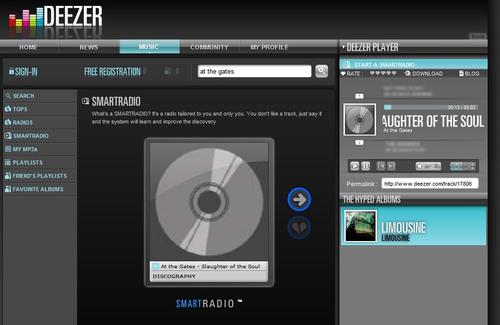
Deezer, o Pandora francês?

«Users from outside the United States try lots of things to get access to Pandora which streams customized Radio to users with US IPs only. Some succeed with the user of proxies, virtual private networks or services like Global Pandora that come and go. Others point their eyes to France to discover a music service that resembles Pandora in many aspects but is way better.

The most obvious difference is that everyone has access to the service called Deezer which does not only provide custom radio stations with music that you (could) like but also ways to search for bands or songs and play them right in the browser. All of that is possible without creating an account at Deezer.

You will need an account however if you want to create playlists, upload an unlimited amount of mp3 that you can listen to online or participate in community matters.

deezer

Information are easily accessible. While listening to the Smart Radio feature you can open a band’s discography page which does not interrupt the music. There you have access to information about albums, related artists and community members who share your taste. Only albums with tracks available will be shown.

I had troubles creating a playlist though. The system accepted my input but did not add the playlist to the menu. Deezer is nevertheless a brilliant better Pandora.» Deezer offers what Pandora does not, 6/3/08

Análise a mais um site de musica - JANGO

« (...) Customising stations certainly helped me shape the song selections more to my liking, though with only 15,000 artists and 200,000 songs in rotation, the service has limits to what it can play. For instance, at review time, just 10 Queen songs were in the system. (According to Jango, the service has access to much more music than is listed, but analysing it and adding it to the listener database takes time. Jango also says it is constantly adding tunes to the rotation.)

Since Jango follows restrictions defined by the Digital Millennium Copyright Act - and pays royalties to labels and artists - the site is perfectly legal. Jango makes money when you click on links to buy music through its partners as well as through advertising.

Jango's real prowess lies in its social-networking features, which help you hook up with people who have the same good (or bad) taste as you when you create a Jango profile. The Jango player (located at the upper-right of the Jango browser window) displays alternate songs by the currently playing artist, as well as users who are listening to the same performer or similar artists.

Clicking on a song takes you to the station that's playing it; selecting a user takes you to their Jango profile page, where you can check out that person's stations and other information (birth date, location and favorite books and movies, for example) that they have chosen to share. »

March 5, 2008 Jango beta internet radio site review, PC Adviser

« Jango.com launched in July with a preview of a social network wrapped around a personalized webcasting service. Within two months of its formal debut in November, it had attracted 1 million listeners who created 3 million customized stations. Chief Executive Dan Kaufman says he expects to reach 2.5 million unique listeners this month. An audience that size can run up big royalty bills in a hurry -- more than $50,000 per collective hour of music played. (...) "We have, I don't know, 500%, 1,000% more opportunities to show a visual ad than Pandora or Yahoo or AOL," Kaufman said. "Even with a very low CPM [the fee charged advertisers each time their pitch is seen], we break even with a very small number of users, relative to the other guys." Jango's approach reflects one vision for the future of the music business. It's not about selling recordings; it's about monetizing the time people spend listening to music.
That's why Jango surrounds its webcast with social features, such as the ability to find people with similar musical tastes and listen to the stations they designed. It has many of the usual elements, such as the ability to send instant messages to friends and e-mail to other users. But it also has some nifty little touches -- for example, prompting users to send thank-you notes electronically when they stop listening to someone else's station. It also tries to keep people interacting with the site's musical content by rating songs, reading about artists, creating new stations and recommending their creations to friends. (...)Just to cover royalties obligations, a music webcaster has to generate a little more than 2 cents per user per hour this year (assuming it plays 15 songs per hour). That number, which rises to 2.85 cents by 2010, seems minuscule, but webcasters say they raise only 1.5 cents to 2.5 cents per listener per hour on average.» fonte: How to get ahead in webcasting By Jon Healey Los ANgeles Times March 21, 2008

Há dez anos a rádios tinha crescimentos de 10%

«Here are the revenue trend totals from the past 10 years, according to RAB statistics:

2007 –2.0%
2006 +1.0%
2005 0%
2004 +2.0%
2003 1.0%
2002 5.7%
2001 –7.5%
2000 +12.3%
1999 +14.6%
1998 +11.9%


The totals for 2004-07 also are boosted by non-spot/off-air revenue and increased network participation in the survey in the last two years.»

fonte: radioworld newsbytes What a Difference a Decade Makes 7/02/08