Blogia

Transistor kills the radio star?

Optimismo, optimismo...

«"We think the future of radio is just really, really bright.  One of the reasons...is the opportunity to serve local communities.  As long as we do our job of providing local information and local news to our communities, we know that there are going to be people who listen and who care about their communities.  So, as long as we do our job, we think there's going to be a lot of listening and, if there is listening, we are going to be in great shape," Friesen [Lyndon Friesen, President of Golden West Radio] concluded» (New President at Golden West Radio, discovermoosejaw.com, Maio 08)
Meemix - mais uma rádio só minha

«Right now I'm playing with MeeMix Internet Radio. Meemix is a browser-based player which offers both an audio and video mode. MeeMix thinks of itself as an Internet community which offers members the ability to create and listen to personalized radio stations. MeeMix uses a "taste prediction algorithm" which tries and figure out what you will want to hear - not unlike what Internet stations like Pandora or Last.fm pioneered. I started by typing in "Abba" (It's just my default music search term) upon which MeeMix began playing "Take a Chance on Me" - a big 1978 hit for the band. MeeMix then decided I should hear Donna Summer's "Bad Girls" followed by a 1979 disco hit by Cameo. (...) MeeMix has a "Mood Control" with three controls: Surprize Me, Pulse, and Volume. (...). I definitely was surprised. MeeMix has a Not or Hot slider control which let's you tell it whether or not you like what it's picking for you to hear. MeeMix provides a lot of other controls to promote interaction, too: a favorites tool, another to block cuts, the ability to buy the CD you're listening to, recommendation tools, and more. MeeMix is fun to play with and free to use. First time visitors can try it out before registering and create up to 3 radio stations that allow you to listen to 5 songs on each one.»

Corey Deitz, Make Your Own Radio Stations with MeeMix Internet Radio 12/05/08 

Os novos utilizadores: novos ou mais do mesmo? (conc)

Poderemos falar realmente de um novo consumidor (marcado por palavras/caracteristicas como 'produtor',  'inconstante', 'individualista', 'multitasking') ou na verdade não irão aumentar significativamente os indices de participação e estaremos a falar sobretudo de uma moda (de um capricho)? O consumidor maioritário continuará a ser como antes, passivo (por conveniencia ou por custo)?

A tendência para a música na net ser grátis

O que factos como este (A popularidade da música via streaming (e grátis)) ou este (prejuizos na rádio satélite: as pessoas não querem pagar?) demonstram é que, podendo existir outras formas de viabilizar a musica na internet, o negócio tende a ser gratuíto.


Os sites de musica via streaming mais populares

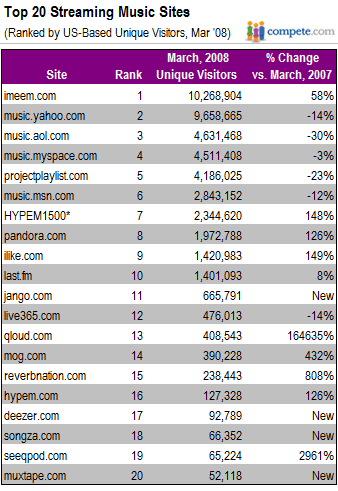
«These social streaming communities have risen rapidly in popularity. iMeem recently overtook Yahoo! Music as the most popular streaming site on the web.

*The Hypem1500 presents aggregate traffic to the more than 1500 music blogs tracked by the Hype Machine, a popular blog aggregator. The Hype Machine itself is ranked separately from its network at #16.

fonte: Music Industry Downfall, Part II: The Rise of Social Streaming by Alex Patriquin Compete.com May 12th, 2008

A popularidade da música via streaming (e grátis)

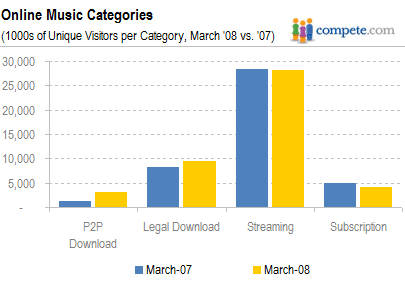
«(...) many consumers don’t pay for music at any price. The chart below, based on Compete’s data on more than 1,000 music sites, shows how the most popular options for listening to music online are free.

Despite lawsuits against illegal download sites, the fastest growing category in online music last year was P2P downloads, which shot up 140%. Nearly ten years after Napster raged through college networks, online music piracy continues to grow.»

fonte: Music Industry Downfall, Part II: The Rise of Social Streaming by Alex Patriquin Compete.com May 12th, 2008

Do ouvintes desleal e inconstante...

«Cornetto cria concurso de bandas no My Space, de acordo com o M&P.

“A Cornetto lançou um concurso de música no My Space, o Auditions, que vai permitir à banda vencedora subir ao palco do festival Optimus Alive”. [ler]

A tendência é clara e está instalada: o consumidor é cada vez mais volátil e saltita entre meios diferentes. As marcas têm de ir ao seu encontro, procurá-lo, acompanhá-lo, servi-lo e surpreendê-lo em novos ambientes, com novas propostas e novas abordagens. A rádio deveria seguir o exemplo da Olá, ou em alternativa, associar-se à Olá e lançar iniciativas que liguem o meio às comunidades que os mais jovens (e menos jovens, a avaliar pelos e-mails que recebo de comunidades como o hi5, Orkut ou Linkedin) utilizam e nas quais estabelecem ligações que podem potenciar o consumo de produtos culturais e da rádio» (Paula Cordeiro)

prejuizos na rádio satélite: as pessoas não querem pagar?

«XM's first quarter numbers are out, and what do you know?  Its losses widened to nearly 6 percent, even though revenue is up.  For the quarter, XM hemorrhaged $129 million, and their customer acquisition costs rose to $73 a subscriber (up from $65 last year)» (Jacoblog). Mas para quê pagar quando «According to data released by Digital Music News and media tracking firm BigChampagne, one-third of all PCs worldwide have LimeWire installed. For those who are among the other two-thirds, LimeWire is the top P2P file sharing software - the iTunes of "stealing" music so to speak. Usage comes in at exactly 36.4% of all PCs according to the survey, and of course its the target of a multi-year RIAA lawsuit (no doubt a side effect of its popularity)».


CBS compra mp3.com

Depois de ter comprado a Last.FM, a CBS comprou agora a CNet, que - entre outros activos - tem a mp3.com, um site com «Artist-provided content from both independent and major-label acts including customized artists pages with songs, videos, similar-artists lists, photos, bios, news, blogs, and forums. Fan-generated content such as ratings, reviews, videos, blogs, forums, and favorites lists. Exclusive coverage, editorial features, and original programming including web shows, artist interviews, concert webcasts, event reports, video album reviews, and more. Thousands of free MP3s, plus streams of popular music videos and selected new albums.».

a CBS, um dos operadores mais importantes de rádio convencional, parece ser a que melhor se posiciona para liderar na nova tendência de consumo activo.

Sobre a «guerra» CBS - Clear Channel pelo dominio da rádio online: «It only took them about three years to catch up with their traditional media counterparts, but the big radio groups are finally embracing digital in a major way. Now two of the industry's biggest players, CBS Radio and Clear Channel, are in an arms race to see who can build the most scale the fastest. Clear Channel wants to lure more, younger listeners to its weekly listener base of 1.4 million by creating its own indie-rock online music app, eRockster, to bring a catalog of 5,000 indie, alternative and electronica songs to its music library by the end of May. And, later this summer, Clear Channel will launch its own personalized radio station, with a best-of-breed partner».


Os telemóveis (e a medição de audiencias) afastam os jovens da rádio

«According to a study by the Centers for Disease Control and Prevention, 22.3 percent of U.S. households with both landline and cell phones receive almost all of their phone calls on their mobile phone. That's 13.1 percent of all households in the United States. Combined with wireless-only households, 28.9 percent, or nearly 3 out of every 10 households, are reliant or almost completely dependent on cell phones. Now obviously Arbitron is aware of this problem. And, as they often tell us, coping with it is difficult and expensive. But what does it mean for these people to be - as a group - potentially stripped of qualification for your ratings? What does it mean for radio's effort to target younger audiences in particular? What does it mean when the 100 shares in your Arbitron rank don't include the one in four households who opt out of landlines?» Mark Ramsey

Pandora aproxima-se da rádio convencional?

«Following up on its erockster Internet radio initiative during Coachella, Clear Channel is expanding its online presence with a number of new services -- including a personalized radio player, lyrics page, and widget strategy, among others.
Clear Channel is not yet providing many details about the new personalized radio feature, only that one is coming by the end of the summer. But Billboard has learned it is negotiating with Pandora to offer the company’s customized radio service across all its Web properties nationwide, but no deal is finalized at this time. Pandora allows users to build a custom playlist of sorts based off the characteristics of one song. The system recommends songs that sound similar to the one first chosen, based on a catalog of about 500,000 titles.
The partnership should prove a major boon to Pandora, which is struggling with how to remain operational under the weight of the new Webcaster royalty rates. The exact details of the deal between the two parties have not yet been disclosed, and Clear Channel declined to comment on the specifics.
But adding such a feature is considered essential for Clear Channel to stay competitive in the online space. Competitor CBS Radio earlier this month unveiled plans for a similar custom DJ feature called Play.It, working in conjunction with sister company Last.fm. Both efforts show how terrestrial radio stations are responding to listeners' increasing demand for more control of their listening experience.
"Online, there is a lot of variety and choice," says Evan Harrison, Clear Channel executive VP and head of the company's online music and radio unit. "If we don't expand our offerings under our umbrella, people will just go elsewhere for it."

In other news, Clear Channel has added a lyrics service provided by Gracenote. Available immediately, the service adds a lyrics link to each song profile streamed online which takes the listener directly to a page providing the lyrics. Lyrics links also now appear on the home page of individual stations, artist pages and more, and will be promoted via on-air house ads from its many terrestrial stations. Gracenote has compiled the myriad of publishing rights required to post the lyrics, and provides it as an outsourced service to other customers such as Yahoo Music. Finally, Clear Channel is creating widgets of it member station Web sites allowing fans to stream the station from social networking profiles. Widget syndication firm Clearspring is providing the backend technology. The effort starts with widgets of the "Stripped" live performance series, and will eventually expand to incorporate streaming stations, erockster and other Clear Channel applications.

fonte: «Clear Channel Expands Online Plan, Eyes Pandora Link Bilboard Biz May 12, 2008  By Antony Bruno

Imeem começa a ser um caso sério

«Imeem is now becoming a serious contender in the streaming music space, at least according to data points surfacing Tuesday.  In a ranking of streaming music destinations compiled by Boston-based Compete, Imeem topped heavy-hitters Yahoo, AOL, MySpace, and Last.FM.  "As the music industry seeks to reassemble in the wake of digital distribution, it should recognize social streaming communities as the fastest growing opportunity in its evolution," explained Compete analyst Alex Patriquin. 
During the month of March, Imeem grabbed a unique visitor tally of 10.3 million, a bump of 58 percent from last year.  Yahoo Music (music.yahoo.com) was not far behind at 9.7 million, though AOL Music, MySpace Music and others trailed considerably. Specifically, AOL Music (music.aol.com) pulled 4.6 million uniques, down 30 percent, while MySpace Music (music.myspace.com) earned 4.5 million, down 3 percent.  That was followed by Project Playlist (playlist.com), MSN Music (music.msn.com), Pandora, iLike, Last.FM, Live365, and others.  Compete aggregated its data based on ISP, toolbar, and survey information
»
Alex Patriquin, "Music Industry Downfall, Part II: The Rise of Social Streaming"

A AOL escolheu a rádio para relançar o seu serviço de música online?

Não, a LASTFM!

«Ahead of the official re-launch of its European online radio platform, Internet service provider America Online (AOL) has announced that the returning service will be powered by none other than popular Internet radio and music community Last.fm. Set for an initial rollout in the United Kingdom, France and Germany -- with more European regions to follow in the coming months -- AOL Radio users are bound to benefit from the association with CBS-owned Last.fm, which currently boasts a worldwide visiting audience of around 21 million. Specifically, the new AOL Radio will include various new features and engaging multimedia options for users to familiarise themselves with, including the ability to search for favourite artists through the service before then listening to a continuous stream of their music.»

«Estamos a assistir a um renascimento da rádio» (????)

«“We are seeing a renaissance in radio with respect to programming – programming that has become
more versatile, more experimental and of a higher quality than ever before
,” said Jeff Haley, President and CEO of RAB. “This is an industry that is being bold, taking risks and engaging audiences in a variety of creative ways. And listeners are taking note. More than 90% of Americans say that radio continues to play an important role in their lives.”» Radio 2020 Next Phase Debuts: Radio Heard Here!, Radio2020, 15/04/08)

O problema de percepção da rádio - como resolver

«The perception of radio is bad. That's what has to be turned around first - and you do that by improving the product. Repackaged you-know-what is still you-know-what.
This is the end result of delivering poor product to young people for over a decade.
Radio used to be a soundtrack to popular culture. Today, radio, especially formats appealing to the young, aren’t even close.» (Radio Heard Fear, John Gorman, RBR.com, 4/05/08)

É a música que dá mais dinheiro nos telemóveis

mais do jogos ou venda de imagens

«Mobile social networking stands a good chance of jumpstarting mobile Internet adoption because mobile social networking is based more on communication than content. Time and again, communication services have led the way for content and advertising to follow. In the case of the Internet, it was e-mail and discussion boards—not Web pages—that triggered the explosion from early adoption to mainstream consumer use. SMS services drove mobile data use and they still account for the majority of mobile data revenues by carriers. It is not surprising, therefore, that mobile carriers and mobile content providers have warmed to mobile social networking as a new opportunity to ramp mobile Internet use. In truth, they have little choice. Their attempts to convince the mass market to sign up for mobile Internet have proved moderately successful, at best. According to February 2008 research by Informa, the global market for all current forms of paid mobile entertainment should reach $31.7 billion by 2012. Back in 2006, the same forecast optimistically predicted $42 billion by 2011. »

«Jumpstarting the Mobile Internet», eMarketeer, MAY 12, 2008


(intro) Estudos feitos online

Muitos dos estudos citados neste trabalho são realizados online, pelo que a amostra fica enviezada (a favor da tecnologia digital); Gustavo Cardoso demonstra-o no estudo E-generation (2007: 27-31);

muitos são pagos pela industria (nos EUA), directa (rádios e associações de rádios) ou indirectamente (consultoras que trabalham nesse mercado, agências de publicidade, fabricantes), o que pode enviezar, apesar da credibilidade das instituições que os realizam;

- muitos têm amostras reduzidas

- tambem se pode questionar a forma como alguns são construidos, colocando por exemplo uma questão contra outra, não permitindo outra opção (entre este e este, prefere...») possibilitando resultados que de outra forma não apareceriam.

como é que se combate esta situação: por um lado eliminando aqueles estudos que oferecem mais dúvidas e por outro tendo a consciência que, se os seus autores estão directa ou indirectamente ligados à industria (EUA) e os resultados são maus para essa industria, então apenas devemos desconfiar se não deveriam ser piores

Se quase quatro em cada dez (EUA) têm um iPod/mp3, a rádio...

pode beneficiar? Pelo menos ao nivel dos podcasts...

(conclusão):

« New iPod models Continue To Fuel Growth of Portable MP3 Players: The introduction of the iPhone and new iPod models continue to propel growth. Nearly four in ten Americans now own an iPod or other portable MP3 player. Continued growth and ubiquity means media companies need to have a podcast and iPod/MP3 player strategy.»

«Infinite Dial 2008», Arbitron e Edison Media Research, Abril 2008 [http://arbitron.com/downloads/digital_radio_study_2008.pdf]

Reduzir o tempo dos programas será solução?

«When public radio has to consider making its programs shorter because young listeners won’t listen, we officially have a documented attention span problem. (...) Break the programming down into smaller chunks. That is, one hour of music is fine if you’re in the mood to listen for an hour. You’ll rarely find a young person doing that. In the past radio worked well with block programming -- variable length shows at different times. Growing up I remember "the adults" listening to WOR, New York that had, say, a 15-minute newscast, then a 45-minute program with the legendary Jean Sheppard. There was a different standard for program length. You just had to stay tuned. Maybe it’s a 45-minute show. Maybe a 55-minute program on health. The all-night show tended to be one long block figuring that the station was providing company for night owls. Back to the future. Even a top 40 station can break into a five song countdown anywhere on its clock -- say, featuring the five newest releases in the genre.»

 The Attention Span Problem  Inside Music media, 6/05/08 

O perfil no MySpace será 'universal'

«(...) a quebra de barreiras vai permitir que o comunicador Yahoo Messenger atualize automaticamente dados como foto e "música favorita" tendo como base o perfil do MySpace. O compartilhamento de dados também vai acrescentar fotos, vídeos e dados biográficos do usuário em seu perfil do eBay, assim como enriquecer o Twitter com um perfil mais completo.
O anúncio foi feito por Chris Wolfe, diretor-executivo da rede social. "Os sites não serão mais ilhas na internet. O objetivo é reforçar a troca de informações entre os serviços on-line", disse em entrevista. "Com isso, seu perfil no MySpace vai virar seu endereço de internet, sua identidade", completou. 
O usuário terá o perfil padrão do MySpace e poderá compartilhá-lo com todos esses outros sites. São quatro níveis de compartilhamento: informações básicas, fotos, vídeos e lista de amigos. Uma das principais preocupações dos envolvidos na iniciativa é dar ao internauta total controle sobre quais informações serão divulgadas, em que sites ele fará isso e para quais contatos.» Parceria entre MySpace, Yahoo e eBay cria perfil único na web Globo 08/05/2008 - JULIANA CARPANEZ E RENATO BUENO