Blogia
Transistor kills the radio star?

3.4.3 Canais de streaming

A origem dos canais de streaming

«The search for a user-customized music "station" started in the early 1990s, when MIT's Media Lab created Ringo, a music recommendation engine that asked listeners to grade a few tunes and then offered them songs they might like. Now, CBS's Last.fm site has become the first of the new generation of music sources to offer free, on-demand, full-length spins of any tune you want to hear -- not just the 30-second snippets available on iTunes and most other music sites.»

fonte: Name That Tune-In: Who Will Emerge as The Future of RadioMarc Fisher Washington Post Staff Writer March 23, 2008

O próximo capítulo da história da rádio (?)

«As the audience for AM and FM radio declines, start-up entrepreneurs and giant media companies alike search for the "next radio" -- a way to make money by helping listeners discover new music. Online music providers such as Pandora, Imeem and Last.fm provide an early glance at that next chapter in radio history. »

fonte: Name That Tune-In: Who Will Emerge as The Future of RadioMarc Fisher Washington Post Staff Writer March 23, 2008

O negócio das webradio ou dos serviços on demand (custos)

De acordo com o Digital Millenium Copyright Act, que define os royalties que os serviços musicais pagam aos artistas,as verbas em causa são mais pequenas se um serviço for considerado «web radio», em vez, por exemplo «on-demand»,o que faz com que muitos dos serviços streaming cumpram os critérios para serem considerados web radio.

Eis os varios tipos de serviços digitais previstos:

1. Unrestricted download (The basic and well-known delivery of an encoded, compressed copy of a sound recording,)  These are typically sold in pay-per-download stores that do not carry major-label music (such as EMusic or Audio Lunchbox). 

2. CD burn – this type of delivery enables the user to make a copy of a downloaded file to a recordable CD, enabling users to take the music anywhere (or even rip the music back off the CD into another portable format).  Rhapsody offers CD burning options as part of their service.  

3. Restricted download –; These downloads include DRM (Digital Rights Management) Technologies that place restrictions on copying the file. Apple iTunes, Napster, Real and most download stores with major label content put this DRM on their files.

4. Tethered download – A type of delivery similar to renting, with users having access to the file for a limited amount of time. The limits are enabled by various DRM technologies that track information such as where files are moved to and how many times they are used.  Services such as Napster and MusicNet offer this type of download. Microsoft is currently toying with this idea as well.

5. On-demand interactive streaming – streaming delivery of music over the network "on-demand," or when the user requests it. (...) the music begins playing immediately after the user clicks. On-demand streams are available from services such as Rhapsody, MusicMatch, and Napster.

6. Interactive radio – streaming delivery of music over the network like traditional radio, but allowing the user the ability to skip songs or rate tracks and artists to influence the experience. . Can be subscription or non-subscription offerings, and separate licenses that address the specific features and value provided by each product are required.

fonte: «3. Getting Paid For Your Music Online – Digital Music Rights»

On-Demand and Downloadable Music Services — By our count there are close to 150 music subscription and download services offering a wide range of digital delivery methods including on-demand streaming, CD burning, time and/or location limited (tethered) downloads, unrestricted downloads, and a variety of interactive radio options.

Interactive radio is generally a premium service that allows the listener to skip songs, rate songs to affect your playlist, build custom stations based on your artist preferences and otherwise influence the listening experience. MusicMatch, Yahoo! Launch, Rhapsody, and Napster all offer such services.


Non-interactive radio is most like the normal radio experience, just a constant stream of music that the user cannot influence, usually programmed to a specific style of your choosing. It may come with or without commercial advertising, often depending on a subscription. Most of the services mentioned above offer a non-interactive radio option, often for free, as do products such as Realplayer, Windows Media Player, Live365, and countless other independent and small webcasters. And, of course, many traditional radio stations broadcast across the Internet.

Sobre o serviço Napster (EUA, GB, Canada, Alemanha e Japão)

«O Napster criado em 1999 foi um serviço pioneiro de troca de arquivos que permitia aos usuários o download gratuito de músicas digitais, igual ao Kazaa ou Emule. A companhia foi processada pelas maiores gravadoras do mundo, incluindo Universal Music Group, Sony Music, BMG Entertainment, EMI Group e Warner Music. A Napster acabou sendo fechada por tribunais dos Estados Unidos em 2002 por causa de violações de direitos autorais. Os ativos da marca foram comprados pela Roxio em 2002 para criar a atual Napster Inc., um serviço legal de música online. Porém os usuários do Napster acabaram migrando para outros sites, comprovando que as grandes gravadoras além de não conseguirem deter a baixa gratuita de músicas pela internet, também perderam uma grande oportunidade de dar um salto no tempo aproveitando essa tecnologia para obter ganhos financeiros»

«Napster, the pioneer of digital music, offers the ultimate in interactive music experiences, creating better ways to discover, share, acquire and enjoy music – anytime, anywhere. The company's offerings include "Napster" (www.napster.com) – the most popular on demand music subscription service in the world; "Freenapster" (www.freenapster.com) – a unique Web experience offering free on demand music legally; and "Napster Mobile" – one of the industry's fastest growing mobile music platforms. Napster is headquartered in Los Angeles, with offices in New York, Luxembourg, Frankfurt and Tokyo.» (oficial); Napster is currently available in the US, Canada, the UK, Germany and Japan.

Songkick; concertos ao vivo ("symantic web")

British Internet startup Songkick launched Wednesday with a vow to inspire digital-age music lovers to reclaim the joy of hearing bands play hot in real-world venues. The London-based website debuts with a free online utility that matches people's tastes in music with the schedules of bands performing in the US or UK. (...) Songkick cofounder Ian Hogarth told AFP during an interview in San Francisco."The music industry isn't dying; it is just moving to live. People really value that real-world experience. We are focused on using the web to make people get off the web and in front of a band." Songkick's goal is to make it as simple to find live music as it is to find out which movies are playing at local theaters. (...)Songkick struck alliances with all major concert ticket vendors in the United States and United Kingdom, compiling a database of scheduled performances and getting fees for each customer sent their ways. Songkick uses "symantic web" software to scan the Internet for references to bands in blogs, social-networking pages and other online commentary. (...) For example, if a blogger likens the band Linkin Park to Limp Bizkit the software notes that for future recommendations to Songkick users that enjoy either of the groups.»

Songkick website guides music lovers to real-world concerts (AFP) SAN FRANCISCO (AFP)


O que falha nos serviços de streaming

«(...) there are some inherent disadvantages to these services. For starters, unless you want to take your whole computer with you, you can't take the services with you, because the playlists can't be offloaded to digital music players like iPods. “So in order for these websites to be considered web radio you can only skip a certain amount of songs, so if you don't like five songs in a row you can't just skip five songs,” said Monson. “Also, the playback order is going be randomized so you can order the songs in the order you want to play them back. You have to have at least 15 songs, so you can't just pick a playlist of five songs and play it over and over again.”

fonte: «Make your own online radio station By: Adam Balkin, NY1 18/03/08

Outro projecto de streaming musical, playlists.com

«(...) The startup, Playlist.com, involves former MySpace vice president Shawn Gold, now head of networking consultancy SocialApproach.  Jeremy Riney is the founder and chief executive of the company. Initially called Project Playlist, the beta startup is now putting some serious deals together, including tie-ups with MySpace and Yahoo.  On Tuesday, Gold shared exclusive details on both the roadmap and partnerships with Digital Music News.  "We're scaling this in a big way," Gold promised, hinting at potentially serious investments ahead. Gold views playlists as a great mechanism for artists and labels to monetize their content.  "Playlists are one of the best angles you have at actually driving commerce," the networking executive explained from his home in Los Angeles.  "If there is a practical application to your life, you are more likely to buy it."

In line with that thinking, the Playlist.com destination is peppered with iTunes buy links.  But the playlists themselves pull streaming content from all across the internet.  For example, one track within a playlist could be sourced from a music blog, another from a MySpace band profile page, and another from an artist website.  "Nothing is being hosted by us," Gold said, though he did point to ongoing label negotiations. Once a playlist is created, the distributed fun begins.  Playlists themselves are quickly turned into widgets, and can be embedded into networks like MySpace, Facebook, hi5, and Bebo.  But Gold is tying the concept more heavily into his old professional hangout, MySpace.  The networking heavyweight is actively building an integrated application component, and Playlist currently tops the list at apps.myspace.com, a beta testing ground.»

fonte: Digital Music News, Got Playlists? Fresh Startup Strikes Yahoo, MySpace Relationships  18/03/08 

As limitações impostas pelos royalties

«(...) nightmare scenario painted by many Internet radio companies who have claimed that the royalty hike would kill online broadcasting in its cradle. In fact, Internet radio is far from dead. Online broadcasters like Pandora and Live365 still serve millions of listeners. But the higher rates have driven away many small online broadcasters who say they can't afford to stay in business. And even industry leader Pandora says it's in trouble. "We're at the very end of our tether," founder Tim Westergren said. "There's a very good chance that we will shut down."

Critics of the royalty system say the result is decreasing musical diversity on the Internet. They warn of an online music industry dominated by the same giant media companies that presently dominate traditional radio broadcasting. And they point to CBS Broadcasting Inc.'s recent takeover of the Internet radio operations of Time Warner Inc.'s AOL as a harbinger of an Internet radio market rendered bland and predictable.

"They'll push all of us out of business," said Johnie Floater, general manager of media for Live365. "Your Internet radio is going to sound like your AM and FM."

Thousands of Internet broadcasters, ranging from traditional radio stations to individuals who want to share their favorite tunes with the world, pay Live365 to stream their programs over the Internet. Live365 pays their music royalties out of the fees paid by its subscribers.»Internet radio firms say royalties limiting choices By Hiawatha Bray Globe Staff / March 14, 2008

Sobre o «Project Playlis inc» (motor de pesquisa)

«Projectplaylist.com is an information location tool similar to Google® and Yahoo!® but devoted entirely to the world of music. Our purpose is to help you find and enjoy music legally throughout the web in the same way that other search engines help you find webpages, images, and other media, but we also add a social /community twist»

«Our mission at Project Playlist, Inc. is to organize this rapidly growing abundance of legal music on the web for the benefit of the worldwide music community – artists, songwriters, music distributors, and listeners alike»

« we respect the rights of copyright holders and we insist that you do as well. We pay royalties to songwriters and music publishers, and we respect the performing artist’s choice»

«we do not host music files, nor do we make them available. We only enable users to find these files and listen to them»

«You can post your playlist on your social networking webpage or any other website, subject to the terms of use of those sites, or you can email your playlist to friends!»

Project Playlist, Inc. is a privately held company and is not currently seeking investors. If you are interested in the business of Project Playlist, Inc. or discussion of a strategic partnership or investment, then please contact:

KR Capital Partners, LLC
9300 Wilshire Blvd., Suite 200
Beverly Hills, CA 90212.

Just wanted to let everyone know that today is playlist.com's 2nd birthday! Also, we hit a awesome milestone today -- 20 million registered users!»

As diferenças entre o Pandora e o Last.FM

«Taking the nature side, Pandora's recommendations are based on the inherent qualities of the music. Give Pandora an artist or song, and it will find similar music in terms of melody, harmony, lyrics, orchestration, vocal character and so on. (...) On the nurture side (as in, it's all about the people around you), Last.fm is a social recommender. It knows little about songs' inherent qualities. It just assumes that if you and a group of other people enjoy many of the same artists, you will probably enjoy other artists popular with that group. Like Last.fm, most music-discovery systems have been social recommenders».

fonte: Steve KRAUSE, Pandora and Last.fm: Nature vs. Nurture in Music Recommenders, 30/01/06

Os diferentes tipos de serviços de streaming musical

Apenas musica em streaming: PANDORA ou JANGO

«Pandora and Jango, for example, are commercial-free sites that let users enter an artist's name or a song title into the search bar on the Web site. Then the site creates a "radio station" that plays similar types of music. So type Miles Davis into one of these sites, and you might hear selections from Thelonious Monk and John Coltrane. You can rate songs to fine-tune what type of music is played. Since these are free streaming sites, users can't look up a specific song title and play it. And while the songs can't be downloaded, both sites have links that will take you to Apple Inc.'s iTunes or Amazon.com Inc. to buy a particular title.»

MOTORES DE PESQUISA:  SEEQPOD, SONGZA, SKREEMR

«They look specifically for audio recordings on Web sites, including personal pages and blogs. Examples include SeeqPod, Songza and SkreemR, all of which are free.They're not the best way to discover new music, but they can help you find a song you haven't heard in a while or a title someone recommended to you. (...) The search engines seek out songs available in digital formats on Web sites. Not all the songs have the best sound quality - some are recordings taped by a concertgoer.»

PAGINAS DE REDES SOCIAIS: IMEEM, LASTFM, ILIKE, My STRANDS 

«A number of music sites are integrating social-networking functions into their sites to share music. Some of the biggest players are imeem, Last.fm, iLike and MyStrands. These sites feature libraries of music and videos that users can browse through and play. Some songs are available only in 30-second snippets, while others are full-length recordings.Like Facebook, the popular social-networking site, users at these music sites can set up profile pages, add a photo, tell a little bit about themselves and declare their musical tastes. They can also make "friends" with other site users.»

fonte: Internet making it easy for music fans to stay tuned in By Joseph De Avila , The Wall Street Journal Monday, March 10, 2008

Um pagamento por cada música (Pandora)

O modelo de funcionamento do Pandora: «We pay a licensing fee for every song that we stream, which was determined by the Copyright Royalty Board. And the royalty board just voted to almost triple those fees within the next couple of years. So overnight, they’ve made webcast radio pretty much impossible. It’s impossible, at these new rates, to really operate a radio station online»

«We7 é o futuro da indústria musical?»

«(...) the music industry is at a critical juncture: adapt or die. We7 is a music download website that hopes to set the tone for the music industry in the 21st century. It thinks it has found a way to make music available for free and yet still generate revenue for record companies and artists. People want to be able to access and use music in an ever greater number of ways, while artists and record companies want to ensure that they get paid when people use their product. It is now accepted that DRM is too restrictive and impractical to manage, so a new way is needed. (...) We7 was founded less than a year ago, when [steve] Purdham was exploring an investment in music download company OD2. He found himself in a room with VC John Tatham (who’s idea We7 originally was) and musician Peter Gabriel, who had founded OD2 back in 1999. (...) The turning point was last Christmas, when the majors realised that DRM was dead,' said Purdham. ‘Most tracks aren’t DRM protected anyway, with CDs and BitTorrent-type downloads being the source of the majority of music.’ (...) So if you can’t make people pay for music, how do you make money out of it? 'It’s all about choice,' says Purdham. 'Our philosophy is: come to the site, listen to the track and then decide how you want to pay for it. 'We have an ad-funded alternative, which allows us to target advertising at our users, who have to register in order to access our services. This ability to target is very valuable to advertisers. We can also dynamically graft audio ads to the start of the music file, which stay with you when you download it.' Of course, HEXUS.channel wasn’t about to just take Purdham’s word for it so we created an account and downloaded BB King’s Woke Up This Morning. On playing the MP3, we had to sit through a ten second audio ad for Altec Lansing speakers and then it was straight on to BB. We have to report that we were unable to make the streaming function work, but it’s unclear where the fault lies for that. »

fonte: «Is We7 the future of the music industry? Hexus Channel Scott Bicheno - 12 Mar 08

Mais empresas com acordos digitais (música)

«Digital distribution industry leader finetunes and Qtrax, the world's first free and legal peer-to-peer (P2P) music service, today announce that they have signed a digital licensing agreement. For more than four years, finetunes has been a pioneer in creating opportunities for independent labels in the digital music markets. Initially focused on providing digital solutions for the German independent labels, the Hamburg-based company now represents more than 1,000 record labels from around the world.» CNN Money.com, finetunes and Qtrax Sign Digital Licensing Agreement March 12, 2008

Ainda os modelos de negócio

«A plethora of new and re-tooled sites are offering free ad supported music via streaming and download. Spiral Frog, Qtrax, imeem, We7, iLike...
...YouTube and others each offer their own platforms to listen to almost any song or video on demand and sometimes to even download it. Each service has made their own unique deals with labels and publishers for compensation. Some pay a fee per play or download. Others share a portion of ad revenue received; and rumors have a new MySpace music service trying to compensate labels with stock options.
»

Ainda a chegada do MySpace à musica via streaming

«Assuming our previous conclusion about that labels are asking for more per track than ads can realistically provide is correct then one of three things is happening.  Either the labels are lowering their expectations, Myspace is planning to subsidise their music service, or Myspace believes they can monetise the ads better than We7, QTrax, Imeem and the other providers in this market. I really hope it is the first of these.  Myspace subsidising the market might be good in the short term for consumers, but would be bad for the medium term health of both the music and social networking industries.  Similarly - if they are being more aggressive in their monetisation assumptions I would worry that they may end up losing money. (...)The best I have seen so far, by a mile, is Sweden’s Spotify - a company I haven’t talked about much here because they are somewhat in stealth mode.  The cat seems to be increasingly out of the bag now though.  This post from Varsavsky waxes lyrical about how great their service is. (fonte: Free ad-supported music coming closer to reality, 10/03/08)

Definir o termo 'streaming'?

«In this study, we use the term "streaming" to represent listening to music through a live stream on the Internet as well as to represent Internet or online-only radio stations. Therefore, the term streaming covers listening to music via the Internet regardless of the source.» (Albarran, 2007 100) 

Sobre os modelos de negócio para os canais musicais de streaming

«Several companies, including LastFM and Imeem, are attempting to build ad-supported music services. I'm a fan of most of these, especially for the service they provide for independent artists. But lets be clear about one thing… these companies are not offering "free music." They’re offering free on-demand radio. There’s a big distinction. SpiralFrog and Qtrax are building a reputation for delivering free, downloaded tracks, with the cost recouped through advertising revenues. I've had some previous thoughts on the subject. It would take more than traditional ad revenues to support the cost of music given the price points set by labels. But the MySpace story is different, and raises two questions. Can MySpace actually provide even a streaming service supported by advertising when great services like Pandora and Live365 have stumbled. And even if MySpace can, who cares? (...)

As you might imagine, the difference in the cost of broadcasting a song on-demand and downloading the same song is striking. The RIAA recently increased the fee for online broadcasts to $.0019 per performance of a song. Compare this with an estimated $.75 that labels are receiving from iTunes for a download. Now I know broadcast music licenses are a complicated business, and the fee structures are never as simple as they appear. No doubt News Corp has been negotiating the finer points of their deal directly with labels, and we have no way of knowing what the final number is. But regardless, the big picture is clear… streaming a song is relatively cheap compared to downloading.»

fonte: MySpace Ad-Supported Music: Feasible or Fiasco?, 22/02/08, Theseminal.com

Deezer, o Pandora francês?

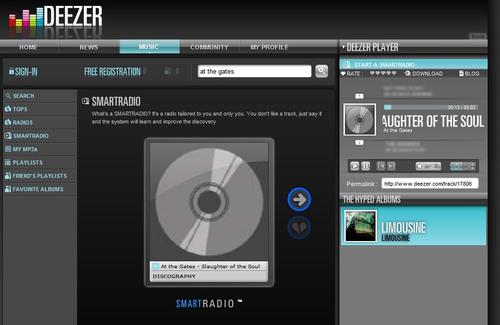
«Users from outside the United States try lots of things to get access to Pandora which streams customized Radio to users with US IPs only. Some succeed with the user of proxies, virtual private networks or services like Global Pandora that come and go. Others point their eyes to France to discover a music service that resembles Pandora in many aspects but is way better.

The most obvious difference is that everyone has access to the service called Deezer which does not only provide custom radio stations with music that you (could) like but also ways to search for bands or songs and play them right in the browser. All of that is possible without creating an account at Deezer.

You will need an account however if you want to create playlists, upload an unlimited amount of mp3 that you can listen to online or participate in community matters.

deezer

Information are easily accessible. While listening to the Smart Radio feature you can open a band’s discography page which does not interrupt the music. There you have access to information about albums, related artists and community members who share your taste. Only albums with tracks available will be shown.

I had troubles creating a playlist though. The system accepted my input but did not add the playlist to the menu. Deezer is nevertheless a brilliant better Pandora.» Deezer offers what Pandora does not, 6/3/08

Análise a mais um site de musica - JANGO

« (...) Customising stations certainly helped me shape the song selections more to my liking, though with only 15,000 artists and 200,000 songs in rotation, the service has limits to what it can play. For instance, at review time, just 10 Queen songs were in the system. (According to Jango, the service has access to much more music than is listed, but analysing it and adding it to the listener database takes time. Jango also says it is constantly adding tunes to the rotation.)

Since Jango follows restrictions defined by the Digital Millennium Copyright Act - and pays royalties to labels and artists - the site is perfectly legal. Jango makes money when you click on links to buy music through its partners as well as through advertising.

Jango's real prowess lies in its social-networking features, which help you hook up with people who have the same good (or bad) taste as you when you create a Jango profile. The Jango player (located at the upper-right of the Jango browser window) displays alternate songs by the currently playing artist, as well as users who are listening to the same performer or similar artists.

Clicking on a song takes you to the station that's playing it; selecting a user takes you to their Jango profile page, where you can check out that person's stations and other information (birth date, location and favorite books and movies, for example) that they have chosen to share. »

March 5, 2008 Jango beta internet radio site review, PC Adviser

« Jango.com launched in July with a preview of a social network wrapped around a personalized webcasting service. Within two months of its formal debut in November, it had attracted 1 million listeners who created 3 million customized stations. Chief Executive Dan Kaufman says he expects to reach 2.5 million unique listeners this month. An audience that size can run up big royalty bills in a hurry -- more than $50,000 per collective hour of music played. (...) "We have, I don't know, 500%, 1,000% more opportunities to show a visual ad than Pandora or Yahoo or AOL," Kaufman said. "Even with a very low CPM [the fee charged advertisers each time their pitch is seen], we break even with a very small number of users, relative to the other guys." Jango's approach reflects one vision for the future of the music business. It's not about selling recordings; it's about monetizing the time people spend listening to music.
That's why Jango surrounds its webcast with social features, such as the ability to find people with similar musical tastes and listen to the stations they designed. It has many of the usual elements, such as the ability to send instant messages to friends and e-mail to other users. But it also has some nifty little touches -- for example, prompting users to send thank-you notes electronically when they stop listening to someone else's station. It also tries to keep people interacting with the site's musical content by rating songs, reading about artists, creating new stations and recommending their creations to friends. (...)Just to cover royalties obligations, a music webcaster has to generate a little more than 2 cents per user per hour this year (assuming it plays 15 songs per hour). That number, which rises to 2.85 cents by 2010, seems minuscule, but webcasters say they raise only 1.5 cents to 2.5 cents per listener per hour on average.» fonte: How to get ahead in webcasting By Jon Healey Los ANgeles Times March 21, 2008